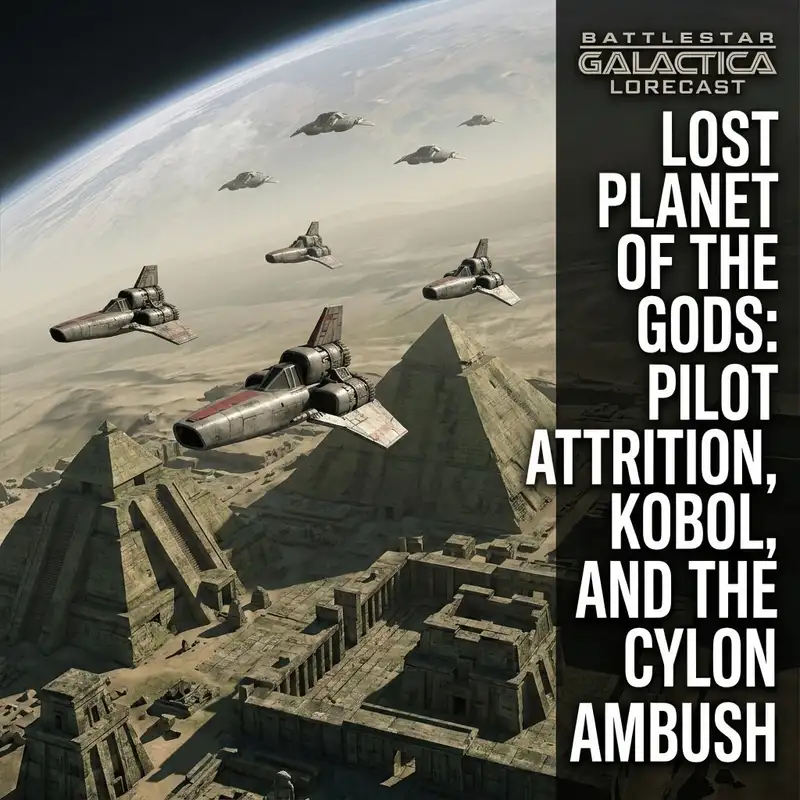
Lost Planet of the Gods: Pilot Attrition, Kobol, and the Cylon Ambush
A celebration aboard a refugee battlestar should have been a small act of defiance. Apollo and Serina were preparing to marry. For a few hours, people who had escaped the destruction of the Colonies could pretend that ordinary life had not entirely vanished. But the fleet was still moving through hostile space, screened by a limited number of Vipers and defended by experienced warriors who could not be replaced quickly. When Jolly returned from deep patrol and skipped decontamination to attend the gathering, he did more than break a routine. He opened a path for an illness to move from one patrol crew into the center of Galactica’s fighting force.
That is the military crisis at the heart of Lost Planet of the Gods. The episode is remembered for Kobol, the ancestral world, the ruins of the Lords, and the first major expansion of the fleet’s search for Earth. Yet its immediate problem is far more practical. A contagious disease disables the people responsible for flying the fleet’s Vipers and running much of its bridge watch. Galactica does more than lose bodies. It loses flight hours, judgment, formation discipline, combat memory, and the ability to turn warning into action under pressure.
For a fleet that has only recently escaped the Cylon attack, that kind of loss is dangerous in a particular way. The civilian ships cannot rely on distant bases, reserve squadrons, or a secure industrial system. They have Galactica, its surviving warriors, and whatever training capacity can be improvised while moving. Every patrol is both reconnaissance and fleet defense. Every experienced pilot is also an instructor, a potential rescue asset, and a leader for less experienced personnel. If illness removes them all at once, the military problem becomes inseparable from public health, command continuity, and civilian survival.
The infection begins with Boomer and Jolly after their patrol near an asteroid in a region watched by the Cylons. Jolly’s decision to bypass decontamination is not presented as villainy. It is the mistake of someone trying to return to human life after combat, eager to attend a party rather than remain in an isolation procedure. But on a battlestar, routine is often the thin barrier between a manageable risk and a fleet-wide emergency. Decontamination is not ceremonial bureaucracy. It protects flight crews, medical personnel, and everyone who depends on them.
Soon, Jolly is dizzy, feverish, and visibly deteriorating. Boomer becomes sick as well. Dr. Salik identifies an unfamiliar infection that drives up pulse and internal temperature with alarming speed. His concern is not limited to the two returning warriors. The people at the gathering had close contact with them, and the illness spreads through a community already living in crowded, mobile conditions. The same social event that affirmed continuity of family and affection becomes an epidemiological chain.
The consequences escalate rapidly. The disease affects every fighter pilot in the fleet, along with a substantial portion of the bridge officers who attended the party. The episode does not establish a complete count, and it does not need one. What matters is the concentration of loss. A battlestar can survive the illness of many people if the affected personnel are spread across functions and shifts. It is much harder to survive when the same disease reaches the specialized population needed to fly, coordinate, launch, recover, arm, and direct the Vipers.
Salik’s answer is cryogenic suspension. It preserves the sick, or at least delays their deaths while a cure is sought. That is a medical achievement, but it does not restore operational readiness. A pilot in suspension is not available for patrol. A bridge officer in suspension cannot make navigation decisions, direct a launch, or help manage an engagement. The fleet has bought time for its people, but it has not bought back its defensive capacity.
The practical difference is that military organizations often speak of casualties as if personnel can be counted like supplies. They cannot. An experienced Viper warrior is more than an empty cockpit waiting for a new name. That warrior knows how a Raider moves, how long to hold formation, when a damaged Viper can be recovered, when an order is no longer possible, and when a civilian vessel is more important than an enemy kill. Those skills are built through training and sharpened through survival. Galactica has neither the time nor the infrastructure to recreate them on demand.
Colonel Tigh confronts the problem in the manner of an executive officer responsible for keeping a ship functional when the commander’s choices run out of good options. He prepares a list of people in the fleet with any useful flight background. The roster includes older warriors whose physical limitations have pushed them out of regular combat duty, shuttle pilots, and people with enough aviation familiarity to be considered only because the alternatives are worse. It is not a reserve squadron. It is a collection of partial answers.
Commander Adama orders Apollo to turn those people into a usable Viper force. Apollo’s task is nearly impossible, not because the volunteers lack courage, but because courage is only one part of combat flying. Shuttle training teaches a pilot how to handle a craft, follow procedures, navigate, and land. Viper combat demands something else. It requires control under acceleration, pressure-suit discipline, weapons employment, visual identification, radio clarity, formation spacing, recovery judgment, and the ability to make decisions when the person giving orders has been shot down or has disappeared from view.
The fleet has no room for a normal qualification pipeline. There is no rear-area academy, no long conversion course, no stable training command that can graduate replacements while veteran squadrons defend the fleet. Apollo and Starbuck must become instructors while remaining two of the few experienced combat leaders still capable of flying. That means every hour they spend correcting trainees is an hour not spent scouting, planning, resting, or flying patrol. The shortage is not just in cockpits. It is in the people who know how to fill those cockpits responsibly.
Serina’s decision to join the emergency program makes the crisis personal, but it also clarifies its social meaning. She has shuttle-pilot training and has completed a solo flight. That gives her a foundation, not combat readiness. Apollo objects because he understands the gap. He is not dismissing Serina’s ability or treating her participation as a private inconvenience. He knows what happens when a person enters a Viper without enough time to learn the demands of combat.
Serina sees another side of the problem. The fleet has no genuinely safe civilian role. Reporters, teachers, shuttle crews, families, technicians, and passengers all travel under the protection of a military force that is shrinking before their eyes. If the survivors intend to continue, people will have to learn new work, accept new burdens, and take risks that would have been unthinkable in the Colonies. Her argument is strategically serious. A refugee fleet cannot preserve a strict division between military and civilian labor when its survival depends on every scarce skill.
That does not make the policy painless or automatically wise. Emergency conversion transfers danger onto people who were not trained for it. It can also create an illusion of strength. A squadron roster may show occupied Vipers, but numbers alone cannot tell a commander whether those pilots can survive first contact with a disciplined enemy. Adama’s decision is not that inexperienced personnel are equivalent to veterans. It is that the fleet cannot wait for equivalence. It must create enough capability to survive the next crisis and hope that survival permits better training afterward.
Before the emergency force can be tested, the medical emergency imposes another demand. Salik concludes that the only realistic chance of finding a cure lies at the asteroid where Boomer and Jolly became infected. The source must be investigated. Samples must be recovered. The fleet’s medical staff lacks the depth to solve the problem simply by examining the patients aboard Galactica. The disease has transformed an asteroid patrol route into an objective of operational importance.
Tigh immediately recognizes the tactical danger. The asteroid lies near a Cylon listening-post area. Returning there with only Apollo and Starbuck as experienced Viper pilots would be close to suicidal. A listening post cannot be reduced to a target. It is an intelligence node, a warning system, and a sign that the enemy has already identified the region as useful ground for surveillance. A medical expedition into that area could expose the fleet’s location, reveal its weakness, and draw a Cylon response before the new pilots are ready.
Adama authorizes the mission anyway. It is tempting to call that decision reckless, but recklessness suggests that a safe alternative existed. It did not. Leaving the infected in suspension might postpone death, but it would leave Galactica without its experienced air arm. Waiting for ideal trainees would mean accepting that the fleet could be found and attacked while nearly defenseless. Sending an underprepared force toward a Cylon position is dangerous. Doing nothing is dangerous in a different direction. Command at this level is often the selection of the loss one believes the fleet can survive.
The newly formed Blue Squadron trains in simulators, and the training scenes are important precisely because they are not triumphant. The trainees make errors in control, spacing, weapons discipline, and mutual awareness. Athena crosses Starbuck’s firing path during one exercise. In a simulator, that mistake produces a reprimand and another attempt. In live combat, it can mean fratricide, collision, a lost firing opportunity, or a broken formation at the moment a Raider attack arrives.
The simulator gives the trainees a controlled place to fail, which is better than discovering every weakness under fire. But it cannot reproduce launch stress, changing acceleration, damaged controls, radio confusion, enemy movement, or the shock of watching a leader disappear. It cannot teach the full emotional burden of deciding whether to follow an order that now seems wrong because the tactical picture has changed. Training systems can prepare reflexes and procedures. They cannot compress years of judgment into a few urgent sessions.
Apollo and Starbuck understand that their most valuable contribution may no longer be shooting down Raiders. They must organize inexperienced pilots around simple, reliable habits. Stay in formation. Watch your spacing. Know where your wingman is. Do not fire through a friendly craft. Recover when ordered. These are basic principles, but basic principles become life-preserving doctrine when a force lacks depth. In a small squadron, the practical substitute for experience is not individual brilliance. It is disciplined mutual support.
Blue Squadron’s first real Viper launch is therefore more than a sortie. It is an institutional gamble. The trainees leave the protection of the simulator and enter the fleet’s actual defense system while still learning how to operate inside it. Brie initially struggles to control her Viper after launch. The moment is brief, but it exposes the difference between training and combat. A launch does not wait for confidence. The ship has committed the aircraft, the deck crew has done its work, and the pilot must now either regain control or become a danger to everyone nearby.
The mission has two linked objectives. The force must escort the medical expedition to the asteroid and protect the people collecting the material Salik needs. It must also neutralize the Cylon listening post if possible. Apollo and Starbuck provide the experienced core, while Blue Squadron supplies numbers that the fleet can no longer obtain from its normal warrior force. The arrangement is not ideal, but it creates enough escort strength to make the mission conceivable.
The engagement succeeds. The Colonial pilots overcome the Cylon Raiders defending the area, and Apollo destroys the listening post. The medical party obtains what it needs to pursue a cure. The episode reports no Colonial losses in that immediate action, a result that should be treated as a short-term tactical success rather than proof that the training problem has disappeared. The trainees have performed under fire and survived, but surviving one engagement does not make a force mature.
The strike also changes the intelligence situation. Destroying a listening post removes a local Cylon sensor, but it may also tell the Cylons that Galactica is operating in the area and has reasons to return. Intelligence warfare is rarely clean. A successful attack can deny the enemy one source of information while revealing the attacker’s interest, methods, or location. The medical mission helps save Galactica’s warriors, but it also makes the fleet’s movement more visible at a dangerous moment.
That danger connects to an earlier discovery made by Apollo and Starbuck during patrol. They encounter a vast magnetic void, a strange region that interferes with their instruments and prevents effective scanning beyond it. Apollo flies too far into the hazard and loses the ability to navigate normally. Starbuck follows, using practical visual reference and a controlled return path to guide both Vipers back. It is a small-scale lesson in a larger problem. Technology can fail, and when it does, skilled crews must fall back on procedure, observation, and discipline.
For Adama, the void is more than an obstacle. It may be a route. The ancient Book of the Word describes a star beyond darkness, and Adama believes the phenomenon may lead toward Kobol, the lost mother world of humanity. The episode does not establish a scientific explanation for the connection. It presents a commander whose religious tradition, inherited records, and immediate observations align strongly enough to shape a strategic decision.
Faith here is not the opposite of caution. Adama does not just order the fleet to rush blindly into the unknown because a sacred text appears relevant. Galactica brings the civilian ships close, moves at probe speed, and relies on visual contact because the ships’ instruments fluctuate in the magnetic disturbance. The operation becomes a convoy-navigation emergency. A battlestar may be able to absorb uncertainty with trained crews and military systems. A refugee fleet of civilian vessels, each with different capabilities and levels of confidence, cannot.
Distress calls and panic from the fleet underline the human reality of the maneuver. For the people aboard those ships, the void is not a theological symbol or a navigational puzzle. It is a place where displays cannot be trusted and where separation from Galactica may mean permanent loss. The fleet survives the passage because it moves slowly, maintains formation, and treats mutual visual reference as a substitute for instruments. Faith gives the fleet a destination. Seamanship, or its spacefaring equivalent, gives it a method.
While Adama guides the fleet through the void, the Cylon command is adapting as well. Baltar, spared by the Imperious Leader after earlier failure, is assigned command of a basestar. Lucifer, an I L-series Cylon, serves as his second-in-command. Baltar’s new position does not make Cylon command perfectly clear or unified. Lucifer’s reactions make plain that Baltar’s intentions are not fully understood even by the machine officer assigned to support him.
Baltar’s plan is more patient than a direct attack. Rather than charging Galactica immediately, the basestar shadows the fleet beyond effective scanner range. The goal is to capture a patrol pilot, gain information, and understand where the Colonials are going. This is surveillance and controlled exposure, not just pursuit. The Cylons have learned that a premature attack can waste an opportunity. Better to observe, create a local advantage, and exploit the Colonials’ uncertainty.
Starbuck’s capture follows from that method. He is not taken because he suddenly becomes incompetent. He is drawn into a trap designed to let a patrol approach before the Cylon force closes around it. The event demonstrates a hard truth of fighter operations. Even excellent pilots are vulnerable when the enemy controls the timing, numbers, and information environment. Skill matters, but no pilot can fly out of an intelligence failure alone.
Aboard the basestar, Baltar offers Starbuck a claim that is deliberately difficult to evaluate. He says the Cylon Empire has changed and suggests a path toward peace. The episode does not provide enough evidence to call the offer sincere, and it does not provide enough evidence to dismiss it as a simple lie. Baltar remains a collaborator with deep ties to the enemy, but he is also a human figure operating inside a Cylon hierarchy whose purposes are not entirely transparent. Adama later has reason to distrust him. Distrust, however, is not the same thing as certainty.
At the far side of the void, the fleet finds the star Adama expected. Guided by the Book of the Word, he orders a search for a planet in elliptical orbit. The result is Kobol, understood by the Colonials as the ancestral home from which the thirteen tribes departed long ago. For refugees who have lost their own worlds, the discovery has enormous emotional force. Kobol is not just another planet on a navigation chart. It is evidence that their history extends beyond the destruction they have just endured.
The ruins give Adama material for interpretation. He identifies the seal of the Ninth Lord of Kobol and reads inscriptions as support for the inherited account: thirteen tribes once left this world, twelve eventually founded the Colonies, and the thirteenth became associated with the legendary planet Earth. This does not amount to a complete map. The evidence is fragmentary, the history is ancient, and the episode does not prove every element beyond doubt. But for Adama, the ruins, the tradition, and the star beyond the void point in the same direction.
Kobol therefore offers the fleet something strategically valuable even before it offers a destination. It gives the search for Earth a historical frame. A people running from annihilation needs more than fuel and fighter cover. It needs a reason to believe that movement leads somewhere other than another temporary escape. Adama’s faith supplies that direction. Yet the same discovery also creates vulnerabilities. The fleet slows, lands personnel, establishes a surface camp, and divides its attention between exploration, security, and defense.
A sacred site is still terrain. Ruins conceal approaches. Tombs restrict movement. Landing parties require protection, communications, transport, and a plan for rapid withdrawal. The very act of searching Kobol spreads the fleet’s limited experienced personnel across Galactica, the airspace above the planet, and the surface below. That dispersion matters because the fleet has only recently begun to recover from the infection. Its air arm may be returning, but it has not regained the depth it possessed before the illness.
Baltar eventually reaches the Colonial party on Kobol and makes another proposal. He claims that he can lead Galactica back into the Cylon Empire in support of a counterattack. Adama and Apollo have every reason to be wary. Baltar has served the enemy, and his presence on Kobol is itself suspicious. But they do not immediately kill him. That restraint is not naïveté. A captured or isolated enemy intermediary may possess intelligence that cannot be obtained any other way. He may also reveal more through his choices than through his statements.
The decision to keep Baltar alive creates a familiar command dilemma. Eliminate a dangerous figure, and one removes a potential threat. Keep him under watch, and one may gain information, preserve legal or moral restraint, or discover the larger plan. The danger lies in confusing custody with control. On a ruined world, far from the battlestar and surrounded by incomplete security, Baltar remains able to influence events.
In the tomb of the Ninth Lord, the symbolic and tactical risks converge. Baltar is warned not to interfere with the burial site, but he removes the lid of the sarcophagus and takes the ruler’s scepter. The chamber collapses, trapping Baltar, Adama, Apollo, and Serina. The episode does not establish that Baltar planned the collapse. His act may be greed, contempt, calculation, or some mixture of all three. What is clear is that he turns a historical site into an immediate survival problem.
The collapse also exposes the consequences of divided leadership. Adama and Apollo are trapped below ground. Serina is trapped with them. The surface camp loses access to key decision-makers at the moment the Cylons begin their attack. In a stable military operation, command redundancy and security arrangements can reduce that risk. Galactica has neither ideal conditions nor time. Its senior people are operating in unfamiliar ruins while its newly trained pilots remain only partially integrated into the defense system.
The Cylon ambush begins with Raiders attacking the Kobol camp. The timing exploits Colonial dispersion. Some pilots and trainees are on or near the surface. Others remain on Galactica. The veteran force has only recently been released from medical danger. The Colonials must build an air defense while recovering from the very crisis that made Blue Squadron necessary in the first place.
Starbuck takes the practical approach available to him. He organizes the less experienced pilots into pairs and orders wingmen to protect their leaders. That is not sophisticated doctrine in the abstract. It is a survival measure. The new pilots may not yet have the judgment to manage a complex fight independently, but they can be given a clear responsibility: stay with a more experienced pilot, maintain mutual support, and do not let the formation dissolve into isolated duels.
The return of the recovering warriors is equally important. Boomer, Jolly, Giles, and Greenbean have been ill, but they recover enough to launch from Galactica when the attack comes. Their presence does not erase the effects of the infection. They are returning to combat after a serious medical crisis, and the squadron has already been forced to rely on trainees. Still, even a small infusion of experienced hands can change the shape of a defensive battle, especially when those hands can stabilize formation and give new pilots someone to follow.
Galactica launches additional Vipers as the situation develops. The fight is not a clean offensive strike designed to destroy every Raider in the area. Its purpose is to protect the camp, preserve the fleet’s ability to withdraw, and prevent the Cylon attack from turning Kobol into a disaster. That distinction explains Tigh’s later order to recover rather than pursue. Once the Raiders break off, chasing them could scatter the Colonial force, expend fuel and ammunition, or create new opportunities for a counterattack.
The Colonial defense succeeds in the narrow tactical sense. The Raiders withdraw, the camp remains standing, and the fleet avoids immediate destruction. But the cost is real. The episode describes the loss of good pilots without offering a precise count. That imprecision is appropriate to the larger point. The exact number matters less than the category of loss. Galactica has just endured a crisis in which veteran warriors became unavailable. It has trained new people under emergency conditions. Now, in its first major test after that emergency, it loses more of the personnel it can least afford to lose.
The battle demonstrates that Blue Squadron can contribute to defense. It also demonstrates why emergency manpower is not regeneration. The new pilots can fly, fight, and support one another. Some will improve rapidly through experience. But combat experience is gained through exposure to danger, and every loss in that process carries more weight when the fleet has no large reserve behind it. The force is learning because it must learn, not because conditions permit a safe and deliberate expansion.
The most painful consequence comes after the air battle. Serina survives the Raider attack. Her death is not the simple result of an aerial defeat or a failed Viper mission. It comes during the ground-security failure that follows, when Centurions emerge from concealment near the damaged tomb complex. The airspace may be temporarily secured, but the surface is not. The distinction is militarily important. Defeating an enemy’s fighters does not guarantee that a landing site, ruin, or camp has been cleared of hostile ground forces.
Adama, Starbuck, and Deitra destroy the Centurions, but the action comes too late for Serina. She is mortally wounded and brought back aboard Galactica, where she says farewell to Apollo and Boxey. The scene carries private grief, yet it also reveals the wider cost of the fleet’s emergency manpower policy. Serina entered flight training because survival had erased the boundary between civilian life and military necessity. She was more than a passenger caught near a battle. She had chosen to become part of the fleet’s defensive effort because the fleet needed people willing to take on new roles.
That choice deserves respect without turning it into a sentimental justification for the conditions that demanded it. Serina’s courage does not make the training pipeline adequate. Her willingness to serve does not make the danger fair. The fleet needed her because it lacked enough trained warriors, and it lacked enough trained warriors because disease had exposed how narrow its margin had become. Her death is the human price of improvisation under extinction pressure.
Apollo’s loss is therefore larger than the end of a relationship. Serina’s death leaves Boxey without his mother and reminds the fleet that families are not insulated from military decisions. Every emergency launch, medical expedition, training order, and landing-party deployment reaches into civilian life. A refugee fleet cannot treat personnel as separate from the society it is trying to preserve. The people filling new roles are also parents, partners, children, workers, and carriers of whatever future the Colonies may still have.
Kobol does not erase that truth. The planet gives Adama evidence of a past older than the Twelve Colonies and a possible direction toward Earth. It offers hope, continuity, and a language through which the refugees can understand their survival. But it is not a secure refuge. It cannot restore the dead. It cannot instantly rebuild Galactica’s squadrons. It cannot remove the Cylons from the pursuit. The discovery is strategically meaningful because it gives the fleet a reason to continue, not because it solves the fleet’s immediate problems.
The infection crisis is eventually contained because Salik’s expedition reaches the source of the disease. The veteran pilots begin to return. Blue Squadron has proved that trainees can be brought into the fight when there is no alternative. The Cylon listening post has been destroyed, and the ambush on Kobol has been repelled. Those are real successes. A commander who ignores them would misunderstand what Galactica has accomplished under extreme conditions.
But the episode refuses the easier conclusion that every loss can be repaired by courage, faith, or another launch cycle. The fleet has cured an illness, reached a sacred world, and survived a Cylon attack. It has also lost experienced warriors, exposed civilians to combat, and watched one of its newest volunteers die after the shooting should have been over. Galactica survives the Kobol crisis because it can improvise across medicine, training, command, and belief, but improvisation is not regeneration. It preserves the fleet’s future by spending people the fleet cannot truly replace.