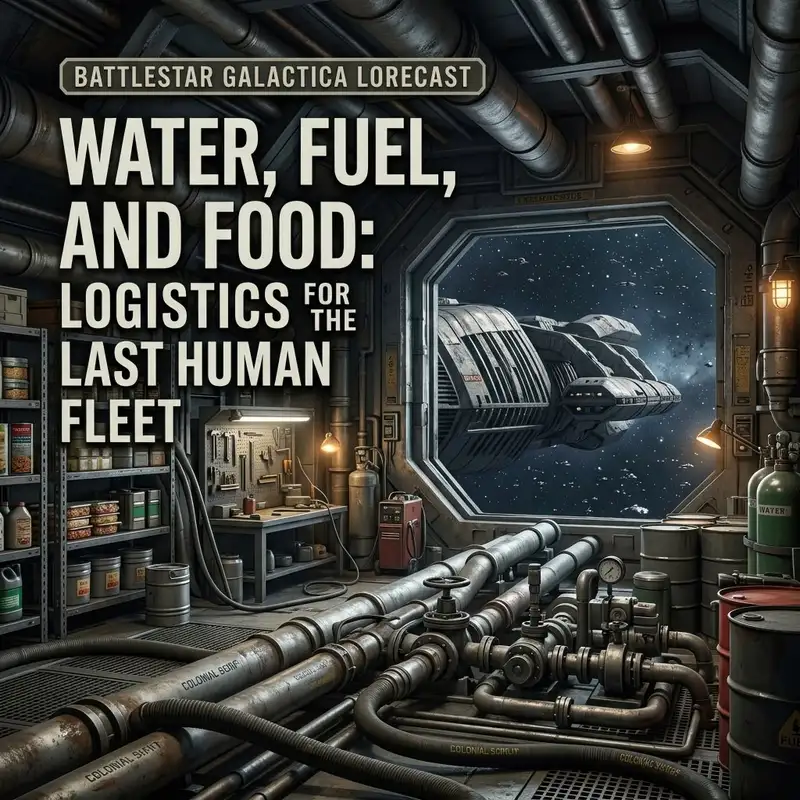
Water, Fuel, and Food: Logistics for the Last Human Fleet
The explosion did not breach Galactica’s armor or disable its Vipers. It struck something more basic. A blast ruptured the battlestar’s port-side water tanks and destroyed roughly ten million jugs of potable water, close to sixty percent of the ship’s reserve. Lieutenant Gaeta’s report made the immediate arithmetic plain. Galactica had perhaps six days of water left for itself. Around one-third of the civilian fleet, some sixteen thousand people by the estimate given at the time, depended on Galactica for replenishment and could run dry in two days.
That was the kind of damage a peacetime navy might classify as serious but manageable. The ship still had engines, weapons, flight decks, medical spaces, and a trained crew. In an ordinary theater, it could have withdrawn to a port, met a tanker, requested replacement parts, and allowed someone else to solve the problem. The last human fleet had no port, no tanker force waiting over the horizon, and no rear area. Its principal warship had become a water utility for thousands of civilians.
Galactica’s reclamation equipment gave it an advantage over many ships in the convoy. It could recover and reuse water more efficiently than older commercial vessels or passenger liners built for a very different kind of journey. But reclamation is not magic. Water must still be stored, moved through pipes, kept clean, rationed, and transferred safely. Filters wear out. Pumps fail. Tanks can be ruptured. A ship with a capable recycling system can endure a crisis longer than its neighbors, but it cannot make an entire fleet independent of replenishment.
The water crisis exposed the distinction between a warship surviving damage and a society surviving war. Galactica could remain combat capable while the people behind its guns became thirsty, sick, frightened, and politically unstable. The battlestar’s armor mattered. Its Vipers mattered. But neither could replace drinking water. From the first days after the Fall, the fleet’s military problem was inseparable from a quieter question. Could tens of thousands of displaced people keep their environmental systems running long enough to remain a people at all?
The Fall of the Twelve Colonies had destroyed far more than ships in orbit and military installations on the ground. It had erased the physical geography that made ordinary life predictable. Farms, reservoirs, food-processing plants, refineries, hospitals, warehouses, factories, shipyards, transportation networks, and civil administrations were lost with the worlds that supported them. The Colonies had possessed industrial depth. A damaged ship could once have entered a yard. A hospital could request medicine. A city could receive food from another region. The survivors inherited fragments of those systems, scattered across a convoy and cut off from the civilization that had made them useful.
Faster-than-light travel gave the fleet a way to escape immediate destruction. It did not give the survivors a supply chain. Every jump changed location, and every location had to be assessed before the fleet could risk stopping. The destination might contain water, fuel, salvage, or a defensible hiding place. It might also contain Cylons, radiation, hazardous debris, unusable terrain, or nothing at all. A convoy that remained mobile was harder to kill. It was also harder to feed, maintain, govern, and repair.
The surviving ships were not a neat naval formation designed for sustained operations. They were a heterogeneous collection of military vessels, freighters, passenger liners, prison transports, commercial craft, industrial platforms, and support ships. The screen record never provides a complete manifest, and it would be a mistake to pretend otherwise. What matters is that each ship carried different vulnerabilities and different forms of value. Some had cargo space. Some had technicians. Some had medical supplies, food stores, machine tools, fuel-handling equipment, or environmental capacity. Some carried mostly frightened civilians. Some carried people whose skills had become more valuable than any weapon in Galactica’s magazines.
The Cylons had achieved a strategic victory precisely because they destroyed the human civilization’s ability to replace losses at scale. The survivors still possessed individual ships, trained people, and a few pockets of equipment. They did not possess a secure industrial base. Every broken seal, depleted medicine cabinet, damaged launch rail, and exhausted technician therefore mattered more than it would have before the attack. The fleet could improvise. It could salvage. It could ration. It could occasionally find or seize what it needed. It could not just resume normal production.
Galactica stood at the center of this improvised system because it could do so many things at once. It was the fleet’s principal combatant, its fighter carrier, its command platform, and its most visible shield against Cylon pursuit. It could launch Vipers for combat air patrol, send Raptors on reconnaissance, coordinate defensive action, treat casualties, conduct repairs, house trained personnel, and maintain enough order to make collective movement possible. It also became a political symbol. To many survivors, Galactica represented continuity with the Colonial Fleet, with lawful authority, and with the belief that the human race had not merely become a collection of isolated ships waiting to be hunted down.
But a battlestar was not a civilization in miniature. Its flight decks required fuel, munitions, spare parts, deck crews, maintenance personnel, and rested pilots. Its medical spaces depended on supplies that could not be manufactured indefinitely aboard ship. Its engineering crews could repair damage, but repair is not the same as replacement. A machine shop can keep aging equipment alive. It cannot necessarily reproduce specialized components, rebuild a destroyed flight pod, or manufacture an entire new generation of aircraft.
Even Galactica’s military strength depended on civilian capacity. Food did not grow in the battlestar’s hull. Cargo did not move itself between ships. Fuel had to be located, extracted, refined, stored, and transferred. Sick civilians needed medicine and care whether or not they served in uniform. A technician on a refinery ship might contribute more to the fleet’s survival in a given week than a talented Viper pilot, because without fuel the pilot’s aircraft would remain in its launch tube.
The water emergency made that dependence impossible to ignore. Galactica imposed rationing and suspended nonessential use. Those were necessary measures, but they were not a solution. Rationing stretches a reserve. It does not create a new source. The fleet had to search nearby systems for water, assess what it found, and decide whether the risk of stopping was less dangerous than the certainty of running dry. Raptors became essential to that effort.
Raptors are often remembered for reconnaissance, electronic warfare, rescue, and transport. In the refugee fleet, they also became logistical instruments. They could scout ahead, inspect a potential resource site, carry small teams, relay information, and help connect a dispersed convoy that could not remain tightly grouped at every moment. A Raptor mission might not look glamorous beside a Viper strike, but it could determine whether the fleet found water before civilians began dying from dehydration. In a fleet with finite resources, the craft that locates a safe source may be strategically more important than the craft that destroys an enemy target.
The water crisis also became an intelligence problem because the damage was not just an accident. The sabotage was connected to Sharon Valerii, known to the crew as Boomer, acting under programming she did not consciously understand. That detail mattered not because it proved every breakdown was Cylon sabotage. It did not. The ships were old, damaged, overstressed, and operating without proper maintenance cycles. Equipment failures were inevitable. Treating every malfunction as enemy action would have paralyzed the fleet with suspicion.
The real danger was more subtle. A Cylon infiltrator did not need to destroy Galactica in a direct assault if she could compromise a system that made the fleet’s survival impossible. Water tanks, navigation systems, fuel storage, communications, maintenance records, and access procedures all became strategic targets. Sabotage could force the fleet to stop. It could push commanders into dangerous territory. It could generate fear, accusations, and political conflict at precisely the moment cooperation mattered most.
That was the cruel advantage of infiltration. It turned ordinary infrastructure into a battlefield and transformed trust into a security vulnerability. Yet the fleet had no reliable method for separating suspicion from proof. A system built entirely on mistrust would not function any better than one built on naïveté. Engineers need access. Pilots need maintenance crews. Ship captains need to share information. Civilians need confidence that emergency inspections will not become arbitrary punishment.
The fleet therefore faced a permanent counterintelligence dilemma. It had to harden essential systems, improve procedures, and remain alert to the possibility of infiltration. It also had to avoid treating every frightened or unpopular person as a potential enemy. The Cylons could exploit both weaknesses. They could exploit careless trust, and they could exploit a human community that tore itself apart trying to find an enemy inside every compartment.
Water sustained life moment by moment. Food revealed the scale of that life. During the same early crisis, Gaius Baltar calculated what the reported civilian population would require over a week. His estimate assumed a population of forty-five thousand, two hundred sixty-five people and listed minimum needs in grain, meat, fruit, vegetables, and roughly two and a half million jugs of water. The figures should be understood as an emergency planning estimate, not as a perfect census or a nutritional study that can be converted neatly into modern measurements. Survivor counts changed, records were incomplete, and the series never gives the listener a fully reconciled inventory of every ship’s stores.
Even so, the estimate establishes the reality commanders had to confront. Feeding the fleet was not a matter of putting more food in Galactica’s mess hall. Food had to exist somewhere. It had to be stored without spoilage, processed with functioning machinery, transported between ships, protected from theft or contamination, and distributed through a system people considered fair enough to obey. Every meal was the result of labor, equipment, power, water, sanitation, and administrative decisions.
Shortages were never evenly distributed. One ship might possess preserved food, medical supplies, environmental capacity, or a useful stock of alcohol that could become barter material. Another might have almost nothing except people who needed help. Such inequalities gave ship captains and civilian communities practical leverage. They also produced resentment. A person who sees another ship receiving fresh fruit, antibiotics, or better rations does not experience scarcity as an abstract statistical problem. Scarcity becomes evidence of who is valued, who is ignored, and who has access to power.
Medicine intensified the same pressure. Antibiotics, pain medication, surgical supplies, and basic treatments could not merely be replaced once they were used. Sanitation was equally important. A shortage of water did not only create thirst. It affected hygiene, waste management, wound care, food preparation, and disease prevention. A population already weakened by fear, displacement, grief, and crowded living conditions could not afford a public-health crisis.
Water keeps bodies alive. Food keeps the population alive over time. Tylium keeps the fleet able to choose where that population can go.
The fuel crisis in “The Hand of God” made that point with unusual clarity. Fleet tylium reserves had fallen to roughly five percent, described as enough for only two more jumps. That was not just an inconvenience in a universe where faster-than-light movement is optional. Without fuel, the fleet could not evade Cylon pursuit, scout safely, reposition its defenses, or move civilian ships away from danger. A ship that cannot jump is not merely slow. It is trapped.
Tylium also affected nearly every other function. Military operations consume energy and require mobility. Raptors need to scout. Vipers need to launch and recover. Civilian ships need power, environmental control, and the ability to remain with the fleet. The exact consumption rate of every vessel is not established, and there is no reason to invent it. What the crisis demonstrates is enough. Fuel was a strategic resource because it determined whether the fleet retained operational freedom.
Colonial scouts located a Cylon-operated mining and refining installation. That discovery presented an opportunity, but not an easy answer. The fleet did not need to destroy the installation merely because it belonged to the enemy. It needed the tylium. A careless attack that destroyed the resource, wrecked the refinery, or drove the fleet into a costly engagement would solve nothing. Resupply had become a military operation.
The plan combined civilian and military assets. Civilian mining ships served as decoys, drawing attention and helping create the conditions for Galactica’s strike. Vipers carried out the attack. Reconnaissance mattered because commanders needed to understand enough about the target, its defenders, and the available resource to risk the operation. Timing mattered because the longer the fleet remained exposed, the more likely Cylon forces could respond. Coordination mattered because civilian ships were not expendable props. They were part of the means by which the fleet intended to recover its future mobility.
The tactical result was a success. The Cylon facility was struck, and the fleet gained access to fuel. Operationally, that restored the ability to move and evade. Strategically, however, the episode offered no permanent solution. The fleet had not recovered an entire industrial economy. It had not built a secure refinery network or established a protected supply route. It had demonstrated that survival would repeatedly require dangerous expeditions into contested space.
The operation also showed why the fleet could not divide military action from logistics. The mining ships, Raptor crews, Viper pilots, technicians, and planners were participating in the same campaign, even if they did not all carry weapons. A fuel transfer is not as cinematic as a dogfight, but it can decide whether the dogfight occurs at all. A scout crew that identifies a viable source may preserve more lives than a squadron that scores an impressive number of kills.
None of those jobs could be created on demand. A commander could order a ship to jump. He could not order a new trained navigation specialist into existence. A president could authorize emergency work details. She could not instantly replace a technician who understood a unique system carried by one aging vessel. The fleet’s labor pool was both indispensable and finite.
Maintenance was especially unforgiving. The mixed age and mixed purpose of the surviving ships meant that the fleet inherited incompatible equipment, uneven repair capability, and systems never meant to operate without shore support. Some parts could be fabricated or improvised. Some could be salvaged. Others were irreplaceable once lost. The ship that carried a particular machine tool, diagnostic device, or experienced mechanic might be strategically significant even if it looked insignificant beside a battlestar.
The same was true of personnel fatigue. A Viper pilot could not remain on alert forever. A deck crew working through emergencies would make mistakes. A refinery crew operating under pressure might accept unsafe conditions because the alternative was immobilizing the fleet. In a conventional war, commanders can sometimes rotate units, draw replacements from training commands, or move damaged equipment to a rear-area depot. The refugee fleet had no such depth. Its people were the reserve.
There is a limit to what command authority can accomplish in such conditions. An admiral can issue an order to conserve fuel. A president can direct rationing. Neither can manufacture a replacement seal, a trained engineer, or a safe transfer procedure through force of personality. The fleet’s leaders could set priorities. They could not repeal material reality.
That fact became politically explosive whenever control of a scarce resource became a question of who had the right to command.
The crisis in “Resistance” exposed the fleet’s constitutional fault line. With Adama incapacitated, Colonel Tigh imposed martial law. He faced a real command problem. The fleet was under pressure, leadership was fractured, and the ordinary political process appeared too slow or too vulnerable to manage the emergency. Yet Tigh’s government quickly confronted the practical power of civilian infrastructure.
The Aturian refining vessel and other ships refused to release fuel, food, medicine, and even coffee until civilian government was restored. The refusal was not a minor dispute over comfort. Fuel affected movement and defense. Food and medicine affected health. The civilian captains and workers possessed leverage because their ships controlled resources the military could not do without.
Tigh could interpret that resistance as insubordination, extortion, or a dangerous challenge to fleet unity. There was truth in the concern. A convoy cannot survive if every ship can unilaterally withhold essential supplies whenever it dislikes political decisions. But the civilian refusers also understood something important. If military command could seize essential goods whenever it declared an emergency, then civilian authority had become ceremonial. The question was not only whether the fleet needed the supplies. It was whether the people who controlled them retained any meaningful political rights.
The attempt to resolve the dispute through coercion ended with Marines seizing supplies and four civilians dead. Tactically, force could obtain cargo. Institutionally, it produced a far more serious loss. The deaths confirmed civilian fears that martial law had become rule by armed command. They widened resistance, damaged trust, and made later cooperation harder.
This does not mean that every act of requisition was unlawful or that military officers had no responsibility to prevent paralysis. Emergency conditions can require difficult decisions, and a commander cannot permit a fuel crisis to become an invitation for every faction to impose its own terms. But the episode demonstrates the cost of treating political consent as an obstacle rather than a resource.
A refinery ship cannot be run indefinitely by people who believe they are being robbed at gunpoint. Workers can slow down, resist, sabotage, flee, or simply lose the willingness to take dangerous risks for a government they no longer recognize as legitimate. Coercion may deliver supplies once. It cannot create durable compliance, skilled labor, or public confidence.
By the time Pegasus appeared, the fleet had acquired a new source of strength and a new argument about what strength was for. Pegasus was a surviving battlestar with more modern systems, substantial military resources, and technical capacity that Galactica badly needed. Its arrival improved the survivors’ combat position. It offered reserves, personnel, equipment, and the possibility that the human race possessed more than one warship capable of fighting the Cylons.
Admiral Cain’s conduct after the Fall gave that dilemma a darker form. Pegasus had stripped civilian ships of parts, supplies, and selected personnel in the name of survival. Not every member of her crew shared responsibility for every decision, and it would be wrong to flatten Pegasus into a single moral character. Many aboard the ship had endured trauma, isolation, and relentless combat. They had watched the Colonies die and had come to believe that military survival was the only survival that mattered.
Yet Cain’s approach revealed the danger in that belief. A military force can sustain itself for a time by consuming the civilian world around it. It can seize expertise, strip machinery, commandeer supplies, and decide that the needs of noncombatants are secondary to combat power. But such a policy destroys the social base from which meaningful military power ultimately comes. The people being stripped of parts and labor are not incidental to survival. They are the engineers, families, patients, workers, and future citizens whose existence gives the war a purpose.
Pegasus did not become an unlimited shipyard merely because it had better resources than Galactica. It could repair, build, and support more than the older battlestar in certain circumstances. It could strengthen the fleet’s military capacity. But it could not recreate the lost industrial civilization of the Twelve Colonies. It could not replace every trained worker, rebuild every destroyed ship, or produce limitless aircraft, weapons, medicine, and spare parts.
The arrival of Pegasus therefore did not end the logistics problem. It made the allocation problem sharper. The fleet now had more resources, but also competing chains of command, competing institutional cultures, and competing theories of who should bear scarcity. Galactica represented a military force trying, unevenly and imperfectly, to remain accountable to civilian government. Pegasus represented the temptation to define survival in narrower terms: preserve the military instrument first, then decide later whether there is anyone left for it to defend.
Scarcity also created institutions outside formal command. By the time of “Black Market,” essential goods had become scarce enough and unevenly distributed enough that informal trade flourished. Civilians bartered liquor and other valuables for food, antibiotics, medicine, and access to supplies they could not obtain through official channels. The black market was not a colorful side economy. It was evidence that the fleet’s formal distribution system could not meet every need.
But the same system rewarded hoarding, manipulation, coercion, and unequal access. A person with savings, connections, cargo, or a willingness to threaten others could obtain necessities more easily than someone who had nothing to trade. The market could withhold medicine until desperation increased its value. It could turn medical need into leverage and transform vulnerable civilians into customers with no alternative.
The problem was not merely greed. It was the collision of scarcity with weak institutions. The fleet lacked a normal economy, stable currency, reliable supply routes, and a secure legal system capable of regulating every exchange across dozens of ships. Shipboard stocks varied. Enforcement varied. Civilian desperation varied. Under those conditions, black markets were almost inevitable.
The policy challenge was difficult because suppression alone could make conditions worse. If formal distribution remained inadequate, eliminating informal trade would not eliminate need. It might merely drive transactions deeper underground and make them more dangerous. On the other hand, accepting the black market as normal would allow access to life-saving goods to be determined by bargaining power rather than medical necessity.
The episode’s lesson is not that markets are wicked or that regulation solves scarcity by decree. It is that scarcity creates social power. Whoever holds antibiotics, food, fuel, or safe shelter possesses leverage over someone who does not. A legitimate government must recognize that reality and build distribution systems people can trust. If it fails, private force and private wealth begin replacing public obligation.
By the time the fleet encountered New Caprica, logistics had become inseparable from the question of whether endless flight was still tolerable. The planet offered food, water, breathable air, and limited habitable regions. It was difficult terrain, not a paradise. But after months of crowding, rationing, uncertainty, and dependence on fragile ships, even an imperfect world had obvious appeal.
President Roslin saw New Caprica primarily as a place to resupply and recover before moving on. Her judgment reflected the military danger. A fleet in space retained mobility. It could jump away from a threat, divide its forces when necessary, and avoid concentrating the entire population in one fixed location. A settlement on a planet would trade mobility for shelter. It would gather civilians, infrastructure, and political authority in a place that could be found, surrounded, or occupied.
Gaius Baltar and Tom Zarek gave voice to a different calculation. Their argument was not merely cowardice or political opportunism, though politics always mattered. Many civilians were exhausted. Life aboard ship had become a permanent emergency. Crowding, shortages, black-market exploitation, interrupted families, limited work, and uncertainty about the future had worn away faith in the idea that flight itself was survival. A planet with air to breathe and ground beneath one’s feet offered more than food and water. It offered the possibility of ending the condition of being a refugee.
The debate was therefore not a simple disagreement about navigation. It was a vote about what survival should mean. Roslin feared that settlement would create a strategic trap. Baltar and Zarek argued that a people cannot live forever as passengers under military protection, dependent on reserves that might fail at any moment. Both positions emerged from the same logistical reality. The fleet could keep moving, but movement required fuel, maintenance, labor, discipline, and continuing sacrifice. The population could settle, but settlement would expose it to risks that mobility had helped avoid.
New Caprica appeared to answer the supply problem by reconnecting human survival to a world with local resources. It promised water without tanker transfers, food without ration stores, shelter without overcrowded compartments, and a degree of civilian life beyond the control of a battlestar’s command deck. Its appeal was genuine because the fleet’s logistical system had always been fragile.
But a logistical answer can carry a strategic price. A planet may provide resources while taking away the ability to leave. It may reduce the daily strain of convoy life while making the population easier to locate and control. The decision to settle was not evidence that the survivors had forgotten the Cylons. It was evidence that material exhaustion can become as powerful as fear of the enemy.
The last human fleet remained alive because it learned, slowly and often painfully, that logistics was not a support function behind the war. Water, fuel, food, medicine, maintenance, labor, and fair distribution were the war. A Viper patrol could buy time. A battlestar could repel an attack. A Raptor could find a resource. But none of those achievements meant much if the people protected by those missions could not drink, eat, receive treatment, repair their ships, or believe that sacrifice was being shared justly.
Galactica was indispensable because it provided defense, command, repair capacity, and a focal point for organized resistance. Pegasus increased the fleet’s strength because it brought resources and military capability that could not easily be replaced. Yet neither battlestar was the fleet’s true center of gravity. That center lay in the cooperation of people spread across civilian and military ships, people whose labor and consent turned scattered hardware into a functioning society.
The danger was always that emergency would make leaders forget this. A commander facing a fuel shortage could seize cargo. An admiral could preserve reserves by denying aid. A civilian captain could withhold vital supplies to force political change. A trader could profit from medicine that someone else desperately needed. Each act might have an immediate logic. Each could also weaken the relationships that made collective survival possible.
Force can secure a shipment once. It cannot manufacture trust. It cannot replace the skilled worker who leaves, the civilian crew that stops cooperating, the patient who dies before medicine arrives, or the political legitimacy lost when armed personnel become the primary method of distribution. The fleet needed command authority, but it also needed accountable authority. It needed military protection, but it needed civilians to remain citizens rather than inventory.
That was the enduring logistical lesson of the refugee journey. The survivors could not preserve humanity by keeping Galactica fueled while the people around it starved, lost faith, or ceased to see any future beyond obedience. They survived only when protection, labor, law, and shared sacrifice were held together long enough for a scattered convoy to remain a human community worth defending.