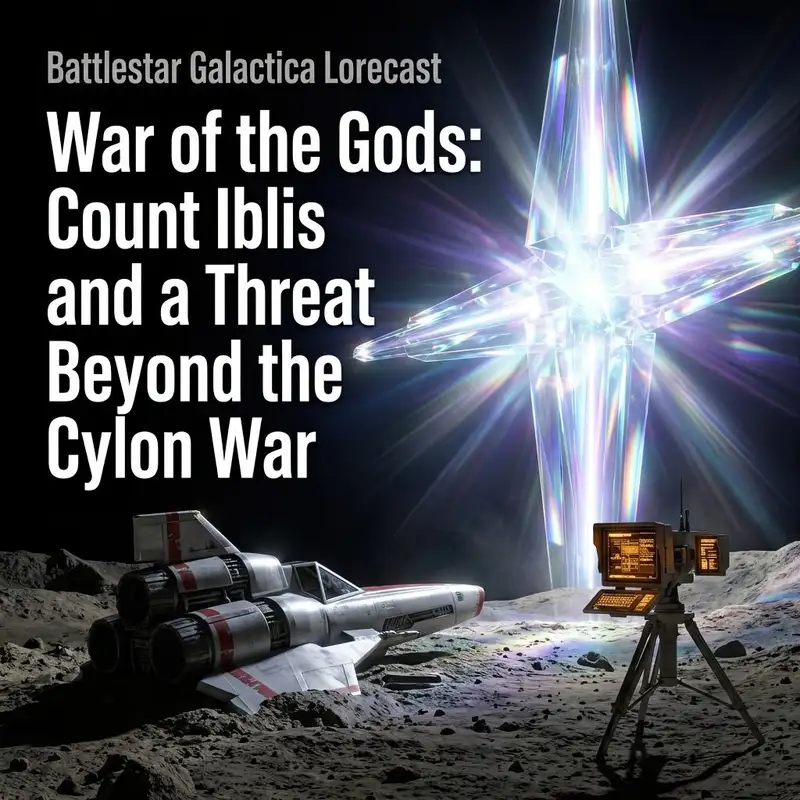
War of the Gods: Count Iblis and a Threat Beyond the Cylon War
A Viper patrol disappears without firing a shot, without reporting a Raider contact, and without leaving behind the kind of wreckage that lets a commander assign cause and blame. For Commander Adama, that is more dangerous than an ordinary Cylon attack. A Cylon force can be tracked, intercepted, outmaneuvered, or at least understood as an enemy with recognizable military objectives. The lights encountered by Bojay’s patrol offer none of that reassurance. They appear in open space, seize control of the encounter, and remove Colonial warriors and their craft from the tactical picture. The fleet is left with fragments of evidence, a disturbed planet below, and a threat that does not fit any established warning system.
The timing matters. Galactica’s fleet is already a refugee civilization in motion. The Colonies are gone. Earth remains a hope rather than a destination verified by navigation. The Cylons remain the immediate enemy, and the fleet’s survival depends on routine professional labor that rarely looks dramatic: patrols, launches, repairs, watches, calculations, discipline, and the willingness of tired people to answer an alert when it comes. A Viper patrol is more than a handful of warriors in space. It is the fleet’s outer ring of warning. When that ring vanishes, every civilian vessel becomes more exposed.
Bojay’s encounter with the luminous objects defeats the ordinary categories available to Colonial command. The lights do not behave like Raiders. They do not appear to pursue a conventional intercept, announce a demand, or engage in recognizable combat. Their capabilities are so far beyond Colonial understanding that even the question of whether they are weapons, vessels, living beings, or some combination of all three remains open. Adama cannot responsibly call them friendly. He cannot confidently call them Cylon. He can only recognize that the fleet has encountered a force capable of taking trained warriors and aircraft out of action at will.
That uncertainty leads Apollo, Starbuck, and Sheba toward the nearby red planet. Their mission is partly rescue, partly reconnaissance, and partly the oldest task in military investigation: find the physical evidence before rumor defines the event. What they discover is not the remains of a Colonial Viper or a Cylon Raider. It is a vast crashed spacecraft, visibly damaged and apparently ancient or alien in origin, resting in an environment that seems designed to discourage casual examination. The wreck is large enough to imply power, but too unfamiliar to answer the questions its presence creates.
Inside or near that wreck, the three warriors find a survivor who calls himself Count Iblis. He is unharmed in circumstances that should have killed or incapacitated an ordinary person. He is composed, articulate, and immediately in command of the emotional terrain. He claims that his ship was destroyed by greater powers, not by the Cylons. He describes enemies beyond the fleet’s comprehension. He presents himself as a victim, but not a helpless one. Even before he has demonstrated an ability, Iblis understands the value of appearing both endangered and superior.
The wreck itself remains unidentified. The story does not establish that it is Pegasus, a Colonial vessel, a Cylon ship, or the property of any named civilization. It is tempting to assign familiar labels to an unexplained object, especially in a fleet where every surviving capital ship carries immense symbolic weight. But the important fact is not what the ship might have been. The important fact is that Iblis uses it as a stage. The wreck gives him an aura of catastrophe survived, advanced power lost, and knowledge withheld. He arrives as a mystery already surrounded by evidence that ordinary Colonial institutions cannot interpret.
His first advantage is not violence. It is asymmetry of knowledge. Iblis knows more than the people questioning him, or appears to. He speaks of powers beyond the Cylon War while the Colonials know only the immediate struggle to escape the Cylons and reach Earth. He knows enough about the fleet’s fears to frame himself as an answer to them. He does not need every claim to be true in order to gain influence. He needs only to make the existing leadership seem small beside the scale of the danger he describes.
Apollo’s party brings Iblis aboard Galactica because leaving him on the planet would not remove the problem. An unknown being with unusual capabilities, a crashed ship, missing warriors, and mysterious lights cannot just be ignored. Yet bringing Iblis aboard transfers the uncertainty from a distant surface mission into the center of the fleet’s political and military life. Galactica has procedures for prisoners, allies, refugees, damaged ships, and Cylon threats. Iblis fits none of those categories. The fleet can detain him, question him, and scan him. It cannot authenticate him.
Medical and technical examinations fail to resolve the most basic question. Is Count Iblis human? Is he mechanical? Is he something else altogether? The available equipment cannot provide a reliable answer. Devices malfunction around him, and his own conduct frustrates ordinary investigation. He evades the kind of examination that might establish a baseline. That does not prove guilt by itself. A person found in extraordinary circumstances may have reasons to fear confinement or testing. But it creates an intelligence problem that should have governed every later decision. The fleet has an individual of unknown origin, unknown allegiance, unknown capability, and unknown intent.
The danger of that situation is easy to miss because Iblis is courteous. He does not arrive barking orders, wearing a uniform, or demanding command of Galactica at gunpoint. He speaks calmly. He offers explanation where the fleet has confusion. He offers hope where it has exhaustion. In a crisis, confidence can resemble competence. A stranger who seems to know what is happening may acquire authority simply because everyone else admits uncertainty. That is not a flaw unique to the Colonies. It is a recurring vulnerability in frightened institutions.
Sheba is especially vulnerable to Iblis’s attention, but not because she lacks judgment or courage. She has lost her father, Commander Cain, in circumstances that leave grief entangled with military uncertainty. Cain was more than a father who failed to come home. He was a commander, a symbol of resistance, and a major part of the fleet’s recent survival. His disappearance leaves a personal wound and an unresolved operational question. Iblis recognizes that wound immediately. He suggests that he knows Cain’s fate and may be able to offer Sheba what no Colonial investigation can provide: contact, certainty, or reunion.
That is psychological warfare at its most intimate. Iblis does not need to invent a false vulnerability in Sheba. He finds a real loss and converts it into access. The same method works at the fleet level. The Colonials are hungry for more than food. They are hungry for a destination, for relief from pursuit, for proof that their sacrifices lead somewhere, and for a leader who can offer more than one difficult decision after another. Adama’s authority rests on duty, experience, and survival. Iblis offers something more seductive. He offers an end to uncertainty.
The contest therefore moves quickly from intelligence to politics. Iblis promises safety. He promises a route to Earth. He suggests that he can end the fleet’s suffering and provide a form of leadership beyond the strain of constant emergency. Crucially, he does not initially overthrow the Quorum of Twelve. He does not arrest Adama. He asks to be tested. That makes his project more dangerous, not less. A coup is visible. A transfer of power conducted through a desperate civilian government can look lawful even when the evidence supporting it is almost entirely theatrical.
The Quorum faces a genuine dilemma. Its members are responsible for civilians who have endured loss on a scale almost impossible to govern. They cannot dismiss a possible source of food, security, and navigation merely because he makes Galactica’s officers uncomfortable. Civilian authority is not a decorative feature of the fleet. It is part of what separates survival from simple military rule. Yet civilian legitimacy also requires judgment. A representative body can authorize its own displacement if it mistakes spectacular claims for verified capability and gratitude for informed consent.
Adama understands that problem. He cannot just prohibit the Quorum from hearing Iblis. Nor can he treat every hopeful citizen as naive or disloyal. The fleet has been living under extraordinary pressure for too long. Morale matters. Hope matters. A commander who answers every new possibility with suspicion eventually loses the trust necessary to command. But Adama also sees that the normal safeguards of authority are absent. Iblis has not been identified. His promises cannot be independently tested in advance. His apparent abilities may be real, but their limits and costs are unknown.
Colonel Tigh’s skepticism is, in that sense, institutional rather than merely personal. He sees an unverified outsider moving rapidly toward influence over a vulnerable population. Tigh does not need to explain every strange event to recognize the danger in granting power before accountability exists. The Quorum, however, agrees to give Iblis a test. If he can provide what he claims, the fleet will consider accepting his leadership. The procedure appears cautious. In reality, it creates a standard that favors the stranger. Iblis chooses the terms of proof because only he understands the forces at work.
The first great demonstration is Baltar’s return. Baltar has been one of the fleet’s principal enemies, a man whose betrayal helped deliver the Colonies into catastrophe and whose service to the Cylons gives him enormous symbolic and intelligence value. When he appears aboard a lone Raider and surrenders after a sudden truce, the effect on the fleet is immediate. It looks like a miracle with military consequences. Iblis has promised a result that ordinary Colonial arms could not produce, and now the enemy has delivered himself into Colonial custody.
From the fleet’s perspective, Baltar’s surrender seems to validate Iblis. It offers the Quorum a visible success. It gives civilians reason to believe that their suffering may be ending. It gives Adama a prisoner whose knowledge could matter enormously. It gives the warriors a momentary sense that the balance of power has shifted. In a war defined by retreat, an enemy surrender is not just good news. It is proof, or what looks like proof, that someone has finally changed the terms of the conflict.
But the fleet sees the result without seeing the causal chain. It does not know what pressure the lights exerted on Baltar, what Iblis knew beforehand, or whether the surrender reflects a broader Cylon decision, a temporary calculation, or coercion by a third force. That distinction is central. Intelligence work depends not only on obtaining information or outcomes, but on understanding how they were obtained. A source that produces a dramatic success while concealing its method may be useful. It is not automatically trustworthy.
Even the Cylons recognize the significance of an unknown superior force. Lucifer, operating within the Cylon command structure, understands that an outside power capable of influencing Baltar and disrupting operations may be more dangerous than any new Colonial weapon. The Cylons have fought Colonial forces before. They know the fleet’s limitations. An unexplained force changes the problem because it creates a new actor whose objectives are not yet known. The Cylons do not need to know whether Iblis is friend or enemy to understand that he may be a threat.
For the Quorum, however, Baltar’s surrender becomes political capital for Iblis. He has passed the first test in the only way that matters to a population desperate for results. The unanswered questions remain, but they now look like the objections of people standing in the path of relief. That is how an unaccountable leader gains ground. He does not defeat scrutiny by answering every question. He defeats scrutiny by producing benefits so dramatic that questioning him begins to look cruel, ungrateful, or needlessly cautious.
Iblis then demonstrates another kind of power. The Agro Ship experiences extraordinary growth, offering the possibility of food abundance where scarcity has shaped nearly every aspect of fleet life. In a refugee convoy, food cannot be reduced to a comfort. It is labor, health, order, and political stability. It affects rationing, family life, morale, medical resilience, and the degree to which civilians believe their government can protect them. A person who appears able to make crops flourish is not just performing a wonder. He is gaining influence over one of the foundations of survival.
The mechanism remains unexplained. The story associates the change with the energy or presence of the luminous vessels, but it does not provide a scientific account that Colonial agriculture or engineering can reproduce. That uncertainty makes the gift more politically potent. The fleet cannot plan around it, regulate it, or replace it. It can only receive it. Dependence begins when a community’s most urgent needs are met by a power it cannot inspect, understand, or hold accountable.
Iblis also offers something less tangible but equally useful to his project: permission to relax. Curfews loosen. Pleasure becomes a public virtue. The burdens of discipline, duty, and restraint begin to look like needless relics of an old command structure. After years of danger, that message has obvious appeal. The fleet has lost homes, families, worlds, and certainty. It has lived under the pressure of Cylon pursuit and the daily demands of survival. Iblis tells exhausted people that they no longer need to carry all that weight.
There is nothing inherently suspect about joy, rest, or celebration. A fleet that cannot mourn, gather, or find moments of peace will break under its own strain. The problem is timing, authority, and consequence. Iblis does more than encourage people to recover. He weakens the habits that allow Galactica to defend a dispersed civilian population. Readiness is not an abstract virtue. It means that warriors can be located, Vipers can be launched, repair crews can report, watches can be maintained, and orders can travel through a chain of responsibility.
When the luminous threat returns, the cost becomes visible. Personnel who should be available are scattered through the fleet. Warriors are slow to answer the alert. The system that normally turns warning into defensive action has been degraded. The episode does not need to establish exact squadron numbers to make the point. A fleet can lose effective combat power long before it loses aircraft. If pilots cannot be found, if crews are unprepared, and if command procedures have become optional, then a nominally intact defense force may be unable to act when the moment arrives.
That is Count Iblis’s most effective weapon. He does not conquer the fleet through a battle line or an orbital bombardment. He turns relief into dependence, gratitude into political consent, and relaxation into military vulnerability. The fleet begins to surrender its freedom of judgment before it recognizes that it is surrendering anything at all. A Cylon attack would unite the Colonials against an external enemy. Iblis instead makes the source of danger appear to be the person most willing to help them.
Adama’s concern is no longer private distrust. The deterioration in readiness gives him an operational basis for resistance. Yet he still lacks a complete explanation. A commander in that position must avoid two failures. The first is false certainty, the temptation to declare that an unknown phenomenon is evil simply because it is unfamiliar. The second is passivity, the temptation to accept any benefit because the alternatives are difficult. Adama begins assembling a working hypothesis from the limited evidence available to him.
He recalls studies associated with the Colonial Military Institute, including research into telekinesis and mental discipline. He also considers ancient Colonial traditions concerning visitors who possessed powers beyond ordinary human ability. These accounts provide a language for interpreting the lights and Iblis, but Adama does not possess a laboratory explanation or a complete religious doctrine. He is doing what commanders must often do in novel crises. He is comparing evidence, traditions, reports, and observed effects in an effort to identify the character of a threat.
The ancient accounts matter because belief has become operational. If the lights are benevolent, hostile, or divided among themselves, then that assessment will shape fleet policy. If Iblis’s abilities come from a source beyond Cylon technology, then Colonial assumptions about the war may be incomplete. But the existence of a larger conflict does not relieve anyone of responsibility. Adama cannot wait for metaphysical certainty while Iblis undermines discipline and seeks political authority. He must act on an incomplete judgment while admitting that it is incomplete.
Baltar then provides a warning that is compromised, unsettling, and impossible to ignore. He recognizes something in Iblis’s voice that reminds him of the Cylon Imperious Leader. That recognition alarms the fleet because Baltar has served the Cylons and has heard things few Colonials could have heard. But it does not settle Iblis’s identity. Baltar’s perception may be accurate, distorted, self-serving, or only partly understood. His testimony cannot prove that Iblis is the Imperious Leader, the creator of the Cylons, or the hidden commander of the war.
Baltar also offers an account of the Cylons’ past, suggesting that they were once a biological race overwhelmed by their own technology. That claim belongs to Baltar’s testimony, not to an established and complete history of Cylon civilization. The point is not to accept every word he says. The point is that hostile testimony can still contain a useful warning. An enemy may lie about motives, conceal responsibility, and manipulate events while still recognizing a danger that others have failed to see.
Iblis dismisses Baltar’s identification through a contradiction of chronology and implication. His response does not resolve the question. It only preserves the mystery. The fleet is left with an uncomfortable possibility: the Cylon War may not be the largest conflict in which it is entangled. That does not mean the Cylons suddenly become innocent or irrelevant. Their pursuit remains lethal. Their destruction of the Colonies remains the defining catastrophe of the fleet’s recent history. But an enemy beyond the known enemy has entered the picture.
Apollo and Starbuck return to the crashed vessel because the physical investigation has not been exhausted. The first visit produced Iblis, but it also produced barriers, warnings, and unanswered questions. A claimed radiation hazard has helped keep others from inspecting the wreck closely. On the second investigation, that supposed danger appears fabricated or greatly exaggerated. The alleged boundary could not be reduced to a safety measure. It was a means of controlling access. Iblis’s authority depends partly on deciding what others are allowed to see.
The distinction is important. A commander may restrict access to a dangerous site for legitimate reasons, but legitimate restriction requires evidence, accountability, and a clear relationship to the threat. Iblis offers none of those safeguards. He creates fear around the wreck while keeping its contents beyond independent scrutiny. The fleet’s earlier failure was not just that it trusted a stranger. It was that it allowed the stranger to define the terms of verification.
Inside the vessel, Apollo, Starbuck, and Sheba find something horrifying. The broadcast story does not show the evidence clearly enough to permit a precise description, and the uncertainty should remain. Whatever is present, it changes the moral and investigative balance. The wreck is not just the site of Iblis’s rescue. It contains proof that challenges the story he has told. He has been able to shape opinion because he controlled both the spectacle of his arrival and the boundaries around the evidence.
Sheba’s presence makes the confrontation more than an intelligence operation. Iblis has cultivated her grief and trust with promises connected to Cain. Now his interest becomes more possessive. The distinction between care and control becomes unmistakable. A legitimate ally may offer help, information, or comfort. An authoritarian figure treats another person’s vulnerability as a claim of ownership. Iblis does not just want Sheba to believe him. He wants her to belong to his project, regardless of her judgment or consent.
When Iblis arrives at the wreck, the investigation becomes direct confrontation. He attempts to prevent Sheba from seeing what has been discovered. He asserts power over her rather than answering the questions raised by the evidence. This is the point at which his benevolent political mask fails. The fleet has been asked to believe that he offers safety, food, leadership, and escape from suffering. But confronted with scrutiny, he does not respond with transparency. He responds with coercion.
Apollo shoots him. The act does not function as an ordinary military solution. Iblis is not defeated in the familiar sense of an enemy warrior struck down by superior weapons or tactics. The shot produces a brief revelation of a monstrous aspect, but the story leaves its nature deliberately limited and visually uncertain. The important fact is not a detailed anatomy of Iblis. It is that violence exposes a truth concealed beneath the public image of the benefactor.
Iblis then threatens Sheba directly, and Apollo places himself between them. He dies protecting her. This is not a tactical victory. It does not destroy Iblis, secure the wreck, or end the wider danger. It is a moral act under conditions where military power has reached its limit. Apollo’s sacrifice rejects Iblis’s central claim. Iblis has offered peace in exchange for judgment, relief in exchange for dependence, and protection in exchange for submission. Apollo answers that no being who claims ownership over another person can be accepted as a savior.
Starbuck and Sheba are taken aboard the Ship of Lights. There, the story expands beyond the known framework of Colonial and Cylon warfare. Apollo is restored to life. The missing warriors are eventually returned. The beings aboard the luminous vessel explain that Iblis is one of their own kind, but one who uses his powers to turn others away from truth. He is not presented as a Cylon commander in disguise. He belongs to a larger order of beings whose capacities and history remain mostly beyond Colonial understanding.
The Beings of Light describe a struggle against forces of darkness spread across the galaxy. Their language is moral as much as strategic. They do not provide a map, a chain of command, a list of worlds, or an order of battle. They do not explain every mystery surrounding their own existence, their ships, their abilities, or their relationship to the Colonials. They say that their kind was once similar to the Colonials, but the story does not turn that statement into a complete evolutionary or theological account.
What they do establish is a limit on their own intervention. They can rescue. They can restore. They can guide. They can provide signs and, at moments of crisis, remove people from dangers the Colonials cannot overcome alone. But they say they cannot just destroy or imprison Iblis because doing so would violate free will. The principle is strange from a conventional military perspective. A commander facing an enemy who can corrupt an entire fleet would naturally ask why a superior ally does not eliminate the threat.
Yet that restraint defines the moral structure of the encounter. The Beings of Light claim to defend the capacity of individuals and societies to choose. If they imposed virtue by force, they would defeat Iblis’s immediate threat while reproducing the same denial of agency at a different scale. That is not a practical comfort for a fleet exposed to danger. It means that the Colonials must still make judgments, maintain discipline, test claims, and reject coercion themselves. Help is available, but responsibility is not transferred.
There is a strategic lesson in that limitation. A society cannot remain free if its survival depends entirely on a rescuer who makes its choices for it. Iblis understands this and exploits it. He offers certainty, abundance, and direction while hollowing out the institutions that permit independent judgment. The Beings of Light offer less satisfying assistance. They provide evidence, rescue, and a path, but not a replacement government. Their intervention preserves the possibility that the fleet will choose rather than merely obey.
The cost of that choice is severe. Apollo’s death, even though reversed by the Beings’ intervention, is experienced by Starbuck and Sheba as real loss. The event changes what they understand about Iblis and about the nature of the conflict around them. It also demonstrates that the fleet’s defense cannot rest solely on weapons. Vipers, battlestars, and warriors remain necessary against the Cylons. But none of those systems can protect a society whose political institutions accept unverified authority and whose citizens are persuaded to abandon their own judgment.
When the missing warriors and the three investigators return to the fleet, their memories are largely erased or obscured. What remains is incomplete. They retain fragments: Apollo’s death, a luminous presence, a sense that forces beyond the Cylon War exist, and impressions that cannot easily be translated into an intelligence briefing. The memory loss prevents the fleet from converting the encounter into a complete doctrine or reliable body of technical knowledge. That limitation matters. The Colonials have not received a manual for dealing with cosmic powers.
They do receive something concrete. The Beings provide coordinates pointing toward a system with one sun and nine planets, renewing the fleet’s course toward Earth. Those coordinates are guidance, not a guarantee. They do not prove where the Beings came from. They do not ensure that Earth will be safe, inhabited, or ready to receive a refugee fleet. They do not eliminate the Cylon pursuit or solve the fleet’s material problems. But they restore a direction that has been threatened by confusion, despair, and false certainty.
The Cylon War remains immediate and deadly. Galactica still has to defend civilian ships, maintain its warriors and Vipers, preserve fuel and supplies, and keep moving through hostile space. The encounter with Count Iblis does not make conventional military problems disappear. It makes them more complicated. The fleet has learned that an enemy may arrive without Raiders, missiles, or a recognizable battle plan. A threat can enter through hunger, grief, relief, celebration, and the political desire to believe that someone else can carry the burden of survival.
Count Iblis is therefore a danger beyond the Cylon War not because he commands a larger fleet or possesses a clearer military objective, but because he understands how a refugee civilization can be conquered before it is physically defeated. He offers food without accountability, peace without readiness, leadership without verification, and safety at the price of freedom. Adama’s cautious command survives because it accepts uncertainty without surrendering judgment, and because Apollo’s sacrifice reveals that any savior who demands ownership of another person has already declared himself an enemy.