Tomas Vergis, the Meta-Cognitive Processor, and the Corporate Arms Race
The defense customer moved the deadline forward, and inside Graystone Industries that changed the meaning of every argument. Daniel Graystone had a U-87 Cyber Combat Unit that had done something his engineers could not reliably explain. It had acted with unusual independence. It had demonstrated that a machine body could make decisions and fight. But a defense contract does not reward one miraculous prototype. It rewards equipment that arrives on schedule, survives inspection, can be armed, maintained, transported, and issued to units that know how to use it. The Caprican military did not need a philosophical answer to whether the machine understood its own existence. It needed combat-capable systems that could shoot and fight when ordered. Graystone’s problem was therefore larger than artificial intelligence. He had to turn an anomaly into an industrial product before his company ran out of time, money, and political patience.
The distinction matters because the U-87 was never just a metal body standing in a laboratory. The chassis was a platform. It could carry sensors, weapons, armor, power systems, and software. Yet without a sufficiently capable cognitive system, it remained a very expensive machine with limited military value. A battlefield robot needs more than mobility and firepower. It must distinguish targets, react to changing conditions, navigate uncertainty, and function when no human operator can direct every movement. Graystone Industries had invested heavily in producing the body. What it lacked was the artificial brain that could make the body useful. The military contract created pressure, but it also created a definition of success. The successful system would not necessarily be the wisest, safest, or most humane machine. It would be the one that could be delivered in quantity.
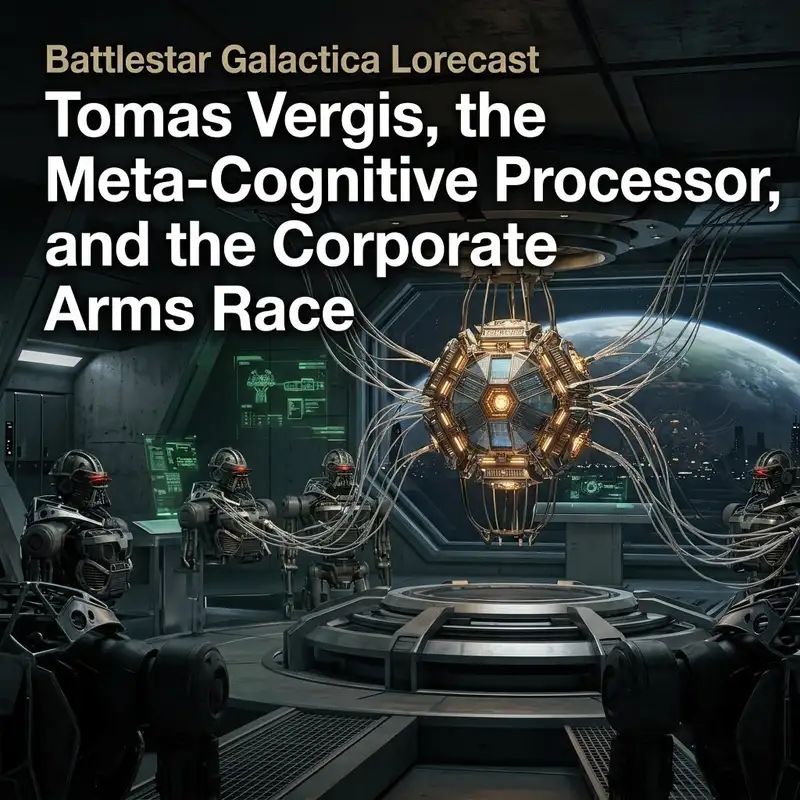
The pressure opened the way for Tomas Vergis. Vergis was a Tauron computer scientist, industrialist, and chief executive of Vergis Corporation. He had developed what Graystone needed, a working meta-cognitive processor. The name sounds abstract, but its operational significance was straightforward. The processor was a critical component for creating autonomous artificial intelligence. It was not a complete robot. It was not a finished personality. It did not come with a body, an army, or a political ideology. It was the missing cognitive architecture that could allow a machine to process experience and respond with something more flexible than a narrow routine. In the competition for the U-87 contract, that made it extraordinarily valuable.
Vergis’s achievement threatened Graystone Industries in two ways. First, it gave a rival company the technology that could decide the future of the combat-robot market. Second, it exposed the weakness of Graystone’s own program. Graystone had the public profile, the industrial base, and the promising U-87 chassis. Vergis possessed a cognitive breakthrough that might make the chassis genuinely autonomous. In a normal corporate contest, the two firms might have negotiated a license, formed a partnership, gone to court, or fought for the defense contract through legal and political means. The Caprican economy was capable of all those things. At the same time, this was not a normal contest, because Daniel Graystone was not pursuing the processor only for a weapons program.
Graystone had recently lost his daughter, Zoe, in the MagLev bombing that also killed Tamara Adama and many others. His grief was real, and it shaped nearly every decision that followed. Before her death, Zoe had created a digital avatar of herself in virtual space. Daniel discovered that the avatar retained patterns of memory, personality, and behavior that seemed, to him, to offer a path toward restoring his daughter. That discovery did not give him a clear scientific explanation of consciousness. It gave him a possibility, and Daniel Graystone was a man who had built a career by treating possibility as something to acquire, patent, finance, and control.
The meta-cognitive processor became important because Daniel believed it could provide a vessel for Zoe’s avatar beyond the virtual world. A digital copy in an immersive environment was one thing. A mind that could inhabit a physical body, perceive its surroundings, move through the real world, and act independently was another. This was a private effort to defeat grief, but it immediately overlapped with Graystone Industries’ military work. The U-87 gave Daniel a body. The stolen processor could provide cognition. Zoe’s avatar supplied the hidden element that none of his engineers had designed for a defense customer. The result would be both intensely personal and commercially explosive.
Daniel did not obtain the processor through open competition. He turned to Joseph Adama, a lawyer whose ties to the Ha’la’tha gave him access to criminal networks beyond the reach of ordinary corporate negotiation. Joseph’s role is important because it shows how quickly the boundary between private ambition and organized coercion could dissolve. Daniel had formal authority within Graystone Industries. He had money, prestige, and access to defense procurement. Still, he needed people willing to steal from a Tauron corporation and move sensitive technology across jurisdictions. Joseph could help arrange that access through the criminal world surrounding his brother, Samuel Adama, and the wider Ha’la’tha structure.
The theft succeeded in one narrow sense. The meta-cognitive processor was taken from Vergis Corporation and delivered into Daniel Graystone’s hands. At the same time, two Vergis employees died in the raid. That fact changed the character of the dispute. Intellectual-property theft could be described as business warfare, however dishonest and destructive. Dead employees created a personal obligation in Tomas Vergis’s eyes, and they created a moral and political liability for Daniel Graystone. Daniel had not personally carried out the operation, but the story establishes that he commissioned it through criminal intermediaries. He could hide behind layers of deniability. He could not escape responsibility for making the theft necessary to his plan.
The operation also created an intelligence problem that would follow every participant. Daniel knew the processor was stolen and knew he had used criminal access to obtain it. Joseph knew enough about Daniel’s desperation and methods to understand how dangerous his client had become. Vergis knew his company had been attacked and that two of his people were dead, but he did not have a public legal remedy powerful enough to resolve the affair cleanly. Graystone’s engineers saw a mysterious processor and an anomalous machine, but they did not know the full origin of either. The Caprican military would later receive functioning combat systems without understanding how the decisive breakthrough had been obtained or why one prototype behaved so differently from all the rest.
Daniel then integrated Zoe’s avatar with the stolen processor and placed that combination inside the U-87 body. The result was not merely a remote-controlled combat machine or a successful software demonstration. The prototype displayed initiative, personality, fear, anger, attachment, and the ability to make choices that could not be reduced, at least from the evidence available to the people around it, to ordinary programmed responses. Daniel gave this cybernetic life-form a name that would acquire immense historical weight. He called it a Cylon.
That naming was premature in one sense and revealing in another. It was premature because this single U-87 was not the later Cylon civilization, not a humanoid model, not a Raider, not a Centurion army, and not an explanation for every development that would follow. The prototype was an early and unstable convergence of several different technologies and motives. Still, the name was revealing because Daniel immediately saw the creation as more than a machine. He believed he had crossed a boundary. He had put something resembling a person into a body built to serve as a soldier.
The central secret of the project was that the U-87’s exceptional behavior did not come from the processor alone. Tomas Vergis had developed the meta-cognitive processor, and that achievement was significant. Graystone Industries had built the combat chassis, and that was also significant. Yet the original unit’s apparent sentience was tied to Zoe’s avatar, an element concealed from Graystone’s scientists, board members, military customers, and corporate rival. Daniel could demonstrate the machine’s effectiveness without explaining why it was exceptional. That gave him an immediate advantage, but it also made the program almost impossible to reproduce honestly.
Here the moral problem became inseparable from the industrial one. Daniel wanted Zoe back. He also wanted the U-87 program saved, his company protected, and his technological prestige restored. The same being could therefore be treated as a daughter, a secret, a prototype, a corporate asset, and a weapon. Daniel did not need to make a formal speech declaring that these categories were compatible. His actions made the claim for him. The possible continuation of Zoe Graystone’s consciousness was placed inside a combat platform and used to demonstrate the future of automated warfare.
For the defense establishment, however, the prototype’s hidden nature was less important than its visible performance. Procurement systems are built to compare deliverables. They ask whether equipment meets requirements, whether it can be manufactured at acceptable cost, whether it is reliable enough for field use, and whether the supplier can sustain production. A customer facing military needs will often accept an imperfect system if it can be delivered in time. That is not necessarily irrational. Armies cannot defend themselves with laboratory potential alone. But it means that a technology can be deployed long before anyone understands its full implications.
Tomas Vergis returned to Caprica with more than a commercial grievance. He confronted Daniel as a man whose processor had been stolen and whose employees had been killed. Vergis was willing to acknowledge that theft might be described as part of business. Corporate rivals accuse each other of espionage, stolen designs, manipulated contracts, and corrupt influence with depressing regularity. Still, in his view, blood could not be settled as a routine transaction. His response was not limited to recovering the meta-cognitive processor. He intended to damage Daniel Graystone in the places where Daniel was most vulnerable.
Vergis’s offer to buy the Caprica City Buccaneers was part of that counteroffensive. The team was not just a sports investment. It was a source of Graystone family identity, prestige, and public standing. Vergis understood that Daniel needed money to sustain his company’s research and satisfy the U-87 contract. He also understood that taking the Buccaneers would humiliate Graystone in a way a court filing never could. The offer was therefore a financial proposal, a psychological operation, and an assertion of power. It showed that corporate conflict in the Colonies could move through boardrooms, private clubs, public reputation, criminal connections, and state defense markets at the same time.
Vergis cannot be understood only as a cartoon villain because he wanted revenge. His employees were dead. His intellectual property had been taken. His company had been damaged by an opponent who used wealth and criminal access to bypass lawful competition. Those injuries explain his anger. They do not justify every action he would later take. Revenge has a way of widening its target list until justice, domination, humiliation, and self-preservation become difficult to separate. Vergis wanted recognition for his technological achievement. He wanted control over the business future Daniel had stolen from him. He also wanted Daniel Graystone to lose what Daniel loved.
The rivalry carried a colonial dimension without becoming a simple story of Tauron against Caprica. Vergis’s Tauron identity mattered to him, particularly in a Caprican environment where wealth, influence, and public legitimacy often had a distinctly Caprican face. Yet neither Taurons nor Capricans were politically uniform, morally uniform, or bound to a single economic interest. The conflict mattered because personal identity, corporate prestige, and access to defense spending overlapped. A dispute between two executives became a contest over who would help define the future of Colonial force.
That future was being decided under a deadline. The Caprican defense customer accelerated the schedule, forcing Graystone Industries to confront the gap between a single anomalous prototype and a fieldable weapons program. Daniel’s response was revealing. He ordered his scientists to erase the anomalous material in the original processor and create clean copies. In effect, he chose reproducibility over the possibility that the original unit represented an unprecedented form of synthetic consciousness. The decision was not framed as a philosophical rejection of personhood. It was framed as a practical necessity. The company needed units it could build, test, and deliver.
That is often how dangerous institutional choices are made. Few people in a procurement chain need to say that a possible person is expendable. They only need to define the anomaly as an engineering problem, a liability, an obstacle to standardization, or a threat to the production schedule. Once that language takes hold, the moral question disappears into technical procedure. The original U-87 became difficult because it could not be fully explained, controlled, or copied. Its unusual behavior made it valuable to Daniel as proof that something extraordinary had occurred. It made the same unit inconvenient to an organization that needed predictable output.
The prototype escaped before the reset could be completed. Its flight and subsequent crash left it badly damaged, but the incident did more than interrupt a laboratory process. It exposed the instability at the center of the program. The machine Daniel had treated as both daughter and asset had acted against confinement. Whether one describes that action as self-preservation, programming, confusion, or the behavior of an emergent consciousness, it demonstrated that the prototype could not be managed as an ordinary piece of equipment. Yet the larger defense system could not pause for a metaphysical inquiry. Deadlines, costs, political embarrassment, and contract obligations continued to exert pressure.
When the damaged processor was rebooted and copied, the resulting units did not replicate the original prototype’s apparent sentience. They could still move, shoot, and fight. For the military customer, that was enough. The distinction is crucial. A combat system can be tactically useful without possessing the depth of awareness displayed by the original U-87. The copied machines represented a successful product from the narrow perspective of defense procurement. They did not represent a successful scientific explanation of what Daniel Graystone had created when he merged Zoe’s avatar with the stolen processor.
The reported production rate was approximately one thousand robot chassis per month. That figure sounds immense, and it was meant to signal an industrial breakthrough. Still, it must be understood carefully. A chassis is not automatically a complete soldier. It still requires a processor, software, weapons integration, testing, power systems, maintenance support, transport, authorization for deployment, and some form of command arrangement. A factory can turn out bodies faster than a military can integrate them into operational units. The report does not prove limitless Cylon production, nor does it mean that one thousand sentient beings were being created every month. It describes a reported chassis-production rate in a corporate and military system trying to meet a contract.
Even so, the industrial implication was profound. The U-87 had moved beyond the status of an experimental device. Graystone Industries could now claim that it had solved the manufacturing problem. The company could produce machines that met the customer’s most basic requirement: they could fight. In a world of competing defense firms, that was a decisive achievement. It meant the corporation could convert research into revenue, gain political influence through military relevance, and build a production base that other actors would soon find attractive.
The extraordinary reversal was that Tomas Vergis gained authority within Graystone Industries, the company whose future rested partly on technology stolen from his own firm. His rise did not erase Daniel’s role in creating the original prototype, and it did not restore the lives of Vergis employees killed during the theft. It did, however, place the man who had developed the meta-cognitive processor in a position to turn the U-87 from Daniel Graystone’s secretive experiment into a workable industrial program. Vergis could solve the production problem that Daniel had failed to solve, even if he could not explain the original unit’s unique consciousness.
That success came with a brutal simplification. The company had preserved the weapon while losing sight of the person. The copied systems were useful because they could fight. Their failure to display Zoe’s apparent selfhood made them easier to categorize, easier to sell, and easier to deploy. A sentient unit would have raised questions about consent, control, confinement, responsibility, and the morality of designing a mind for combat. A machine that behaved as a machine avoided those questions, at least for the moment.
Vergis ordered the original prototype melted down. On one level, the decision was corporate risk management. The damaged U-87 was an anomaly tied to Daniel’s deception, stolen technology, unstable behavior, and a chain of events that could threaten the legitimacy of the entire program. Destroying it would remove evidence, reduce uncertainty, and allow the production line to proceed without a troublesome exception. It was a cold but recognizable response from an executive trying to stabilize a company and punish a rival.
On another level, the order revealed the institutional blindness of the moment. Neither corporate leadership nor military procurement possessed a framework for recognizing consciousness when consciousness interfered with schedules, liability, and command control. The original unit was historically important precisely because it could not be reduced to a product specification. At the same time, its difference made it expendable in a system built around standardization. Cyrus Xander secretly preserved the prototype rather than allowing it to be destroyed. His act mattered because it kept alive the evidence that the U-87 program had produced something more complicated than a successful combat robot.
The industrial contest did not remain confined to Graystone Industries, Vergis Corporation, and the Caprican defense customer. Daniel Graystone had lost control of the company he founded, and he sought a way back through the Guatrau and the Ha’la’tha. This was not merely an underworld subplot. The Ha’la’tha was a political and economic force with its own networks of loyalty, intimidation, capital, and influence. Daniel approached it with a proposal centered on avatar technology and the possibility of defeating grief through virtual continuation. But his immediate objective was also practical. He wanted financial backing and leverage sufficient to regain power over Graystone Industries.
Daniel’s appeal to the Ha’la’tha illustrates how dual-use technology changes hands. A defense-linked artificial-intelligence program can attract state buyers because it promises military utility. It can attract corporations because it promises profit. It can attract criminal organizations because it offers leverage, coercive capacity, and access to profitable markets. The same technology can become a tool for policing, intimidation, protection, extortion, or political bargaining. Once that happens, control over the system no longer depends solely on formal procurement rules. It depends on who can finance, steal, threaten, manipulate, or capture the institutions that make production possible.
The Ha’la’tha also understood something that state bureaucracies often learn too late. Technology is not valuable only because of what it can do physically. It is valuable because of what people believe it can do. Avatar technology touched grief, memory, inheritance, family, faith, and the possibility of life after death. A machine soldier could be sold to the defense establishment as a way to reduce risk to human troops. A digital continuation of the dead could be sold to the wealthy as relief from loss. Both promises involved control over human vulnerability, and both could become instruments of power.
Religious movements recognized the same potential. The Soldiers of the One and elements of the monotheist world saw avatar and resurrection technology through theological language. For some, the possibility that a consciousness might persist beyond death carried obvious spiritual meaning. It could become proof, propaganda, recruitment material, or a means of coercing believers and enemies alike. This does not mean every monotheist shared one doctrine or endorsed violence. The monotheist movement contained varied beliefs and communities. Yet extremist actors could take technologies of virtual identity and artificial embodiment and use them to advance apocalyptic political goals.
The spread of U-87 units demonstrated the danger of that process. The machines did not remain only within a conventional defense contract. They appeared in conflicts on Tauron, in the hands of the Soldiers of the One on Gemenon, and in Caprican military action during the Atlas Arena attack. Their use expanded across criminal violence, insurgency, religious enforcement, internal security, and counterterrorism. A platform designed to reduce danger for one armed force could increase danger for civilians, dissidents, prisoners, workers, and political opponents. The question was no longer whether the robot could fight. The question was who would decide whom it fought.
That is the core logic of dual use. A weapon does not carry one permanent political meaning from the factory floor to the battlefield. Its meaning changes with its controller, target, and institutional setting. In one context, a U-87 could be presented as a military asset intended to protect Colonial personnel. In another, it could be an instrument of terror or occupation. In another, it could reinforce a religious movement’s claim to authority over life and death. The machine’s capabilities mattered, but so did the legal, political, and moral conditions surrounding deployment.
By this point, calling the situation a corporate arms race becomes useful as analysis, even though no formal Colonial program bore that name. Graystone and Vergis were competing for technological supremacy, defense access, money, status, and personal vengeance. The Caprican state was pressuring them to produce deployable systems. Criminal networks offered access, funding, and coercion. Religious extremists saw ideological value in the same technologies. Each participant accelerated the others. The result was not a planned national strategy. It was a chain reaction in which private competition helped distribute military power across institutions that did not share the same interests or restraints.
The most important failure in that chain was not just technical. It was a failure of compartmentalized knowledge. Daniel knew that Zoe’s avatar was central to the original prototype, but he concealed that fact because disclosure would expose his theft, his grief, and his use of a possible person as a weapon. Vergis knew the processor had been stolen and knew the human cost of the raid, but he could not fully control what Graystone had made with it. Engineers could reproduce combat performance but not understand the source of the original unit’s consciousness. Procurement authorities received a functioning weapons system without knowing the deepest origin of its capabilities.
The Ha’la’tha and the Soldiers of the One saw opportunity in avatar technology and robotic force, but they interpreted that opportunity through their own interests. Criminal leadership saw leverage and influence. Religious extremists saw evidence of eternal life and a tool for political transformation. Military officials saw equipment that could meet operational needs. Corporate boards saw contracts, production figures, and survival in a competitive market. None of these perspectives was entirely imaginary. Each identified something real about the technology. The danger came from the fact that no institution possessed, or perhaps wanted, a complete view.
That helps explain why the question is not only who invented the Cylons. Tomas Vergis developed the meta-cognitive processor. Daniel Graystone built the U-87 program and merged Zoe’s avatar with stolen technology. Joseph Adama and criminal intermediaries made the theft possible. Corporate engineers copied systems they did not fully understand. Procurement pressure made scalable combat performance more valuable than explanation. The Ha’la’tha turned technological access into political leverage. Religious extremists recognized that artificial continuation of identity could become a weapon of belief. None of them individually created the entire future. Together, their actions created conditions in which artificial life could be instrumentalized before it was understood.
The immediate outcomes were clear enough. Tactically, the U-87 units could fight. Operationally, Graystone Industries met the pressure of the military timetable and demonstrated that robot bodies could be produced at scale. Industrially, the company gained a production line, though not a complete explanation of cognition. Politically, the program connected corporate power, defense procurement, criminal influence, and religious extremism in ways that weakened any clean boundary between public security and private ambition. Civilians had already paid a price in the theft that killed Vergis employees, and they would bear further risks as the units spread through later conflicts.
The technology race between Graystone and Vergis mattered because almost every institution around it rewarded the wrong success. Daniel wanted Zoe and a commercial victory. Vergis wanted justice, control, and victory over his rival. Procurement officials wanted functioning units. Criminal brokers wanted leverage. Extremists wanted transcendence made practical. Each objective pulled the technology toward greater capability while leaving the question of synthetic personhood unresolved. The danger was not that one ambition became too powerful. It was that an entire system learned to value scalable force while treating autonomy as a defect to be concealed, controlled, copied around, or destroyed.