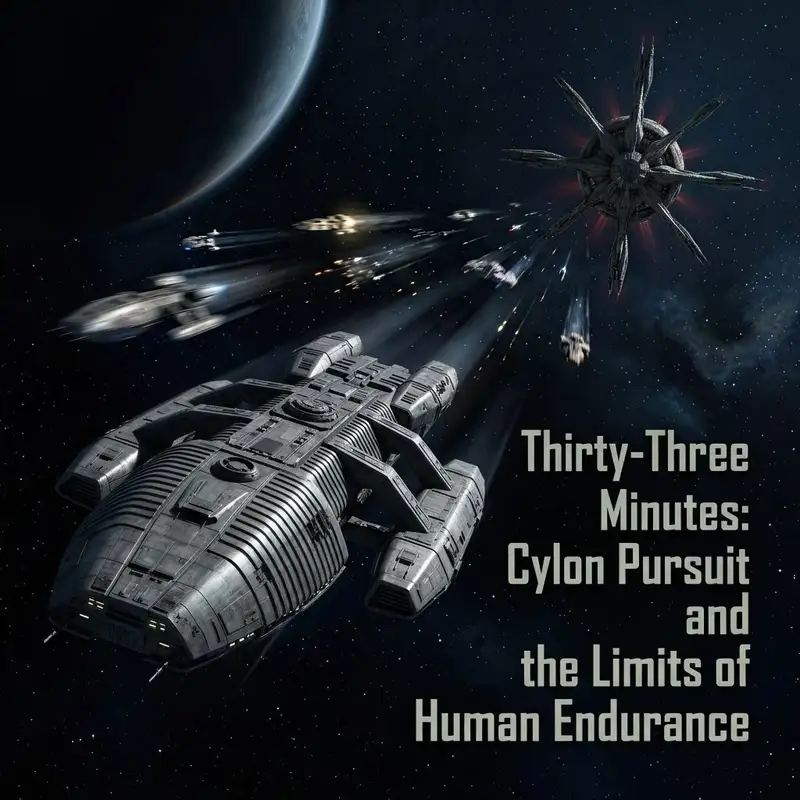
Thirty-Three Minutes: Cylon Pursuit and the Limits of Human Endurance
Jump two hundred thirty-seven was not a maneuver anyone would have chosen in peacetime. It was another emergency departure in a sequence already so long that the number itself had begun to lose meaning. Fifty-three surviving ships were trying to calculate, coordinate, and execute another faster-than-light jump. Some were ready. Some were not. Colonial One, carrying the civilian government, was among the vessels reporting trouble. Across Galactica, people who had been awake for days watched the same clock they had watched over and over again. Thirty-three minutes after each jump, the Cylons came back.
That interval was the weapon. The Raiders, Basestars, and nuclear weapons were real enough, but they were not the whole operational problem. The Cylons had imposed a tempo that denied the Colonial fleet every normal recovery cycle. There was no protected anchorage, no rear area, no night shift that could hand a problem to a rested day shift, and no safe opportunity to take a ship offline for repair. Every thirty-three minutes, the fleet had to decide where to go, prepare the jump, gather its ships, launch fighters, track the enemy, recover aircraft, check damage, and do it all again.
The immediate context was the first flight from the destruction of the Twelve Colonies. Galactica had escaped Ragnar Anchorage with a scattered civilian convoy and the remnants of an emergency government led by President Laura Roslin. The fleet had already survived the first catastrophe. That did not mean it had escaped the war. It had only moved from a strategic defeat into a pursuit campaign, and pursuit campaigns have their own brutal arithmetic. A force does not always have to be crushed in one battle. It can be exhausted until its machinery fails, its people lose judgment, or its leaders decide that some risk is too great to bear.
The Cylons appeared to understand that arithmetic. Their repeated contacts gave the Colonials too little time to rest but just enough time to keep moving. That is a particularly cruel form of pressure. An enemy who destroys you quickly gives you little time to think. An enemy who chases you without pause makes thinking itself unreliable. The fleet’s problem was no longer simply whether Galactica could defeat a Cylon attack. It was whether a refugee civilization could continue to make competent decisions after every member of that civilization had been denied sleep, certainty, and safety.
A faster-than-light jump sounds, in the abstract, like an escape button. In practice, it is an operational act. A ship needs a functioning drive, a calculated destination, a system capable of accepting the coordinates, and enough time to prepare for the jump. It also needs a destination that does not place it in a hazardous field, an atmosphere, a solid object, or directly into an enemy formation. One vessel can make a risky leap on limited information. A fleet of military and civilian ships must coordinate many such leaps at once.
Galactica could not just jump away and call the job done. It was the armed protector of a convoy, not an independent raider. Every civilian ship carried people, supplies, expertise, social institutions, and some fragment of the civilization that had been lost behind them. A passenger liner might contain families and medical personnel. A refinery ship might carry fuel-processing capability. Another vessel might hold technicians, agricultural workers, teachers, or the tools of civil government. The fleet could not know in every case precisely what skills would prove indispensable. That uncertainty was itself a reason not to discard ships casually.
The practical problem was that the fleet moved at the speed of its least reliable jump calculation. Military ships were designed for combat operations. Their crews trained around alert procedures, navigation, and command discipline. Civilian vessels had different missions, different maintenance histories, different equipment, and different levels of readiness. Some could prepare more slowly. Some had drives or jump-control systems already strained by repeated use. Each malfunction forced a choice. Wait for the damaged ship and expose the larger formation, or leave it behind and accept the likely loss of everyone aboard.
Repeated jumping also imposed a hidden maintenance burden. Drives had to function when ordered. Navigation teams had to calculate correctly. Engineering crews had to diagnose failures under pressure. Communications staff had to confirm which ships were present, which were delayed, and which had been lost. A ship that failed to jump did not just create a human tragedy. It disrupted the whole formation. Galactica might have to remain exposed longer, deploy more fighters, alter a destination, or choose between rescue and escape. In a pursuit campaign, a small technical delay can become a fleet-wide emergency.
The Colonial survivors had no industrial depth behind them. They could repair, improvise, cannibalize parts, and stretch equipment beyond the assumptions of prewar planners. They could not count on a secure shipyard network, an unlimited pool of trained technicians, or factories producing replacement drives and aircraft on demand. The Fall had not only destroyed cities and fleets. It had severed the system that made sustained military power possible. Every damaged component now mattered because it might be irreplaceable.
By the time the pursuit had reached its later jumps, the more immediate danger was no longer mechanical fatigue alone. It was human fatigue. The episode presents the fleet as having endured roughly one hundred thirty hours of continuous pressure. That is not merely a matter of people feeling tired. Sleep deprivation degrades reaction time, memory, concentration, emotional control, and the ability to recognize one’s own mistakes. A person who has been awake too long may feel certain while becoming less reliable. That combination is dangerous in any workplace. On a battlestar directing a refugee fleet, it can be fatal.
Colonel Saul Tigh had to help keep Galactica functioning as a command system while its staff degraded around him. In the Combat Information Center, Felix Gaeta and Anastasia Dualla faced a stream of navigation, tracking, communications, and status-report tasks that required accuracy even when their bodies were demanding sleep. A wrong contact report, missed transmission, or poorly timed order could strand a ship or expose the fleet. These were not glamorous jobs, but they were the connective tissue of survival.
The strain extended beyond the command deck. Chief Galen Tyrol and the deck crews had to keep Vipers available for launch and recovery. Mechanics and ordnance personnel worked around fuel, weapons, damaged airframes, and exhausted pilots. Medical staff had to watch for physical collapse while treating whatever injuries accumulated between jumps. Civilian leaders were expected to make political and legal decisions at the same time they were trying to remain awake. Even the survivor count became a burden. Someone had to know who was still present, who was missing, and which losses could no longer be denied.
The Cylons did not need to know the name of every exhausted technician or pilot to exploit that weakness. They only needed to keep the fleet under pressure. The regularity of the attacks made the pressure worse. Thirty-three minutes was long enough to create a false sense that the next jump might provide relief. Then the countdown returned. It was short enough that no one could settle into genuine rest. The fleet was caught between alarm and anticipation, unable to sleep because the next attack was always close and unable to relax because the last attack had never really ended.
Carrier aviation made that strain visible. Galactica’s Vipers were not symbols of individual heroism, however impressive their pilots could be. They were fleet-defense assets. Their job was to launch on alert, intercept Raiders, identify threats, screen civilian ships, escort vulnerable craft, and delay enemy forces long enough for the convoy to complete another jump. A Viper could not create safety by itself. It could only create time, and time was the commodity the fleet lacked.
Captain Lee Adama, serving as commander of the Colonial Air Group, occupied the point where fleet-level necessity became tactical action. Commander Adama could order the fleet defended. Colonel Tigh could keep the ship at readiness. But Lee had to translate those orders into missions flown by specific people in specific Vipers. He had to decide who could launch, who could remain alert, and how much exhaustion could be accepted before a pilot became more danger than asset.
Kara Thrace made the problem personal. She was one of Galactica’s most capable Viper pilots, but competence does not exempt anyone from physiology. She resisted the use of stimulants, and her reluctance mattered. Stimulants can temporarily sharpen alertness or delay the sensation of fatigue. They do not restore sleep. They do not undo slowed judgment, accumulated stress, or the emotional distortion of operating at the edge of endurance. In a real emergency, commanders may accept such measures because the alternative appears worse. That does not make the measure harmless or sustainable.
Thrace eventually accepts the stimulant because the fleet needs pilots in the air. The scene is not a celebration of toughness. It is an indicator of institutional distress. A force that must chemically extend its pilots is admitting that its operating tempo has exceeded healthy limits. The drug may buy a little time. It cannot repair the system that has run out of time. In this campaign, the Vipers could keep the Cylons from immediate contact. They could not give the people below a chance to recover.
The recurring pursuit also created an intelligence crisis. The Colonials knew one fact with terrible clarity: the Cylons kept finding them. They did not know how. The mechanism might have involved navigation data, communications, compromised systems, an infiltrator, a signal, or some other capability beyond their understanding. The pattern was too regular to dismiss as chance, yet the fleet lacked the evidence to identify a single cause. This was not ignorance in the simple sense of having no information. It was uncertainty under pressure, which is often harder to manage.
A commander prefers a threat he can name. A named threat can be measured, assigned to a team, and countered with a procedure. An unknown tracking method turns every system into a suspect. It makes every transmission potentially dangerous. It makes every returning ship questionable. It makes even a rescue attempt a possible avenue of attack. Once that suspicion takes hold, the fleet risks two opposite failures. It can become careless and accept a compromised asset. Or it can become so distrustful that it destroys the relationships and procedures necessary to survive.
Gaius Baltar raised the possibility that a communication from a returning ship could carry another form of electronic compromise. That warning was operationally plausible in a fleet already traumatized by the Cylon exploitation of Colonial systems during the Fall. Yet Baltar was not a neutral analyst. Doctor Amarak, a survivor associated with knowledge of the defense collapse, was aboard the missing Olympic Carrier. Baltar had personal reasons to fear what Amarak might say if he reached the fleet. His self-preservation colored his urgency.
The missing Olympic Carrier brought those dangers into focus. The ship had failed to make a jump with the rest of the fleet. Dualla reported that it carried one thousand three hundred forty-five people. In the rhythm of repeated emergency jumps, a ship can disappear almost accidentally. One moment it is on the roster. The next, the fleet has moved, the Cylons are approaching, and the remaining vessels must choose whether they can turn back. For those left behind, the distinction between mechanical failure and abandonment may matter less than the fact that help cannot arrive.
At that point, the Olympic Carrier was a civilian disaster, not yet a confirmed security threat. The fleet did not know whether the ship had been destroyed, captured, disabled, or merely stranded. The people aboard might have survived. They might not have. The available account leaves that uncertainty intact. That uncertainty matters because it prevents easy moral accounting. The Colonials were not deciding the fate of an empty hull. They were facing the possibility that more than thirteen hundred civilians had been left in the path of the enemy.
Elsewhere, on the ruined surface of Caprica, Karl Agathon faced a smaller and more isolated version of the same problem. Helo was injured, exposed to radiation, pursued by Centurions, and surviving through improvisation rather than a functioning support system. He used what weapons and materials he could find, but his position was not sustainable. Then he encountered figures who made the landscape even more uncertain: a Number Six copy and a Sharon Valerii copy. The fleet knew little of what had happened on Caprica. Helo knew even less. His story did not explain the pursuit in space. It reinforced the larger condition of the war: survival depended on acting with incomplete information while the identity of friend and enemy had become dangerously unstable.
The Olympic Carrier’s return initially looked like a break in the pattern. The fleet had experienced an unusual respite. The expected Cylon attack did not arrive on schedule. That absence created hope, but it also created a new question. Had the Cylons finally lost the fleet, or had something changed? In pursuit warfare, a sudden silence is not automatically safety. It may mean the enemy has failed. It may also mean the enemy is maneuvering, waiting, or approaching by another route.
Then the Olympic Carrier reappeared. Its crew reported that its faster-than-light drive had malfunctioned and that the Cylons had broken off rather than destroying the ship. In another circumstance, that account might have invited relief and an immediate rescue effort. The ship carried civilians. It also carried Doctor Amarak, whose information might help explain the failures that had led to the destruction of the Colonial defenses. For Roslin, Amarak represented potentially valuable testimony. For Baltar, he represented a threat. For Adama, the carrier represented an unknown vessel arriving at the exact moment the pursuit pattern had changed.
The timing did not prove that the ship was compromised. It did not prove the passengers were collaborators, captives, dead, or alive. It did not prove that the Cylons were tracking the fleet through its systems. But the timing made ordinary trust impossible. The Colonials had already learned that their enemy could exploit systems, appearances, and human assumptions. A civilian vessel that had been left behind, apparently spared, and now returned during a break in the pursuit could not just be welcomed into the center of the formation.
Galactica responded with isolation procedures. Communications were jammed. The Olympic Carrier was directed by signal light to hold its position. Vipers were assigned to ensure it did not approach the fleet. Those measures were not an accusation proven beyond doubt. They were containment. When commanders do not know whether an incoming platform is safe, the first task is to preserve distance. An unknown ship may be harmless. It may also carry compromised systems, hostile personnel, a tracking device, or weapons. Physical separation buys time to investigate. In this case, time remained scarce.
The decision to jam communications also reflected the cyber trauma of the Fall. Baltar’s concern about electronic compromise was not a full explanation of the Cylon pursuit. The episode does not establish that the Olympic Carrier was transmitting a virus or that the Cylons could seize any system at will. It establishes a more modest and more frightening reality. The fleet had reason to fear that contact itself might be dangerous. Under those conditions, a routine call for help could not be treated as routine.
The Olympic Carrier did not remain safely at a distance. It continued toward the fleet. That changed the character of the crisis. A civilian ship in distress is a rescue problem. A civilian ship ignoring isolation orders while approaching a vulnerable convoy becomes a fleet-defense problem. The distinction was painful because the same hull could fit both descriptions. The fleet had no way to conduct a calm inspection. It had no secure boarding opportunity. It had no hours to negotiate, investigate, or wait for confirmation.
Lee Adama and Kara Thrace launched in Vipers. Sharon Valerii supported the operation from a Raptor. Their mission was not to win a conventional battle against the Cylons. It was to identify the threat, signal the carrier, prevent it from reaching the civilian fleet, and preserve the larger formation’s ability to jump. This is what fighter defense often looks like in a convoy crisis. The decisive action may not be the destruction of enemy fighters. It may be the containment of one dangerous contact before that contact can reach the people behind the screen.
The pilots were operating under the same exhaustion as everyone else. They had flown repeated patrols and interceptions. Their aircraft had been launched and recovered through cycle after cycle of alarm. Yet they were now asked to confront a ship that was, at least by name and registry, part of the population they had sworn to protect. This is where operational language becomes morally inadequate. A tactical officer can say “intercept.” A commander can say “contain.” But the pilots understand that an interception may end with weapons fired at civilians.
The thirty-three-minute clock returned as the carrier approached. Cylon forces reappeared. The production account describes two Basestars and a large formation of fighters, enough to make clear that Galactica could not remain in place for a prolonged engagement. The exact tactical picture mattered less than the operational conclusion. The Colonial fighters could not defeat the entire pursuing force and then leisurely investigate the Olympic Carrier. Their purpose was to hold the line long enough for the fleet to escape. Every minute spent confronting the carrier was a minute in which the Cylons closed the distance.
The carrier’s return strongly implicated it in the renewed pursuit pattern, but implication is not explanation. The episode never gives the Colonials a complete technical account of how the Cylons had followed them or why the destruction of the carrier would end the chase. Perhaps the ship had been compromised. Perhaps it was carrying a tracking mechanism. Perhaps its behavior enabled the Cylons in some way the Colonials could not identify. What mattered to Adama and Roslin was not philosophical certainty. It was the convergence of risk. The ship had reappeared under suspicious circumstances, ignored instructions, approached the fleet, and coincided with the enemy’s return.
Then Galactica’s radiological alarm detected nuclear weapons aboard the Olympic Carrier. That warning changed the immediate decision environment. An approaching ship was no longer merely a potential intelligence or communications risk. It might be a weapon capable of devastating the concentrated civilian formation. The fleet did not need to know the weapon’s exact yield or delivery mechanism to understand the danger. Nuclear weapons in an unprotected convoy create a threat that cannot be managed by patience alone.
Even then, detection did not remove uncertainty. The presence of nuclear material did not reveal who controlled the ship, what had happened to the passengers, or whether any people aboard retained the ability to resist. The ship could have been a Cylon weapon. It could have been a compromised civilian vessel. It could have been a human crew operating under coercion or deception. The fleet did not have courtroom-level proof. It had a shrinking window, incoming Cylon forces, and a radiological warning that made allowing the carrier to close seem intolerable.
This was the point at which military necessity collided directly with civilian authority. President Roslin was not just another passenger whose opinion could be noted and set aside. She represented the surviving Colonial government. If a civilian ship carrying more than thirteen hundred people was to be destroyed, the decision carried political and moral consequences beyond Galactica’s chain of command. Roslin had to consider the meaning of authorizing the deaths of people her government was meant to protect.
Adama faced a different but equally severe responsibility. He commanded the battlestar, the Vipers, and the defensive operation. He had to assess the carrier not as a symbol of civilian innocence but as a possible weapon approaching a defenseless population. From his perspective, failing to act could mean the destruction of the entire fleet. That did not make the act clean. It made it a choice between risks whose consequences could not be fully known.
Roslin named the human reality of the decision. Destroying the carrier could mean killing civilians. Adama named the military reality. The carrier had become a threat that could not be allowed into the fleet. Neither position was frivolous. Neither resolved the other. Roslin’s caution was not weakness because she hesitated before authorizing mass death. Adama’s urgency was not cruelty because he understood the danger of an incoming nuclear platform. The tragedy was that both were reasoning within their proper responsibilities, and those responsibilities pointed toward an act neither could make morally comfortable.
The final burden moved downward. Adama could issue the order. Roslin could authorize it. But Lee Adama and Kara Thrace had to carry out the intercept. Sharon Valerii had to support the mission from the Raptor. In military operations, responsibility is distributed, but distribution is not evasion. The commander who gives an order remains responsible for it. The civilian leader who authorizes the act remains responsible for it. The pilot who fires the weapon remains responsible for his own action, even when he had no power to create the circumstances in which that action became necessary.
The Olympic Carrier was destroyed. The episode’s aired account preserves uncertainty about the condition of the passengers at that final moment. It does not allow the listener to turn the event into a confirmed rescue of hostages or a confirmed killing of living civilians. What is certain is the scale of the loss as the fleet understood it. A vessel carrying a reported population of one thousand three hundred forty-five people was gone. The tactical problem had been solved by destroying the thing that embodied it.
The immediate military result was clear. The potential nuclear threat was removed. The fleet could jump. The Cylon pursuit stopped, at least for the moment. Galactica had preserved the escape window that the carrier’s approach had endangered. As a mission of fleet defense, the operation succeeded. The pursuing force did not destroy the convoy. The civilian ships escaped another contact. The thirty-three-minute cycle, which had seemed endless, finally broke.
The emotional result was visible in the exchange between William and Lee Adama. The commander had given the order. His son had pulled the trigger. That division matters because it rejects two comforting lies. The first lie is that command responsibility disappears once the order reaches a subordinate. The second is that the person who fires a weapon is merely a machine without moral experience. William Adama could not honestly tell Lee that the burden belonged only to the pilot. Lee could not honestly tell himself that the burden belonged only to his father.
The fleet’s survivor count had to be revised. Numbers in a refugee crisis are never merely administrative. Each reported loss represents families, work crews, skills, memories, and political claims that will no longer be present. A population already reduced to a fraction of its former civilization could not lose more than thirteen hundred people without consequence. The loss affected labor capacity, medical care, technical knowledge, representation, and the simple human ability to believe that survival had a future.
Yet the episode does not allow the ledger to close only on death. A baby is born aboard Rising Star. The birth does not cancel the destruction of the Olympic Carrier. It does not provide sentimental balance, and it does not solve the fleet’s demographic crisis. Its importance lies elsewhere. It reminds the survivors that they are not only a convoy of damaged ships running from an enemy. They are a population still producing a future. A child requires food, medicine, shelter, education, security, and some expectation that law and community will endure.
That expectation was now harder to sustain. People in the fleet had watched their leaders authorize the destruction of a civilian vessel because it might be a Cylon weapon. Even if the decision was operationally justified under the available information, the precedent was terrible. Future commanders and politicians would have to live with the knowledge that emergency survival could demand acts once considered unthinkable. The question was not only whether the fleet could endure another Cylon attack. It was whether it could endure the moral residue of its own decisions.
The Cylons had pursued the Colonials with warships and fighters, but the deeper attack was directed at maintenance cycles, sleep, trust, judgment, and legitimacy. They forced Galactica to operate as a carrier, escort, rescue ship, intelligence center, and emergency government protector without time to perform any of those functions well. They forced civilian leaders to make military decisions and military officers to confront civilian catastrophe. They made every delayed ship a possible sacrifice and every unexpected return a possible trap.
That is why thirty-three minutes mattered more than its length on a clock. It was long enough to keep the fleet alive. It was short enough to make life unsustainable. The Colonials could evade a superior pursuer for a time by protecting their ability to jump, identifying likely threats, and accepting terrible risks when no clean alternative existed. They could not evade indefinitely on courage, skill, or stimulants alone. Eventually, ships needed repair, pilots needed sleep, and people needed reasons to trust the institutions ordering them forward.
The destruction of the Olympic Carrier may have been necessary given what Adama, Roslin, and the pilots knew at that moment. The evidence pointed toward an immediate and potentially catastrophic threat. But necessity did not make the loss painless, certain, or morally pure. It bought the fleet time at a price measured in human lives and in the further erosion of the world the survivors hoped to preserve.
The fleet survived the pursuit because it gained a pause. That pause did not mean exhaustion had ended. It meant the survivors had enough room to recognize what was actually at stake. Keeping ships in motion was essential, but it was not the final purpose of the journey. Survival meant preserving people, judgment, law, memory, and the fragile institutions that could still make those ships more than a fleeing convoy.