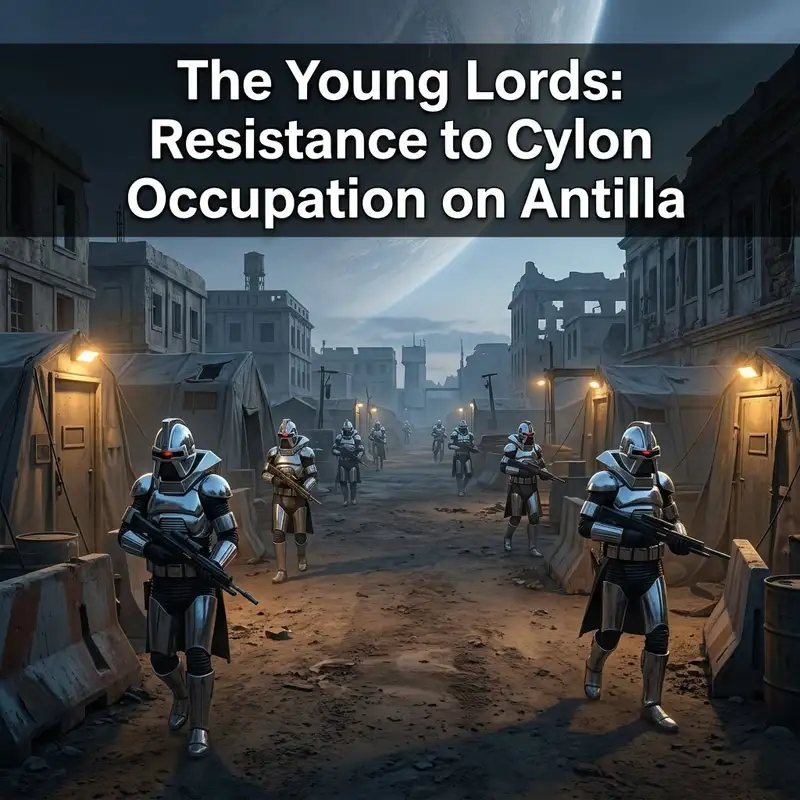
The Young Lords: Resistance to Cylon Occupation on Antilla
Starbuck’s Viper came down hard in swamp country after a Cylon patrol turned an ordinary reconnaissance flight into a survival problem. He and Boomer had been operating in the Omega sector, far enough from the Galactica that a damaged fighter could become more than a maintenance loss. It could become a missing pilot, a compromised patrol route, and a reason for the fleet to linger where it did not want to be found. Starbuck survived the descent, but survival on the ground did not improve his position. Centurions were already hunting through unfamiliar terrain. He had no secure link to the Galactica, no friendly base, and no reason to assume that the people of the planet would be able to help him.
The people who did help were children. They emerged from concealment, struck the pursuing Centurions, and pulled Starbuck out of immediate danger. That rescue establishes the real military fact of this story. The Colonial pilot has not arrived to create resistance on an occupied world. He has stumbled into a resistance that already exists. It is small, young, improvised, and carrying burdens no children should carry. But it has scouts, hiding places, local intelligence, signals, a command relationship, and a reason to keep fighting.
The supplied title calls this world Antilla. The aired nineteen seventy-eight Battlestar Galactica episode identifies it in dialogue as Attila, a remote planet near the edge of the Omega sector. Robert Thurston’s later novelization uses Antila, while some episode listings use Trillion. Those names belong to different source traditions and reference habits, not to one settled geography that can be quietly combined. For the television story, Attila is the relevant name. Antila belongs to the literary expansion. What matters is not the spelling. It is the condition of the settlement: isolated, damaged, and held under pressure by a Cylon garrison.
The children’s account of that pressure is concise and severe. Their settlement has been destroyed. Their mother has been killed. Adult defenders have been killed or captured. Their father, Megan, is a prisoner in the Cylon-held castle that had once been their home. The episode does not provide a complete history of the planet, a map of its population, or the bureaucratic machinery of a large occupation government. It shows something narrower and more immediate. A Cylon force has taken a settlement, imprisoned one of its adult leaders, and used violence to break local resistance. The surviving children have refused to disappear.
Kyle is the practical commander of that refusal. His authority is not formal Colonial military rank. There is no surviving headquarters handing him orders, no orderly chain of command, and no professional staff to convert plans into operations. His authority comes from competence, necessity, and the willingness of the others to follow him. He assigns tasks, understands patrol patterns, judges risk, and speaks in the language of a commander because someone has to make decisions. In an emergency, practical authority often arrives before legal authority can be restored.
Miri performs a different but equally necessary role. She helps treat injuries, maintains family life, and teaches the younger children. That schooling is easy to overlook because the episode also contains ambushes, prisoners, and Cylon patrols. Yet it may be the clearest sign of what the resistance is defending. A community that continues to teach its children is more than waiting to be evacuated. It is preserving memory, habits, and a future social order. The lessons say that the settlement expects a life beyond the next raid. Education becomes an act of defiance because occupation has not reduced the survivors to fugitives alone.
That does not make the children’s situation charming or harmless. It is a tragedy. They have learned skills that adults usually try to keep from children because the adults who should have protected them are gone, imprisoned, or dead. Their competence should not be romanticized as proof that war is good for the young. It is evidence that war has entered every part of their lives. Kyle’s patrols, Miri’s medical care, the younger children’s discipline, and the settlement’s hidden routines are all adaptations to a condition that should never have become normal.
Before Starbuck appears, the resistance has already developed a sensible irregular campaign. The children attack Cylon patrols when conditions favor them. They raid ammunition stores and fuel dumps. They avoid standing in the open against superior weapons and armored Centurions. Their purpose is not to seize ground through a conventional battle. They cannot do that. Their purpose is to make the garrison spend effort protecting itself, to deny it confidence beyond the castle walls, and to keep it from treating the surrounding countryside as fully controlled.
This is guerrilla warfare at its most basic level. A weak local force survives by refusing the enemy’s preferred terms of engagement. The Cylons possess firepower, transport, and a fortified position. The children possess concealment, mobility over familiar ground, and the ability to decide when contact occurs. They know the swamp paths, the approaches to the bridge, the old passages in their own castle, and the places where a patrol can be watched before it sees anyone watching it. Their intelligence is local, persistent, and difficult for an outside garrison to duplicate.
The attacks on fuel and ammunition matter because they reach beyond simple harassment. A patrol can be replaced more easily than a secure supply arrangement. Every successful raid forces Specter, the Cylon commander, to devote more attention to guarding stockpiles, moving stores, and responding to alarms. Every diversion creates uncertainty about where the resistance will strike next. The children do not need to destroy the garrison in a single blow. They need to impose enough friction that the Cylon presence becomes costly, inconvenient, and vulnerable to a larger mistake.
Their campaign also rests on a social advantage. They are defending parents, siblings, a home, and a way of life they remember. The Cylons occupy a position. The children inhabit a place. That distinction can be militarily important. An isolated garrison may hold a building and still lack the local relationships needed to control the country around it. The castle gives Specter walls and weapons. It does not give him the settlement’s memory of every passage, trail, family connection, and hiding place.
Starbuck recognizes the children’s skill because he is himself trying to survive under conditions that have stripped away his usual advantages. In a Viper, he has speed, weapons, training, and a fleet behind him. In the swamp, he has none of those things in reliable form. The children’s ambush proves that the terrain cannot be reduced to a hazard. It is a weapon, if someone knows how to use it. Starbuck brings professional military experience, but the local resistance brings the intelligence without which that experience would have little value.
Back on the Galactica, the problem looks different. Commander Adama is ill, and the fleet cannot afford to turn a missing-pilot search into an open-ended planetary operation. Apollo argues for a small rescue mission, not a large squadron or a conspicuous assault force. That choice is not indifference toward Starbuck. It is fleet discipline. The Galactica is responsible for more than one downed pilot. It is responsible for a refugee convoy still being pursued by the Cylons and still moving toward an uncertain future.
A large deployment might reveal too much, attract Cylon attention, or force the Galactica to remain in one area longer than is safe. Apollo and Boomer therefore operate under a narrow mission: find Starbuck, recover him if possible, and return to the fleet. Adama warns them that they have limited time before they risk losing contact. The episode expresses that limit in centars, without offering a useful modern conversion, and the precise measurement matters less than the operational reality. The Galactica cannot wait indefinitely. Local survival and fleet survival are running on different clocks.
That limitation gives the Attila resistance a problem that military rescue alone cannot solve. Apollo may be able to remove Starbuck. He cannot promise a sustained campaign to free Megan, rebuild the settlement, or hunt down every Cylon who remains on the planet. The children need more than extraction. They need a way to recover their father and break the immediate hold of the garrison before the only outside help disappears back into space.
The Cylon side of the conflict is represented by Specter, the older I L-series commander supervising the local force. Specter has a straightforward assignment. Maintain control, suppress resistance, and exploit the arrival of a Colonial pilot for intelligence. Starbuck is valuable not just as a prisoner but as a possible source of the Galactica’s position. Baltar, receiving reports from a distance, sees that opportunity clearly. A captured Viper pilot might reveal information that could matter far beyond one remote settlement.
Specter’s problem is that the local situation is not as stable as he wants Baltar to believe. The resistance has damaged supplies, disrupted patrols, and created an environment in which the garrison must constantly react. Instead of reporting that weakness honestly, Specter delays. He tells Baltar that Starbuck is being medically stabilized before interrogation. The claim buys time, preserves Specter’s appearance of control, and postpones the moment when Baltar might ask why a single downed pilot has become such a complication.
Lucifer, Baltar’s adviser, notices reasons for suspicion. Specter’s reports and requests do not fit comfortably together. That detail is useful because it prevents the Cylon command structure from becoming a single, flawless machine. Superior weapons do not guarantee superior administration. A commander far from the theater receives filtered information. A subordinate has incentives to conceal failure. An adviser can identify warning signs and still fail to force timely correction. The garrison’s weaknesses are not proof that every Cylon is foolish. They are proof that hierarchy, self-protection, and distance can degrade any command system.
Specter also confronts a difficult operating environment. The climate is hard on his force, and the surrounding terrain gives the children more opportunity to hide and move than it gives the Cylons a clean field of fire. He can occupy the castle, but he cannot make the resistance vanish. Like many isolated garrison commanders, he faces a choice between dispersing his forces to protect vulnerable points and concentrating them around the position that symbolizes his control. Neither option is comfortable. Dispersal creates targets. Concentration leaves the countryside to the enemy.
The prisoner exchange emerges from that imbalance. Kyle proposes trading Starbuck for Megan. From Kyle’s perspective, the logic is painful but understandable. The resistance has a captive of value, however temporary. Megan is their father, an adult leader, and a prisoner the Cylons are using as leverage. Starbuck is an outsider, even if he is a Colonial pilot and a potential ally. In a community with very few people left, every life becomes part of a calculation that no one wants to make.
Miri objects because the calculation is not just tactical. To exchange Starbuck for Megan is to treat one human being as bargaining material. Her objection identifies the moral wound created by occupation. A resistance may be fighting for freedom while still being forced into choices that compromise its own standards. Kyle is not presented as cruel. He is trying to recover his father and preserve the group with the leverage available to him. Miri is not naïve. She understands that a bargain made under coercion can change what a community is willing to do to survive.
Starbuck refuses the exchange for his own reasons. He will not accept another human being traded for his life. That refusal matters because it prevents the plan from becoming a clean solution. Even if Specter honored the deal, the Cylons would retain their power to seize another hostage, impose another demand, or retaliate against the children. An exchange might rescue Megan, but it would leave the system of coercion intact. It would also tell Specter that family loyalty could be used repeatedly against the settlement.
Specter understands that leverage very well. He pressures Megan to promise that the resistance attacks will stop, and he threatens the children if Megan refuses to cooperate. The threat is not sophisticated military strategy. It is coercion aimed directly at family obligation. An occupier who cannot secure the surrounding territory may attempt to control it through hostages, fear, and the hope that parents will surrender what fighters will not. The episode does not dwell on legal terminology, but the conduct is clear. Specter is using civilians, prisoners, and family ties as instruments of control.
That helps explain why the exchange plan cannot offer a durable answer. It addresses one captive but not the garrison’s ability to seize captives. It treats the immediate crisis but not the operational structure that created it. The children need an alternative that restores initiative. Starbuck’s value lies in helping them see how their earlier raids, secret knowledge, and scattered capabilities can become one coordinated operation rather than a sequence of desperate reactions.
The key intelligence concerns the castle and the supplies around it. Kyle explains that the Cylons have moved their petro, their fuel supply, closer to the castle because repeated raids have made the old arrangement unsafe. This is a revealing adaptation. The children’s campaign has pressured Specter into centralizing a critical resource. Centralization makes guard duty easier in one sense. It also creates a more concentrated vulnerability. A fuel dump near the heart of the garrison can become a source of disruption far more serious than an isolated store beyond the walls.
Kyle estimates that roughly two or three score Centurions are normally present in the main hall. It is an approximate local assessment, not a verified order of battle. The episode does not justify precise counts, casualty totals, or technical calculations. But the estimate gives Starbuck the right conclusion. The resistance cannot storm the castle. Even a damaged garrison contains too much concentrated firepower for that. The operation must separate, distract, and confuse the Centurions, not defeat them in a formal engagement.
The children have already supplied most of the necessary pieces. They know a secret passage into the castle. They understand the bridge approaches and the ground around the moat. They can move mounted riders through country where Cylon patrols are more predictable. They have practiced signals, including the horn Kyle uses to draw attention and coordinate movement. They know where the petro is stored and which garrison habits have formed in response to their earlier attacks. Starbuck does not invent these assets. He recognizes how to synchronize them.
That distinction is central to the episode. Professional military knowledge often consists less of possessing secret tricks than of organizing available means around a clear objective. Starbuck helps turn local information into a plan with phases. The objective is not to capture every Centurion or hold the castle forever. It is to create enough confusion to get inside, free Megan, and give the garrison reason to abandon its position. That is a limited objective, suited to the force available.
The operation begins with deception and diversion. Kyle’s mounted movement and horn signals draw Centurions outward. The sound is simple, but it functions as command and control. In a setting where the resistance has no secure electronic network, a horn signal is difficult to intercept, difficult to jam, and easy for people who have rehearsed it to understand. It does not provide perfect coordination. Nothing does under combat conditions. But it gives the children a resilient method of signaling across terrain they know.
Other children strike at the petro dump. The purpose is not just destruction for its own sake. Fuel is the garrison’s mobility and a visible source of alarm. An attack there forces Cylon attention inward, toward the castle and the stores it is trying to protect. Another action disrupts the bridge area, complicating movement and multiplying uncertainty. Every small attack makes it harder for Specter to decide where the main threat is, where Starbuck might be, and whether the resistance is attempting escape, rescue, sabotage, or all three.
While the garrison reacts, Starbuck and Miri use the secret passage. Their movement through the old castle is possible because it was once the settlement’s home. Occupation has captured the visible structure but not erased the knowledge accumulated by those who lived there. That is one of the oldest weaknesses of an occupying force. Buildings have histories. Walls contain routes, routines, and memories that may be invisible to a new garrison until someone uses them under pressure.
The plan does not depend on the children being stronger than the Centurions. It depends on the Cylons being unable to be strong in every place at once. A patrol sent toward Kyle cannot guard the petro. Centurions responding to the bridge cannot immediately reinforce the main hall. Guards distracted by alarms may overlook a hidden route. The attackers use time and attention as weapons. They force the garrison to divide itself, then exploit the gaps created by that division.
This is also why the attack remains risky. Small irregular forces can create confusion, but confusion cuts both ways. The children are operating around fuel, heavy weapons, and a fortified enemy position. They have no reserve battalion waiting beyond the ridge, no medical evacuation chain, and no guarantee that a diversion will remain a diversion. If the Cylons identify the real objective too early, Starbuck and Miri may be trapped inside the castle. Their success depends on discipline, timing, and the accumulated knowledge gained through earlier survival raids.
The operation achieves its immediate purpose. Starbuck and Miri reach Megan, and the resistance regains the adult prisoner whom Specter had used as leverage. Yet the military result is larger than one rescue. The garrison’s confidence has been shattered. It has been attacked at its supplies, distracted in its movement, penetrated through its own stronghold, and deprived of a hostage. The children have demonstrated that the castle is not secure simply because Centurions occupy it.
At the same time, Specter is protecting himself at the command level. He reports to Baltar that Starbuck is dead. He explains the devastation around the settlement as the result of a deliberate human scorched-planet policy rather than an active local resistance that has repeatedly disrupted his force. The report is false, but it is useful falsehood. It turns Specter’s loss of control into evidence that humans have destroyed their own position. It converts embarrassment into a story Baltar can accept from far away.
Baltar does accept it. He authorizes Specter’s withdrawal, in part because the environment is damaging the garrison. The decision is important because it clarifies what the resistance has actually accomplished. The children do not annihilate a superior Cylon force in open battle. They help make continued occupation appear more expensive, more confusing, and less rewarding than withdrawal. Specter’s deception completes the process. The local military setback becomes an administrative reason to leave.
That outcome illustrates a recurring truth about small wars. A resistance does not always need to destroy the enemy to win a local objective. It may only need to deny the enemy a credible claim of control. If patrols are unsafe, supplies are vulnerable, prisoners cannot be held securely, intelligence is unreliable, and reports upward are shaped by self-protection, then the garrison’s material superiority can become politically hollow. It still has weapons. It may even retain enough force to punish civilians. But it no longer has a stable basis for staying.
The surviving Centurions retreat toward their transport. Apollo and Boomer arrive after the decisive action, finding the garrison abandoned rather than encountering a battle they can claim as their own. Their arrival reinforces the distinction between rescue and liberation. The Galactica’s people have done what their mission allowed. They located Starbuck and reached the planet. But the local resistance had already created the conditions that made liberation possible.
Starbuck’s gift of his collar insignia to Kyle is therefore symbolic rather than bureaucratic. It is not a Colonial Fleet commission. Kyle has not become a professional Colonial Warrior, and the children have not become a regular military unit. The insignia recognizes leadership under extraordinary conditions. Starbuck sees that Kyle has carried responsibility, made difficult decisions, and directed others through danger. The gesture honors competence without pretending that the burdens imposed on the children are normal or desirable.
Megan’s decision to remain on Attila gives the ending its political weight. He does not treat evacuation to the Galactica as the only definition of safety. The settlement’s people have fought to make the planet their home, and they intend to rebuild and remain ready if the Cylons return. That choice is not irrational confidence that danger has vanished. It is a claim of self-determination. A homeland is more than a place from which civilians are extracted when conditions become dangerous. It is a community that may choose restoration even after violence has tried to uproot it.
The decision also acknowledges that the Galactica cannot become the permanent answer to every isolated human crisis. The battlestar protects a refugee fleet, but it cannot gather every survivor of the Cylon war into one convoy without limit. Its fuel, time, secrecy, and responsibilities are finite. The people of Attila choose to accept the risks of staying because departure would mean surrendering the local society they have preserved at such cost. Their resistance is not only against Cylon weapons. It is against the erasure of their home.
Robert Thurston’s nineteen eighty novelization, The Young Warriors, approaches the same premise through a separate literary branch. It adapts the television episode but should not be treated as a transcript that corrects or completes the aired story. The novel calls the planet Antila, which helps explain the supplied title. It also changes and expands major elements. Its settlers are pacifist exiles from militaristic Scorpia. The resistance includes twenty-seven children. Megan is the mother rather than the father. Telepathic unicorns become part of the local setting, and native disease weakens the Cylon garrison.
The novel also describes several Centurions as robots built by Specter. Those details belong to Thurston’s literary interpretation. They do not establish the history, ecology, Cylon construction, or family structure of the television Attila. The differences matter because they change the story’s emphasis. The aired episode is a compact study of local resistance under occupation. The novel turns that premise into a more elaborate fable about pacifism, childhood, unusual alien ecology, and a distinctive culture shaped by exile.
Neither version needs to be forced into the other. The television account is stronger as an operational lesson in irregular warfare because it focuses on the practical relationship between a small resistance and an isolated garrison. The literary version asks additional questions about a pacifist community confronted by violence and about the exceptional qualities of the world itself. Both retain the core image of children defending a home under Cylon pressure, but they reach that image through different continuities and different assumptions.
The television story answers its central question without pretending that courage alone defeats superior force. The children resist because they preserve the capabilities that occupation has not managed to destroy. They retain local intelligence. They maintain concealment. They establish enough discipline to act together. They use signals that fit their environment. They strike supplies rather than armored strength. They keep teaching, caring for one another, and treating family authority as something worth recovering. Those are not dramatic ornaments around the fighting. They are the foundation of the resistance.
Starbuck contributes something essential, but it is specific. He sees how to turn scattered survival skills into a coordinated operation. He identifies the importance of the centralized petro supply, recognizes that the castle cannot be taken by assault, and helps organize deception, diversion, infiltration, and rescue around a limited objective. His professional judgment gives the resistance structure at the moment it needs it. But without the children’s knowledge of the terrain, their secret passage, their established signals, and their willingness to act, he would have been only one stranded pilot in hostile country.
The tactical outcome is the freeing of Megan and the disruption of the castle garrison. The operational outcome is more significant. Repeated attacks on supplies, combined with a synchronized rescue operation, make Specter’s position difficult to sustain. His false report to Baltar turns the garrison’s confusion into a withdrawal order. For the larger campaign, Attila remains outside immediate Cylon control and avoids being absorbed into the Galactica’s already burdened refugee population.
The political and civilian result is the deepest one. The settlement retains its right to decide what survival means. Miri’s teaching, Kyle’s leadership, Megan’s return, and the choice to rebuild all show that resistance has preserved more than lives. It has preserved a civic identity. The children have not won because war has made them into miniature soldiers. They have won because they have held onto enough community, memory, and local will to make restoration possible.