The Twelve Colonies: Geography, Identity, and Strategic Rivalry
The worlds were gone, but their constituencies were not. In the refugee fleet, hunted by Cylons and held together by a few military ships and dozens of civilian vessels, survivors still gathered to rebuild a Quorum of Twelve. The immediate dispute was over Sagittaron and whether Tom Zarek, a convicted political prisoner with a violent past, could claim to speak for it. That argument might seem strangely formal beside starvation, flight operations, and the possibility of another Cylon attack. It was not. A representative body decides who belongs, whose grievances count, and whether survival will be governed by force alone. The Colonies had been reduced to survivors, memories, and ship manifests. Yet people still carried the political identities of worlds that no longer existed.
That was the central paradox of the Twelve Colonies. They had formed one civilization, with shared institutions, a common military, commercial ties, religious memory, and enough mutual confidence to describe an attack on one world as an attack on all. Still, they had never become culturally uniform or politically simple. Each colony remained a place of inherited loyalties, rivalries, assumptions, and complaints. The destruction of the planets did not erase those differences. It concentrated them aboard the fleet.
To understand why Sagittaron still mattered after Sagittaron itself had been destroyed, it is necessary to go back before the Fall, before the battlestars became the armed shield of a refugee population, and before the word colony came to mean a lost home. The Twelve Colonies were not merely locations on a navigation plot. They were the political architecture, social memory, and strategic foundation of the civilization that the Cylons nearly destroyed.
Colonial tradition placed humanity’s remembered origin on Kobol. The surviving religious and archaeological record did not provide a clean modern history of migration, nor does the story establish a precise route by which every settlement was founded. What it did preserve was a powerful account of descent. The peoples of the Colonies understood themselves as inheritors of twelve tribes associated with Kobol, and the symbols connected to those tribes remained recognizable in the later Colonial world.
The connection became especially important when survivors reached the Tomb of Athena on Kobol. The symbols there linked the ancient tribes to the twelve Colonial societies known in the modern era. For the people who interpreted them, geography was never only geography. A colony was a world, certainly, but it was also a descendant community. It carried a name, a sacred inheritance, and a claim to participation in a civilization older than any living government.
This shared origin gave the Colonies a language of belonging. It did not prove that they had always been politically harmonious. Ancient ancestry can unite communities, but it can also become a source of rivalry over who best preserves the inheritance. The Colonies appear to have shared religious traditions and historical reference points without sharing a single culture, class structure, or political outlook. Their common story was real. So were the arguments over what that story required in practice.
The Articles of Colonization attempted to turn that shared story into a political order. By the time of the refugee fleet’s first effort to reconstitute the Quorum, the Articles were remembered as more than half a century old. They served as the constitutional foundation for a common Colonial government, a President, a Quorum representing the Colonies, and institutions that could operate across planetary boundaries. They made it possible to speak of a Colonial state rather than merely a collection of neighboring worlds.
The exact division of authority remains incomplete in the surviving record. The Colonies were not presented as twelve provinces administered from one unquestioned capital, nor as entirely independent states that happened to cooperate when convenient. The arrangement had features that resemble both a federation and a confederation, but forcing it into a modern category obscures more than it explains. What matters is that Colonial identity remained politically meaningful even within the common government.
The President possessed civilian authority. The Quorum represented colonial constituencies. Local authorities, professional institutions, corporations, religious communities, and military commands also retained practical influence. That structure gave the Colonies a way to negotiate common interests without demanding that every world become the same. It also created opportunities for delay, grievance, and competition. A system built to include many constituencies must accept that those constituencies will disagree.
This was not an institutional flaw in itself. Political pluralism can be cumbersome because it is designed to prevent the fastest and strongest actor from deciding everything. Yet it imposes costs. A divided legislature may struggle to reach consensus. A President may have legal authority but lack local trust. Wealthier or more connected regions may acquire influence beyond their formal representation. Communities that believe they are ignored may treat the common government as someone else’s project.
The strategic benefit of unity was substantial. Twelve worlds could coordinate defense, transport, trade, public institutions, and military procurement. A shared political framework made mutual defense more than a temporary alliance. It allowed the Colonial Fleet to serve a civilization-wide purpose. It created a system in which a threat to Picon, Caprica, Tauron, or any other colony could be understood as a threat to the whole Commonwealth.
But the very need for the Articles revealed the basic fact of Colonial life. These communities were geographically dispersed. They did not share one continent, one capital city, or one immediate frontier. Their political relationship depended on travel, communications, common standards, and the confidence that distant institutions would respond when needed. The Twelve Colonies were connected by faster-than-light travel and by the systems built around it. They were not connected by magic.
A multi-world civilization faces ordinary political problems at unusual scale. Government officials must travel or communicate across distances that make personal familiarity difficult. Commerce depends on reliable transport and shared legal expectations. Military forces must identify threats, coordinate deployments, move supplies, and maintain common procedures. Civilian life depends on the less dramatic parts of that system: schedules, maintenance, trained labor, records, education, medical care, fuel, and the ability to trust that a message sent from one world will reach another.
The pre-Fall record does not give a complete authoritative map of all twelve worlds. It does not establish exact distances, travel times, population totals, or a universal pattern of planetary development. Detailed maps may exist in later reference traditions, but they should not be mistaken for the full historical record of the screen continuity. What the evidence does show is a civilization in which some worlds and regional systems were more visible than others, and in which proximity did not erase difference.
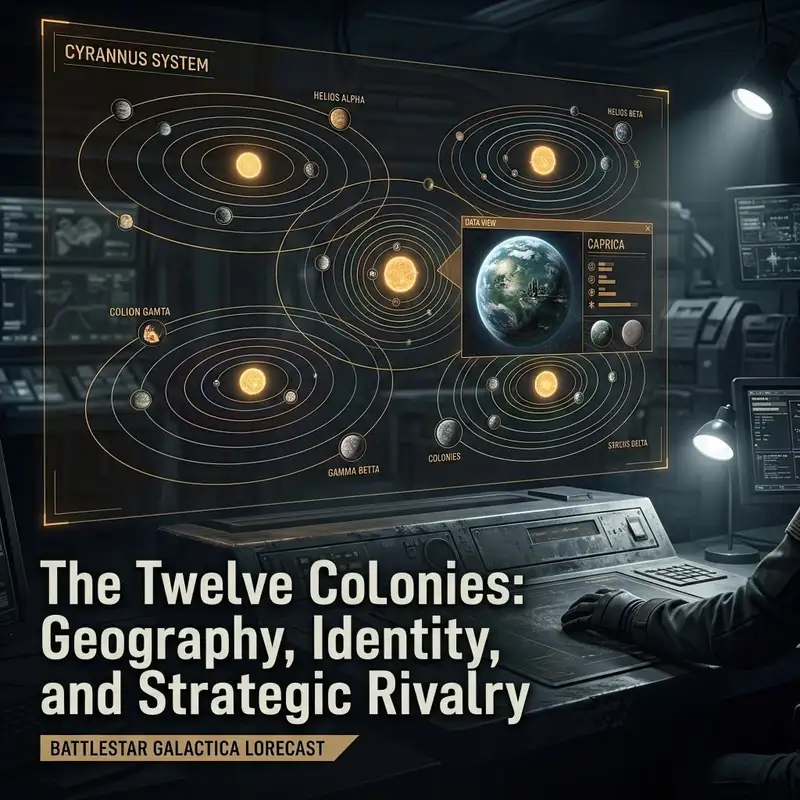
The prequel story set on Caprica presents Caprica and Gemenon as sister worlds associated with Helios Alpha, with Picon and Tauron also connected to that wider system. The presentation varies somewhat between released versions, so it should not be used to construct a rigid orbital model for all Colonial history. Its value lies elsewhere. It shows that even worlds linked by regional geography remained separate societies with their own institutions, memories, and social tensions.
Geographic dispersion required central nodes. There had to be places where information converged, where military forces were organized, where political influence gathered, and where technical systems were administered. Such concentration creates efficiency. It also creates hierarchy. A world that hosts prominent institutions, major corporate activity, universities, military facilities, or government offices gains access to decisions that affect everyone else. Other colonies may benefit from that concentration while also resenting it.
Caprica was the clearest example of prominence in the surviving record. It was politically important, technologically advanced, highly urbanized, and culturally influential. It produced or hosted institutions whose reach extended beyond its own population. The Caprica of the pre-Fall era appears prosperous and sophisticated, with corporate research, virtual environments, ambitious public life, and a social class confident that modern technology could solve problems previously left to religion, family, or local custom.
Yet Caprica was not a placid model of successful modernity. Its technological sophistication existed beside grief, inequality, corporate power, organized crime, political violence, and religious conflict. The world shown in the prequel was capable of producing advanced virtual systems and experimental artificial life. It was also capable of leaving vulnerable people isolated inside a highly connected society. Wealth and influence did not create moral clarity. They often made it easier for powerful people to avoid seeing the costs borne by others.
Caprica’s prominence should not be exaggerated into a claim that it was the formal capital of every Colonial institution. The screen record supports political and cultural importance, not a complete constitutional map. Picon, for example, was explicitly associated with Fleet Headquarters. Other colonies clearly possessed their own political representatives, local identities, and claims on the larger order. Still, prominence matters even without formal supremacy. A society can be shaped by the habits and assumptions of its most visible world without being ruled by it in every respect.
That influence also produced resentment. When central institutions appear distant, affluent, or socially exclusive, people outside them may conclude that the language of common citizenship conceals an unequal distribution of power. Such judgments may be fair, exaggerated, or both. Yet once widely held, they become political facts. The Colonial system depended not merely on shared law but on the willingness of people from very different worlds to believe that the law belonged to them.
Tauron illustrates how colonial identity could survive migration and operate across borders. Tauron was not simply a separate planet with a separate flag in a history book. Tauron identity was carried by families who lived on Caprica, by people whose ancestry shaped their faith, language, kinship obligations, and political memory. The Adama family’s experience shows that a person could be embedded in Caprican society while still being marked by Tauron origins.
The identity could bring solidarity, but it could also bring exclusion. Migrant communities often form dense networks because they need them. Family, neighborhood, religion, and mutual aid become means of protection in a society where access to wealth and respect is uneven. Those networks can sustain dignity. They can also become entangled with coercive institutions, criminal power, and inherited political violence. The Ha’la’tha and the violence surrounding some Tauron-associated communities are part of the record, but they do not define every Tauron any more than Caprican corporate power defined every person on Caprica.
Tauron demonstrates the danger of treating colony identity as a simple substitute for class, ethnicity, religion, or politics. These categories overlapped, but they were not identical. A wealthy Tauron, a poor Tauron, a Tauron migrant, and a Tauron living on the homeworld might share memories without sharing the same interests. Nor did every conflict involving Tauron communities arise from ancient loyalty alone. Modern inequality, personal ambition, state policy, and local coercion all mattered.
Gemenon occupied another important place in the Colonial imagination. It was associated with religious tradition and with the Sacred Scrolls, which gave it a special weight in a civilization whose public language still drew upon the legacy of Kobol. This did not mean every Gemenese person held the same beliefs, practiced faith in the same manner, or supported the same political causes. Religious association is not religious uniformity.
What Gemenon represented was the continuing force of tradition in a civilization often impressed by technical progress. Colonial society had advanced weapons, F T L travel, sophisticated computing, and virtual environments. It also preserved sacred texts, ritual language, temples, and competing claims about divine purpose. Religion could create cohesion across colonial lines because the memory of Kobol belonged to the wider civilization. It could also sharpen disagreement when one community believed that central institutions had become detached from sacred obligation.
The political significance of these identities was not confined to elite debate. It reached into labor, education, professional status, and the daily distribution of respect. Aerilon is associated in later dialogue with agriculture and with the labor required to sustain the wider Colonial economy. The association matters because food production is a strategic function. A civilization that travels between worlds and maintains a large military still depends on people who grow food, repair machinery, process materials, and perform work that receives little ceremonial recognition.
Gaius Baltar later described a Colonial class hierarchy in which people from poorer worlds were more likely to perform necessary labor while officer culture, advanced education, and institutional influence were associated with wealthier places. His speech was self-serving and politically charged. It is not a reliable census or a complete account of Colonial society. Baltar was not an impartial social historian. He was making an argument about power, grievance, and who had been permitted to define respectability.
Even so, self-interested arguments often gain traction because they touch a recognizable truth. The question is not whether every Aerilonian worked in agriculture or whether every Caprican held privilege. The question is whether Colonial society distributed opportunity, risk, and recognition unevenly enough that people recognized the pattern. The available evidence suggests that many did. Essential labor may have been treated as background to political life, even though without it there would have been no food, no fuel processing, no maintenance, and no capacity to sustain military operations.
The imbalance matters in strategic terms. A fleet is not maintained by admirals alone. A government does not survive on speeches. Food, repair, sanitation, medicine, transport, and trained technicians are not secondary concerns that can be solved after a security crisis. They are the conditions that make security possible. When a society treats the people who provide those functions as politically invisible, it becomes less resilient. It loses not only fairness but practical understanding of what keeps the system alive.
The remaining Colonial names appear in the political record as more than decorative entries: Virgon, Leonis, Libran, Aquaria, Canceron, and Scorpia all belonged to the common order and retained representation within it. Yet the screen record develops them unevenly. It would be easy to invent complete cultural profiles, industries, landscapes, or strategic doctrines for each. That would create the illusion of knowledge rather than history. Their political significance is clear even when the details are not. They were constituencies, homes, and sources of identity whose representatives expected recognition.
The unevenness of the record is itself revealing. Powerful systems often remember some places more clearly than others. A colony associated with high government, military command, a major crisis, or a prominent family may appear often in surviving accounts. Another may be known mostly through a delegate’s name, a religious symbol, or a passing reference. That does not make the less documented world less important to the people who lived there. It means the historical record was shaped by access, catastrophe, and the survival of evidence.
Economic interdependence could strengthen the Colonial order because each world did not need to be identical. Different regions could contribute different skills, resources, institutions, and forms of labor. Yet specialization also creates dependence. If a commonwealth comes to rely on certain centers for military command, others for food, others for technical development, and others for political legitimacy, then the loss or failure of a single node can affect every part of the system.
The interdependence made disputes over representation unavoidable. Communities that believed they carried an unfair share of labor or sacrifice would ask whether they received a fair share of power. Communities distant from central institutions would ask whether the government understood their conditions. Political conflict was not proof that Colonial unity had failed. It was the normal consequence of trying to govern a large and unequal civilization without abolishing local identity.
Sagittaron made that problem impossible to ignore. By the time the fleet attempted to rebuild its Quorum, Sagittaron’s representative claim centered on Tom Zarek. To government officials, Zarek was a terrorist and a criminal, a man whose political career included violence. To many supporters, particularly those who saw Sagittaron as neglected or disenfranchised, he was a defender of people excluded from the comfortable language of Colonial consensus.
Neither account can simply cancel the other. Political grievance does not make violence harmless or automatically legitimate. A history of exclusion does not disappear because the government can point to a criminal conviction. Zarek’s case exposed the difficulty of constitutional survival after a catastrophe. The fleet needed order, security, and legal continuity. It also needed a way to recognize constituencies whose relationship with the old order had been bitter long before the Cylons arrived.
The dispute over Sagittaron was therefore larger than one man. If the Quorum existed only to confirm the preferences of military commanders, established elites, or the most socially acceptable survivors, then it would not represent the Twelve Colonies in any meaningful sense. It would be an advisory council for those already in power. Representation matters most when it includes people whose presence is inconvenient.
This did not mean that every claim had to be accepted without scrutiny. A constitutional system must confront coercion, violence, and manipulation. Still, it cannot preserve legitimacy by declaring unpopular communities politically expendable. The purpose of a representative institution is not to eliminate conflict. It is to prevent conflict from being settled entirely through force, wealth, or access to weapons. Under extinction pressure, that purpose becomes harder to defend and more necessary.
Before the Fall, however, the most visible practical expression of Colonial unity was not the Quorum chamber. It was the shared defense system. The Colonial Fleet linked the worlds through common command structures, military procedures, personnel, communications, and strategic planning. It embodied the proposition that the Twelve Colonies faced external threats together. A battlestar might operate near one world or another, but its mission belonged to the broader civilization.
Picon occupied a particularly important place in that system because Picon Fleet Headquarters served as a central military node. The existence of such a headquarters did not mean that every base, ship, air wing, or command decision was controlled from Picon alone. Military institutions are rarely that simple. Still, it did mean that Picon connected political authority, fleet operations, intelligence, planning, and command in a way that made it strategically valuable.
Centralization had obvious advantages. A common fleet could coordinate defense against a threat no single colony might be able to resist. Shared doctrine and communications could reduce confusion. Personnel could be assigned across colonial lines. A unified command structure could move forces toward a crisis without negotiating a new alliance every time danger appeared. In peacetime, such integration looked like efficiency. In war, it could be the difference between mutual defense and isolated defeat.
Yet centralization also creates a decapitation target. An enemy who understands where command authority, communications, and technical dependencies converge does not need to defeat every local institution separately. Destroying or disabling a few key nodes can produce confusion far beyond the physical damage. The problem is not that centralization is inherently foolish. A dispersed civilization needs some means of coordination. The problem is believing that a system built for efficiency will remain secure merely because it has worked during peace.
The Fall demonstrated this with brutal clarity. The Cylon attack was not only a series of battles or a sequence of nuclear strikes. It was a systems failure at the scale of civilization. The destruction of Picon Fleet Headquarters removed a critical center of Colonial command. Admiral Nagala assumed command from the Battlestar Atlantia after the initial attack, but Atlantia was itself soon lost. The Colonial defense system did not merely lose ships. It lost the ability to see, communicate, decide, and coordinate at the speed required by the crisis.
Early reports of attacks across Caprica, Picon, Aerilon, Tauron, Gemenon, and other colonies reached survivors in fragments. They were emotionally overwhelming and operationally incomplete. In the first hours of such a disaster, reports are not a final damage assessment. They are what frightened commanders, civilians, and communications officers can still receive through a collapsing system. Their importance lies in showing scale and confusion. The Colonies were under coordinated attack, and the people responsible for defending them did not possess a stable picture of what remained.
The Cylon advantage did not come from one cause alone. The Command Navigation Program and other shared Colonial systems created vulnerabilities that the Cylons could exploit. But the technical compromise operated alongside Cylon infiltration, supply-chain exposure, intelligence failure, political complacency, and a military posture shaped by decades of armistice. The Cylons had studied their target. They understood that modern integration could be turned against the people who depended upon it.
It would be wrong to say that the Colonial Fleet fell because it used computers. Galactica itself demonstrates why that explanation is too simple. Older and more isolated systems could reduce exposure to a particular compromise, but they also imposed costs in speed, integration, maintenance, and human workload. Galactica was not computer-free, and it was not invulnerable. Its survival depended on timing, condition, command decisions, and the fact that it stood partly outside the networked assumptions that the Cylons had prepared to exploit.
The larger failure was institutional. The Colonies had built systems that assumed their common architecture would serve common defense. They had not prepared adequately for the possibility that the architecture itself had been penetrated. They had concentrated authority in nodes that improved coordination during ordinary conditions but became catastrophic liabilities when the enemy struck first. They had allowed a long peace to become a reason for confidence rather than a reason for disciplined skepticism.
Tactically, Colonial defensive forces were disabled, surprised, or destroyed before they could establish an effective response. For the wider campaign, command coordination collapsed as headquarters and capital ships were eliminated. For the war as a whole, the Colonies lost not only territory but their industrial, agricultural, governmental, and demographic foundation. Farms, factories, shipyards, archives, schools, hospitals, laboratories, homes, and families disappeared in the same campaign.
The civilian loss cannot be understood only as a survivor count. A world is not only a population number. It is accumulated skill, habit, language, public memory, burial places, institutions, and the unrecorded routines that let people imagine a future. When the Colonies were destroyed, survivors did not merely lose places to return to. They lost the material systems that could train new workers, replace skilled professionals, build ships, grow food at scale, and sustain political life across generations.
And yet the destruction of territory did not erase political geography. The refugee fleet became a compressed version of the Twelve Colonies. People brought accents, family loyalties, religious traditions, professional skills, class assumptions, and old resentments aboard ships that had never been designed to carry a civilization. A fleet assembled in emergency did not become socially neutral because everyone now faced the same enemy.
Some survivors possessed education, influence, and access to political authority. Others possessed the labor and technical knowledge without which the ships would stop functioning. Some came from communities accustomed to seeing the central government as protective. Others came from places where official promises had long sounded hollow. Some saw the restoration of the old constitutional order as the only barrier against military rule. Others wondered whether that order had ever served them fairly in the first place.
The logistics of the fleet made those differences more consequential. The survivors had lost farms, factories, universities, hospitals, courts, and shipyards. Galactica could defend ships, repair damage, and improvise under pressure. It could not recreate the industrial depth of twelve inhabited worlds. No battlestar could replace a civilization’s agriculture, manufacturing base, medical system, or population of trained specialists. Every repair, ration, work assignment, and political compromise took place under the shadow of what could no longer be replaced.
That was why civilian representation remained necessary even under military protection. A battlestar can defend people. It cannot define their political community by itself. Military command can allocate defensive resources and issue orders during an attack. It cannot, without damaging the society it claims to protect, decide whose memories count, whose faith is tolerated, whose labor is valued, or who may speak for a destroyed world.
The Twelve Colonies were neither a seamless nation nor twelve isolated planets. They were an unfinished political civilization. Their shared origin on Kobol, their Articles of Colonization, their Quorum, their fleet, their economic ties, and their religious memory created genuine collective strength. They had built enough unity to imagine a common defense and enough institutional depth to make that defense possible.
Still, they had never resolved every inequality within that unity. Regional loyalties endured. Prominent worlds shaped the wider culture. Labor and class remained politically charged. Religious and civic identities overlapped without becoming the same thing. Communities such as Sagittaron could regard the common order as both their inheritance and their exclusion. The Colonial state was strong enough to coordinate vast systems, but not strong enough to make every citizen trust those systems equally.
The Cylon attack did not erase a collection of isolated worlds. It shattered a commonwealth whose members had learned to cooperate without ever becoming identical. That distinction is what gives the Twelve Colonies their political weight. Their diversity was not the defect that doomed them. The danger lay in unequal burdens, concentrated authority, shared technical dependencies, and confidence that common institutions were stronger than the tensions beneath them. The Colonies had achieved unity. What they had not completed was the harder work of making that unity equally trusted by everyone who depended on it.