The Twelve Colonies and the Colonial Fleet: Battlestars, Vipers, and Warrior Culture
The peace conference was supposed to end a war that had shaped Colonial life for a thousand yahrens. Instead, it became the opening move in the destruction of the Twelve Colonies of Man. When the Cylon attack came, Galactica was no longer simply one battlestar within a larger defense establishment. It became a warship carrying the remnants of that establishment into exile. Its decks held Warriors, technicians, commanders, political leaders, wounded personnel, families, and civilians who had lost the worlds that gave their offices, professions, and loyalties their meaning. The ship’s Vipers could still launch. Its weapons could still fire. Its officers could still issue orders. But the country those instruments had been built to defend had been devastated behind them. The distinction has practical consequences. A military force can survive the defeat of its state, at least for a time. It can preserve discipline, weapons, trained people, and a chain of command. It cannot automatically restore the farms, factories, schools, hospitals, courts, homes, archives, and local communities that make a civilization more than an armed convoy. Galactica’s task changed in a single catastrophe. It was no longer defending settled territory. It was screening a refugee fleet while trying to preserve enough order for that fleet to remain a people. Commander Adama held indispensable military authority, but he did not become the sole source of legitimacy. The President, the Council of Twelve, ship captains, families, and civilians still mattered because survival required more than obedience to a battlestar commander. The question facing the surviving Colonial Fleet extended beyond how to defeat the Cylons in the next engagement. It was what a military institution becomes when the civilization it served exists chiefly in memory, aboard damaged ships, and in the shared hope of finding a new home.
The Twelve Colonies were not presented as twelve identical planets with one uniform culture and one simple political system. They were a human civilization linked by common history, political representation, religious memory, trade, travel, and the long experience of war against the Cylons. The series gives the listener glimpses rather than a complete constitutional atlas. It establishes a President, a Council of Twelve, and a wider Colonial society whose people could recognize themselves as part of a common political world. That shared identity was important because the Cylon attack could not be reduced to an attack on military installations. It was an assault on the continuity of a civilization. The worlds of the Colonies represented homes, families, local customs, institutions, and the accumulated work of generations. The fleet’s survivors did not become interchangeable refugees merely because they now traveled together. Their old identities remained a source of pride, disagreement, grief, and political claim. The Colonial military drew its authority from that wider society. Battlestars and Vipers carried enormous symbolic weight because they represented organized protection in a civilization that had lived under the shadow of a long war. Yet the military was never the whole of Colonial life. It existed to defend a society that included civilians who did not wear uniforms, people whose work was agricultural, technical, medical, political, religious, commercial, or domestic. That helps explain why it is misleading to imagine the Twelve Colonies as a neat military diagram, with one battlestar assigned to each world.
The screen record does not establish that arrangement. The peace conference shows several flying battlestars, and later stories identify more named ships without providing a complete inventory. The number twelve describes the political and civilizational framework of the Colonies. It does not prove a fixed order of battle. The military mattered because the Colonies mattered, not because the military alone defined them.
A thousand-yahren war created institutions, habits, and expectations. It gave military service prestige. It made battlestars familiar symbols of defense. It produced experienced commanders, skilled pilots, technical specialists, and generations of people who understood that the Cylons remained a strategic danger. But long war also creates a dangerous kind of confidence. Institutions learn routines. Political leaders come to rely on procedures that worked in earlier crises. Military commands become accustomed to recognizable threats, predictable deployments, and the assumption that a declared peace process has rules. The Cylon peace offer exploited those assumptions. It appealed to a real desire for an end to conflict, not foolishness in the simple sense. A civilization exhausted by war has reasons to seek negotiation. The failure lay in the gap between what Colonial leaders hoped the peace conference meant and what the Cylons intended it to be. The attack that followed was not caused by one mistake, one officer, or one failed weapon system. It involved strategic deception, political hope, operational surprise, and the ability of the Cylons to strike a civilization whose military forces depended on warning, coordination, communications, bases, supply systems, and civilian infrastructure. A battlestar is formidable, but no warship operates alone in any meaningful strategic sense. It needs fuel, ammunition, maintenance, trained replacements, intelligence, and a population behind it. The destruction of the Colonies therefore exposed both the strength and the limit of Colonial military professionalism. The Fleet could still fight.
Some units could survive the first blow. Galactica could launch Vipers and impose costs on pursuing forces. Yet the strategic foundation beneath that combat power had been torn away. The old war had taught the Colonies how to maintain a military. The Cylon deception demonstrated that maintaining a military was not the same as preserving a civilization against an enemy capable of choosing the moment and terms of annihilation.
A battlestar was valuable because it concentrated capabilities that were difficult to replace even before the destruction of the Colonies. It was a warship, certainly, built to fight and endure combat. But it also functioned as a command center, a fighter carrier, a communications hub, a transport platform, a medical refuge, a repair base, and a visible expression of Colonial authority. Galactica did not matter simply because of its guns. It mattered because it contained trained people and the systems that allowed those people to work together. Its bridge coordinated movement and combat decisions. Its launch facilities turned Vipers from stored aircraft into a mobile defensive force. Its maintenance personnel kept damaged craft flying. Its medical staff preserved lives that could not be casually replaced. Its engineers kept propulsion, power, weapons, life support, and internal systems functioning under pressure. Its command staff preserved habits of planning, discipline, and accountability. In the refugee era, the battlestar became even more important because it provided a place where military knowledge could be retained and passed on. A Viper pilot required more than courage. So did a technician, a weapons officer, a bridge specialist, or a flight-deck crew member. Each represented training, experience, and a professional culture developed over years. Galactica also became a political object. Civilians could see it as their shield, their last organized defense, and the surviving emblem of the Colonies. That symbolism gave Adama practical influence, but it also imposed responsibility.
A battlestar that claims to protect refugees cannot treat them as cargo. Its authority depends partly on whether civilians believe the ship is defending their future rather than merely preserving its own military hierarchy. The original series does not provide enough evidence for a complete prewar battlestar inventory, detailed ship classes, or precise fighter complements. What it does show is more important than those missing specifications. A battlestar was a mobile institution. Losing one meant losing not just a hull, but a community of knowledge, command capacity, and organized force.
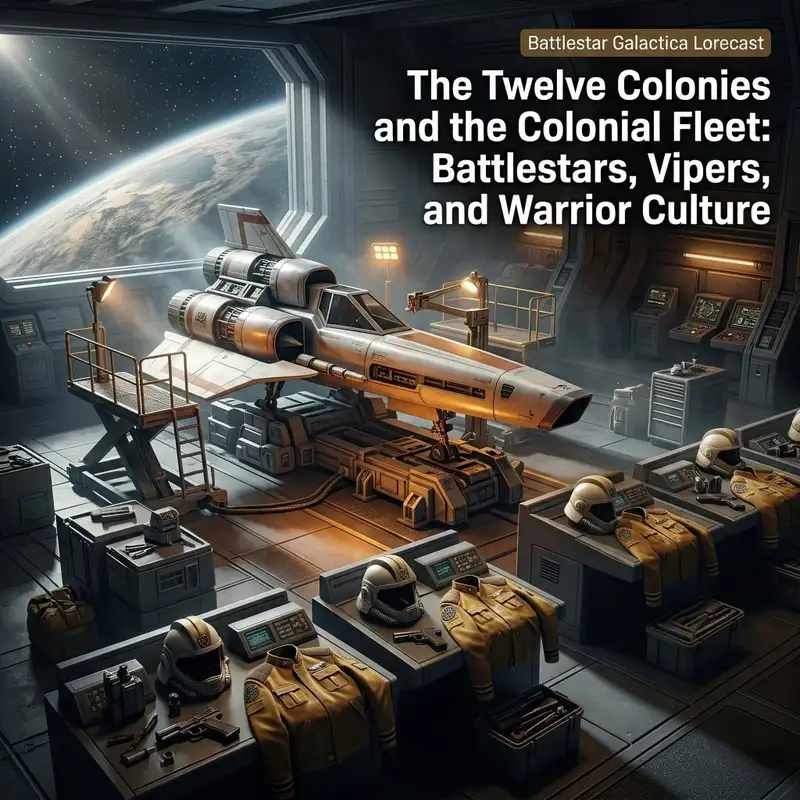
The Viper was the most visible expression of that force. A single-seat Colonial fighter could leave the battlestar, range ahead of the fleet, intercept Raiders, scout unknown space, escort civilian vessels, support rescue efforts, and carry the fight toward a Cylon threat. To the civilians watching from the fleet, the launch of Vipers offered a direct image of protection. To the Warrior who climbed into a cockpit, it meant accepting that a mission might end far from Galactica, with no recovery and no replacement waiting behind the next jump. Yet the Viper should not be understood as an independent dueling machine, dependent only on the talent of its pilot. Every launch rested on a larger carrier system. Someone had to maintain the craft. Someone had to fuel it, arm it, inspect it, position it, launch it, track it, recover it, and repair it after combat. Commanders had to decide where the limited aircraft would be used, which pilots were rested enough to fly, which threats were urgent, and how much risk the fleet could accept. A patrol that destroyed no Raiders might still be a success if it found a safe route, identified danger early, escorted a civilian ship through a vulnerable passage, or bought the fleet time to change course. A combat victory that damaged too many Vipers, exhausted too many pilots, or left civilian ships exposed could be a failure at the larger level. The original series frequently presents Viper operations as fast, personal, and dramatic, but their real military meaning lies in fleet defense.
The Vipers extended Galactica’s reach beyond the battlestar’s hull. They gave the refugee convoy eyes, speed, and the ability to meet danger before it reached the slower civilian ships. Their limitations were equally clear. Each lost fighter represented maintenance work, scarce equipment, and a pilot who might be impossible to replace. Each mission asked the fleet to spend a little of its future in order to survive the present.
The men and women who operated within that system were Colonial Warriors. The title was broader than Viper pilot. It described a military profession and, more deeply, a culture of service. The series shows Warriors in cockpits, on bridges, in command spaces, on reconnaissance missions, in security roles, and on dangerous assignments beyond the battlestar. The boundaries of the institution are not documented with the precision of a modern defense ministry, and the viewer should resist inventing numbered branches, detailed service schools, or a formal doctrine manual that the screen never provides. Still, the culture is visible. Warriors wear a recognizable uniform. They observe hierarchy and procedure. They take pride in skill. They accept risk as part of professional identity. They show loyalty to their ship, their comrades, and the larger fleet. They are expected to act with initiative when communications fail or when a mission develops beyond its original plan. That flexibility was essential in exile, where a Viper patrol might become a rescue mission, a diplomatic contact, a ground operation, or an intelligence task with little warning. Warrior culture also preserved memory. It carried the customs of the old Colonial military into the refugee fleet, giving the survivors a language of duty and a framework for organizing danger. But military prestige has costs. A society that celebrates the Warrior can become dependent on heroic individuals. It can treat personal courage as a substitute for institutional preparation. It can elevate martial judgment above civilian judgment, especially when civilians appear hesitant in a crisis.
And it can encourage those in uniform to see service as the highest form of citizenship, rather than one necessary contribution among many. The Warrior was not just a fighter pilot and not just a warrior in the ancient, ceremonial sense. The Warrior was a trained professional whose identity blended discipline, courage, technical competence, and public duty. That made the institution resilient. It also made it vulnerable to the belief that military excellence alone could answer political or social problems.
Apollo, Starbuck, Boomer, and their fellow Warriors demonstrate why this culture had real value. They are remembered as pilots because Viper combat is visually central to the series, but their usefulness extends well beyond interception and dogfighting. They scout unfamiliar areas, investigate possible destinations, escort vulnerable vessels, conduct rescues, make contact with strangers, and enter hazardous situations when the fleet has too little information and too few alternatives. Their importance lies in adaptability. A refugee fleet cannot maintain a strict division between combat aviator, explorer, diplomat, investigator, and emergency responder when its survival repeatedly depends on whoever can reach a problem first. Apollo often embodies the disciplined side of the profession, the Warrior who understands command responsibility and the need to connect action to the safety of the fleet. Starbuck represents a more improvisational strain, a pilot whose unconventional initiative can create both opportunities and headaches for commanders. Boomer’s role reminds us that Warriors also include people whose value lies in steadiness, technical competence, and the ability to function as part of a team rather than as a legend. The point is not that these individuals alone save the fleet. No military institution survives by treating a few talented officers as a replacement for structure. Their stories instead reveal what the institution asks of its best people: flexibility, courage under incomplete intelligence, and the willingness to carry consequences that cannot be delegated. But every success carries a warning. The more frequently a fleet must depend on the same small circle of exceptional specialists, the more clearly it is consuming irreplaceable human capital. A civilization can admire heroes. It cannot build its long-term survival on the assumption that heroes will always return, always make the right decision, and always be available when the next emergency begins.
That problem becomes sharper after the destruction of the Colonies because experienced pilots and trained Warriors cannot be replaced by administrative order. The fleet can identify promising young people. It can recruit volunteers. It can place them under instruction and attempt to turn civilians into useful military personnel. But training is not a shortcut around loss. It requires instructors who are themselves needed for operations. It requires aircraft that may be scarce and vulnerable. It requires time, discipline, confidence, and the ability to teach judgment rather than simply the mechanics of flying. A recruit may learn how to handle a Viper before learning how to manage fear, fuel limits, separation from formation, uncertain identification, or the burden of making a decision that places civilians at risk. Stories involving younger recruits and new qualifications show the pressure placed on the surviving military community. The fleet needs pilots, but the need itself can produce dangerous incentives. Commanders may be tempted to accelerate training. Recruits may seek the status of the Warrior before they understand the cost. Families may see service as honor, opportunity, or a painful necessity. The civilian fleet pays for every new military recruit. A young person trained for combat is also a person no longer available for education, agriculture, medicine, engineering, repair work, childcare, or family responsibilities. In a stable state, those trades are supported by a large population and a deep labor pool. In exile, every skilled hand has competing claims on it.
This does not mean recruitment is wrong. A fleet without defenders soon becomes a fleet without civilians. It means that pilot replacement is a demographic and institutional problem, not a mere matter of filling empty seats. The Fleet can create new Warriors. It cannot easily recreate accumulated experience, old mentors, lost schools, or the vast population that once stood behind the military profession. Each casualty weakens both the immediate defense of the fleet and the long-term ability to teach the next generation how to survive.
That helps explain why Adama’s command cannot be understood only as military command. He directs Galactica, makes operational decisions, and bears responsibility for the survival of Warriors under his authority. But the fleet also includes civilians and political institutions that retain meaning even after the destruction of the Colonies. The President and the Council of Twelve represent the claim that the refugees remain more than dependents of an armed ship. The precise constitutional workings of this government are not fully laid out on screen, and there is no need to invent articles, ministries, or legal procedures to see the basic problem. Military power is necessary because Cylon forces can destroy the fleet. Civilian legitimacy is necessary because military power cannot by itself decide how people should live, how burdens should be distributed, whose interests matter, or what future the refugees are trying to preserve. Galactica can organize defense. It cannot produce food simply by issuing an order. It cannot create homes, settle every dispute, educate children, heal grief, or command genuine consent at gunpoint. The Council and civilian leaders, meanwhile, cannot preserve their political authority if they ignore the operational knowledge of the people responsible for navigation, patrols, fighter readiness, and immediate defense. Cooperation is therefore not sentimental. It is a survival requirement. The military needs civilians for labor, political consent, social continuity, and a reason to endure. Civilians need the military because their ships cannot face Cylon attack alone. Tension between those roles is inevitable.
Political deliberation can look slow to someone who sees an approaching threat. Military urgency can look authoritarian to someone who has already lost a home and fears losing civil freedom as well. The Colonial Fleet’s achievement is not the absence of that tension. It is the continuing effort to manage it without allowing the battlestar’s weapons to become the only basis for government.
The arrival of Pegasus and Commander Cain complicates any easy picture of Galactica as the sole surviving center of Colonial military strength. Pegasus demonstrates that the aftermath of the Cylon attack was more complex than a single ship’s survival. It also provides a sharp contrast in command style and strategic judgment. Cain is a formidable military leader. His presence, his ship, and the discipline of his command offer the promise of additional combat power at a moment when Galactica has been carrying the burden of fleet defense. But military capability does not settle the question of legitimate authority. A surviving commander may possess a strong ship, experienced personnel, and a willingness to strike hard at the enemy. None of that automatically gives him the right to define the purpose of the remaining Colonial people. Cain’s approach brings into focus a recurring problem of catastrophe. When a state is shattered, commanders may believe that only military decisiveness can save what remains. They may see civilian restraints as luxuries from a vanished age. They may regard ships carrying refugees as burdens on operational freedom. Yet abandoning civilians in the name of military efficiency would defeat the larger purpose of the Colonial struggle. The fleet is not valuable merely because it can continue fighting. It is valuable because it carries people whose survival gives the fight its meaning. Pegasus also reveals the difficulty of unifying surviving military commands. Two capable commanders can possess different experiences, different assumptions, and different ideas about risk.
Their disagreement is more than a matter of personality. It concerns whether the mission is to seek battle, preserve a population, find Earth, maintain political continuity, or somehow do all of those things at once. Material superiority and aggressive combat doctrine can be useful. They cannot replace trust, lawful authority, or responsibility toward people who cannot defend themselves.
The civilian fleet gives that responsibility its practical form. A convoy of ships needs more than protection from Raiders. It needs food, water, shelter, medical treatment, maintenance, labor, education, family life, and enough political order to prevent desperation from becoming permanent chaos. Galactica can help coordinate, defend, and sometimes assist with emergencies. It cannot recreate the industrial depth of the lost Colonies. A damaged Viper may be repaired. A system may be improvised. A technician may find a way to keep aging equipment in service. But repair is not the same as replacement. The screen evidence does not establish that the refugee fleet possesses a complete mobile shipbuilding economy capable of replacing every lost fighter, civilian vessel, or battlestar component. That absence changes every military decision. An aircraft lost in a reckless mission is not just one less weapon. It is a maintenance burden gone unrecovered, a pilot perhaps gone forever, and a reduction in the fleet’s ability to defend itself tomorrow. A civilian ship lost to attack does more than lower the number of hulls in formation. It may mean lost families, specialized workers, shelter, supplies, knowledge, and a piece of the social world the fleet is trying to save. Warrior culture can sometimes make sacrifice appear straightforward. The refugee reality makes it complicated. Courage remains necessary, but commanders must ask what a mission costs the people who will still need food, care, work, and hope after the battle is over. The battlestar’s weapons defend the fleet’s physical survival. Civilian labor and institutions defend its ability to remain a civilization worth defending.
The later sequel branch, Galactica nineteen eighty, places the surviving fleet near contemporary Earth and introduces changed personnel, technologies, and operational problems. It belongs to the original screen tradition, but it should not be used to redefine the Colonial military culture that existed before the destruction of the Colonies. The circumstances are different. The fleet has traveled farther, its original leaders and younger generations face new realities, and the problem of approaching Earth is not identical to the problem of escaping the Cylon attack. The earlier series leaves the central journey unresolved rather than completing it with a simple military victory. That is appropriate to the deeper character of the original Colonial Fleet. Its mission was never only to win the next engagement. It was to preserve enough people, knowledge, law, and purpose to make a future conceivable. Battlestars provided mobile command and protection. Vipers gave the fleet reach, reconnaissance, and a chance to meet danger before it reached defenseless civilians. Colonial Warriors provided trained courage, technical skill, discipline, and a shared identity in conditions designed to break all of those things apart. But the greatest surviving asset was not any one warship or squadron. It was the body of people who knew how to serve, train, command, repair, decide, and remember what the Colonies had been. The destruction of the Twelve Colonies revealed both the strength and the limit of that inheritance. Military professionalism could keep a shattered people alive long enough to search for a future. Only civilian life, political legitimacy, and the possibility of rebuilding a recoverable social order could tell that survival what it was for.