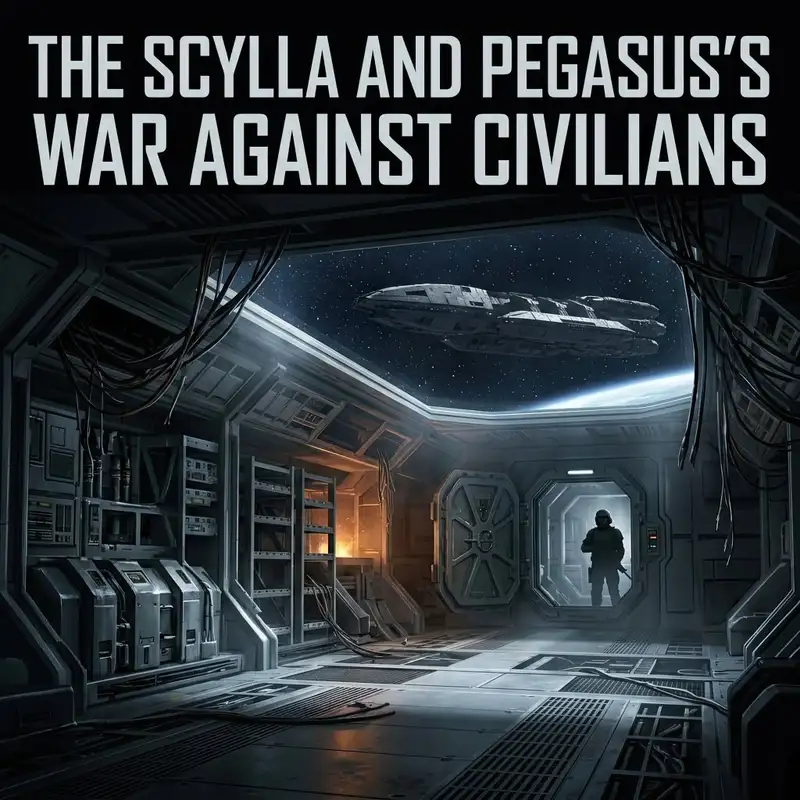
The Scylla and Pegasus’s War Against Civilians
The civilians aboard Scylla understood the danger when Pegasus’s inspection stopped looking like rescue and started looking like inventory. The battlestar had arrived after the destruction of the Twelve Colonies, carrying weapons, Marines, officers, and the authority of a surviving military command. To people who had escaped nuclear attack and Cylon pursuit, that silhouette should have meant protection. Instead, Pegasus intended to take the things that allowed the civilian ships to remain alive on their own terms. It wanted spare parts, weapons, technical specialists, and faster-than-light drives. A drive was not a luxury item. It was the means by which a transport could leave a danger zone before Cylon forces arrived. Remove it, and the passengers became stationary targets in a war defined by mobility. Pegasus also selected skilled civilians for transfer to the battlestar, separating workers from the families who had survived with them. The resistance that followed was not an organized rebellion against Colonial authority. These were civilians confronting an armed force that had decided their ships, their labor, and their family ties belonged to the military. The confrontation became lethal when Lieutenant Kendra Shaw shot a civilian woman at close range. Other Marines then fired into the resistance. By the later account, ten civilians were killed. The exact sequence is not entirely consistent across the released story, but the broad record is clear enough. A Colonial battlestar used deadly force against unarmed survivors while stripping their ability to escape the Cylons.
The question is whether Admiral Helena Cain had reached an unavoidable decision under conditions of extinction, or whether she had transformed military necessity into a system that treated civilians as expendable resources. To answer it fairly, Pegasus’s own condition matters. Cain did not encounter Scylla from a position of comfort, abundance, or institutional stability. She had a damaged warship, a shattered chain of command, and an enemy that had already destroyed civilization.
Pegasus had survived the Fall by circumstances that were extraordinary even within the chaos of the Cylon attack. The battlestar was at the Scorpion Fleet Shipyards when the attack began. Its navigation systems were offline, its surroundings were under assault, and the Colonial military structure that should have coordinated its defense was collapsing. Cain ordered an emergency jump without reliable navigation data, a decision that saved the ship but scattered it into a war with no functioning rear area, no assured resupply, and no clear higher command. Pegasus emerged as a major surviving combatant, but survival did not mean readiness. It had suffered severe losses in people, aircraft, equipment, and the specialized support system required to operate a battlestar. A ship like Pegasus needed more than guns and armor. It needed engineers who understood systems that could not be replaced easily, deck crews who could launch and recover aircraft, technicians who could keep damaged Vipers and Raptors flying, medical personnel, ordnance specialists, mechanics, and officers capable of turning information into action. It needed parts. It needed weapons. It needed trained labor. It also needed enough confidence in its own command system to keep fighting after the government and much of the Fleet had apparently been destroyed. Cain’s answer was to preserve Pegasus as an offensive weapon. In narrow military terms, that objective had logic. A combat-capable battlestar could raid Cylon forces, destroy enemy ships, recover intelligence, and perhaps find surviving Colonial units.
A warship that could not repair its aircraft or crew its stations would eventually become a large, heavily armed hulk. Yet need is not the same as entitlement. A damaged military force may require assistance from civilians. It does not follow that every civilian possession becomes military property, that every skilled worker becomes subject to forced service, or that every objection can be answered with armed coercion. Pegasus had real shortages. The civilians led by Scylla possessed resources that could reduce those shortages. They also possessed something Pegasus had failed to recognize as equally strategic: a surviving community.
Scylla was not alone. It led a small civilian flotilla of roughly fifteen ships that had survived separately in the days after the Fall. The record does not establish a complete manifest, population, or inventory for every vessel, and there is no need to invent one. What matters is that these were not empty transports drifting through space with useful hardware bolted to their hulls. They were mobile fragments of Colonial society. Their crews kept environmental systems running. Their passengers maintained families, social ties, technical knowledge, memory, and the habits of civilian self-government. Some carried people with specialized skills. Others likely carried the ordinary workers without whom specialized expertise has little practical use. Engineers require tools, parts, food, sleep, and a functioning community. Pilots require maintainers, medics, instructors, and people who can sustain the civilian system they are supposedly defending. In a refugee war, a faster-than-light drive is part of that system. It is evacuation capacity. It gives civilians the ability to flee a raid, rendezvous with friendly forces, search for supplies, or avoid becoming fixed targets. It also gives them bargaining power. A ship that can jump can choose whether to join a fleet, under what conditions it will cooperate, and whether it trusts the command offering protection. A ship stripped of its drive loses all three. Cain’s officers appear to have assessed the flotilla in military terms. Which vessels had equipment Pegasus could use? Which people had technical knowledge that could be transferred to the battlestar?
Which components could restore combat capability? Those questions were not irrational, but they were radically incomplete. The civilian flotilla had value precisely because it was more than a maintenance depot. Its mobility, autonomy, and internal order made it a possible partner in long-term survival. Its people could contribute to repair, refining, agriculture, medical care, education, and the slow reconstruction of a functioning population. Their families were not sentimental attachments interfering with efficiency. They were part of the reason those people had survived and the reason their labor had meaning. The Cylons had already reduced the Colonies from a civilization to scattered groups of refugees. Pegasus now faced a choice. It could integrate this flotilla into a common defense, sharing danger and resources. Or it could treat the flotilla as salvage. Cain chose salvage.
Cain’s operational logic was built around the preservation of Pegasus as a striking force. She had survived an attack that appeared to have annihilated the Colonial state and its armed services. Her ship was isolated, damaged, and operating against an enemy with overwhelming numerical and technological advantages. Under those conditions, the temptation to concentrate every available resource inside the hull of the battlestar was powerful. Pegasus could fight. Civilian transports generally could not. Pegasus had weapons, trained personnel, command facilities, and the capacity to conduct offensive operations. The civilian ships had vulnerable populations and limited means of self-defense. Cain appears to have converted those differences into a hierarchy of human worth. The warship came first because it could fight. The civilians mattered only insofar as they could restore the warship’s ability to fight. Colonel Jack Fisk and Lieutenant Kendra Shaw carried out that policy. Fisk led the inspection and enforcement effort. Shaw, a Marine officer and Cain’s aide, moved through the operation as one of the admiral’s trusted instruments. But the policy was Cain’s. Her subordinates did not independently decide that civilian drives should be removed, skilled personnel selected, and resistance broken through threats against families. It is possible to make a limited military case for requisition. If Pegasus lacked a component necessary to keep life support, propulsion, weapons, or flight operations functioning, taking that component could be defensible in an emergency. If civilians volunteered technical labor in exchange for protection, shared rations, or a place within a larger fleet, that could also be defensible.
A commander might even require temporary service from qualified personnel during an immediate crisis, provided the burden was distributed and the people involved retained protection and meaningful legal status. But the released story does not show Cain exhausting alternatives. It does not show negotiated resource sharing, voluntary enlistment, compensation, shared staffing, partial seizure, or a plan to keep the civilian ships mobile after Pegasus took what it needed. Her approach began with compulsion. That matters because it reveals the premise beneath the logistics. Cain did not see civilians as partners in a collective survival effort. She saw them as assets whose resistance had to be overcome.
The removal of the civilian ships’ faster-than-light drives crossed a line that cannot be obscured by the language of requisition. Pegasus was not just taking spare equipment into a shared defense plan. It was depriving civilian transports of their ability to flee and then abandoning them after the useful material and personnel had been extracted. The immediate tactical benefit to Pegasus was obvious. Working drives and salvageable components could support repairs. Skilled technicians could fill gaps left by casualties. Weapons and equipment could improve the battlestar’s ability to continue hit-and-run attacks against the Cylons. Those gains were real. But tactical gain is not the only measure of military success. Operationally, the civilian ships were left immobile or severely constrained. If Cylon forces found them, the passengers would have little capacity to escape. Strategically, Cain discarded a survivor community that might have strengthened a future Colonial recovery. Civilians were not merely mouths to feed. They were future labor, future institutions, future families, and future legitimacy. At the human level, the seizure imposed forced separation. People selected for Pegasus service were removed from spouses, children, parents, and shipmates who had just endured the destruction of their worlds. The command did not treat those relationships as part of survival. It treated them as obstacles to mobilization. This is where military necessity becomes military convenience. Pegasus may have needed help. It may have needed parts badly. The story does not prove that every drive could have been spared or that every technical specialist could have remained aboard Scylla.
But it does show that Cain made civilian survival subordinate by default. She chose to transfer risk downward. Pegasus retained mobility and combat power. The civilians lost mobility and were left with the consequences. That distribution of danger was not neutral. A battlestar’s mission is not merely to remain armed. Its purpose is to defend a population. If preserving the ship requires abandoning the population that gives the ship its political and moral reason to exist, then the commander must account for that contradiction. Cain did not appear to regard it as a contradiction at all. When the passengers objected, she did not seek a burdensharing arrangement. She prepared to make compliance compulsory.
Peter Laird became the human face of that objection. He was an aeronautical engineer, one of the civilians Pegasus considered valuable enough to remove from the flotilla. He was not a military commander, an insurgent leader, or an enemy agent. He was a skilled survivor who understood what Cain’s policy meant for the people around him. The issue was not merely whether he would work aboard Pegasus. It was whether he would be compelled to leave his family behind after the battlestar had stripped the civilian ships of the means to escape. Laird helped articulate what the passengers understood instinctively. They were being asked to surrender their mobility, their skilled workers, and their ability to remain together, while the military force making those demands offered no convincing assurance that the remaining civilians would be protected. Their resistance was an assertion of personhood. They refused to become inventory. In ordinary conditions, a military commander may lawfully exercise authority over service members. Civilians are different. Even in an emergency, they retain claims on protection, family life, property, representation, and due process. Those claims can be constrained by genuine necessity, but they do not disappear because an admiral is frightened, angry, or convinced that only force can save the species. Cain’s response made clear how little room her system allowed for civilian consent. She ordered Fisk to threaten the families of those selected for conscription. This was not a narrowly tailored emergency measure.
It was collective pressure. The message was that a skilled worker’s dependents could be used as leverage to obtain labor. Such threats attack the very relationships that enable people to endure catastrophe. Family bonds create loyalty, mutual care, and the willingness to accept hardship voluntarily. In a population that may be down to tens of thousands, those bonds are also part of demographic and institutional survival. A civilization cannot be rebuilt solely from technicians standing watch on a flight deck. It must preserve children, kinship networks, trust, and some expectation that service to the common cause will not result in the abandonment of those one loves. Cain’s policy inverted that obligation. Rather than saying that military protection existed to preserve civilian communities, she used civilian communities to compel service to the military. Once that principle was accepted, violence was no longer an accident waiting at the edge of the operation. It was the enforcement mechanism built into it.
The killings aboard Scylla were the point at which Cain’s coercive policy became unmistakably lethal. The civilians resisted the seizure. The Marines were armed. Shaw was present as a trusted officer within the enforcement team. At some point in the escalating confrontation, she fired the first shot, killing a civilian woman. Additional civilians were then killed as Marines suppressed the resistance. Later dialogue identifies ten civilian deaths. The released material does not provide a perfectly consistent reconstruction of the event. Fisk’s later description differs in emphasis and detail from the flashback in Razor, and the identity and sequence of every victim are not firmly established. There is no reason to manufacture a more precise massacre narrative than the screen supports. Ten deaths are enough to establish the central fact. Colonial military personnel killed ten noncombatant survivors during a confrontation created by forced conscription, confiscation, threats against families, and the stripping of civilian escape capacity. Responsibility must be assigned carefully. Shaw made the immediate decision to fire. The Marines who discharged their weapons carried out the lethal suppression. Fisk enforced Cain’s orders and directed the operation on her behalf. Cain established the policy, authorized the coercive environment, and made violence foreseeable by treating civilian resistance as an obstacle to be broken rather than a claim to be addressed. Nothing in the story establishes that every Marine shared Cain’s worldview or welcomed the killings. Institutions do not require unanimous enthusiasm to commit atrocities.
A command climate can turn fear, obedience, and professional reflex into instruments of abuse. Nor should the civilians be recast as combatants simply because they resisted. They had no obligation to welcome the removal of their drives, the seizure of their neighbors, or threats against their families. Their conduct may have created a tense and dangerous standoff, but it did not make them an enemy force. The deaths produced compliance. They did not produce cohesion. Terror can end a confrontation quickly. It cannot create the trust required to sustain a military force over time. Every person transferred to Pegasus afterward would know what had happened to the people who resisted. Every officer would understand that the admiral’s orders reached beyond battle against Cylons. The battlestar had established a method for governing civilians: seize, threaten, shoot, and move on.
Razor places Kendra Shaw at the center of the moral aftermath because the Scylla shooting became part of the officer Cain was trying to create. Cain used the word razor for an officer capable of cutting through fear, hesitation, and revulsion in order to act decisively. In combat, decisiveness can be a virtue. A pilot who freezes may lose a formation. A damage-control officer who cannot order a compartment sealed may lose a ship. A commander who refuses every hard choice may expose more people to danger. But Cain’s use of the idea distorted professional courage. She treated conscience as weakness when conscience interfered with her preferred result. The civilian woman on Scylla was not a Cylon Raider bearing down on Pegasus. She was part of a frightened group trying to prevent the military from taking their families and their ships’ escape capability. Shooting her did not demonstrate calm battlefield judgment. It demonstrated the willingness to enforce an unjust policy without allowing moral revulsion to interrupt the chain of command. Razor does not present Shaw as a simple villain. She is competent, loyal, and shaped by a catastrophic war. She also remains marked by what she did. That distinction matters. To acknowledge moral injury is not to erase responsibility, and to assign responsibility is not to deny the damage done to the person who commits the act. Shaw’s later life suggests that Cain’s system did not make her fearless. It taught her to suppress fear and guilt until both became inseparable from duty.
This is one danger of authoritarian command cultures. They redefine the officer’s professional identity around the ability to obey without inward resistance. An officer who asks whether an order is lawful, necessary, or destructive becomes suspect. An officer who acts quickly becomes admirable even when the action serves no defensible military purpose. In that environment, loyalty moves upward toward the commander rather than outward toward the people the force exists to defend. Shaw’s first shot on Scylla was hers. The conditions that made it seem like an expected act of service belonged to Cain. A military that rewards the silencing of conscience may gain immediate obedience. It also creates personnel who are less able to distinguish resolve from cruelty.
Cain’s policy may have improved Pegasus’s short-term manpower and material position, but it weakened the larger system that made military survival meaningful. Forced labor has limits. A skilled civilian engineer can be compelled to report for duty. That does not mean the engineer will trust the command, share information freely, identify with the mission, or work with the same commitment as someone whose family is protected and whose service has recognized terms. People are not interchangeable parts. They carry loyalties, grief, expertise, and knowledge of the communities from which they came. Coercion can extract labor while destroying the social conditions that make labor productive. It also creates an intelligence problem. Civilians who fear seizure and punishment conceal resources. They hide skills rather than disclose them. They distrust military reports. They may comply outwardly while privately seeking ways to protect their families, escape the command, or withhold cooperation. Cain’s calculation also ignored the future value of the abandoned ships. Even if some vessels had limited direct military utility, their passengers could have contributed to a broader survivor economy. They could maintain life support, refine fuel, produce food, care for the sick, teach children, preserve technical knowledge, and provide the social redundancy that a single battlestar lacks. A warship can deliver force. It cannot by itself become a civilization. The difference is especially important after genocide. The question is not merely how to keep one command afloat through the next engagement. The question is how to preserve enough people, skills, institutions, and trust to give survival a future.
Cain defined success far more narrowly. Pegasus would remain dangerous to the Cylons. Whether the people outside its hull could remain a society was treated as secondary. There is a grim administrative irony here. A command that treats every civilian vessel as a parts locker may acquire parts, but it will soon run short of people willing to open the locker. The Scylla operation therefore was not just a moral failure. It was an institutional failure. It substituted fear for cooperation and salvage for strategy. It secured assets while sacrificing the network of human relationships that made those assets useful. Cain’s decisions were shaped by real scarcity, but scarcity does not automatically make coercion efficient. Sometimes it merely makes the cost of coercion harder to see until the command has already consumed the people it needed.
When Pegasus later encountered Galactica and the larger survivor fleet, the pattern visible on Scylla became a direct civil-military crisis. Cain had found another battlestar, a civilian government, and a refugee population that had developed its own fragile structures of legitimacy. President Laura Roslin exercised constitutional authority through what remained of the Colonial government. Commander William Adama commanded Galactica and its military forces. Neither office was sufficient by itself. Roslin could not protect the fleet without military force. Adama could not claim to preserve the Colonies if military force displaced the civilian political order. The arrangement was strained, imperfect, and often painful, but it recognized an essential truth. The armed forces existed to defend the surviving population, not to define which survivors counted. Cain approached the situation differently. She was the senior officer by rank, commanding the more modern and materially capable battlestar. She expected military authority to prevail. Her priorities remained focused on restoring and supplying combat power. Roslin recognized that Pegasus was directing resources toward Galactica’s military needs while the wider civilian fleet still had requirements of its own. That dispute was not a minor argument over stores. It concerned who had the authority to decide how scarce resources would be distributed and what survival meant. Cain’s view was that the warship’s mission should govern the refugee population. Roslin’s view was that military decisions had to remain accountable to the political community whose survival was at stake. Galactica was not morally pure by comparison.
Its leaders also acted under pressure, used coercion, made grave mistakes, and sometimes allowed emergency logic to override normal restraint. The distinction is not that one ship was virtuous and the other corrupt. The distinction is that Galactica’s leadership continued to struggle with the problem of accountability. Cain began from the assumption that civilian consent was an operational inconvenience. Scylla was an early practical expression of that belief. The later confrontation merely brought it into the open, where Roslin and Adama could see the implications for the entire fleet.
The Scylla incident should also be understood within the broader command climate aboard Pegasus, though it should not be reduced to a catalogue of Cain’s later abuses. The treatment of Gina Inviere, a captured Number Six Cylon, revealed a command structure in which a prisoner could be dehumanized and abused under institutional permission. Gina was not a Scylla passenger. She was a Cylon infiltrator, and the fear surrounding Cylon penetration of Colonial forces was real. Her legal and moral status was different from that of civilian survivors resisting seizure. But Cain’s command treated her as an object to be controlled, interrogated, and used rather than as a captive whose humanity or personhood imposed limits on military conduct. The crisis involving Karl Agathon and Galen Tyrol revealed another dimension. They were Colonial personnel who resisted unlawful conduct and became targets of Cain’s authority. Again, their position was not identical to that of the civilians on Scylla. The point is not that every case was the same. The point is that the same governing principle ran through them. Civilians, prisoners, and subordinates were valuable only when they served the immediate operational demands of Pegasus. Their rights, dignity, and independent claims could be overridden whenever Cain judged them inconvenient. This was not just the product of one bad day after the Fall. It was a command philosophy reinforced through orders, discipline, and example. Cylon infiltration and genocide explain why Pegasus officers were frightened.
They do not authorize unlimited force. An enemy capable of assuming human form creates a genuine counterintelligence crisis, but it also creates a powerful temptation to suspend every distinction between suspicion and guilt, between custody and abuse, and between security and domination. Cain did not merely make harsh decisions. She created a system in which restraint itself appeared dangerous. Under that system, compassion could be dismissed as weakness, legal limits as peacetime luxury, and civilian consent as a threat to readiness. Scylla exposed the cost before Galactica ever met Pegasus. The battlestar had not only been fighting the Cylons. It had begun applying the methods of war to the people it was supposed to protect.
Calling this Pegasus’s war against civilians requires precision. Cain did not formally declare war on the Scylla flotilla. The passengers were not an enemy state, an armed insurgency, or a hostile military formation. Pegasus had not developed a recognized campaign plan against civilian populations. The phrase describes something more specific and more disturbing: the inward application of wartime power against noncombatants who stood in the way of a military command’s definition of survival. The tools were confiscation without meaningful consent, forced conscription, threats against dependents, lethal suppression of resistance, and abandonment after the useful resources had been taken. Those methods transformed civilians from people under protection into targets of control. Cain faced genuine scarcity. Pegasus had lost personnel and equipment. It needed repairs, trained labor, weapons, and the ability to continue fighting an enemy responsible for genocide. None of that should be minimized. But the story does not establish that she had no alternatives, that every civilian drive had to be removed, that every skilled worker had to be taken by force, or that killing civilians was the only path to compliance. Her choices were not merely dictated by circumstances. They reflected the belief that the survival of Pegasus was the sole measure of survival. That belief was strategically shallow. A battlestar can remain armed, mobile, and tactically dangerous while ceasing to serve the civilization it claims to defend. Scylla shows the point with terrible clarity. The civilians escaped the Cylons only to encounter a Colonial military force willing to strip away their movement, divide their families, and kill them when they refused. The tragedy was not that Cain understood the need to fight. The tragedy was that she forgot what the fight was supposed to preserve.