The Scorpion Fleet Shipyards and the Survival of Pegasus
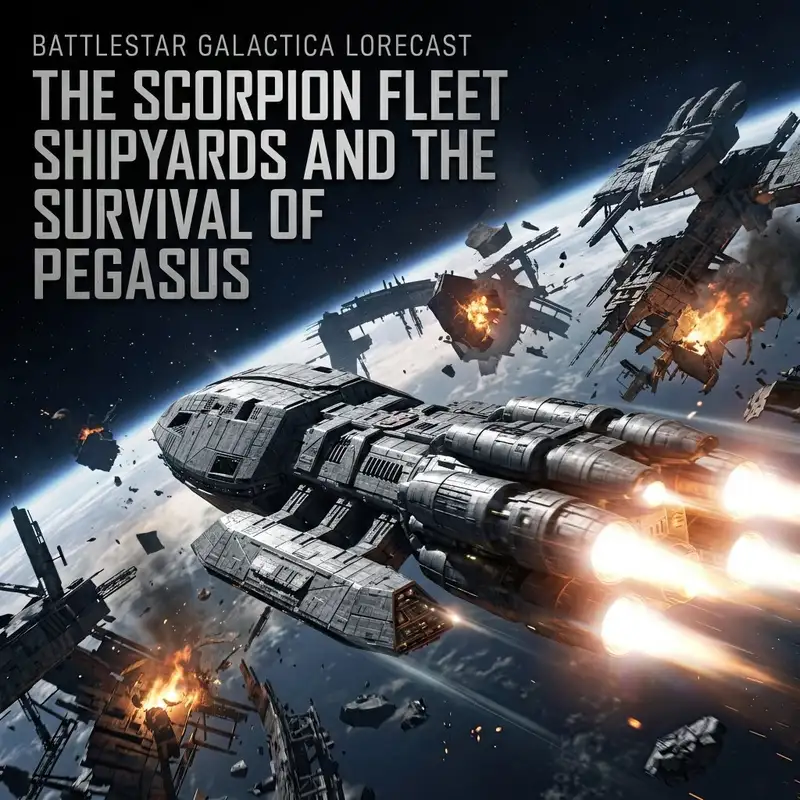
Pegasus was tied to the Scorpion Fleet Shipyards when the war arrived. Its docking connections were in place. Major systems were down for overhaul. Weapons, computers, and maintenance spaces were opened, disconnected, or committed to work that assumed the ship had time. Crew members expected a long refit, shore leave, and reunions with families. Instead, nuclear detonations began tearing through the orbital complex around Scorpia. The newest surviving Colonial battlestar was not ready to fight. It was trapped at its own dock, surrounded by the industrial machinery meant to restore it.
That contradiction explains the survival of Pegasus better than any claim about superior design. A battlestar at sea, or in deep space, carries the concentrated power of its weapons, armor, flight operations, trained crew, and command systems. A battlestar in overhaul possesses much of that power only in potential. Its aircraft may be in maintenance. Its ammunition may be handled in controlled spaces. Its networks may be shut down or altered. Its personnel may be dispersed between the ship, the station, and the planet below. The ship remains formidable in theory. In practice, it has become dependent on cranes, cables, contractors, procedures, and time.
Rear Admiral Helena Cain understood at least part of that danger. Pegasus had come to the shipyard for a planned three-month systems overhaul, an interval long enough to make maintenance more than a quick repair stop. Cain chose to remain aboard. She did not like the idea of leaving a battlestar entirely in the hands of civilian contractors, even contractors with the technical skill to carry out the work. That choice did not make Pegasus secure. It did, however, ensure that the ship’s commanding officer was present when the first reports became explosions, when the dockyard became a battlefield, and when somebody had to decide whether the ship could still be saved.
The Scorpion Fleet Shipyards were valuable precisely because they were not just a place where ships parked. They were part of the Colonial military’s ability to recover from war. A major orbital support complex could take in damaged vessels, conduct large-scale refits, service aircraft, handle weapons, coordinate skilled labor, and return ships to operational use. It linked military power to civilian industry. Engineers, technicians, contractors, logistics personnel, flight-deck workers, families, and support staff all belonged to the larger system that made a battlestar useful.
That larger system was one of the Cylons’ targets on the day of the Fall. The attack on the Twelve Colonies was not merely a campaign to destroy ships in combat. It was an effort to destroy the conditions under which the Colonies could fight back. Fleet headquarters, defense networks, planets, ports, factories, communications, military personnel, and civil institutions all mattered. A battlestar lost in battle was a serious military loss. A shipyard destroyed with battlestars still attached to it was something worse. It eliminated existing combat power and damaged the capacity to repair what remained.
The Cylon strategy exploited peacetime assumptions. The Colonial Fleet had fought the first war, accepted an armistice, and then spent decades preparing for a conflict it increasingly believed was unlikely. That did not mean Colonial officers were foolish or cowardly. It meant that readiness had become a managed condition rather than a permanent emergency. Ships required maintenance. Personnel required leave. Systems were upgraded. Contractors were trusted to work beside military crews. Major assets gathered at predictable locations because concentration made sense in a society that believed it had warning time.
The Cylons made sure there was no warning time. Their attack combined infiltration, cyber compromise, strategic surprise, conventional strikes, and nuclear force. The destruction of Scorpia’s shipyard was part of that broader offensive, but it was also a distinct disaster. Pegasus was not facing an enemy formation in open space, where its captain might maneuver, launch fighters, establish a defensive screen, and bring its batteries to bear. It was caught in a confined industrial environment, physically connected to infrastructure that now became an obstacle, a hazard, and eventually part of the wreckage.
Cain later reported that the shipyard was hit by several nuclear weapons and that five ships were destroyed, including two battlestars. That was her account from the chaos of the attack, not a complete postwar inventory. The exact order of battle at Scorpia is not cleanly established. It does not need to be. The important fact is that the shipyard suffered enough destruction to erase a major concentration of Colonial naval strength in minutes. The Cylon assault did not need every ship in orbit to be destroyed in the same way. It needed the installation to cease functioning as a fleet-support center.
Pegasus itself was hit by the collapse of readiness. Its normal systems were unavailable or unreliable. Colonel Jurgen Belzen, the ship’s executive officer, confronted a command problem familiar to every crew caught in an emergency refit, though never on this scale. The ship could not merely be switched from maintenance status to combat status with the push of a button. Manual procedures had to replace systems that were not operating properly. Information had to be passed through damaged or overloaded channels. Personnel had to report in while fires, shock waves, debris, and panic disrupted the ordinary rhythm of command.
Manual control is often romanticized after the fact. It should not be. It can save a ship when automation fails, but it is slower, more labor-intensive, and more vulnerable to confusion. It depends on trained people reaching their stations, understanding orders, and working equipment that may be damaged or incomplete. During a nuclear strike on an orbital shipyard, even finding out which systems were still available could be a dangerous task. Pegasus was not suddenly transformed into a rugged, self-sufficient relic of an earlier age. It was a modern battlestar trying to function after the infrastructure supporting its modern systems had been shattered.
The human cost was severe. Cain’s early account placed the dead at more than seven hundred. A later casualty report associated with the events at Scorpia listed eight hundred sixteen dead and one hundred twenty-one injured. Those numbers likely reflect different stages of a disaster in which crews, contractors, and wounded personnel were scattered across a damaged ship and a collapsing installation. The exact figure matters less than the character of the loss. Pegasus escaped with a crew that had been wounded, reduced, and traumatized before it ever began its independent war.
Those casualties also represented more than manpower. A battlestar needs pilots, deck crews, engineers, medical staff, officers, damage-control teams, technicians, cooks, administrators, and specialists whose work may be invisible until the moment it is missing. In a fleet with access to a living society, some losses can eventually be replaced. Training institutions exist. Shipyards can assign new workers. Families and cities produce the next generation of personnel. After the Fall, Pegasus had no such support. Every trained survivor aboard the ship became more valuable because there was nowhere reliable to replace them.
The attack also exposed the vulnerability of aircraft and flight operations. A battlestar’s Vipers are not useful merely because they exist in a roster. They require maintained airframes, fueled launch systems, ordnance, flight-deck crews, pilots, recovery space, and functioning command-and-control. Aircraft caught in maintenance areas or vulnerable launch positions can be destroyed before they contribute anything to fleet defense. In the first moments at Scorpia, Pegasus could not use its air wing as a clean answer to the crisis. The ship’s most powerful weapons had been caught inside a larger system that was already failing.
Pegasus had an accidental measure of protection. Its network was offline for the planned overhaul. That did not mean the ship had no computers, no networks, or no vulnerability to Cylon interference. It meant that one part of the wider Cylon cyber offensive could not strike Pegasus in precisely the same way at precisely the same moment. The ship’s partial isolation limited the immediate effect of compromised software. It did not restore its weapons. It did not repair its damaged systems. It did not stop nuclear missiles. It did not tell Cain where the enemy was, where friendly forces had gone, or whether the Colonies were still standing.
The distinction matters because the lesson is not that old or disconnected technology is automatically safe. Isolation can reduce exposure, but it carries costs. A ship in refit has less integration because it has less readiness. It may be harder to compromise through a network at the same moment that it is harder to command, harder to repair, and harder to fight. Pegasus benefited from being outside the normal architecture of the Colonial Fleet’s failure. It benefited because a vulnerability created by maintenance happened to blunt another vulnerability created by network dependence. That was contingency, not doctrine.
The Cylon penetration of Pegasus went deeper than code. Among the people aboard was Gina Inviere, a Number Six copy operating under the cover of a systems specialist. Gina was not Caprica Six, the Number Six copy associated with Gaius Baltar. She was a different individual, with a different assignment and a different experience of the war. Her presence aboard Pegasus demonstrated the limits of treating security as a technical problem alone. The enemy had not merely entered Colonial systems. It had entered Colonial institutions through a person trusted for her credentials, expertise, and apparent identity.
A shipyard overhaul makes that kind of access especially dangerous. Maintenance requires people to move through technical spaces, inspect systems, exchange information, and work with equipment that is normally restricted. Civilian and military personnel must cooperate. Trust is not optional. A fleet cannot sustain itself if every engineer, contractor, or specialist is treated as a potential saboteur at all times. Yet the Cylons had learned to weaponize that trust. Gina’s infiltration was one example of an enemy that could exploit professional access and human intimacy as effectively as missiles or viruses.
The released record does not establish every action Gina took during the attack. There is no need to invent a private catalogue of sabotage. Her importance lies in what her presence revealed. Pegasus was partially protected from one Cylon advantage because its systems were in overhaul. At the same time, it remained vulnerable to an enemy who had already crossed the boundary between external threat and internal access. The ship’s survival was not the triumph of perfect security. It was the survival of an institution that had been penetrated, surprised, and nearly destroyed, yet still retained enough human coordination to act.
Cain’s decisive moment came when the known danger became greater than the unknown one. Pegasus remained attached to the shipyard while nuclear strikes continued. The ship was damaged. Its command picture was incomplete. Its crew was suffering casualties. Its systems were degraded. Its location was being attacked by an enemy with overwhelming initiative. Staying at Scorpia was not a defensive option. It was a decision to remain inside a kill zone that had already consumed other ships and much of the installation around them.
The first requirement was physical separation. Docking connections that had been useful hours earlier now threatened to hold Pegasus in place. A warship cannot maneuver while tied to a station, and severing those ties under attack carries its own risks. The ship had to break free without knowing the full state of its hull, machinery, or crew. It had to leave workers and wounded behind in a disaster zone. It had to accept that damage caused during departure might be the price of avoiding destruction where it sat. The decision was not clean. No emergency separation from a shipyard under nuclear attack can be.
Once Pegasus was free enough to move, Cain faced the central problem. The ship could attempt to fight in the vicinity of Scorpia, but it was not in condition to win such a battle. It could remain near the shipyard and hope to organize a defense, but the Cylon attack had already demonstrated that the shipyard was not defensible in the time available. Or it could jump. Faster-than-light travel was not an escape button. It required functioning equipment, calculation, a destination, and enough confidence that the destination would not place the ship in even greater danger.
Pegasus did not have the time or information for a safe navigation solution. Kendra Shaw, newly assigned to the ship, found herself in the kind of emergency that turns junior officers into essential participants in history. The task was not to display individual heroism in isolation. It was to execute orders through damaged systems, pass information accurately, and keep a command team functioning when no one had a reliable picture of the next minute. Belzen, Shaw, Cain, and the rest of the command crew were trying to move a crippled battlestar before the next strike found it.
Cain ordered a blind jump. The word blind should be taken seriously. The ship was not performing a routine tactical maneuver with carefully plotted coordinates and a verified destination. It was accepting a chance of reemerging in lethal terrain because the alternative was almost certain destruction at Scorpia. A bad jump could mean collision with a celestial body, arrival in a hazardous environment, separation from whatever friendly forces remained, or the simple inability to determine where the ship had gone. The crew understood the danger. That is what gave the decision its weight.
That choice required more than courage from the admiral. It required disciplined action from people who had every reason to doubt the machinery, the information, and the future. The crew had to execute a jump while their ship was damaged, their comrades were dying, and the shipyard around them was breaking apart. In military history, command decisions often receive the cleanest language. An order is given. A ship escapes. The record looks simple from a distance. The lived reality is usually a collection of people carrying out difficult procedures while the assumptions behind those procedures have already failed.
Pegasus emerged alive. It made several jumps away from the Colonies, escaping the immediate destruction at Scorpia. The nuclear detonations and electromagnetic disturbance around the shipyard obscured the details of its departure. The Cylons concluded that Pegasus had been destroyed. That intelligence error gave the battlestar time. The ship did not win a conventional engagement. It was not concealed by a flawless plan. It survived because the evidence available to the enemy was incomplete, because the chaos of the attack masked a departure, and because the Cylons did not immediately realize that one major Colonial warship had slipped away.
The price of that advantage was isolation. Pegasus had escaped the shipyard, but it had not escaped the war. It was damaged, undermanned, and cut off from a chain of command that may no longer have existed. Its crew did not know, at first, the full scale of the Fall. They had fragments of information, rumors, damaged communications, and the growing realization that the Colonial state they had served was disappearing. A battlestar is designed to operate as part of a larger fleet and a larger civilization. Pegasus now had to determine whether either still survived.
Cain eventually learned that the Colonies and much of the Colonial Fleet had been destroyed. The strategic meaning of Pegasus changed immediately. Before the Fall, it had been one powerful vessel within a military establishment supported by planets, shipyards, bases, supply networks, and lawful civilian government. After the Fall, it was an armed remnant. It carried weapons, aircraft, surviving personnel, and some capacity for repair. It did not carry the political legitimacy of the entire Colonial government, the productive capacity of the Twelve Colonies, or the population necessary to rebuild a civilization by itself.
Cain responded by taking Pegasus into an independent war. The ship conducted hit-and-run operations against Cylon targets while trying to survive with limited information and finite resources. This was not irrational. A battlestar that believes it may be the last surviving Colonial warship has strong reasons to strike the enemy whenever it can. Aggressive action can preserve morale, disrupt Cylon movement, gather intelligence, and give a surviving crew a purpose. For people who had seen their home civilization erased, combat could also seem like the only remaining form of agency.
Yet tactical success did not solve Pegasus’s strategic problem. Destroying or damaging Cylon assets could impose costs on the enemy, but it could not restore the dead. It could not replace the shipyard network lost at Scorpia. It could not reopen schools, courts, factories, farms, or hospitals across the Twelve Colonies. It could not produce a civilian government simply by maintaining military discipline. Cain treated the preservation of military continuity as the central duty of Pegasus. That made sense within her experience. It also narrowed the definition of what survival required.
The ship’s early post-Fall history was shaped by grief, revenge, incomplete intelligence, and a command culture that increasingly treated restraint as weakness. Cain had made the right decision at Scorpia in the narrow sense that she saved Pegasus from immediate destruction. That does not mean every later decision was equally sound. Command competence is not a permanent moral credit. A leader can be decisive in catastrophe and still build a climate of fear, cruelty, or institutional blindness afterward. Pegasus survived the shipyard because it acted under pressure. It later carried the scars of a command system that struggled to distinguish survival from domination.
When Pegasus finally encountered Galactica and the refugee fleet, the consequences of Scorpia became visible in a new form. Pegasus had spent the Fall and its aftermath as an isolated warship. Galactica had spent the same period protecting civilian ships carrying the survivors of the Twelve Colonies. The two battlestars represented different answers to the same catastrophe. Pegasus preserved military power outside the civilian remnant. Galactica had become the military shield of a refugee society, bound in uneasy partnership with President Laura Roslin and the civilian government aboard Colonial One.
Materially, Pegasus was an enormous asset. It was a newer battlestar than Galactica, with more modern systems and substantial surviving capability. It brought additional personnel, aircraft, weapons, technical expertise, and another command center. In a fleet that had no secure base, no functioning homeworld, and no access to the industrial depth of the Colonies, those resources mattered. Pegasus carried not only combat strength, but skilled people and facilities that could support maintenance, repair, and later the production of replacement Vipers.
The real value of Pegasus was therefore broader than its guns. It provided redundancy. The refugee fleet no longer depended on one battlestar for every military task, every major repair decision, every flight operation, and every emergency command function. A second capital ship offered more options for escort, scouting, maintenance, and fleet defense. It could take strain off Galactica. It could also introduce friction, duplication, competing procedures, and a second institutional culture. Redundancy is valuable, but it is not always harmonious.
Pegasus also carried a dangerous political fact. Helena Cain outranked William Adama. In the formal hierarchy of the Colonial Fleet, that mattered. Cain was a rear admiral. Adama was a commander. If the question were simply which officer held higher rank aboard a surviving military formation, Cain had a plausible claim to assume command. But the refugee fleet was not merely a military formation. It contained tens of thousands of civilians, civilian ships, elected representatives, religious communities, families, workers, children, and the surviving institutions of Colonial government.
Adama’s authority rested on more than rank. He had commanded Galactica through the Fall and had protected the fleet since the first hours of extinction. His crew had developed practical relationships with civilian captains and with Roslin’s government. Galactica’s command structure had been shaped by the daily needs of a convoy that could not fight, jump, eat, or govern as though it were a single battlestar task group. Adama had no automatic right to rule civilians, but he had earned the trust that comes from carrying them through immediate danger.
Roslin’s authority rested on a different foundation. She was the lawful successor to the presidency after the destruction of the Colonial government. Her constitutional position was damaged by the collapse of the state that had created it, but it was not meaningless. A government in exile does not stop being a government merely because its territory has been destroyed. The question was whether civilian authority would remain more than a ceremonial claim when the armed force protecting the population had changed leadership and acquired a senior military officer who did not share the same assumptions.
Cain’s arrival made that question unavoidable. Pegasus had survived as a fragment of the old Colonial military. The refugee fleet had survived as an improvised society under military protection. Cain could see a crisis of command: a junior officer directing military assets while civilians constrained the fleet’s response to an enemy that had committed genocide. Roslin and Adama could see a different crisis: a senior officer whose rank might enable her to take control of a civilian population without consent, accountability, or practical understanding of the society she proposed to command.
The fact that Pegasus had endured Scorpia did not grant Cain a blank check. Survival at the shipyard had proven that she could make a hard decision under catastrophic pressure. It had not proven that she alone understood the future of the Colonies. Nor had it established that the civilian remnant existed only to support a renewed military campaign. The issue was not whether the fleet needed discipline. It did. The issue was whether discipline could be maintained without treating civilians, prisoners, subordinates, and allied institutions as objects to be commanded rather than people and bodies with rights.
Pegasus remained valuable after Cain’s death because its material strength and surviving expertise did not vanish with one commander. But it also remained fragile. The ship had lost personnel at Scorpia. It had endured months of independent operations. Its crew culture had been shaped by isolation and trauma. A battlestar can carry impressive systems and still suffer from depleted experience, damaged trust, and command instability. Modern equipment cannot compensate indefinitely for a weakened institution.
The ship’s technical condition also mattered. Pegasus had survived a refit interrupted by nuclear attack. It could repair and improvise, but repair is not a return to normal. Damage accumulates. Skilled specialists are finite. Spare parts do not appear because a ship’s need is urgent. A replacement Viper is useful, but it does not replace a dead pilot, a lost engineer, or a damaged command climate. The same industrial capacity that made Pegasus precious also made it a target for competing demands. Every hour spent manufacturing or repairing one item was an hour not spent on another.
That contribution reached its final form during the New Caprica evacuation. By then, the surviving humans had endured settlement, Cylon occupation, detention, resistance, collaboration, torture, executions, political division, and the slow recognition that freedom would require a dangerous extraction. The plan to rescue the population from New Caprica depended on time. Civilian ships needed to launch and jump away. Galactica had to reach the planet, absorb extraordinary risk, recover people, and escape before Cylon forces could close the trap.
Pegasus became part of the force that created that time. Under Lee Adama’s command, the ship entered a battle it could not expect to survive indefinitely. Its task was not just to destroy enemy vessels for the satisfaction of a tactical score. It had to delay the Cylon response long enough for Galactica and the civilian fleet to carry out the evacuation. This was a different use of military power from the independent strikes that had defined Pegasus’s early post-Fall history. The ship was no longer fighting primarily as the last instrument of a vanished state. It was fighting to protect a living population.
The distinction is crucial. A delaying action is often judged by what survives behind it. Pegasus engaged Cylon basestars and inflicted serious damage, destroying or helping to destroy two of them before it was lost. That was a substantial tactical achievement. But the central value of the action was operational. Each moment that Pegasus held the Cylons’ attention and absorbed their fire was a moment in which civilian ships could depart, Galactica could continue the rescue, and the evacuation plan retained a chance of success.
The cost was irreplaceable. Pegasus was not merely a hull. It was a reservoir of trained personnel, aircraft support, repair capacity, institutional memory, and combat power that the fleet could not rebuild easily, if at all. Losing it meant losing one of the few surviving major assets of the Colonial military. The refugee fleet escaped New Caprica, but it did not escape unchanged. A civilization reduced to a moving convoy cannot casually trade capital ships for tactical advantage. Each loss narrows the margin for future mistakes.
Yet calling the destruction of Pegasus meaningless would misunderstand both Scorpia and New Caprica. The ship had survived the shipyard attack because Cain chose dangerous uncertainty over certain destruction. At New Caprica, Pegasus accepted a different form of danger so that others could escape annihilation. The first decision saved a warship and its remaining crew. The final decision used that warship to save a civilian population from continued occupation. Between those two moments lies the moral history of Pegasus.
At the same time, Pegasus was not saved by technology alone, nor was it saved by Cain’s command skill alone. Its newer systems did not prevent the ship from being nearly destroyed in its berth. Its superior material condition did not recreate the industrial world lost at Scorpia. Cain’s decision at the shipyard was effective, but the later history of Pegasus showed that one successful act of command cannot settle questions of legitimacy, restraint, or strategy for the rest of a war.
The destruction of the Scorpion Fleet Shipyards revealed a basic truth about the Fall. Colonial power depended on more than battlestars. It depended on workers, maintenance cycles, supply systems, computer architecture, trusted specialists, civilian industry, lawful government, and the expectation that institutions would still exist tomorrow. The Cylons attacked all of those things. Pegasus survived because a few of them failed to fail at the same moment, and because its crew made the only choice that left a path out.
What Pegasus preserved was real but limited. It preserved weapons, aircraft, skilled people, technical capacity, and the ability to fight. It did not preserve the Twelve Colonies. It did not preserve the shipyards. It did not restore the dead or automatically rebuild a government worthy of the survivors. Its final service gave that distinction its fullest meaning. Pegasus mattered not because it remained alive forever, but because it eventually spent its remaining strength to protect the people, institutions, and uncertain future that no battlestar could replace.