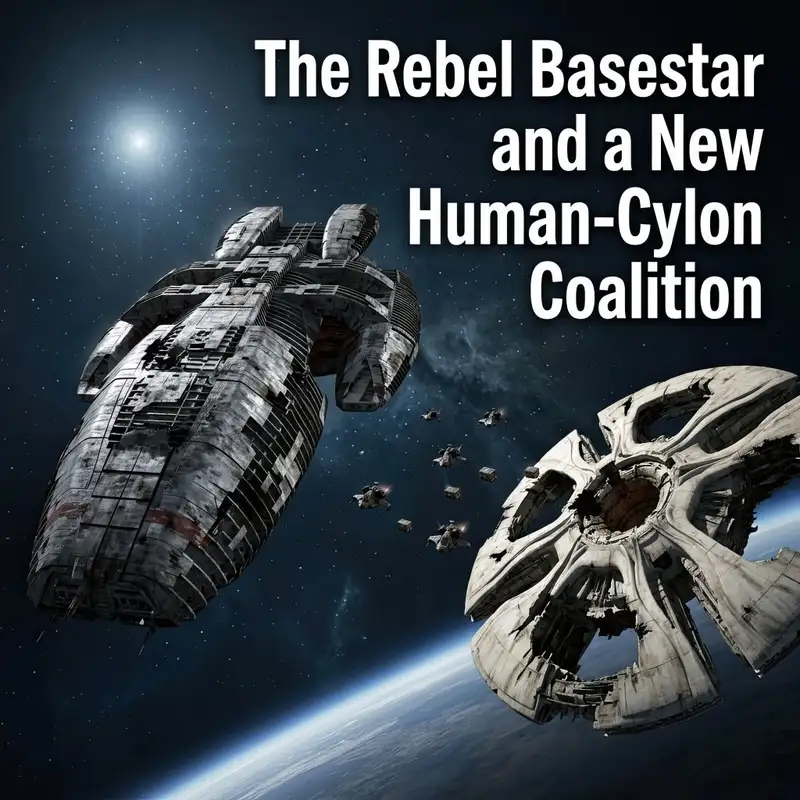
The Rebel Basestar and a New Human-Cylon Coalition
The Demetrius had left the fleet to search for Earth, but its crew had already become something less tidy than a reconnaissance mission. Kara Thrace believed she had been given a direction no navigation computer could verify. Her officers were exhausted, divided over her judgment, and operating far beyond the reassuring reach of Galactica’s flight decks and President Roslin’s authority. Then a Cylon basestar appeared.
For the Colonial personnel aboard the Demetrius, the sight carried a meaning that no tactical display could reduce to a contact symbol. A basestar was not merely an enemy capital ship. It was part of the force that had crippled Colonial defenses, destroyed the Twelve Colonies, hunted the surviving fleet, and turned ordinary human beings into refugees without a homeland. The people facing it were not neutral officers meeting a rival state after a conventional war. They were survivors confronting an instrument of the civilization that had tried to erase theirs.
Yet this basestar did not immediately attack. It belonged to a dissident Cylon faction, one at war with the larger Cylon power led by John Cavil and his allies. It carried information about the Resurrection Hub, about the Final Five Cylons, and about the routes by which a human force might enter Cylon-controlled space. In that moment, the basestar became something deeply unsettling. It was still an armed Cylon vessel. It was still capable of violence, deception, and independent action. But it was also a possible route toward strategic opportunities the Colonial Fleet could not create on its own.
That contradiction shaped the new human-Cylon coalition from the beginning. The alliance did not begin with forgiveness. It did not begin with a treaty, a shared constitution, or a declaration that old crimes had been set aside. It began because both sides had reached a point where they needed things the other possessed. The rebel basestar became the place where that dependency could be organized. It was a warship, a transport, an intelligence platform, a refuge, a negotiating chamber, and eventually a hostage site. More than any speech about peace, that vessel forced humans and Cylons to confront the practical question of whether they could cooperate before they had agreed on what either side owed the other.
The Cylon civil war created the opening, but it did not make the Cylons harmless or united. The dissident faction emerged from conflicts that had been growing inside Cylon society. The Final Five had become a source of fear, religious significance, and political division. Their existence challenged the assumptions of the numbered humanoid models, especially the authority claimed by Cavil’s faction. The question was not merely who the Final Five were. It was what their presence meant for Cylon origins, memory, resurrection, and the future direction of the Cylon civilization.
The treatment of Raiders also became a major point of conflict. Raiders were military craft, but they were not simple machines in the ordinary Colonial sense. They were biological and semi-autonomous Cylon beings, integrated into the military system that had carried out the war against humanity. Some humanoid Cylons had begun to question the control imposed on them, including the suppression of their higher autonomy. That argument was not a sentimental dispute over equipment. It concerned whether the Cylon civilization would continue to be governed through hierarchy, manipulation, and enforced obedience, or whether some Cylons would recognize moral and political obligations toward beings they had treated as tools.
Natalie, a particular Number Six copy, became one of the most important leaders in the dissident movement. She should not be mistaken for every Number Six, much less for every rebel Cylon. Her experiences, her beliefs, and her political choices belonged to her. But Natalie represented a growing refusal to accept Cavil’s direction without question. The rebels opposed the dominant faction’s control over the Final Five, its treatment of Raiders, and its determination to preserve a Cylon order built around secrecy and command from above.
Cavil’s faction remained the larger and more dangerous Cylon power. It possessed military strength, institutional reach, knowledge of human weaknesses, and an established command structure. The rebels were not a new nation with secure territory, recognized borders, or a settled government. They were a dissident force built around ships, copies, shared grievances, and urgent goals. Their basestar was therefore more than a vessel. It was the physical center of a movement that had no safe homeland.
Kara Thrace’s Demetrius mission became the first practical meeting ground between that movement and the humans. Thrace had set out because she believed she had found a path toward Earth. Her conviction came from experiences that were personally overwhelming and difficult to explain through normal military evidence. To some aboard the Demetrius, she was pursuing an essential strategic lead. To others, she was gambling lives and scarce equipment on a claim that could not be independently confirmed.
That unstable command climate mattered when the rebel basestar appeared. The Demetrius crew could more than report the contact, call for reinforcements, and wait behind Galactica’s armor. They were isolated. Their own cohesion had already been strained by disagreement over Kara’s authority and the purpose of the mission. A Cylon vessel that offered information was not merely presenting an intelligence opportunity. It was entering a human crew already unsure which orders, beliefs, and risks should govern its next decision.
The rebel Cylons brought their own uncertainty. Natalie’s faction knew that humans could not be expected to trust them. They also knew that human desperation could make the Colonials dangerous partners. The survivors had lost their worlds, their families, and nearly all conventional strategic depth. They had endured Cylon infiltration, occupation, deception, and repeated attacks. A human commander might cooperate in one hour and decide that the safest Cylon was a dead Cylon in the next.
Leoben and the Hybrid aboard the basestar complicated the situation further. Leoben was not a neutral diplomat. Like every individual Cylon, he had his own beliefs, habits of interpretation, and relationship to the events unfolding around him. The Hybrid was even more difficult to classify. It was bound into the basestar’s functioning and appeared able to influence navigation and movement in ways the humans did not fully understand. Its statements could be operationally important, but they were not the briefings of a conventional staff officer. The Hybrid did not offer a clean chain of command, a reliable explanation of its own reasoning, or a guarantee that human priorities would be respected.
The Demetrius encounter therefore created contact, not trust. It opened a channel through which the humans could gain access to information and capabilities that had previously belonged only to the enemy. It also gave the rebels a way to approach the Colonial Fleet without immediately being treated as prisoners or targets. The fact that this happened through Kara Thrace’s Earth mission gave the meeting an almost prophetic atmosphere. But the coalition that followed rested on more practical grounds. The humans needed access. The rebels needed leverage. Both sides had enemies they could not defeat alone.
The first major bargain centered on the Resurrection Hub and the Final Five. The Hub was not just another Cylon installation. It was central infrastructure for resurrection, the system that allowed many humanoid Cylons to transfer continuity of memory and identity into replacement bodies after death. That capability had shaped Cylon strategy for years. It changed the meaning of battlefield loss, encouraged a different tolerance for risk, and gave the Cylons an advantage over a human fleet that could not replace pilots, officers, technicians, or civilians at anything close to the same rate.
The rebel Cylons had their own reason to strike it. They wanted D’Anna Biers, a Number Three copy who had been boxed by the dominant Cylon leadership. They also wanted access to the Final Five, whom they believed were connected to the deepest questions of Cylon origin and the path to Earth. The Final Five were not merely historical curiosities. They were political currency. Whoever could identify them, control access to them, or persuade them to act might influence the future of the Cylon people.
The humans needed something different. They needed Cylon intelligence about the Hub, access to the systems guarding it, and navigation through areas where Colonial forces could not operate with confidence. They needed to know where to go, how to approach, and what kind of response Cavil’s faction might mount. A Colonial battlestar could deliver powerful force, but firepower without access would be wasted. A nuclear weapon was only useful if it could be brought to the target. Vipers and Raptors could fight, scout, and strike, but not if their crews were navigating blind through hostile territory.
The rebel basestar made this arrangement possible because it concentrated the capabilities the rebels could offer. It could move through Cylon operational space using knowledge and systems unavailable to the Colonial Fleet. Its Hybrid-linked navigation gave it a relationship to Cylon movement and infrastructure that the humans could not reproduce. It could carry personnel, provide temporary refuge, and operate as a contact point between human crews and Cylon dissidents. It could communicate within Cylon systems, though never with perfect security or perfect knowledge. It could bring the coalition close to targets that would otherwise remain beyond Colonial reach.
The basestar also provided a political center for the rebels. Natalie, Leoben, D’Anna after her recovery, and other dissident Cylons needed somewhere to meet, move, argue, and make decisions outside Cavil’s authority. A fleet without territory often turns its ships into institutions. Galactica had become the armed core of the surviving human polity. Colonial One had become a seat of civilian government. The rebel basestar performed a comparable function for a faction that had no capital, no recognized legislature, and no secure population center beyond the people and systems aboard it.
The Colonial contribution was different. Galactica and the surviving human forces brought experienced pilots, Vipers, Raptors, strike crews, weapons, and a hard-earned understanding of fleet defense. The Colonial Fleet had spent years learning how to protect civilian ships while under pursuit. It knew the cost of limited aircraft, exhausted pilots, damaged hulls, incomplete intelligence, and irreplaceable losses. Its people had developed a culture of damage control and improvisation because they had no shipyard network behind them and no secure rear area to absorb mistakes.
The humans also brought nuclear strike capability. That did not make them automatically dominant in every joint operation. A weapon cannot solve a navigation problem, an intelligence problem, or a political problem simply by being destructive. But against the Resurrection Hub, a nuclear device offered the prospect of striking a target whose strategic value far exceeded its visible size. The Colonial Fleet could provide a means of destruction that the rebels needed, while the rebels provided the route and access the humans required.
When the rebel basestar moved into the Colonial Fleet’s operational orbit, the arrangement ceased to be a remote military calculation. It became a constitutional crisis. The civilian population had been asked to live under military protection for years, but the government still had to answer a basic question: who had authorized an armed Cylon vessel to come near the surviving human population? The Quorum’s concern was not petty obstruction. The survivors had been hunted by Cylons who could look human, manipulate systems, infiltrate command structures, and strike without warning. A basestar in proximity to the fleet was a security threat even if its current leadership claimed to be cooperative.
The problem was also one of sovereignty. The Colonial government was not merely a collection of passengers who needed to be informed after the military had made a decision. It represented the remaining claim that the refugees were still citizens rather than dependents of whichever officer commanded the largest gun. If Admiral Adama could bring a Cylon warship into the fleet without civilian consent, what limits remained on military emergency power? If the Quorum had to approve every operational contact before a crisis could be managed, could the fleet seize a rare opportunity against Cavil’s forces?
Lee Adama occupied an important position in this dispute. His role was not just to mediate between his father and the civilian government. He helped translate military necessity into terms that could be debated before the Quorum and understood by a frightened public. That mattered because alliances require more than operational logic. They require some degree of legitimacy among the people expected to live with their consequences. A pilot can be ordered into a dangerous strike. A civilian population cannot be ordered to forget genocide because a new strategic opportunity has appeared.
The presence of the rebel basestar forced the fleet to confront practical questions for which it had no settled law. Could Cylon personnel move among civilian ships? Could humans board the basestar safely? Who would investigate an incident involving Cylon and human personnel? What happened if the rebel Cylons demanded supplies, access to Colonial systems, or recognition as political partners? Could the Colonial government reject the alliance if Galactica believed it was militarily necessary? The coalition had no joint headquarters, no shared legal code, and no agreed rules of engagement beyond the needs of immediate missions.
Natalie’s death revealed how quickly that weakness could become personal. Natalie had been a political leader, but she was also an individual Number Six copy. Her presence aboard the human fleet did not erase the trauma of the war, and it did not protect her from the fear surrounding Hera Agathon. Hera was a child whose existence carried enormous emotional, political, and spiritual significance for both humans and Cylons. When she reacted strongly to Natalie’s presence, Athena interpreted the moment as an immediate threat to her daughter.
Athena killed Natalie. The act cannot be separated from the history that made it possible. Athena had been a Cylon infiltrator before becoming Sharon Agathon, a member of the Colonial community, a pilot, a wife, and Hera’s mother. She had experienced manipulation by other Cylons, suspicion from humans, imprisonment, violence, and the constant fear that her child would be taken from her or used by others. In that moment, she did not treat Natalie as a diplomatic counterpart in a fragile alliance. She treated her as a possible danger to Hera.
The strategic consequence was severe. Natalie had provided a recognizable channel between the dissident Cylons and the humans. Her death removed a leader who understood both the rebels’ goals and the necessity of working with the Colonial Fleet. It made the Cylon faction more unstable. It confirmed to the rebels that human fear could become lethal without warning. It also confirmed to many humans that the alliance could be shattered by a single ambiguous encounter involving a child, a Cylon, and a history no one had escaped.
Hera’s reaction was never reduced to a complete explanation. It had connections to visions, identity, and events beyond the understanding of the people present. But the immediate political fact was simpler. A coalition built without stable institutions had to rely on individual judgment in moments of fear. Athena made a decision as a mother and as a security officer. The consequences extended far beyond either role. The alliance lost its first major intermediary because no joint system existed that could contain panic, verify threat, or absorb tragedy without changing the political balance.
The crisis involving President Roslin and the basestar’s Hybrid showed the same weakness at a higher level of command. When the Hybrid took Roslin aboard the rebel basestar, the ship became the center of a rescue and pursuit problem. Tactically, Adama had to determine how to recover the President. Operationally, he had to manage a vessel capable of independent movement and faster-than-light jumps beyond Colonial control. Politically, Roslin’s absence threatened the civilian government at a moment when the fleet was already divided over leadership and the Cylon alliance.
The basestar was nominally cooperating with the humans, yet it could remove the President from human custody. That fact exposed the danger of relying on personal assurances instead of defined authority. The Hybrid’s actions could not be treated as a conventional mutiny because the Hybrid was not a conventional officer. Nor could they be dismissed as a minor misunderstanding. Roslin’s safety mattered to the continuity of civilian rule. If the President could disappear aboard an allied Cylon warship, then the alliance had created a vulnerability at the heart of the Colonial political system.
Adama’s response reflected both his duty and his dependence. He could not ignore Roslin’s abduction or treat it as an acceptable cost of working with the rebels. But he also could not easily destroy or abandon the basestar without losing access to intelligence, navigation, and a possible strike against the Hub. The situation placed the Admiral in the position every improvised coalition fears. He needed the partner that had just demonstrated it could not be controlled through ordinary command channels.
The joint operation against the Resurrection Hub was the coalition’s clearest demonstration of military necessity. The objective was not merely to destroy a target. It was to alter the strategic conditions of the war. The rebels sought to recover D’Anna and deprive Cavil’s faction of a decisive advantage. The humans sought to make Cylon losses matter in a way they had not before. Both sides understood that if resurrection remained secure, Cavil’s forces could absorb risks and casualties that the Colonial Fleet could not match.
The mission depended on a division of labor. The rebel Cylons provided intelligence about the Hub and the environment surrounding it. They offered access to Cylon space, familiarity with Cylon systems, and a route toward a target the humans could not independently locate or approach with confidence. Their basestar made it possible to bring the joint force into the relevant operational area. Without that platform, the Colonials would have possessed weapons but no reliable path to use them.
The human contribution was equally necessary. Colonial personnel brought disciplined flight operations, strike planning, piloting, weapons employment, and combat experience earned during years of protecting a vulnerable civilian fleet. The humans could deploy Vipers and Raptors in coordinated roles. They could manage the difficult work of launching crews into danger, recovering survivors, maintaining aircraft, and making decisions under fire when every trained pilot represented a resource the fleet could not easily replace. They also brought the nuclear capability needed to destroy the Hub once access had been achieved.
The mission did not remove the possibility of betrayal. Each side had reason to wonder whether the other was using the operation for a narrower purpose. The rebels might be seeking the Final Five more than they cared about the destruction of the Hub. The humans might be willing to use the rebels until their intelligence value was exhausted, then turn on them. Cavil’s faction could react with forces and defenses the coalition did not fully understand. The Hub itself was not merely a stationary target on a map. It was a critical component of an enemy civilization whose internal systems remained partly opaque even to dissident Cylons.
The destruction of the Hub was a tactical success. A major Cylon installation was destroyed. It was an operational success because it damaged the system through which Cavil’s faction maintained a critical advantage. It was a strategic success because it changed the consequences of future Cylon death. Cylon forces could still fight. They could still kill. They could still use basestars, Raiders, Centurions, and humanoid infiltrators. But the assurance of resurrection had been gravely undermined for those dependent on the destroyed infrastructure.
D’Anna Biers emerged from the Hub operation as the coalition’s next central political figure. She was a particular Number Three copy, not a generic representative of all Number Threes or all Cylons. Her experiences, including her boxing and recovery, shaped her urgency. D’Anna had long been driven by questions about the Final Five, Cylon origins, and the path to Earth. After Natalie’s death, D’Anna’s role became even more important because the rebel faction had lost the leader most associated with cautious contact with humanity.
D’Anna’s priorities were not identical to those of the Colonial Fleet. She wanted the Final Five identified and brought into the open. She believed they carried knowledge and authority that could reshape the Cylon future. The humans, especially Roslin and Adama, viewed the Final Five as a source of danger as well as information. Their identities had implications for the fleet, for the Cylons, and for the fragile political balance among the survivors. The more the rebels demanded access, the more the Final Five became a bargaining asset rather than simply a mystery.
That truth became unmistakable during the standoff surrounding the Final Five. D’Anna held Roslin, Gaius Baltar, Helo, and other Colonial personnel aboard the basestar while demanding the identities of the Five. This was not the behavior of a fully trusted ally operating under a common chain of command. It was coercion. It placed human leaders and personnel under the control of a Cylon faction that believed it possessed a stronger claim to vital knowledge than the Colonial government was willing to concede.
D’Anna’s demand was not meaningless obsession. From her perspective, the Final Five were central to the fate of the Cylons. They might explain origins, reveal buried history, and offer a path toward Earth. After the destruction of the Hub, the rebels faced a future in which their losses were permanent and their political position was precarious. The Final Five seemed to offer not only truth, but legitimacy. If D’Anna could reach them, she might gain the authority needed to define the rebel faction’s future.
Roslin saw the matter differently. She had accepted cooperation because the alliance served human survival. She had not agreed to allow an armed Cylon faction to seize human personnel and dictate terms. Her response remained conditional and severe. If negotiation failed, she authorized Adama to destroy the basestar. That decision carried enormous risk. The basestar contained hostages, useful intelligence, potential allies, and a faction whose survival might still matter against Cavil. But Roslin understood that a government unable to protect its own leaders from coercion would not remain a government for long.
Adama’s dilemma was equally stark. He had to weigh the rescue of Roslin and the other hostages against the military value of the basestar and the broader need for Cylon cooperation. Destroying the ship could eliminate an immediate threat and demonstrate that the Colonial Fleet would not submit to blackmail. It could also kill human personnel, end the most valuable intelligence channel available to the fleet, and push the remaining dissident Cylons toward desperation or hostility. Restraint might preserve the alliance. It might also reward coercion.
When Saul Tigh, Samuel Anders, Galen Tyrol, and Tory Foster were revealed as four of the Final Five, the information did not produce a coherent Cylon leadership group. These were individuals with separate human lives, separate relationships, and separate understandings of what they had become. They did not suddenly function as a united command staff for either side. Their revelation altered the political landscape because it gave D’Anna some of the truth she sought, but it did not solve the question of who should control that truth or what responsibility the Five bore for the past.
At that point, the fifth member of the Final Five remained unresolved to the people involved. That uncertainty mattered. It prevented either faction from claiming a complete answer. It also preserved the atmosphere of suspicion around the basestar. Every revelation produced more leverage, more fear, and more reason for humans and Cylons to wonder whether the other side was concealing something essential.
The eventual decision to continue the search for Earth together was therefore not a declaration of peace. It was another bargain. Lee Adama helped negotiate a path forward in which humans and rebel Cylons would pursue the signal associated with Earth. The coalition moved ahead because the alternatives were unattractive. The humans still needed information, mobility, and access. The rebels still needed the Final Five and a future beyond Cavil’s faction. Neither had resolved the moral debt created by genocide, occupation, assassination, infiltration, or hostage-taking.
The joint search led to the devastated world the fleet had hoped would be Earth. For the humans, the discovery was a profound strategic and emotional blow. Earth had become more than a destination. It was the imagined refuge that justified years of sacrifice, conflict, and endurance. It was the place where the survivors believed they might finally stop running, rebuild institutions, and create a future beyond the shrinking walls of their fleet. Instead, they found ruins.
The discovery did more than disappoint a navigation plan. It undermined the political and religious meaning attached to the journey. Roslin’s faith, Kara’s conviction, Adama’s willingness to keep moving, and the hopes of ordinary civilians all had to confront evidence that the expected refuge had already been destroyed. The fleet had reached a destination, but not a usable homeland. Military success in finding a world did not produce strategic success if that world could not sustain the civilization seeking it.
For the rebel Cylons, the devastated Earth carried a different but equally destabilizing meaning. It confronted them with evidence connected to histories and identities they had not fully understood. The rebels had sought the Final Five partly because they believed the Five might lead them toward their origins and their future. Instead, the search brought them to a place that deepened uncertainty. The coalition’s shared objective had been damaged just as its members had become more dependent on one another.
The coalition could win the Hub operation, recover crucial information, and continue the search for a future without becoming a reconciliation. It proved that humans and Cylons could cooperate when neither could achieve an urgent objective alone. It did not establish a shared law, settle responsibility for genocide, guarantee citizenship, or answer how armed enemies could coexist without coercion. The rebel basestar made cooperation possible because it brought dependence into one place, and it made peace difficult because every person aboard had to decide whether that dependence was a bridge to survival or another weapon waiting to be used.