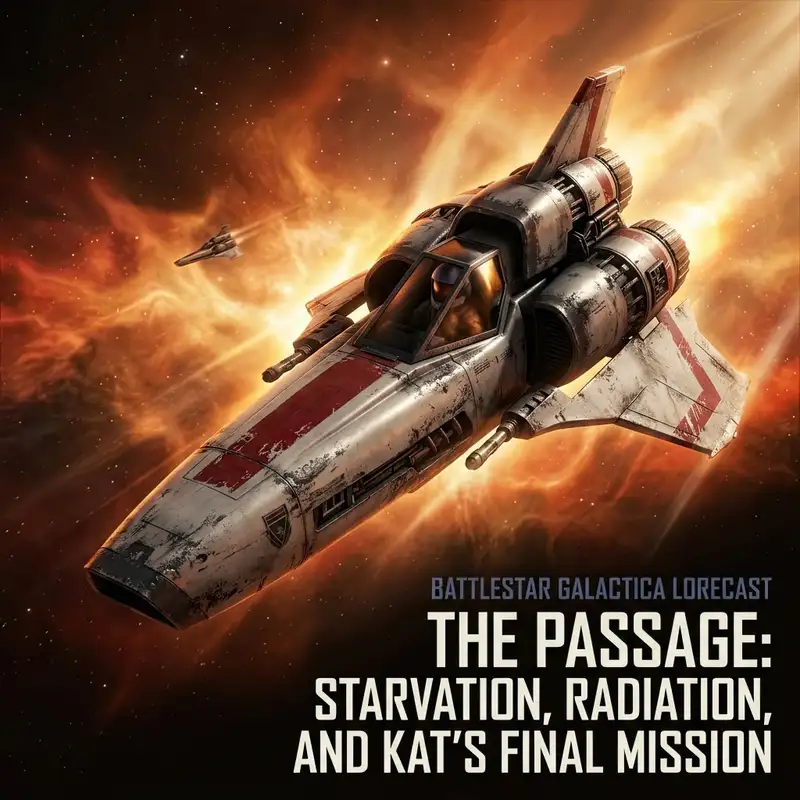
The Passage: Starvation, Radiation, and Kat’s Final Mission
A protein bar has become something to divide, not something to eat. Flight crews break food into small pieces, pass crumbs across a table, and try to keep the routine of work from revealing how close hunger is to changing everything. The fleet’s food system has been contaminated. Whatever stores may exist in principle, the practical supply of safe, usable rations is collapsing. The estimate is brutal enough without false precision: perhaps a week, perhaps ten days. After that, the problem is no longer a reduced menu. It is starvation in a civilian population already living aboard crowded ships with limited medical care, limited labor reserves, and no secure place to resupply.
That distinction matters. A fleet does not live on inventory figures alone. Food has to be processed, transported, distributed, prepared, and trusted. A failure anywhere in that chain can turn apparent abundance into hunger. For the civilians, it means fear, rationing, exhaustion, and arguments over who receives what. For Galactica, it means every watch station, repair crew, pilot, and medic is working with less physical reserve. Hunger does not announce itself with one dramatic failure. It weakens concentration, patience, judgment, and the ability to endure the next emergency. In a refugee fleet, those are military resources as surely as fuel or ammunition.
The fleet does have a possible answer. A nearby planet contains algae that Doctor Cottle judges can provide real nutrition, even if no one expects it to inspire fond culinary memories. The algae is not a miracle, and the planet is not a new home. It is a replenishment opportunity, a way to keep people alive long enough to face the next problem. But the route to it crosses a region of intense radiation and blinding stellar light. The obstacle is not merely danger in the abstract. It is a navigational environment that strips civilian ships of the reliable information required to move, orient themselves, and make coordinated faster-than-light jumps.
Lieutenant Sharon Agathon, Athena, finds the planet during reconnaissance. Her role is operationally decisive because she can endure conditions that would likely kill an ordinary human pilot. That advantage is not a general statement about every Cylon or every mission. It is a specific fact of this one. Athena can enter the radiation-blasted region, survive long enough to gather information, and return with a route toward food. The fleet benefits from a Cylon officer’s physiology at precisely the moment when old categories of human and machine are least useful. The question is not philosophical. It is immediate. Can the fleet use the capabilities available to it before its people run out of food?
Going around the stellar region is not a serious alternative. The detour would take too long, and time is the one resource starvation does not permit commanders to borrow. Going straight through is dangerous because the civilian ships cannot trust their own navigation under that radiation and glare. A ship can survive a hazard and still be operationally lost if it cannot determine where it is, communicate reliably, or calculate a safe jump. In deep space, confusion is not merely inconvenient. It can become separation, collision, a jump into danger, or a civilian vessel left behind with no realistic means of recovery.
Admiral William Adama’s response is not a fighter attack, a bold flanking maneuver, or a single ship’s stand against an enemy. It is convoy work. The fleet must move vulnerable civilian vessels through a lethal environment in controlled groups. Galactica becomes both escort and refuge. Many civilians are moved temporarily aboard the battlestar, while their own ships operate with skeleton crews. That reduces the number of people exposed inside each civilian hull. It also concentrates a large civilian population aboard a warship whose primary function is already stretched between defense, command, maintenance, and survival.
The evacuation procedure is grim but rational. A civilian ship cannot be abandoned lightly. Each vessel carries people, equipment, living space, technical skills, records, and some share of the fleet’s social and economic capacity. But leaving every passenger aboard during the crossing would expose them to a threat the ship cannot adequately withstand. Moving people to Galactica is a form of risk distribution. The civilian vessels remain necessary, but the greatest number of civilians are placed behind the battlestar’s comparatively stronger protection. It is a reminder that the fleet’s military and civilian structures are not separate worlds. In a crisis, they are forced to become one improvised survival system.
The Raptors are the essential craft in that system. Vipers are built for interception and combat air patrol. They are not the principal tools for a passage defined by navigation, communication, coordination, and faster-than-light movement. Raptors can guide the civilian ships through the radiation, provide navigational reference when civilian systems fail, and make the necessary jumps with the vessels they shepherd. They are scouts, pathfinders, communications nodes, and, if something goes wrong, the first available rescue asset. Their mission resembles the work of a convoy escort in hostile seas, except that the sea itself is killing the ships.
Galactica’s armor and shielding provide better protection than the civilian fleet’s thin, varied collection of transports, passenger liners, freighters, and utility vessels. But better is not the same as safe. The battlestar can enter the hazard because it has more protection and greater resilience. It cannot remain there indefinitely, and it cannot absorb every failure without consequence. The entire plan depends on time. The crews have to move civilians, prepare ships, assign Raptors, establish order, enter the passage, retain enough orientation to jump, and emerge with enough people and equipment still functioning to continue the operation.
That makes the pilots and Raptor crews a critical bottleneck. Ships can have armor. Machines can have shielding. But the people in the cockpits remain biological. They accumulate radiation exposure, fatigue, hunger, fear, and the strain of making decisions while their instruments are degraded. The fleet uses radiation badges that darken as exposure builds. They are not presented as laboratory-grade medical instruments. They are practical warning devices, a rough way to tell a pilot and a commander that someone has reached a limit and should not be sent back into the hazard.
The badges make visible something every military organization must manage, even when it prefers not to see it. Personnel are not interchangeable parts. A pilot may be willing to fly again. A commander may desperately need that pilot to fly again. Neither fact means the pilot’s body can safely comply. The badge is supposed to turn an invisible injury into a command decision. When it darkens, the system is meant to remove the pilot from the rotation before exposure becomes fatal. That is not weakness. It is force preservation. A fleet with no replacement pipeline cannot afford to spend trained crews as though there will always be another class waiting behind them.
The hunger crisis complicates even the simplest medical choices. Stimulants may keep a tired pilot alert for a few more hours, but there is a cost. Kat points out the practical danger. Increasing a starving person’s metabolism does not create food. It can drive an already depleted body harder while offering no real recovery. Her observation is not the complaint of someone avoiding work. It is the judgment of a pilot who understands that endurance has limits, and that military medicine cannot defeat biology through confidence or chemical shortcuts.
Colonel Saul Tigh returns to the Combat Information Center during this crisis. The crew applauds him, and then the moment ends because the work has to continue. His return matters less as ceremony than as institutional restoration. Galactica has endured occupation, exile, divided command, and the destruction of Pegasus. Now its executive officer is back at his station while the fleet attempts one of the most dangerous noncombat operations of the journey. In a smaller story, that might be a triumphant entrance. Here, it is something more restrained. A battered institution has regained an experienced officer just in time to confront a problem no individual can solve alone.
The first passage establishes the real nature of the mission. This is not a clean escort operation in which military craft protect civilians from Raiders and then return to a safe carrier deck. Brendan Costanza, known as Hot Dog, guides the civilian ship Adriatic into the hazard. The ship is lost. No enemy weapon has to fire. Radiation, glare, disorientation, degraded navigation, timing, and the simple difficulty of keeping a convoy together are enough. The failure exposes the cruelty of the environment. A vessel can vanish because the fleet cannot see clearly enough to save it.
The loss of Adriatic is not just an unfortunate mark on an operations board. It means people are gone. It means another ship’s worth of shelter, labor, equipment, and social connection has disappeared. The exact count is less important than the effect. Every lost civilian hull makes the surviving ships more crowded. Every lost crew reduces the fleet’s pool of mechanics, cooks, teachers, nurses, technicians, and ordinary workers. Every loss also changes trust. Civilians are being asked to surrender their ships to military procedure, leave their families temporarily aboard Galactica, and believe that the command plan can get them through a region that has already taken one of their own.
That is why the operation cannot be judged simply by whether the fleet reaches algae. Reaching the destination matters. It may prevent starvation. But the manner of getting there matters as well. A command structure that saves food while treating civilian ships as disposable cargo would damage the legitimacy it needs for every later emergency. Adama’s plan attempts to avoid that logic. The civilian vessels are not expendable. They are the object of the mission. The difficulty is that preserving all of them may be beyond the capability of any plan available to him.
Kat is at the center of that difficult distinction. She is a capable Raptor pilot, a squadron leader, and an officer who understands the passage better than many people watching it from a safer compartment. It would be easy to cast her only as Starbuck’s abrasive rival, the hard-edged pilot who drives herself too far and receives a tragic ending. That would miss the professional record in front of the fleet. Kat is trusted with difficult work because she has earned that trust through performance. She can assess risk, manage a crew, and keep functioning in a mission that requires calm when every visual cue says that the universe has become uninhabitable.
But Kat carries a concealed fracture in her identity. A man named Enzo recognizes her by another name, Sasha. His presence reveals that Kat’s history before the Fall includes drug running and that, shortly before the Cylon attack, she assumed the identity of Louanne Katraine after the real Katraine died. The deception is serious. In any functioning peacetime military, identity fraud would raise questions about enlistment, records, access, and command suitability. In the survivor fleet, it also raises a more intimate question. If the name on Kat’s uniform began as an act of survival, does that make every act of service that followed a lie?
The episode’s answer is more complicated than either condemnation or absolution. Kat entered the fleet under a false identity. The record does not establish that every part of her military career was fabricated, or that her competence in the cockpit was false. It does not show that she is a Cylon infiltrator, a sleeper agent, or part of an enemy intelligence operation. This is a human case of reinvention, deception, and vulnerability to blackmail. Enzo’s leverage comes from what Kat fears others will conclude. She believes that if Sasha is exposed, Kat will cease to exist.
That fear makes her unusually susceptible to a damaging kind of courage. People under identity pressure often try to solve a moral problem by becoming indispensable. If Kat can fly better, work harder, take greater risks, and save more lives than anyone expects, then perhaps no one can dismiss her as a fraud. It is an understandable response, but it is dangerous. Competence can establish trust. It cannot erase a secret through sheer physical punishment. A pilot who treats every mission as a trial of personal worth will eventually mistake self-destruction for duty.
Kara Thrace sees enough of this to force a confrontation. Starbuck is not gentle, and the relationship between the two women has never been easy. Yet her judgment reaches beyond the fraud itself. Kat has committed deception, but she has also become someone through her service. The mistake is not that Kat has a past. Everyone in the fleet has one, and many have done things before or after the Fall that they would rather leave buried. The mistake is Kat’s belief that she can only be legitimate if she destroys Sasha completely.
Starbuck’s intervention is not a sentimental reconciliation, and it does not erase the deception. It asks Kat to stop turning her former self into an enemy that must be beaten every day. That is a difficult lesson in a military culture that rewards endurance and can confuse suffering with character. A person can accept responsibility without treating pain as proof of sincerity. Kat appears to understand that, at least briefly. But understanding a truth and living by it are different tasks, especially when the fleet needs pilots and the next passage is already forming.
During one of the crossings, Kat loses contact with the civilian ship Carina. She stays in the radiation long enough for her badge to turn black. The darkness is not a symbolic inconvenience. It means she has crossed the limit that should remove her from further exposure. She returns with evidence that the mission has taken something from her body that skill cannot recover. The procedure has worked in one narrow sense. It has identified a pilot who should be grounded. But the procedure depends on honesty. It assumes that the person carrying the badge accepts the authority of the warning.
Kat does not. She exchanges her blackened badge for Karl Agathon’s unexposed badge and conceals the extent of her exposure. It is a small act in physical scale, one badge traded for another. Institutionally, it is enormous. The exposure-control system is only as reliable as the reporting chain behind it. A badge can warn a pilot, but it cannot compel that pilot to tell the truth. Supervisors can establish limits, but they cannot protect personnel who are determined to evade them. In a force operating under extreme scarcity, every safeguard is vulnerable to the belief that one more mission is worth any cost.
Kat’s hair begins to fall out. The body tells the truth even when the paperwork does not. Her deception is not merely an individual moral failure, though it is that. It is also evidence of the pressure built into the operation. The fleet has too few qualified crews, too little time, and too much at stake. Kat knows that others may have to take her place if she is grounded. She also knows that, once she is removed from flying, Enzo’s knowledge and her own past may become harder to outrun. The badge swap lets her remain useful. It also turns usefulness into a path toward death.
Here, command responsibility becomes painful. It would be simplistic to blame Adama for every choice made by a pilot under radiation exposure. He has established a rule designed to protect crews. He has not ordered Kat to falsify her condition. Yet commanders must understand the environment their orders create. In an exhausted unit, especially one that regards itself as civilization’s last defense, personnel may interpret duty as an invitation to conceal weakness. A system built on voluntary self-reporting needs oversight, trust, and enough depth of manpower that grounding someone does not feel like abandoning the fleet.
The final passage begins with that weakness already inside the operation. The pilot force is tired. The convoy has lost ships. The food crisis has not disappeared just because algae has been found. Galactica itself enters the dangerous region and begins to suffer. Heat rises. Decompression problems appear. The battlestar’s protection is real, but it is finite. The ship that sheltered civilians and anchored the convoy is now experiencing the same basic truth as every other vessel. It cannot remain indefinitely in an environment that is steadily damaging its systems and threatening the people aboard.
A civilian ship is missing. Under ordinary circumstances, a search would be the moral and professional instinct. A commander does not casually leave a vessel behind. But Adama must assess the situation at fleet scale. The longer the Raptors search visually in the radiation, the more danger they face. The longer Galactica remains in the region, the more serious its own damage may become. The civilians temporarily concentrated aboard it are also at risk. A rescue effort can become a wider disaster if it consumes the force needed to protect everyone else.
Adama orders the Raptors to stop searching and complete the jump. It is a hard order, but it has coherent military logic. Tactically, it preserves the remaining navigation assets and flight crews. Operationally, it protects Galactica and the larger convoy from a hazard that is already causing damage. Strategically, it prevents starvation relief from becoming a catastrophe that destroys the fleet’s central military refuge. Politically and morally, however, the order carries a terrible implication. One missing civilian ship may be abandoned because the force cannot safely spend itself trying to recover it.
That tension is the essence of command under extinction pressure. A good commander cannot promise that no one will be left behind. He can only decide where further sacrifice will stop producing a survivable result. The order is not heartless because it recognizes limits. It is tragic because those limits are real. If Galactica is crippled, if the remaining Raptors are lost, or if the entire group fails to jump, the fleet does not become more humane because it tried to save one additional ship. It merely loses more people.
Kat refuses the order. She remains in the radiation and continues the search until she finds the missing civilian vessel, Faru Sadin. Then she guides it through the passage. Her action saves a ship that would otherwise likely have been lost. The success is materially important. Faru Sadin is not just a point of light on a DRADIS display. It carries human beings and preserves some portion of the fleet’s already diminished capacity to live, work, house people, and endure. Kat has not saved the whole fleet by herself. She has succeeded within the larger system created by Adama’s convoy plan, Galactica’s protection, Raptor operations, and the willingness of civilians to submit to a dangerous procedure.
Her success also does not turn disobedience into doctrine. Withdrawal orders exist because commanders must prevent a difficult situation from consuming all available assets. Kat had better information than Adama in one important respect: she found Faru Sadin. She also had a hidden medical condition that made her judgment inseparable from self-punishment. Had she failed to find the ship, her Raptor and crew might have been lost as well. Had other pilots followed the same instinct without restraint, the passage could have become a cascade of isolated searches and avoidable deaths.
That is what makes Kat’s action both admirable and troubling. She does something brave. She does something useful. She accepts a risk that no one should casually demand of another person. But she also turns an order-defying decision into a final test of whether she deserves her own name. Her courage is real. So is the self-destructive force driving it. The fleet can honor the result without teaching the wrong lesson. A military organization should recognize initiative, but it cannot survive if every exhausted pilot decides that personal redemption outranks command discipline and medical limits.
Kat returns to Galactica to celebration. The fleet sees what it can see. A pilot stayed behind, found a missing ship, and brought it through. In a community desperate for evidence that courage still matters, the response is immediate and heartfelt. Then Kat collapses. The public moment gives way to sickbay, where the damage is no longer something she can hide with a substituted badge. The radiation exposure is terminal. There is no recovery plan, no return to flight status, and no further act of service that can reverse what has happened to her body.
The final care Kat receives must be understood with care as well. Starbuck gives her medication that allows her to avoid prolonged suffering from irreversible radiation injury. This is not a triumphant warrior’s death, and it should not be romanticized as one. Kat is not choosing death because life has become meaningless in a general sense. She is already dying from injuries sustained during the mission. The moral question is about mercy, consent, pain, and the relationship between two officers who have spent much of their time together in conflict. Starbuck’s role is not to celebrate Kat’s death. It is to remain present when the consequences of that mission become unbearable.
Adama visits Kat as she prepares to confess what she believes disqualifies her from honor. He does not demand the confession. He understands enough to recognize the person before him. That does not mean identity fraud has suddenly become irrelevant. It means that the fleet’s judgment cannot be reduced to the name Kat used before the Fall. She served. She led. She took responsibility. She saved people. Her past remains part of the record, but it is not the whole record. In a fleet made of refugees, survivors, former criminals, politicians, workers, soldiers, and people remade by catastrophe, that distinction is essential.
Adama restores Kat symbolically to the position of Combat Air Group commander. The gesture is significant precisely because it is not an operational rewrite. Lee Adama remains the active CAG. The air group still needs a functioning command structure, and memorial recognition cannot replace the officer actually managing sorties, pilots, and flight operations. Kat’s restoration is a statement about service and belonging. The institution acknowledges that she became a real officer through the work she did, even if the path that brought her into uniform began with deception.
That recognition is generous, but it is not uncomplicated. Kat’s death exposes the terrible economy of the refugee fleet. The people most needed for survival are often those most willing to spend themselves beyond safe limits. Pilots, engineers, medics, deck crews, and civilian specialists can all become trapped in the same logic. If I stop, others will suffer. If I disclose my weakness, someone else must take the risk. If I can keep working one more day, perhaps I will prove my value. That logic can produce extraordinary service. It can also destroy the very people a civilization needs to preserve.
The passage succeeds at the tactical level because Raptors guide civilian vessels through a radiation-blinded route. It succeeds at the operational level because Galactica acts as escort, refuge, and command platform while civilians are moved out of the most exposed ships. It succeeds strategically because the fleet reaches a source of algae and avoids immediate starvation. But none of those successes are clean. Civilian ships are lost. Crews are exposed. The battlestar is damaged. The food source is temporary. The fleet has gained time, not a functioning agricultural base, a replacement industry, or a secure homeland.
The operation also reveals the limits of technological advantage. Athena’s Cylon physiology makes reconnaissance possible. Hardened Raptor systems make guided passage possible. Galactica’s armor makes temporary refuge possible. Yet none of those advantages eliminate hunger, radiation, confusion, or human error. The most sophisticated ship in the fleet still overheats and suffers decompression. The most capable pilots still need food and medical limits. The most carefully designed convoy procedure still depends on people accurately reporting their condition under pressure. Technology changes the available options. It does not remove the consequences of choosing among them.
For Adama, the passage demonstrates the value of disciplined, system-wide planning. He does not solve starvation with a speech or defeat radiation with a single ship. He assembles a procedure from the assets still available: Raptors, civilian crews, evacuation capacity, medical monitoring, hardened navigation, and Galactica’s greater resilience. It is a sound approach because it recognizes that the fleet survives through coordination. But the same mission demonstrates that no procedure is self-executing. A plan can establish limits. It cannot guarantee that frightened, proud, exhausted people will honor them.
For Kat, the passage becomes a final answer to the question she has been asking herself since she took another woman’s name. Was she really Katraine, or only Sasha hiding behind a uniform? The answer is not found in the deception, and it is not found in her death. It is found in the accumulated reality of her service. She became a pilot, a leader, and a person others depended upon. That was real. Her redemption lies in that truth, not in the radiation that killed her or the pain she endured to prove it.
Her death is the warning. A fleet can ask much of its people when extinction is the alternative. It can ask them to work hungry, fly tired, accept danger, and carry responsibilities that should never have fallen on one generation of survivors. But it cannot build a future by requiring its wounded people to prove their worth with their bodies.