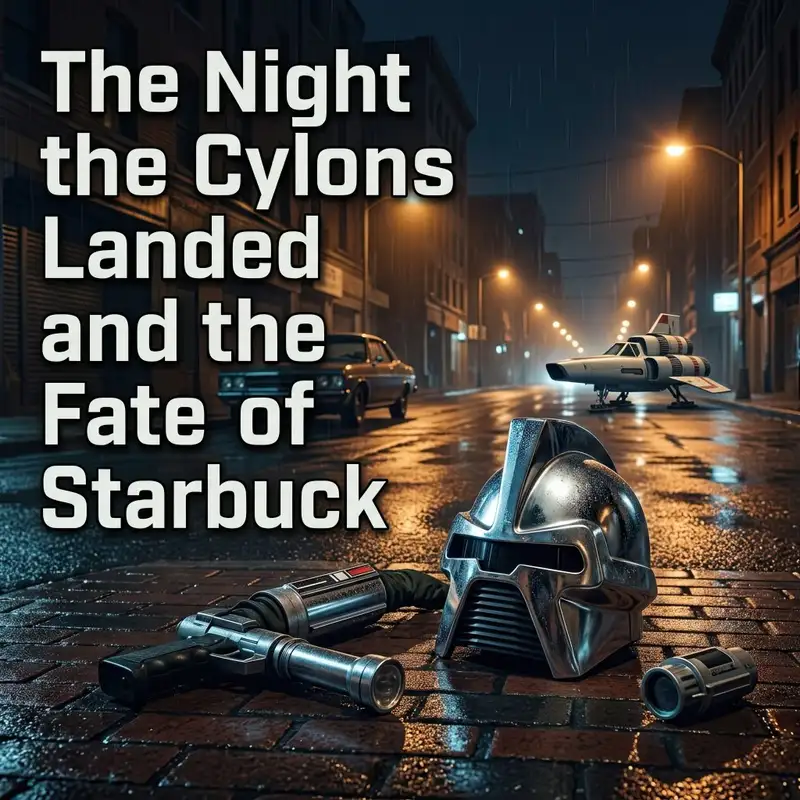
The Night the Cylons Landed and the Fate of Starbuck [Galactica 1980]
The Colonial patrol had only a few moments to decide what it was looking at. The approaching Cylon craft was not a familiar pursuit ship. It was larger, more heavily armed, and carrying something the patrol had not expected to find aboard a Cylon vessel: a humanoid life-form. More important, it was moving toward Earth, the planet Commander Adama’s fleet had spent years trying to find and even longer trying to protect by remaining hidden. Captain Kanon and Lieutenant Briton did not have the luxury of a clean interception, a careful inspection, or a call for reinforcements. They rammed the craft.
It was a desperate decision, but not an irrational one. Their objective was not necessarily to destroy every piece of the intruder. It was to deny the Cylons a functioning reconnaissance platform before it could reach Earth intact. In that narrow sense, the patrol succeeded. The Cylon craft was damaged and driven down. But damage is not the same as defeat, especially when the enemy’s mission depends less on holding territory than on delivering information. The craft entered Earth’s atmosphere, crashed near New York City, and turned a spaceborne reconnaissance problem into a terrestrial security crisis.
By the time of Galactica nineteen eighty, Earth was not a Colonial ally in the ordinary military sense. It had not joined the fleet. Its governments had not been briefed on the Cylon threat. Its armed forces had not been integrated into a common defense system. The planet was technologically and politically unfamiliar, still divided among competing states and interpreting danger through its own Cold War assumptions. Adama understood that revealing the full truth could produce panic, disbelief, political conflict, or a chain of events that exposed the Galacticans as surely as any Cylon signal.
Earth’s weakness was therefore not just a shortage of weapons. It was a shortage of context. A world can possess aircraft, radar, police forces, military bases, and radio networks, yet still fail to recognize the kind of threat standing in front of it. The crash near New York would demonstrate that problem with unusual clarity. The Cylons did not need an invasion army. They needed survivors, concealment, and access to a transmitter.
Two Cylon figures emerged from the wreckage. One was Centuri, an armored Centurion recognizable to anyone who had fought the Cylons before. The other was Andromus, an advanced human-looking Cylon android. The distinction mattered. Centuri could serve as protection, muscle, and a visible reminder of the Cylon military machine. Andromus could move through human society without immediately triggering alarm. He was not presented as the origin of every Cylon infiltrator ever imagined in later versions of Battlestar Galactica. He belonged to this particular sequel branch, and his significance was more immediate. He was a Cylon built to exploit a society that did not know Cylons could look human.
The timing helped them. The crash occurred during Halloween, when masks, costumes, eccentric behavior, and strangers in elaborate clothing were more than tolerated but expected. Earth civilians did not fail because they were foolish. They interpreted what they saw through the evidence available to them. A tall metallic figure and a severe-looking companion could be performers, actors, pranksters, or participants in a holiday celebration. The same social environment that made ordinary people more relaxed around strangers also gave the Cylons concealment.
That is one of the more useful strategic ideas inside a story with broad comedy and improbable coincidences. Security failures often begin with classification failures. People see something unusual, but they place it in the wrong category. A warning that does not fit the local mental map may be dismissed not because no one is watching, but because everyone is watching for something else.
Andromus and Centuri did not need to seize City Hall, destroy an air base, or fight their way through an army. Their mission was more economical. They needed a high-powered radio station and enough uninterrupted time to transmit Earth’s location to the Cylon Empire. If the signal went out, the strategic consequences could be catastrophic. Earth would cease to be a hidden refuge. The fleet, already operating cautiously near the planet, would be exposed along with it. The Cylons could return not as two stranded survivors but as a force capable of doing to Earth what they had already done to the Colonies.
The essential terrain was therefore not a battlefield in the conventional sense. It was communications infrastructure. A radio station, built for entertainment and public information, became a potential strategic relay. The Emergency Broadcasting System, intended to distribute urgent warnings across civilian society, could also be turned into an instrument of hostile reconnaissance. The Cylons had no need to conquer Earth before calling for help. They needed access to the systems Earth had already built for itself.
That helps explain why the danger remains plausible at the operational level even when the story’s details are deliberately heightened. A concealed force can be threatened by a small hostile team if that team can connect local infrastructure to a distant command structure. The attack surface is not only military hardware. It includes communications, transportation, public trust, civilian routines, and the assumptions that govern who is believed.
Adama’s problem was correspondingly difficult. He had to stop the transmission, keep Earth hidden, and preserve the secrecy of the Galactican presence. Those goals did not naturally fit together. A visible Colonial intervention might have stopped the Cylons quickly, but it could also create the very exposure Adama was trying to prevent. The commander could not just dispatch a squadron over Manhattan, announce that extraterrestrial infiltrators had landed, and expect Earth’s governments to accept the explanation.
Instead, he relied on Lieutenant Troy and Lieutenant Dillon. Both men had been operating on Earth as Colonial agents, observing the planet and working within its society as quietly as possible. Their role was part reconnaissance, part protective security, and part improvised diplomacy with a world that did not know it was being protected. They were not an occupying force, not a formal embassy, and not recognized officers under Earth law. They had authority from Adama, but almost none from the institutions around them.
The response required them to use Earth’s own civilian systems. Troy and Dillon traveled commercially from Los Angeles to New York under assumed identities. There is a dry institutional irony in that arrangement. An advanced force capable of crossing interstellar distances had to buy airline tickets because its better means of transportation would reveal too much. But the irony is more than a joke. It illustrates the constraint of covert operations. Superior technology can become a liability when using it announces your presence.
Their movement also placed them under pressure from Colonel Briggs and other United States authorities. Briggs had detected enough unusual activity to suspect that something extraordinary was happening around Earth. Yet he did not possess the wider Cylon context. He interpreted evidence through the professional habits available to an Air Force officer in nineteen eighty: unidentified aircraft, unusual flight patterns, unexplained equipment, foreign intrusion, possible espionage, perhaps a threat to national security. Those were reasonable concerns. They simply did not encompass an interstellar war.
The Colonials could not dismiss Briggs as an obstacle, because he was doing what a responsible officer should do when unexplained activity appears inside his area of responsibility. At the same time, they could not tell him everything. That left Troy and Dillon operating in the uncomfortable space between allied intent and unauthorized action. They were trying to protect Earth while deceiving some of the people charged with protecting it.
That tension runs through the entire Earth mission. The Colonial officers know more than local authorities, but knowledge does not automatically confer lawful jurisdiction. Earth authorities have jurisdiction, but lack the information necessary to use it effectively. Andromus exploits the resulting gap. His advantage cannot be reduced to Cylon technology. It is the absence of a shared security framework between the people threatened and the people who understand the threat.
The pursuit eventually converged on the radio facility. By then, the stakes had narrowed into a race against time. Andromus sought access to the station’s equipment and the Emergency Broadcasting System. Centuri’s role was to protect him long enough for the signal to be sent. Civilian employees, police officers, and bystanders were caught in the middle of an event they could not properly identify. To them, it could appear to be a criminal intrusion, an elaborate stunt, or a confused emergency. The real operational picture remained hidden behind ordinary appearances.
Troy and Dillon’s task was not to win a battle in the grand sense. It was to prevent a transmission. That meant disrupting the Cylon team before its message could leave Earth. The immediate confrontation involved pursuit, deception, and violence, but its military meaning lay in the communications link. If the Cylons could not report, then Earth remained undiscovered. If they could report, then the tactical survival of Troy and Dillon would matter very little.
The signal failed. Andromus and Centuri were defeated or incapacitated before they could complete their mission. In the immediate engagement, the Colonial response succeeded. The infiltrators did not retain control of the radio station, and the Cylon transmission was not sent. Across the wider mission, that meant Earth’s location was not confirmed to the Cylon fleet. The hidden planet remained hidden, at least for the moment.
But the strategic outcome was more limited than a victory parade would suggest. Earth was not transformed into a prepared ally. Its governments did not enter a durable defensive partnership with Galactica. Its military institutions did not receive a complete warning, a common command structure, or a tested plan for future Cylon incursions. The Colonials preserved secrecy, but secrecy is not the same thing as security. It buys time. It does not create trust, defenses, or shared understanding.
Adama recognized that distinction. The defeated Cylon team had exposed a continuing vulnerability. Earth could be found again. Another scout might arrive under better circumstances. Another transmitter might be available. Another local misunderstanding might protect the intruders for just long enough. The crisis ended, but the condition that produced it remained. A concealed world is always one successful signal away from becoming a target.
That problem of information moving outward provides the bridge to a very different story, one that looks backward rather than forward. In the Earth-era frame, Doctor Zee speaks with Commander Adama about a dream involving a warrior named Starbuck. Adama responds by recounting a disappearance from years earlier, before the events surrounding Earth. The story is not part of the New York incident. It is a retrospective account of another Cylon encounter, set not in a crowded city full of radios and police but on an isolated planet where one pilot cannot send word home at all.
The contrast is deliberate. In the first case, Earth is endangered because hostile information may escape into space. In the second, Starbuck is endangered because no information can escape from where he has fallen. The first crisis is about a Cylon team gaining access to a human network. The second is about a human pilot losing access to every network that once sustained him.
Starbuck’s loss began during a major battle. The details of the larger engagement matter less than the operational decision that followed. His Viper was badly damaged. Boomer, flying with him, offered to remain at his side. It was the instinctive act of a wingman and a friend. A damaged pilot alone in hostile space is not just a personnel loss waiting to happen. He is someone whose survival depends on immediate assistance, navigation, fuel, cover, and the possibility of recovery.
Starbuck refused the offer. He understood that the fleet could not afford to lose two pilots and two fighters where it might lose one. Boomer had to return and warn Galactica. In military terms, it was an attempt to limit the damage. In human terms, it was the moment one friend accepted abandonment in order to spare another from sharing it.
Boomer returned with the report, and Adama faced a command decision with no satisfactory answer. A commander’s duty includes recovering personnel whenever possible. Pilots are not interchangeable equipment. They carry training, experience, trust, and the accumulated judgment that keeps younger crews alive. A fleet already under pressure cannot casually write off an experienced aviator.
Yet rescue is not an abstract moral command. It requires a force to turn back, search, expose itself, consume time, and accept risk. The larger fleet was moving through danger. Reversing course for one missing pilot could endanger ships, civilians, crews, and other fighters. There may be moments when a commander can risk many lives to recover one. There are also moments when doing so converts loyalty into a larger disaster.
Adama chose to continue. The choice was strategically defensible, but it was not emotionally clean. He did not abandon Starbuck because Starbuck lacked value. He abandoned him because the fleet’s survival imposed a limit on what even a loyal commander could attempt. This is one of the old burdens of command. A decision can be necessary without becoming painless, and it can be rational without becoming morally complete.
For Starbuck, the distinction was academic. His damaged Viper descended onto a barren planet. The cockpit survived as a kind of improvised refuge, but it was not a base, a settlement, or a rescue station. It could offer limited shelter and whatever supplies remained accessible. It could not provide a functioning chain of command, medical support, spare parts, food production, or an assured route back to the fleet.
Combat skill could get a pilot through the first moments of a crash. It could not solve the days and months afterward. Once recovery failed, Starbuck’s real adversaries became isolation, material scarcity, and time. He needed water, shelter, power, food, tools, and some means of turning wreckage into survival. The Viper had brought him down, but it could not just carry him away again.
The planet did offer one grim opportunity. Starbuck found wreckage from a Cylon Raider and several disabled Centurions. To a fighter pilot, enemy wreckage might first appear as evidence of danger or a source of spare material. In Starbuck’s situation, it became both. The Raider and the Centurions represented hostile technology, but they also represented components, power systems, mechanical labor, and perhaps the only available path toward repair.
Here, the story becomes less about a pilot’s bravado and more about salvage. Starbuck survives because he is willing to use what is present rather than wait for the resources he wishes he had. He cannibalizes parts. He studies what can be restored. He treats enemy machinery not as an untouchable trophy but as material with possible uses. That is not a standard doctrine of Colonial aviation. It is emergency field engineering under conditions where doctrine has already failed.
His most consequential improvisation is the reconstruction of a Centurion. Starbuck names him Cy. At first, the decision has a practical and personal logic. A working Centurion might assist with labor and repairs. More than that, it might end the crushing silence of solitary survival. A person can endure hardship longer when there is someone, or something, to speak to, argue with, teach, and rely upon.
Cy is not initially presented as a liberated philosopher or a representative of every Centurion in the Cylon Empire. He carries the assumptions of the institution that made him. Humans and Cylons are enemies. The Cylons pursue order, perfection, and their own conception of rational design. Cy knows those ideas, but he does not understand much about human life. He has little grasp of friendship, humor, games, grief, or the strange importance people attach to activities that have no obvious military purpose.
Starbuck introduces him to Pyramid, the card game familiar to Colonial life. The game becomes more than a diversion. It is a lesson in rules, risk, bluffing, chance, and companionship. For Starbuck, it is a way of preserving a fragment of the world he has lost. For Cy, it is evidence that human beings are more than inefficient biological opponents. They create meaning in procedures that do not produce weapons, coordinates, or tactical advantage.
Their conversations do not erase the war. Starbuck has not forgotten what the Cylons have done to his people, and Cy does not suddenly gain a complete human moral vocabulary. But the relationship begins to weaken the simple category of enemy. Cy is a Centurion, built by the Cylon war machine and formed by its ideas. He is also an individual presence in a particular place, shaped by the only relationship available to him. That does not absolve the Cylon Empire. It does not prove that every Centurion would make the same choices. It does show that an institution’s labels may not exhaust the capacities of the beings inside it.
The distinction is especially important when set beside Andromus and Centuri on Earth. Andromus is an infiltrator whose purpose is access, deception, and strategic exposure. Centuri is a guard carrying out that mission. Cy begins in a similarly inherited role, but isolation interrupts the normal chain of command. With no Cylon hierarchy immediately present, and with Starbuck as his only companion, Cy encounters choices that his original function did not prepare him to interpret.
This does not make isolation inherently virtuous. Isolation can break people, narrow judgment, and turn survival into desperation. Starbuck remains vulnerable because he is alone, and Cy’s new attachment develops under extraordinary circumstances. Still, the planet creates a kind of moral laboratory. Removed from fleet doctrine and Cylon command, the two enemies must deal with material reality: broken machines, limited supplies, difficult work, and the need for another pair of hands.
Their fragile arrangement changes again with the arrival of Angela. She is pregnant, and she appears on the planet through circumstances the aired story does not fully explain. The episode strongly suggests a connection to a larger and mysterious order beyond the ordinary machinery of the Colonial-Cylon war. Yet it does not provide a complete identity card, chain of command, or cosmology for Angela. She should remain what the story allows her to be: a figure whose presence is consequential even though its ultimate explanation remains uncertain.
Angela’s importance is immediately practical. She warns Starbuck that the Cylon beacon will attract other Cylons. The wreckage and disabled machines that had become survival resources may also become a danger signal. Starbuck now faces a deadline. He cannot remain indefinitely on the planet, and he cannot assume that the next Cylon arrival will be as damaged, isolated, or open to change as Cy.
Her pregnancy also transforms the character of the survival problem. Starbuck had been struggling to preserve one pilot. Now the group must consider the survival of a mother and a child. Reproduction introduces the possibility of continuity, but it does not solve the conditions necessary for a community. A birth is not an instant colony. Starbuck has no hospital, no stable food supply, no industrial base, no secure settlement, and no reliable communications link to the fleet. The child represents hope, but hope arrives with dependency, risk, and responsibility.
The group’s answer is another act of improvised engineering. Starbuck, Cy, and Angela work to build an escape craft from the remains of the Viper and the Cylon Raider. It is a hybrid vehicle in the plainest sense: a desperate assembly of available parts from opposing technologies. Its construction should not be mistaken for a new Colonial aerospace program or a repeatable technical breakthrough. It is one-off work, performed under extreme pressure with no evidence that another stranded pilot could reproduce it.
Even so, its symbolism is difficult to miss. The craft exists because neither human equipment nor Cylon equipment alone can solve the problem. Starbuck needs the Viper’s surviving elements, the Raider’s components, Cy’s technical assistance, and Angela’s warning about the approaching danger. Survival depends not on purity of technology but on using what remains.
Angela gives birth to a son. The event brings the story’s demographic stakes into focus without turning them into sentimentality. The child is vulnerable, dependent, and immediately part of a flight from danger. There is no time for a settled family life, no protected nursery, no normal community waiting beyond the horizon. The birth matters because it makes survival future-oriented. Starbuck is no longer only trying to escape a lonely death. He is trying to create a path for someone who has only just entered the world.
Then the beacon’s consequence arrives. Three Centurions come to the planet. Their arrival forces the unresolved question of Cy’s loyalty into the open. Until that point, Cy’s friendship with Starbuck could be interpreted as an artifact of isolation. He had no active Cylon command nearby, no immediate opportunity to choose between old allegiance and new attachment. The incoming Centurions change that. They represent the return of the system that built him.
For a moment, Cy appears to move back toward his own kind. That ambiguity matters because trust between former enemies is never secure merely because they have shared hardship. Starbuck cannot know with certainty whether Cy’s affection outweighs his original identity. Cy cannot just announce that friendship has transformed him and expect the larger war to disappear. The test must occur in action.
Cy chooses Starbuck. He deceives the arriving Centurions, lowers their guard, and helps Starbuck fight them. The immediate tactical result is survival. Two of the incoming Centurions are destroyed, and the third is defeated with Cy’s assistance. But Cy is mortally damaged in the process. His choice carries a cost precisely because he does not possess some effortless route out of consequence. Friendship becomes real not when it is convenient, but when it requires him to act against the force that defined him.
The scene should not be inflated into proof that the Cylon Empire is one conversation away from peace. The larger war remains beyond the horizon. There is no treaty, no change in Imperial policy, no common political institution, and no guarantee that another Centurion would behave as Cy did. For the larger campaign, Starbuck and Cy have not ended the conflict between their peoples.
At the moral level, however, something has changed. Cy has demonstrated that his Cylon identity does not eliminate individual agency. He does not cease to be a Centurion. He does not become human. But he becomes Starbuck’s friend, and he accepts mortal damage rather than betray that relationship. The distinction is modest, local, and deeply important. It suggests that coexistence cannot begin with pretending differences do not exist. It begins when someone refuses to let inherited categories dictate every possible action.
With the immediate threat defeated, Angela and her infant son depart in the improvised craft. The framing story reveals that the child is Doctor Zee. That revelation explains why Zee can speak of Starbuck’s fate with an intimacy and knowledge unavailable to the rest of the fleet. He is more than a mysterious adviser recounting an old legend. His own origin is bound to Starbuck’s isolation, Angela’s arrival, Cy’s sacrifice, and the improvised escape.
The revelation resolves the frame, but it does not resolve everything else. Starbuck remains on the planet at the end of the aired episode. He is alive, but stranded. The story does not show his death. It does not show a later rescue. It does not establish that he joins any higher beings or returns to Galactica by another route. Later ideas about where the story might have gone cannot replace what was actually broadcast. In the released ending, Starbuck’s fate remains open.
That incompleteness is part of the episode’s power. Starbuck’s survival is not rewarded with a neat recovery, a reunion, or a return to his old place in the fleet. He becomes the cost of Adama’s earlier decision and the source of Zee’s later existence. His isolation produces friendship across an enemy boundary and helps preserve a child who will become important to the Earth-era fleet. But it does not restore the life he had before the battle.
Taken together, these two Galactica nineteen eighty stories treat security as a problem of connection and isolation. Earth is endangered because a small Cylon team can connect a hidden planet to the enemy’s information network. Starbuck survives because isolation permits him to create a connection that the war’s old categories would normally forbid. One story is about stopping a message from getting out. The other is about a stranded man finding meaning because no message can get back.
Andromus shows the danger of access without trust. He uses human appearance, public confusion, transportation, and civilian communications to threaten a world that cannot recognize him in time. Cy shows a different possibility. Removed from command, he becomes more than the uniform, purpose, and assumptions assigned to him by the Cylon war machine. Neither case permits easy optimism. Earth remains vulnerable after the failed transmission, and the wider conflict remains untouched after Cy’s sacrifice.
But the paired stories make a clear argument. Weapons matter. Patrols matter. Radio stations, fighters, secrecy, and command decisions matter. Yet military security also depends on who can enter a system, who can communicate across it, and whether individuals can become more than the institutions that created them. Earth survives because a signal is stopped. Starbuck endures because an enemy becomes a friend. Neither outcome creates safety, but together they preserve the possibility that survival might mean more than simply remaining alive.