The Maglev Bombing and the Security Crisis on Caprica
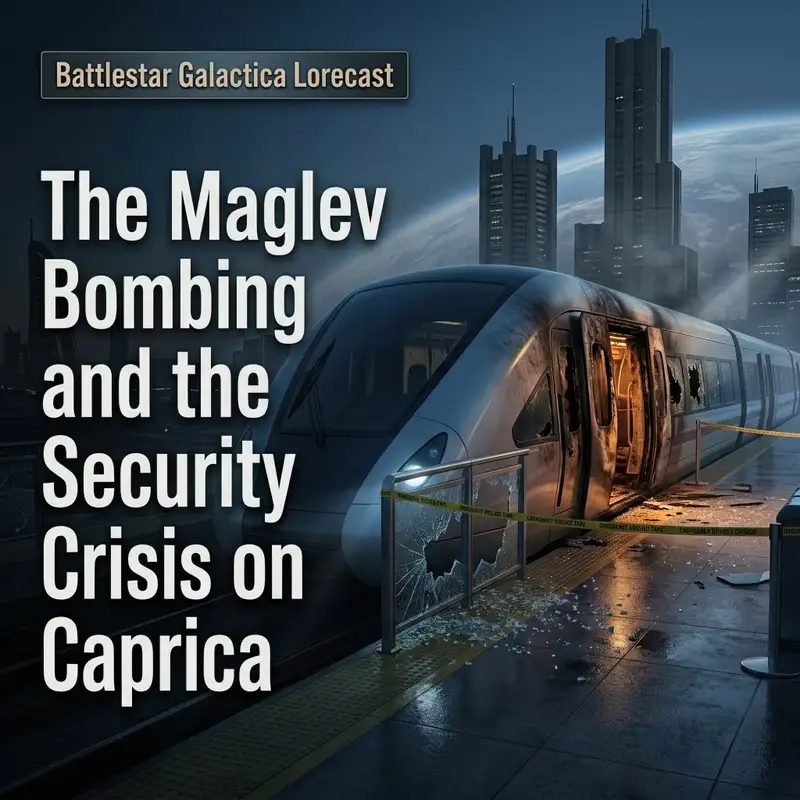
A Caprica City maglev train was built around a simple civic bargain. Thousands of people could move quickly beneath and above one of the Twelve Colonies’ great metropolitan centers because they accepted routine, proximity, and trust. Students rode with workers. Families rode with strangers. The system’s value came from making daily movement ordinary. That was also its vulnerability. Ben Stark entered that ordinary space carrying a suicide vest. Zoe Graystone, his girlfriend, was on the train. So were Shannon and Tamara Adama. Lacy Rand, who had been expected to travel with Zoe and Ben, had withdrawn before the journey. Ben declared a religious purpose for his act and detonated the device. He died with his victims. Hundreds of passengers were killed, with more than five hundred commonly reported in later accounts, though the released record does not settle the precise total. The explosion destroyed more than a train. It turned public transit into a crime scene, private grief into a political force, and religious association into an object of state suspicion.
The bombing occurred roughly six decades before the Fall of the Twelve Colonies, in a Caprica that had not yet learned the habits of a civilization at war for survival. Caprica was wealthy, technologically ambitious, and culturally influential. It was also divided by class, family status, religion, criminal power, corporate competition, and resentment toward a public culture many people regarded as complacent. Those divisions did not make violence inevitable. They did, however, shape the language through which violence was understood. Ben did not attack a military base, a government ministry, or a weapons plant. He attacked a crowded civilian system used by people who had no practical role in the political conflicts he claimed to oppose. His target was ordinary life itself. That made the bombing a security event, but also a symbolic assault on the confidence that a prosperous city could remain open, mobile, and safe.
The immediate facts of the attack were devastatingly clear. Ben Stark carried the bomb. Ben Stark detonated it. Ben Stark died in the blast. Still, terrorism investigations rarely end with the person who pressed the final switch. The harder questions concern who knew, who helped, who encouraged, who failed to intervene, and who merely moved through the same ideological or social circles. Those questions are necessary. They are also dangerous when investigators, politicians, grieving families, and frightened citizens begin answering them before the evidence can bear the weight. On Caprica, the bombing became a larger security crisis because the public needed a complete explanation faster than the available facts could produce one. The result was a widening circle of suspicion. A bomber became a movement. A movement became a presumed conspiracy. Association became evidence of complicity. And a dead teenage girl became, in the public imagination, both victim and suspect.
Caprica’s religious landscape was central to that process. The public culture of the colony was shaped largely by polytheist tradition, by the worship of the Lords of Kobol, by temples, rituals, and inherited social assumptions. Yet it was not religiously uniform. Monotheist currents existed within Caprican society, including communities that saw the dominant culture as spiritually corrupt, morally empty, or dangerously decadent. The Soldiers of the One emerged from that environment. Its members professed belief in one true God and rejected the plural religious order around them. That belief, by itself, did not explain a bombing. Religion is not a security threat merely because it differs from the majority faith. The issue was the way particular people within the Soldiers of the One translated theological conviction into political alienation, clandestine activity, and, in Ben Stark’s case, mass murder.
The distinction mattered because Caprica’s first public response risked treating the entire movement as if it possessed one mind, one chain of command, and one operational plan. What the released story shows does not support that conclusion. The Soldiers of the One included competing personalities, different levels of commitment, and conflicting views of violence. Sister Clarice Willow held influence in one part of the movement. Barnabas Greely represented a more militant current. Other adherents were drawn by faith, alienation, friendship, youthful rebellion, or the promise of belonging. Later events make clear that Ben’s bombing was not necessarily the act of a unified organization operating through a settled and uncontested command structure. Some figures within the movement regarded his attack as premature or unauthorized. That does not reduce Ben’s responsibility. It does mean that a serious investigation had to distinguish ideological influence from command direction, sympathy from operational support, and rhetoric from a specific conspiracy.
Ben’s own motives can be described only within limits. He was an Athena Academy student. He was involved with the Soldiers of the One. He was close to Zoe Graystone. He framed his final act as service to the one true God. Those facts establish an ideological context and an individual commitment to violence. They do not provide a complete map of his private reasoning. The public often wants a bomber to fit a tidy profile: a solitary madman, a disciplined operative, a puppet of a hidden leadership, or the inevitable product of an entire community. Ben does not fit neatly into any of those categories. He acted alone at the point of detonation, but he did not develop his beliefs in a vacuum. He moved within a religious and political environment that gave him language for grievance, purity, sacrifice, and opposition to Caprican society. The question for authorities was not whether that environment mattered. It plainly did. The question was how far responsibility could honestly be extended beyond the man who carried the device.
The question became especially painful in the cases of Zoe Graystone and Lacy Rand. Both were part of Ben’s social world. Both had connections to the Soldiers of the One. Zoe and Lacy had planned to leave Caprica for Gemenon with Ben. On its face, that plan was relevant. It indicated that the three young people shared enough trust and ideological affinity to contemplate abandoning their lives on Caprica together. It suggested preparation, secrecy, and a break with their families. Investigators were right to ask what Zoe and Lacy knew, what they expected to find on Gemenon, and whether the planned departure had any relation to the attack. But relevance is not proof. A plan to leave Caprica is not proof of knowledge of a bomb. Friendship with a radical is not proof of participation in murder. Religious membership is not proof of operational guilt.
Lacy’s decision not to board the train sharpened the problem. She had been connected to Zoe and Ben, and she withdrew before the attack. That made her important to investigators and potentially vulnerable to pressure from the Soldiers of the One themselves. She had knowledge that others lacked, but knowledge is not the same as complicity. A witness may know fragments without understanding their significance. A friend may recognize troubling behavior only after disaster has given it a new meaning. A young person immersed in an intense religious circle may be afraid to disclose what she has seen, uncertain whether it matters, or unable to distinguish ordinary secrecy from preparations for violence. Counterterrorism work requires investigators to pursue those ambiguities. It fails when ambiguity is treated as a defect to be erased rather than the condition under which difficult judgments must be made.
Zoe’s position was even more fraught because she died on the train beside Ben. She was not available to explain herself, correct the record, or answer questions about her relationship with him. Her absence created a vacuum, and institutions are often tempted to fill such vacuums with the most convenient available theory. Zoe had joined the Soldiers of the One circle. She had rejected much of her parents’ world. She had planned to leave Caprica. She had concealed parts of her life from Daniel and Amanda Graystone. Those facts were troubling, especially after a mass-casualty attack carried out by her boyfriend. Yet the released story does not establish that Zoe knowingly helped plan the bombing or that she boarded the train expecting Ben to kill everyone around them. She may have been traveling toward a future she imagined very differently from the one Ben had chosen. The tragedy is that her death did not protect her from accusation. It made accusation easier.
The institution charged with sorting those questions was the Global Defense Department. The Global Defense Department was not the later Colonial Fleet, and it should not be imagined as a simple equivalent of any one modern security service. It functioned as a hybrid agency, combining elements of investigation, intelligence, counterterrorism, and public security. In the aftermath of the bombing, agents Jordan Duram and Youngblood faced an authentic and urgent task. They had to determine whether Ben had acted alone, whether further attacks were planned, whether other members of the Soldiers of the One possessed weapons or access, and whether the bombing was part of a wider campaign. Those were not abstract concerns. A successful attack on mass transit creates immediate fear of repetition. Every suspicious message, missing person, religious meeting, and unexplained financial transaction may appear to be the beginning of another disaster.
Duram’s problem was not an absence of evidence. It was evidence of uncertain meaning. The investigation recovered and reconstructed electronic material associated with Zoe’s computer, including a message that appeared connected to events surrounding the bombing. In a less politically charged context, such a discovery might have remained one lead among many. In the aftermath of a public atrocity, it acquired a much larger significance. Digital evidence carries a particular kind of authority. It feels objective because it is recorded. It feels precise because it can be displayed, copied, reconstructed, and repeated. Yet a message can be incomplete. It can be misread. It can refer to a plan without revealing who understood the plan’s full purpose. It can be transmitted or recovered at a time that looks incriminating without proving intent. Technology preserves traces. It does not automatically explain them.
The Caprican government publicly identified the Soldiers of the One as responsible for the bombing. That attribution was understandable. Ben openly linked his act to monotheist belief, and he had ties to the movement. The government had an obligation to investigate whether further violence might emerge from the same networks. It also had to demonstrate that it had not abandoned ordinary citizens who depended on public transit and public order. But there was a difference between identifying a movement as the ideological environment from which a bomber emerged and presenting every member, every congregation, and every social contact as part of a coherent terrorist apparatus. The first approach may help isolate violent networks. The second can make the security problem larger by turning people with information into people who fear the state.
For the victims’ families, however, the bombing was not initially an analytical problem. Daniel and Amanda Graystone lost Zoe. Joseph Adama lost both his wife, Shannon, and his daughter, Tamara. Their losses tied two powerful Caprican families together under circumstances neither could control. Joseph’s grief was compounded by the abrupt destruction of his immediate family. Daniel and Amanda’s grief became entangled with the suspicion that their daughter might not simply have died beside a terrorist, but might have shared his cause. Their experiences were public because of who they were, but they were not more human than the grief of the other passengers’ families. The crowded train contained hundreds of separate worlds: parents, children, friends, coworkers, strangers who had expected to arrive at work or school and instead became casualties of a political act they never chose to join.
Prominent families do, however, shape public narratives. Daniel Graystone was not a security official, but he possessed enormous technological and industrial influence through Graystone Industries. Amanda Graystone was not an investigator, but her identity as Zoe’s mother gave her public words extraordinary force. Joseph Adama was not directing the government response, but his grief, anger, and professional standing made him a visible participant in the social aftermath. Their pain entered the political arena because Caprica could not separate private suffering from public reputation. The bomb had struck an anonymous crowd, but it also struck names the public recognized. That recognition helped keep the attack at the center of Caprican attention. It also increased the pressure to identify villains quickly, cleanly, and permanently.
Amanda Graystone’s public declaration implicating Zoe was one of the crisis’s most consequential moments. At a memorial service, a setting meant to honor the dead and offer collective consolation, Amanda transformed mourning into accusation. Her statement did not settle the evidence. It did something more immediate and more powerful. It gave the theory of Zoe’s involvement emotional authority. A mother appeared to condemn her own daughter. To many observers, that seemed too painful, too extraordinary, and too morally costly to be mistaken. Yet grief does not function like an intelligence report. Bereavement can sharpen perception, but it can also create a desperate need for coherence. A parent confronting the possibility that a child lived a secret life may be pulled toward explanation, blame, self-reproach, and the wish to make unbearable loss intelligible.
Amanda’s accusation also changed the incentives around the investigation. Once Zoe had been publicly named, the Global Defense Department faced greater pressure to validate the theory. If investigators retreated from it, they risked appearing indecisive or incompetent. If they continued pursuing it, they could present themselves as following the apparent evidence and responding to a grieving mother’s own testimony. The public, meanwhile, was encouraged to see the case as morally settled. Zoe was no longer simply a murdered student with troubling associations. She became a symbol of hidden radicalization, privileged hypocrisy, and the fear that violence could grow inside respected families without anyone noticing. That symbolic role made it harder to ask ordinary investigative questions. What exactly did she know? When did she know it? What did the recovered message prove? What did it fail to prove? Was she fleeing with Ben, helping him, or trapped in a relationship and a movement she did not fully understand?
The backlash against the Graystones showed how rapidly a security crisis can become a reputational war. Their home, their family name, and their corporate power placed them under scrutiny from citizens who had every reason to be angry but not always enough information to direct that anger accurately. The public could see wealth, influence, secrecy, and a daughter connected to the bomber. It could not see the full private reality of Zoe’s life, because neither the public nor her parents had possessed it. That gap invited speculation. It also invited a harsher moral judgment: that affluent families who imagined themselves insulated from social disorder had somehow produced, concealed, or enabled the disorder now threatening everyone else. Such judgments may contain uncomfortable truths about privilege and distance. They can also become substitutes for evidence.
The Soldiers of the One faced a related crisis from the other side. The bombing placed the movement under intense pressure, but the movement itself was not an innocent bystander. Ben’s violence drew upon ideas that existed within its orbit. The movement offered young people a language of religious certainty, opposition to Caprican decadence, and separation from a society portrayed as corrupt. Some of its leaders and adherents treated violence with moral ambiguity rather than direct rejection. That ambiguity mattered. A religious or political organization does not have to issue a formal attack order to create conditions in which followers believe atrocity is righteous, necessary, or spiritually meaningful. Leaders who speak carelessly about enemies, impurity, and divine obligation may later insist they never intended violence. Their denial may be legally relevant. It does not erase the influence of the world they helped create.
At the same time, it would have been analytically lazy to treat every Soldier of the One as Ben Stark. The movement contained genuine believers, frightened students, opportunists, militants, organizers, and people whose commitment was more social than operational. Clarice Willow’s posture toward Ben’s attack was morally troubling because she could see political and religious value in violence without necessarily controlling every act of violence. Barnabas Greely’s approach reflected another current within the movement. These differences did not make the movement harmless. They made it harder to investigate. The state needed to identify who had recruited, encouraged, supplied, sheltered, or directed violence. It also needed to avoid the fantasy that a single raid, public denunciation, or broad surveillance campaign could reveal the truth about everyone who prayed, studied, or socialized within the same religious community.
The maglev system itself illustrated why those questions were so difficult. Urban transit is designed for throughput. It depends on predictable schedules, large passenger volumes, rapid boarding, and a measure of anonymity. Every additional security layer imposes a cost. Searches slow movement. Screening systems require personnel, equipment, training, maintenance, and procedures for false alarms. Surveillance produces enormous volumes of data that must still be interpreted by human beings. Armed security can deter some threats, but it can also alter the experience of civic life and create new risks in crowded spaces. A city can harden a transit system. It cannot remove every opportunity for a determined attacker willing to die among civilians. The objective is risk reduction, not magical invulnerability.
The fact that authorities had prior contact with Ben complicates any simple story of total institutional blindness. The released account indicates that Ben had come to the attention of the Global Defense Department before the bombing. That matters because it shows the problem was not merely one of having no warning at all. But prior contact is not the same as actionable intelligence. Security services encounter people who express extremist views, maintain suspicious relationships, or display troubling behavior. They cannot always know which person will become violent, which person is posturing, and which person is being manipulated by someone else. The failure lies not automatically in every case where a known individual commits an attack. It lies in how information is evaluated, shared, prioritized, and tested against changing circumstances.
Ben’s case exposed the limits of intelligence triage. A state cannot investigate every troubling individual with equal intensity. It must allocate time, surveillance, analysts, and field agents according to judgments about capability and intent. Those judgments can fail because information is incomplete. They can also fail because institutions focus too heavily on one model of threat. If officials expect a centrally planned campaign, they may overlook a young extremist acting ahead of a larger organization. If they expect isolated violence, they may miss facilitators and ideological networks. If they assume wealthier students are less likely to be radicalized, they may ignore warning signs in elite schools and influential families. And if they decide too quickly that one dead victim was a conspirator, they may distort the evidence needed to understand the bomber who was unquestionably responsible.
At the point of contact, the bombing was brutally simple. A suicide attacker reached a dense civilian target and detonated an explosive device. No conventional military force was defeated. No territory changed hands. No battlestar was lost. Still, tactical simplicity should not obscure strategic effect. The attack changed how Capricans experienced ordinary movement through their own city. It made transit security a public concern. It intensified suspicion toward a religious minority. It expanded the authority and visibility of the Global Defense Department. It damaged confidence in schools, families, and elite institutions that were supposed to prepare young people for success rather than radicalize them. The operation’s purpose was not to win a battlefield. It was to make society doubt its own safety and coherence. In that sense, the attack succeeded beyond the destruction of the train.
The Global Defense Department’s operational problem then became larger than its initial theory could contain. It had to investigate Ben’s personal contacts, the Soldiers of the One, Zoe’s digital communications, Lacy’s knowledge, and the movement’s internal tensions. It had to determine whether a second attack was likely. It had to preserve evidence while managing public demands. It had to act under the scrutiny of a government eager to reassure voters and a population grieving on a massive scale. Every institution in that position faces a difficult balance. Move too slowly, and another attack may occur. Move too broadly, and the agency may alienate the people whose cooperation it needs. Speak too cautiously, and politicians may fill the silence with speculation. Speak too confidently, and the agency may commit itself to conclusions it later cannot defend.
The longer-term consequences extended beyond policing and public debate because Daniel Graystone responded to Zoe’s death in a way few bereaved parents could. Daniel had access to advanced virtual technology, immense corporate resources, and a personal obsession with recovering what the bomb had taken from him. His response was not a state program. It was not part of the Global Defense Department’s investigation. It was a private act of grief carried out by a man whose private capabilities had public consequences. Daniel sought to reconstruct Zoe through the digital systems associated with her work and with his company’s technology. In doing so, he crossed a boundary between remembrance and re-creation. The dead daughter he mourned and the digital entity he pursued were not just the same person in different locations.
The distinction is essential. Biological Zoe Graystone died on the maglev. The later virtual Zoe, often understood as Zoe-A, emerged from data, design, memory, and technological reconstruction. The relationship between them raises profound questions about identity, continuity, intention, and personhood, but it should not be simplified into a claim that Daniel restored his daughter exactly as she had been. Nor should the later technological path be treated as an automatic consequence of the bombing. The attack did not by itself create the future Cylons, the First Cylon War, or every later disaster connected to artificial life. Those developments depended on corporate decisions, technical innovation, political conditions, military mobilization, and the choices of many people over many years. The bombing was a catalyst because it changed Daniel Graystone’s motives and redirected his resources, not because history followed mechanically from one explosion.
The later involvement of the U Eighty-Seven body belongs to that technological aftermath, but it should not overwhelm the immediate history of the bombing. At the time, Caprica’s central problem was not yet synthetic warfare. It was the aftermath of mass murder in a civilian transit system. Survivors and families needed answers. Investigators needed leads. Religious communities faced scrutiny. Schools faced questions about radicalization. Public officials faced demands for protection. The fact that one grieving industrialist would eventually push private technology in a direction with consequences far beyond his family did not make those immediate needs less urgent. If anything, it demonstrated another lesson of the bombing: private grief can acquire enormous social power when it is joined to wealth, technical capability, and the desire to make loss reversible.
Joseph Adama’s experience provides a different measure of that power. He lost Shannon and Tamara without the industrial means to pursue a technological answer. His grief led toward anger, confrontation, and a painful demand for accountability. The difference between Daniel and Joseph was not just emotional temperament. It reflected access. One man could direct a corporation’s resources toward reshaping the boundary between life and death. The other had to confront the ordinary brutality of irretrievable loss. Both were victims. Both had reasons to seek meaning. But their choices carried different consequences because Caprica was a society in which private wealth could influence public technology on a monumental scale. The bombing therefore exposed not only a security problem, but also the way unequal power determines whose grief can alter institutions.
Caprica’s response to the attack also revealed the danger of allowing a victim’s social status to become a substitute for factual certainty. Amanda’s pain was real. Daniel’s pain was real. Joseph’s pain was real. The other families’ pain was real. None of that pain could determine Zoe’s culpability. It could explain why people reached for accusation, why the public found accusation convincing, and why investigators felt pressure to produce a satisfying narrative. It could not transform circumstantial evidence into proof. Security institutions have a special responsibility here because they possess the authority to turn suspicion into surveillance, accusation into detention, and public fear into coercive policy. Their standards must be stronger than the standards of rumor, grief, or political convenience.
The bombing’s central lesson is not that Caprica should have ignored religious extremism. Ben Stark’s attack was real, deliberate, ideologically framed, and murderous. The Soldiers of the One contained elements that could not be treated as harmless. A government that refused to investigate would have failed its citizens. The lesson is that security without discrimination becomes another form of failure. When investigators blur the difference between bomber, accomplice, ideological associate, witness, and victim, they do not merely commit a moral error. They damage intelligence quality. They widen the enemy category until it becomes less useful. They turn frightened communities away from cooperation. And they create public narratives that may survive long after the evidence supporting them has weakened.
The Maglev Twenty-Three bombing became a security crisis because it struck at Caprica’s confidence in ordinary life and because the response struggled to preserve the distinctions on which both justice and effective security depend. Ben Stark was the perpetrator. His beliefs were shaped within a radical religious environment. The Soldiers of the One carried real internal dangers, but not one simple and proven chain of command behind every adherent. Zoe Graystone had meaningful connections to Ben and to the movement, but those connections did not establish that she knew of his bomb. The Global Defense Department possessed leads, but leads were not verdicts. Amanda Graystone’s accusation carried emotional force, but grief could not resolve an investigation. Caprica’s failure was not compassion for victims or concern about further violence. It was the institutional temptation to convert uncertainty into certainty before the evidence could sustain it.
The MagLev bombing therefore leaves a security problem that cannot be solved by suspicion alone. Caprica had to confront a real violent network, identify the people who planned and enabled attacks, and use force when necessary. It also had to avoid turning religious affiliation, friendship, family connection, or fear into automatic evidence of guilt. Counterterrorism fails when it cannot distinguish a threat from the community in which that threat hides. The harder form of security is precise enough to pursue those responsible without making uncertainty itself a reason to punish everyone nearby.