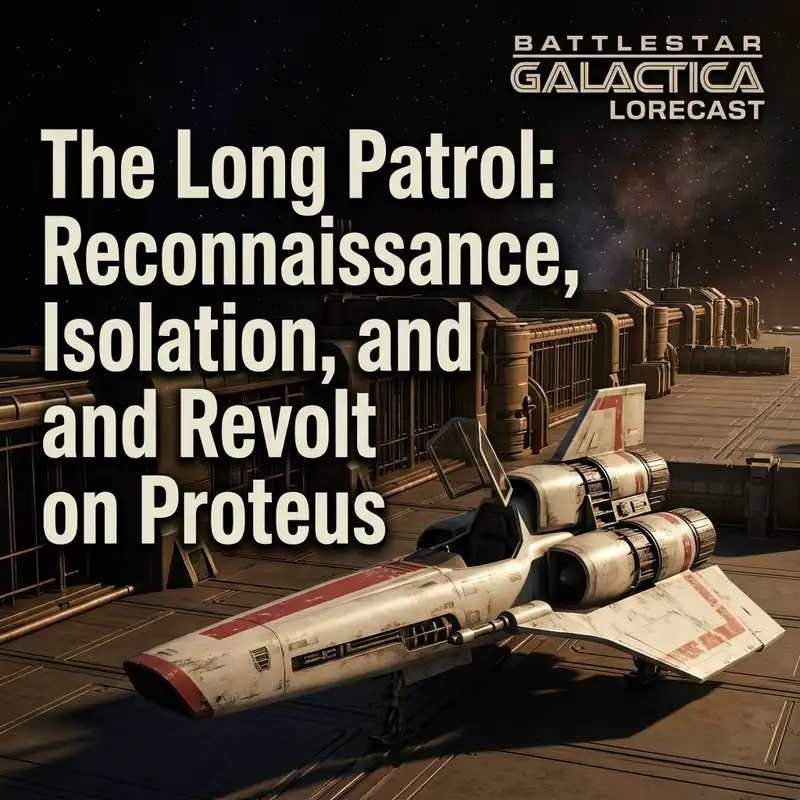
The Long Patrol: Reconnaissance, Isolation, and Revolt on Proteus
Commander Adama sends Starbuck beyond the fleet’s immediate knowledge with an instruction that defines the entire mission. Search for the possible sign of life beyond the asteroid dust field. Mark the route when necessary. Avoid transmissions that might expose the fleet. And if Cylons appear, do not lead them back. It is a hard order, but not a cruel one. The Galactica and the civilian ships moving with her are leaving the region of the Colonies, carrying survivors through uncertain space with limited protection and no secure rear area. Any unexplained contact might offer intelligence, refuge, trade, or evidence that other humans survived. It might also offer the Cylons a trail. Reconnaissance, in this setting, is never simply a matter of seeing farther. It is an exchange of risk. A patrol goes outward to reduce uncertainty for the fleet, while accepting that the patrol itself may become isolated, lost, or compromised. Starbuck volunteers to fly an experimental reconnaissance Viper designed for that outward reach. It has greater speed and range than an ordinary Viper, but the improvement comes at a cost. Its laser generators have been removed to make room for an additional pulse generator. It can travel farther and faster, but it cannot fight in the ordinary sense. Its voice-activated computer, C.O.R.A., can assist with navigation, scanning, and flight calculations, yet the aircraft remains a reconnaissance platform, not an independent combatant. The tradeoff is clear. The fleet gains an eye that can look farther into the dark, but it sends that eye out without teeth. The patrol’s greatest danger is more than destruction. It is the possibility that a lost scout, an intercepted transmission, or a captured aircraft might tell the Cylons where the fleet has gone.
The mission begins to unravel when Starbuck encounters a chase that he cannot fully identify. He finds an old shuttle pursued by a fighter. The shuttle belongs to a smuggler called Robber. The pursuing pilot, Croad, is an armed enforcer from a place called Proteus. From Starbuck’s position, the immediate facts are simple enough. One small craft appears to be fleeing another. The pursued pilot seeks help. The pursuer is armed and determined. Starbuck intervenes, allowing Robber to reach an asteroid and land. It is the kind of discretionary judgment that a patrol commander often has to make beyond easy reach of higher authority. A pilot sees danger, acts on incomplete information, and hopes that speed of decision will compensate for the gaps in the picture. But Robber is neither a helpless civilian nor a conventional enemy. He has his own plan, his own family, and his own reasons for treating Starbuck’s Viper as an escape vehicle rather than a military asset. Once on the asteroid, he knocks Starbuck unconscious and takes the reconnaissance craft. That theft changes the situation at once. Galactica has not just lost contact with a pilot. It has lost a specialized aircraft with unusual range, a powerful flight computer, and a communications capability that could now be used by someone whose intentions are unknown. Starbuck is stranded with an old shuttle and no reliable connection to command. The fleet has no way to know whether he is alive, captured, or dead. The stolen Viper still looks friendly from a distance, but its meaning has changed. In war, identification is rarely a matter of paint markings or hull shape alone. A friendly vehicle in hostile hands can become a threat precisely because it carries the trust, access, and technical advantages of the force that built it.
On Galactica, Starbuck’s disappearance becomes an intelligence problem before it can become a rescue problem. Robber uses the stolen Viper to send a narrow-beam transmission toward the old Colonial region. The signal is unfamiliar, and the direction is alarming. From Adama’s perspective, the available evidence supports a grim assessment. Starbuck may have been killed or seized. The Viper may now be controlled by an enemy force. The unknown transmission could be a beacon, a report, or an attempt to direct Cylons toward the route the fleet has taken. The exact content is not yet understood, but the operational hazard is obvious. The fleet cannot afford to wait passively for certainty while an unidentified signal leaves a missing reconnaissance craft. Adama orders the Viper destroyed. Apollo and Boomer launch to intercept it. Their task is emotionally difficult because the aircraft belongs to a friend, but the decision is not an act of indifference toward Starbuck. It is a command decision shaped by the duty to protect thousands of people who cannot defend themselves. A commander responsible for a refugee convoy cannot assume that every lost asset can be recovered, or that every ambiguous contact can be treated as innocent. The immediate tactical objective is to stop the transmission. The larger operational objective is to prevent the enemy from acquiring a usable trail. If the stolen Viper is functioning as a Cylon relay, then its destruction may be the price of concealing the fleet.
Apollo and Boomer therefore launch under an order that could require them to fire on a Colonial craft. The episode’s tension lies not in whether that order feels harsh. It lies in whether the information supporting it is reliable enough. An order can be reasonable and still turn out to be wrong. In reconnaissance warfare, commanders often act before they can know which of those two truths they are living with.
The assessment changes because the fleet does not rely on one interpretation of the signal. Cassiopeia recognizes something in the transmission that the military watch has missed. Her family background in merchant trade gives her a cultural reference point that the bridge officers do not possess. The narrow-beam message resembles an Aeries merchant code. Athena works through the signal and identifies its purpose. It is a request for coordinates to Aeries, a place now under Cylon control. That does not make the transmission safe. A message directed toward a Cylon-held region remains dangerous, and the missing Viper is still in unauthorized hands. But the signal no longer means what Adama first believed it meant. It is not necessarily a Cylon beacon or a direct effort to expose Galactica’s route. It is evidence that the sender may be human, isolated, and trying to reach a world that no longer offers the refuge he imagines. Adama cancels the destruction order. Apollo’s mission changes from lethal interception to cautious investigation, recovery of Starbuck if possible, and termination of the transmission before it creates further danger. This is not command becoming sentimental. It is command responding to better intelligence. Cassiopeia and Athena demonstrate a point that militaries often learn only after costly mistakes. Useful intelligence does not always come from the person with the highest rank, the largest console, or the most weapons. It can come from a merchant’s daughter who recognizes a trade code, and from a communications specialist able to turn that recognition into a workable assessment.
The fleet has not solved the problem. It has only replaced one uncertainty with a more accurate one. Somewhere beyond the dust field is a human contact. Somewhere beyond the dust field is Starbuck. And somewhere beyond the dust field, the Cylons may now have a reason to look.
While Galactica revises its understanding from afar, Starbuck learns what Proteus has become. Captured by Croad and other enforcers, he is processed into a social order that has kept operating after the world that created it has disappeared. He is given the designation Bootlegger One Thirty-Seven. The people around him carry similar identities: an offense, a number, and little else recognized by the authorities who govern them. Assault Nine. Forger Seven. Adulteress Fifty-eight. These names are more than insults. They are the machinery of the institution. They reduce people to inherited records of wrongdoing, preserving the language of punishment long after any meaningful legal process has vanished. Proteus, as the episode presents it, is an isolated penal community established to support the Colonial war effort. Its inmates once produced munitions and ambrosa. The prisoners explain that munitions manufacture ended when the necessary raw materials ran out. Ambrosa production continued. They believe it has continued for seven hundred yahrens, though that duration is testimony from people cut off from any reliable outside calendar rather than a figure that can be independently verified. What matters is the claim behind it. Generation after generation has labored under the belief that its work still serves the Colonies. The settlement has retained the appearance of productive purpose even after its military supply chain disappeared. It has workers, loading docks, stored goods, guards, regulations, and a vocabulary of duty. But it has no functioning customer, no transport system, no confirmed connection to the government that supposedly requires its output, and no outside authority checking whether the penal mission still exists.
Proteus cannot be reduced to a forgotten prison. It is an industrial system that has survived the disappearance of its own logistics. The ambrosa has been made, stored, and guarded, but no one comes to collect it. Labor continues because the institution remembers the order to work, even though it has forgotten the practical reason why.
The most important fact Starbuck discovers is not the ambrosa stockpile. It is that Proteus no longer physically functions as a prison. The cell doors have not worked for generations. The barriers that appear to confine the prisoners are no longer barriers at all. Yet the prisoners remain in place, while the enforcers continue to command them. The prison survives through inherited status, routine, fear, misinformation, and the force of a story repeated so long that it has become more binding than a lock. The descendants of guards inherit authority. The descendants of prisoners inherit guilt. Both groups live inside roles they did not choose and scarcely know how to question. That does not mean the prisoners are foolish. Isolation changes the meaning of evidence. If no ships arrive, no messages come, and no outside visitor contradicts the system, then daily routine may be the only proof people have that there is still an order beyond their walls. Work produces ambrosa. Enforcers supervise the work. Prisoners are told the Colonies need it. The story is false, or at least long obsolete, but it provides a structure for life in an environment where uncertainty may be more frightening than oppression. Croad and the other enforcers are also products of Proteus. They inherit a hierarchy and treat it as natural because they have never known an alternative. Their isolation helps explain their worldview. It does not excuse the coercion they impose or the lies they preserve.
Authority on Proteus has become self-justifying. It no longer rests on law, communication with a legitimate government, or a real public purpose. It rests on the claim that it has always existed and therefore must continue. That is the deeper prison. The doors are broken, but the institution remains intact because everyone has been taught that leaving is impossible, disobedience is unthinkable, and punishment is permanent.
Starbuck does not create the grievance on Proteus. He provides the evidence that makes the existing grievance impossible to ignore. He sees the accumulated ambrosa at the loading docks and recognizes what the stockpile means. No one has been collecting it. No ship has been carrying it to the Colonies. The product of generations of prison labor has remained exactly where it was made because the larger system that gave it value has vanished. Starbuck tells the prisoners that they have likely been forgotten since the early stages of the war. Croad rejects the claim because accepting it would destroy the foundation of his authority. If there is no Colonial mission, then there is no legal purpose to the prison. If no one needs the ambrosa, then the labor is not service but exploitation. If the cell doors do not work, then the enforcers have been ruling through a fiction. Croad’s response is not to investigate. It is to suppress Starbuck and preserve the narrative. That attempt fails because the prisoners have now seen enough to make obedience unstable. Assault Nine and the others confront the enforcers. They leave the compound and seize their immediate freedom. This is a revolt, but it is not a modern ideological revolution with a developed program for government, trade, defense, or justice. It is a prisoner uprising triggered by the collapse of legitimacy. In the immediate engagement, the prisoners gain control of their own movement. Politically, the hereditary authority of the enforcers is discredited.
In broader terms, however, Proteus remains in grave difficulty. Breaking free of the prison does not produce transport, food security, medical care, legal status, or protection against outside threats. The people of Proteus are no longer confined in the old sense, but they are still isolated on a remote settlement with no functioning relationship to the larger human community. Freedom has begun. It has not yet become sustainable.
Robber’s theft of the reconnaissance Viper becomes clearer when Apollo and Boomer reach Proteus. Their first encounter with him is tense and armed. From their perspective, Robber has stolen a military aircraft, endangered Starbuck, and broadcast a signal toward Cylon territory. Those are serious acts. Yet the situation cannot be reduced to a simple pursuit of criminal and police. Robber has his wife and daughter with him. He is not trying merely to profit from a stolen craft or evade punishment for its own sake. He wants to get his child away from Proteus before she grows old enough to inherit its system of labels, labor, and confinement. He has no ship capable of reaching Aeries on his own, and he does not know that Aeries is now under Cylon control. His plan is dangerous, unlawful, and based on badly outdated information. But its purpose is recognizably human. He is trying to prevent his daughter from becoming another person defined by an offense she never committed. Boomer’s recognition of Robber’s family changes the tactical problem. The patrol is no longer dealing only with a hostile pilot and a stolen aircraft. It is dealing with civilians whose lives could be endangered by a careless interception. Robber surrenders rather than risk their deaths. That choice does not erase what he has done, but it reveals the limit of treating every threat as an enemy target. A military force protecting civilians must identify more than weapons and flight paths.
It must identify relationships, obligations, and the human stakes behind desperate acts. Proteus has failed its people most completely at the generational level. It has taken a prison sentence, transformed it into a hereditary caste, and made the future of a child depend on an old accusation against an ancestor. Robber’s escape plan is flawed, but the desire behind it is a rational answer to a society that offers his family no future at all.
Before Apollo can convert contact into a planned rescue, the original transmission produces the operational consequence Adama feared. Galactica detects three Cylon fighters emerging from the asteroid dust field. They are following the narrow-beam signal toward the place where the reconnaissance Viper landed. The episode does not establish exactly what the Cylons know. They may not know Galactica’s location. They may not understand the history of Proteus. They may simply be investigating an unusual transmission and the presence of Colonial craft. But uncertainty is enough. The fighters now pose a threat not only to the patrol and the settlement, but to the fleet if they can trace its path or discover its direction of travel. Adama orders the fleet to alter course and increase its separation from Proteus. This is the second time the commander must accept the possibility of losing people in order to protect the larger convoy. The first risk concerned Starbuck and the stolen Viper. This one concerns Apollo, Boomer, Starbuck, Robber’s family, and the newly liberated people of Proteus. The strategic logic is hard to dispute. If the Cylon fighters locate the fleet, the danger extends to every civilian ship moving under Galactica’s protection. Yet the human cost is equally plain. By moving away, the fleet weakens the patrol’s chance of finding its way back quickly. Adama is not choosing between safety and abandonment. He is choosing between different forms of exposure. Remaining near Proteus could endanger the convoy.
Leaving Proteus could strand the patrol. Fleet command in this kind of war is not a matter of saving everyone who deserves rescue. It is the burden of deciding when the many cannot be protected without risking the few. The order preserves concealment, but it also makes the patrol’s local defense more urgent. The people on Proteus now have to survive the attack with whatever aircraft, pilots, and improvised resources happen to be present.
The defense is organized around an aircraft that was never meant to fight. Starbuck takes the experimental reconnaissance Viper because its superior speed is now more valuable than the lasers it does not have. C.O.R.A. assists him with scanning, navigation, and the demanding calculations required to get the most from the ship’s performance. The computer has a distinctive voice and a notable degree of operational responsiveness, but the episode does not establish that C.O.R.A. is a self-aware being or an independent commander. She is a flight system supporting a pilot in a crisis. The decisions remain Starbuck’s. He uses the reconnaissance Viper to evade, distract, and draw the Cylon fighters into a situation where its speed can compensate for its lack of weapons. Apollo and Boomer, flying armed Vipers, provide the combat power Starbuck lacks. The engagement is best understood through those functions rather than as a sequence of individual shots. Starbuck survives long enough to disrupt the enemy’s attack and uses a maximum-gee climb to force one Cylon fighter into a fatal crash. Apollo and Boomer destroy the remaining two. It is a successful improvisation, but not a new doctrine for reconnaissance operations. The outcome depends on a skilled pilot, an unusually fast aircraft, a capable flight computer, two armed Vipers, and a very specific tactical opportunity. An unarmed scout is still vulnerable. C.O.R.A. can assist, but she cannot replace the armed support provided by Apollo and Boomer.
The lesson is not that better flying makes weapons unnecessary. It is that a patrol in isolation must use every available advantage, even when its equipment has been designed for the wrong mission. Starbuck’s skill matters because it preserves the time and space in which the armed pilots can do their work. The defense succeeds through cooperation among unequal assets, not through one pilot overcoming every limitation alone.
The victory carries a cost that is both practical and symbolic. The crashed Cylon fighter ignites volatile material near the Proteus settlement, destroying the accumulated ambrosa. Starbuck had hoped that the stores might provide the freed prisoners with some form of wealth. The destruction removes that possibility. But the fire also exposes the illusion behind it. The ambrosa was a large stockpile, yet it was not automatically a source of prosperity. Goods become wealth only within a system capable of moving them, exchanging them, protecting them, and recognizing their value. Proteus had none of those things. It had no established market, no transport link, no secure trade relationship, and no accountable civil authority to distribute the proceeds. The stockpile represented labor, certainly. It may have offered a bargaining asset if contact with the fleet could be made. But it was never a complete answer to the settlement’s needs. The prisoners did not require only a buyer. They required evacuation, medical care, food, legal recognition, protection, and a place in a wider society. The burning ambrosa is therefore not just a reversal of fortune. It is a reminder that liberation cannot be built from stored commodities alone. An obsolete industrial system may leave behind warehouses full of goods, but it cannot leave behind the institutions required to make those goods useful. The people of Proteus have broken the authority that held them captive. They still need a community able to receive them as people rather than as laborers, prisoners, or inherited liabilities.
Galactica eventually confirms that the patrol has survived and that Starbuck, Apollo, Boomer, and the others are returning with two Vipers and the shuttlecraft. The rescued people of Proteus are welcomed aboard the Rising Star. That welcome matters because it changes their status. They are no longer merely the descendants of old prisoners and guards trapped in an abandoned penal order. They become displaced civilians under the protection of a fleet that is itself trying to remain a human society while pursued through space. The episode does not provide a detailed account of their legal settlement, their future work, or the difficult questions that would follow the collapse of Proteus’s old hierarchy. It does not tell us how the former enforcers are judged, how the former prisoners rebuild families, or how a refugee community absorbs people shaped by generations of isolation. Those questions remain beyond the immediate story. But the rescue makes them possible. Without transport and incorporation into the fleet, the uprising would have left Proteus free in name and abandoned in fact. Near the end, Starbuck notices that a map drawn by Boxey resembles the system charted on the wall of the prison cell. The image suggests some larger connection in the fleet’s search, perhaps navigational, historical, or simply mysterious. The episode does not settle its meaning, and it does not need to. The stronger conclusion lies closer at hand.
The long patrol succeeds because it discovers more than a route through dangerous space. It reveals a stranded human population, an obsolete prison system, and the cost of treating uncertainty as something that can be solved by force alone. Adama’s decisions are difficult because he must preserve the fleet even when doing so risks the people sent beyond its protection. His initial order to destroy the stolen Viper is reasonable under the evidence he has. His later decision to move the fleet away from Proteus is reasonable under a renewed Cylon threat. Neither decision is free of moral cost. Starbuck’s role is equally important, not because he performs an impossible act of individual heroism, but because he becomes the outside witness who breaks the false connection between punishment, labor, and public service. Proteus was not freed by force alone. It was freed when outside information exposed that its authority had outlived its law, its production had outlived its logistics, and its prison had outlived its locks. Galactica’s rescue then converts local revolt into an actual chance at civilian life. That is the lasting meaning of the patrol: survival requires recovering people from abandoned systems of authority as surely as it requires evading the Cylons.