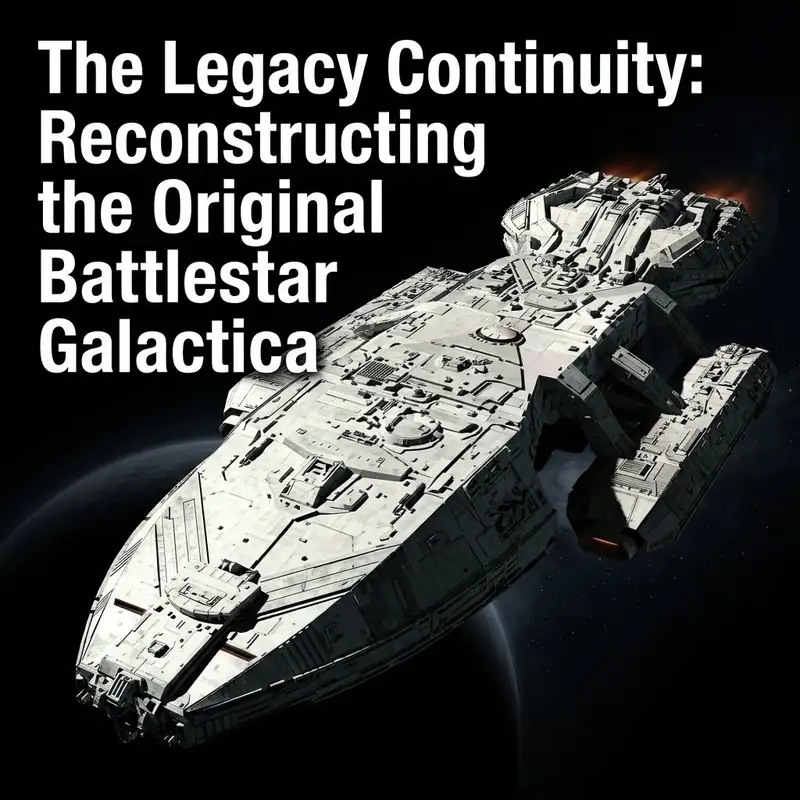
The Legacy Continuity: Reconstructing the Original Battlestar Galactica
In one released version of Battlestar Galactica’s opening disaster, Count Baltar survives the Cylon betrayal. He becomes a prisoner, a political problem, and a recurring reminder that the destruction of the Colonies involved human treachery as well as Cylon force. In another version, the shorter theatrical feature released from the same pilot material, Baltar is executed by the Cylons before the refugee fleet begins its journey. That is not a minor editing discrepancy. It changes who is available to act in later stories, changes the immediate meaning of Baltar’s bargain with the enemy, and tells us something important about how the original continuity must be handled. Before anyone can explain its war, religion, government, or search for Earth, they have to identify which released account they are using.
For the main original television continuity, the starting point is the three-hour ABC television film Saga of a Star World, first broadcast in nineteen seventy-eight. The shorter theatrical Battlestar Galactica feature is a separate released cut of much of that material, not a replacement ending for the television series that followed. Later syndicated television movies create a similar problem. They package episodes into longer features, sometimes changing pacing and presentation, but they do not automatically establish a superior chronology over the original broadcasts. The practical historical method is simple. Start with the broadcast series. Recognize alternate cuts where they materially differ. Do not combine incompatible scenes into one seamless event. The original Galactica already has enough danger without asking Count Baltar to be both dead and imprisoned at the same time.
That discipline matters because the original Battlestar Galactica is not an unfinished draft of the later reimagined series. It is a separate space-opera civilization with its own military language, political institutions, religious traditions, technology, and moral priorities. Its humanity comes from the Twelve Colonies. Its military remnant is the Colonial Fleet. Its central warship is the Battlestar Galactica, commanded by Adama. Its fighter pilots are Colonial Warriors flying Vipers. Its civilian authority appears through a Council, or Quorum, of Twelve and a President associated with the surviving Colonial political order. Its enemy is the Cylon Empire, a militarized robotic power associated with a reptilian civilization that created mechanical successors.
None of that requires humanoid Cylon infiltrators, numbered models, resurrection technology, a compromised Command Navigation Program, or a hidden group of Final Five Cylons. Those belong to a different continuity with different strategic assumptions. The original Cylons are not a secret population living inside Colonial society. They are an external military threat, recognizable as Cylons and organized through their own leaders, commanders, soldiers, ships, and machines. Their danger is not that anyone might discover a friend has been replaced. Their danger is that they are persistent, heavily armed, difficult to deter, and committed to the destruction of humanity.
The original series also does not offer a complete atlas of the Colonies, a detailed constitution, a full military order of battle, or an exact calendar for the Cylon conflict. That absence is not necessarily evidence that no such details existed within the fictional world. It is evidence that the released screen record does not provide them. The historian’s job is not to fill those spaces with later novels, games, production documents, or fan diagrams. It is to reconstruct the civilization from what the stories consistently preserve. At its center stands a mobile people whose homeland has been destroyed, protected by a military force that cannot abandon civilians without abandoning the very civilization it exists to defend.
That core premise emerged from a production built for television at an unusually ambitious scale. Glen A. Larson’s early concept developed into a story of a human exodus in space, a civilization under pursuit rather than a conventional campaign for territory. The initial plan emphasized large television-movie events. That origin remains visible in the pilot and in the larger two-part adventures that followed. The story begins with a diplomatic catastrophe, a fleet disaster, and a mass flight from annihilation. It then has to continue as weekly television, where each new episode needs a mission, a new world, a local danger, a moral problem, or a Cylon threat that can be confronted within a broadcast hour.
The production was expensive by the standards of its time. The pilot required a major effects effort, a long shoot, elaborate models, fighter sequences, costumes, sets, and an attempt to make a television audience believe in fleets crossing interstellar space. John Dykstra and other artists associated with the visual revolution of the late nineteen seventies helped give the series its striking spacecraft imagery. The results were more than decorative. They established the original Galactica’s visual military language. Battlestars were great armored command vessels. Vipers launched into open space from their bays. Cylon Raiders swarmed in formations. Civilian ships moved behind the warship that protected them. The fleet looked vulnerable because it was vulnerable.
But television economics shaped the historical record as surely as fictional battle damage. Large effects sequences could not be created afresh every week. Sets and costumes had to be reused. A continuing war had to become a series of discrete adventures. Some stories therefore feel like strategic operations, others like rescue missions, morality tales, diplomatic encounters, or fables about temptation and trust. The continuity is not a war diary with every day accounted for. It is a surviving set of episodes from a campaign that was imagined as much larger than the screen record could show. When the series was canceled after its nineteen seventy-eight and nineteen seventy-nine run, that incompleteness became permanent. The journey continued in the audience’s imagination, but unmade episodes do not become evidence.
The military catastrophe that begins the series is nevertheless clear. The Twelve Colonies and the Cylons approach what appears to be a peace settlement. Count Baltar acts as an intermediary, presenting himself as a man who can end a long and costly conflict. Colonial leaders gather aboard the battlestar Atlantia. The assembled fleet and political leadership place themselves in a condition of extraordinary exposure. The Cylons exploit that concentration. The peace process is a trap, and the trap succeeds because it is more than a battlefield ambush. It is a strategic deception aimed at the command structure, political leadership, and confidence of an entire civilization.
The Cylons destroy the gathered Colonial force and strike the Colonies themselves. The screen story does not give a complete map of every attack, a reliable total for every ship lost, or a technical breakdown of the weapons used. It does not need to. The strategic outcome is unmistakable. The Colonies suffer civilizational devastation. The Colonial Fleet loses its concentration of force and its senior leadership. A military system designed to defend a network of inhabited worlds is reduced to scattered survivors. The Cylons do not just win a battle. They remove the secure territory, industrial depth, population base, and political center that made the Colonial war effort possible.
The television version preserves Baltar’s survival within this disaster. The Cylons punish and degrade him, but do not immediately execute him. That choice allows the series to return repeatedly to the human dimension of betrayal. Baltar is not just an enemy officer. He is a Colonial aristocrat who believed he could make terms with a power whose objectives were far larger and colder than his own ambitions. The theatrical cut instead executes him, closing that thread at once. Both versions show the Cylon trap. Only the broadcast continuity carries Baltar forward as a living consequence of it.
Galactica survives because it is away from the concentrated destruction and because Adama refuses to allow the remaining civilians to be abandoned. That decision creates the original series’ enduring operational problem. Galactica is now simultaneously a warship, a carrier platform, a mobile headquarters, a sanctuary, an evacuation escort, and a political symbol. It must fight, but it cannot seek battle in the manner of a fleet still backed by shipyards, colonies, replacement crews, and secure supply routes. Every engagement must be measured against the safety of the civilian convoy. A victory that destroys enemy Raiders but leaves refugee ships exposed is not a victory. A bold raid that costs irreplaceable pilots may be tactically successful and strategically ruinous.
The pilot describes a surviving refugee force of roughly two hundred and twenty ships. That is best understood as the fleet’s reported starting count, not as a perfect census or a permanent manifest. These vessels represent communities, professions, families, religious traditions, records, skills, and memories. They are more than cargo transports hiding behind Galactica’s guns. Some may carry food, medical capacity, technical labor, machinery, or people whose knowledge cannot be replaced. Others may be overcrowded, poorly defended, mechanically fragile, or dependent on the fleet’s protection for every essential need. The show does not provide an accountant’s ledger for fuel, spare parts, air, food, and trained personnel. Yet those pressures are embedded in the premise. A refugee fleet has no margin for casual loss.
Galactica’s Vipers and Colonial Warriors are therefore part of a larger survival system. Apollo, Starbuck, Boomer, and their fellow pilots may be the visible tactical edge of the fleet, but their effectiveness depends on far more than personal courage. Fighters need functioning launch facilities, recovery space, maintenance, weapons, fuel, communications, medical care, and people who can repair what returns damaged. The series is more interested in the pilot’s mission than in the deck crew’s work schedule, but the operational burden remains implied. A Viper that fails to return is not just a lost machine. It is a lost pilot, training investment, combat veteran, and future instructor in a civilization with no obvious way to produce replacements.
The same is true of Galactica itself. The battlestar’s strength lies in its ability to place armed force between the Cylons and the civilian fleet. Its weakness is that it must remain present. It cannot just jump away from danger, disappear into deep space, and declare survival achieved. It is tied to slower and more vulnerable ships, to political obligations, and to the human need for a visible defender. The battlestar becomes the physical expression of continuity. The Colonies may be gone, but their people still have a military guardian, a command structure, and a place where the word “Colonial” means something more than a memory.
Adama carries enormous practical authority under those conditions, but the original series does not establish that he has become an unquestioned ruler. He commands Galactica and directs military operations. He is also the senior figure around whom the refugee fleet organizes itself. Yet civilian institutions survive in partial form. The Council or Quorum of Twelve represents the Colonies, and a President remains part of the political structure. Their powers are not mapped in the detail of a modern constitutional system. The show does not offer a complete legal code for emergency rule, a reliable record of elections, or a bureaucracy with visible procedures for every crisis. Still, the existence of civilian representation matters precisely because military necessity is so powerful.
The recurring question is whether a commander can protect a people without becoming the owner of that people. Adama often has to act quickly, sometimes with incomplete information and limited time. The Council often appears cautious, argumentative, idealistic, or vulnerable to manipulation. That is not unusual in a refugee crisis. Civilian institutions are rarely at their most elegant when every decision takes place under threat. But the Council’s imperfections do not make civilian legitimacy irrelevant. The fleet cannot be reduced to a naval formation. It is a society in motion, and society requires more than orders from a bridge.
The original series generally explores this tension through adventure rather than legal argument. A mission may force Adama to choose between the needs of a single community and the security of the larger fleet. A civilian leader may demand a risk that military officers consider unacceptable. A military success may create a political cost. The screen record does not provide enough evidence to turn these episodes into a fully detailed constitutional history. What it does establish is a durable principle. Galactica protects the fleet because the fleet carries the remnants of a political community. If the military remnant preserves bodies but destroys representation, faith, family, and collective purpose, it has protected only the shell of civilization.
How did that fleet fight? At the most reliable level, it fought through a combination of battlestar power, Viper operations, reconnaissance, local initiative, landing parties, raids, rescues, and evasion. Galactica served as a defensive strongpoint and command platform. Vipers intercepted Cylon Raiders, escorted vulnerable ships, conducted patrols, scouted unknown areas, and supported strike operations. Colonial Warriors moved between cockpit combat and hazardous missions on planets, stations, and alien vessels. The series gives them a heroic, flexible role. They are pilots, scouts, combat leaders, and explorers because the fleet cannot afford strict peacetime separation between every military function.
The more important military fact is that every operation occurs under the shadow of pursuit. Galactica may choose to investigate a signal, assist a stranded group, raid a Cylon facility, or search an unfamiliar world, but it does so while responsible for a dispersed civilian force. A mission that would be routine for a secure fleet can become dangerous because the battlestar cannot be everywhere at once. Scouts may be isolated. Landing parties may be cut off. Civilian ships may be exposed while the Warriors are committed elsewhere. The Cylons possess the advantage of strategic persistence. They can continue hunting. The Colonials must continue moving, improvising, and hoping that each risk brings them closer to a destination rather than merely postponing defeat.
That destination is Earth. In the original continuity, Earth is connected to the lost Thirteenth Tribe of humanity and to the sacred history of Kobol. The Sacred Scrolls and related traditions do not function merely as ancient decoration. They give the refugees an account of who they are, where they came from, and where another human branch may have gone. After the destruction of the Colonies, that inheritance becomes operationally important. A people fleeing genocide need more than a place to hide. They need a reason to believe that their journey has direction.
Kobol becomes central in Lost Planet of the Gods because it links religious memory to navigation and historical evidence. The fleet’s search is not a modern survey mission with a complete star chart and a confirmed destination. It is an expedition guided by fragments, interpretation, archaeological clues, inherited belief, and dangerous encounters with the unknown. The Sacred Scrolls offer a cultural map, but they do not eliminate uncertainty. Adama and the fleet must decide what weight to give traditions that may be ancient, incomplete, symbolic, or literally informative. That is a command problem as much as a theological one.
Faith, in this setting, gives the fleet cohesion and endurance. It tells the survivors that they are more than the last remnants of a defeated population. It connects children born in flight to ancestors lost on the Colonies. It offers Earth not just as a strategic refuge, but as a promise that humanity may have a future beyond permanent retreat. At the same time, faith can be interpreted, contested, and exploited. A religious text is not a navigation computer. A vision is not a full intelligence estimate. The original series understands that tension, even when it tells the story in broad mythic terms.
The original continuity does not divide the story into Kobol, a devastated first Earth, and a later habitable Earth. That structure belongs elsewhere. Here, Kobol is the lost source of Colonial memory, and Earth is the hoped-for destination of the Thirteenth Tribe. The exact astronomical and historical relationship remains incomplete in the released record. The series offers clues, encounters, and moments of apparent confirmation, but not a final technical explanation. That incompleteness is part of the fleet’s condition. They are not just lost in space. They are traveling through a history they can no longer fully verify.
Several of the larger episodes reveal how the series imagined war beyond the immediate defense of the convoy. Gun on Ice Planet Zero sends Colonial personnel against a dangerous Cylon installation in a hostile environment. The operation matters because the fleet cannot survive by passive evasion alone. If the Cylons possess a strategic weapon or facility that threatens the survivors, the Colonials may have to risk a small force on the ground to reduce a much larger danger. The episode is not a detailed account of Cylon industrial infrastructure or planetary warfare doctrine. It does establish a pattern. Galactica’s people are willing to trade safety for initiative when the threat seems great enough.
That choice has costs. A ground operation removes experienced personnel from fleet defense. It exposes them to terrain, weather, local defenses, communications failures, and the possibility of capture. It requires recovery planning and a means to get people home. The original series often moves briskly through such practical matters, but its missions still depend on them. The military value of a raid is never just whether the target is destroyed. It is whether the fleet gains time, freedom of movement, intelligence, or a reduction in Cylon pressure without losing people it cannot replace.
The Living Legend complicates the fleet’s military picture even further with the arrival of Commander Cain and the Battlestar Pegasus. Until that point, Galactica appears to be the last great surviving Colonial warship. Pegasus proves that the disaster may have left other pockets of resistance, other commanders, and other military resources beyond Adama’s immediate knowledge. That is strategically encouraging. It is also politically destabilizing. Cain brings a more aggressive combat posture and a ship whose capabilities appear formidable. He represents the temptation to return to conventional offensive war, to strike the Cylons hard, and to measure command primarily through battlefield initiative.
But Cain’s presence raises a question that Galactica cannot avoid. What is a battlestar for after the civilization it was built to defend has been destroyed? Is its highest duty to seek decisive battle, inflict losses, and restore military honor? Or is its duty to preserve the refugee population, even when that means avoiding opportunities for glorious combat? The series does not reduce Cain to a villain or Adama to a passive caretaker. Both men represent real military instincts. Cain sees the danger of surrendering initiative. Adama sees that a warship which leaves its civilians unprotected may win an engagement and lose the war’s human purpose.
The search episodes broaden that sense of uncertainty. The fleet’s route is not a straight line toward a verified destination. It involves signals, planets, ancient records, possible descendants of humanity, and encounters that can either help or mislead. Greetings from Earth and Experiment in Terra push the series beyond simple pursuit-and-escape storytelling. The refugees are not only trying to avoid Cylons. They are trying to discover whether other human societies exist, whether alliances are possible, and whether the old stories point toward something real. Each encounter carries military implications. A new world might offer refuge, resources, intelligence, or danger. It might also draw the Cylons closer.
War of the Gods makes that restraint essential. The introduction of Count Iblis and the Ship of Lights moves the original series into overtly metaphysical territory. The encounter is not presented as a rumor or a private hallucination. It is real within the released narrative. Characters see events and make decisions in response to them. Yet the story does not provide a technical briefing that identifies the Ship of Lights as a known species, a military technology, or a fully explained spiritual order. Nor does it give the audience a complete cosmology in which every divine, alien, or demonic category can be neatly labeled.
Count Iblis is dangerous because he operates through temptation, fear, division, and the offer of certainty. He appears capable of manipulating events and people in ways that challenge ordinary military judgment. But treating him as nothing more than an advanced alien would flatten the episode’s moral structure. Treating him as final proof of a complete literal theology would go too far in the other direction. The released story establishes an encounter with a malign figure and with beings or forces that oppose him. It leaves the deeper mechanism unresolved.
For Adama and the fleet, that ambiguity matters. A refugee people already depends on sacred history for direction. When apparent supernatural intervention enters the record, leaders must decide whether they are receiving guidance, being deceived, or facing a reality that cannot be reduced to ordinary intelligence. This does not make tactics irrelevant. Galactica still needs pilots, weapons, scouts, and disciplined command. But it changes what the search for Earth means. Earth is no longer only a coordinate problem. It becomes a test of judgment, trust, and the willingness to preserve moral agency when someone offers an easy answer.
The broadcast run ends with The Hand of God, which provides one of the series’ most striking links between the Colonial search and contemporary Earth. The fleet receives a transmission associated with the Apollo eleven Moon landing. For the survivors, this is evidence that Earth is not just a religious abstraction. Somewhere, somehow, there is a human world connected to the signal. The discovery gives renewed force to the journey. It suggests that the ancient promise may have a physical destination.
Yet it does not resolve every question. The episode does not provide a final route map. It does not settle the exact relation between Colonial chronology and Earth chronology. It does not explain all the mechanisms that allowed the signal to reach the fleet or guarantee that Earth can be reached safely. It is a clue, a confirmation, and a promise. It is not the end of the migration. The series ends with the essential mission still active because cancellation ended the parent production before it could reach a definitive screen conclusion.
That cancellation should not be confused with an in-universe defeat or with proof that a single intended ending existed somewhere offscreen. Television production had left the series carrying heavy financial expectations. The pilot’s scale, effects demands, and ambitious design made the show expensive. Ratings pressure and cost helped make continuation difficult. The result is that the original Battlestar Galactica remains a compact but unfinished campaign record. Its final broadcast does not close the war, defeat the Cylons, or bring the fleet safely to Earth. It preserves the journey at the moment when renewed evidence makes that journey more necessary than ever.
Galactica nineteen eighty returned to that legacy, but it should be treated as a distinct released sequel branch rather than silently folded into the original series as an ordinary second season. It retains Adama and the fundamental idea of a surviving Colonial fleet. It also changes the production circumstances, the recurring cast, the tone, and the operational problem. The surviving fleet has arrived near contemporary Earth. Instead of moving through deep space while searching for a destination, the Colonials must operate around a world they hope to protect without openly exposing themselves.
That change is significant. Earth is no longer merely a promise on a distant horizon. It is a technologically less advanced society whose people are largely unaware of the Colonial presence and of the Cylon threat. The strategic challenge becomes concealment, intervention, and preparation. Colonial technology may offer enormous advantages, but those advantages create political and ethical complications. A hidden fleet cannot just appear before Earth’s governments and assume cooperation. Intervening in local affairs risks panic, exploitation, misunderstanding, and the possibility that Cylon attention will be drawn to the planet.
Galactica nineteen eighty also introduces stories involving time travel and Earth-defense operations. These are part of the sequel’s released narrative. They are not retroactive explanations for every ambiguity left by the nineteen seventy-eight series. The parent series remains a story of flight and search. The sequel becomes a story of proximity, secrecy, and attempted guardianship. Its altered format and reduced effects resources are visible, but they do not erase its status as an actual screen continuation. They simply mean that it must be understood on its own terms.
The final episode, The Return of Starbuck, is especially important because it addresses a character left absent from much of the sequel. Starbuck is stranded on a remote world and encounters a Cylon named Cy. The episode confines much of its action to an isolated setting, which serves the story’s emotional focus as well as its production realities. It is less concerned with the fleet’s large-scale operations than with loneliness, survival, companionship, and the strange possibility of connection between a Colonial Warrior and a Cylon.
Cy should not be treated as evidence that the original Cylons possess the later continuity’s humanoid individuality, resurrection system, or model politics. Cy is a Cylon within the original sequel’s own framework, and the episode’s significance lies in the moral and emotional situation it creates. Starbuck is forced to confront the possibility that even a Cylon relationship can become personal under conditions of isolation and dependence. That does not revise the Cylon Empire’s larger role as humanity’s pursuing enemy. It does demonstrate that the original franchise, even in its most adventure-driven form, could test the boundaries of simple collective hatred.
The sequel leaves questions unresolved, including questions surrounding Starbuck’s fate and the implications of Doctor Zee. Later commentary, unused concepts, and fan reconciliations have tried to make these threads fit into a more comprehensive account. They may be interesting as adaptation history. They are not substitutes for released narrative. Galactica nineteen eighty provides a sequel record with its own partial answers and its own unfinished edges. It does not give historians permission to declare every uncertainty solved.
A shattered Colonial civilization survives the destruction of its worlds. A military guardian remains powerful enough to fight, but not powerful enough to fight without regard for civilians. A civilian polity remains fragile, incomplete, and dependent on protection, but necessary if the refugees are to remain a people rather than a convoy. The Cylons remain a relentless enemy. Kobol and the Sacred Scrolls preserve a history that points toward Earth. The journey remains unfinished, but it has purpose.
That is the original Battlestar Galactica’s lasting achievement. Its most important victory was never the destruction of a Raider, the survival of a battlestar, or the discovery of one more clue. It was the continuing effort to carry political community, human memory, religious hope, and military protection through a universe determined to scatter them.