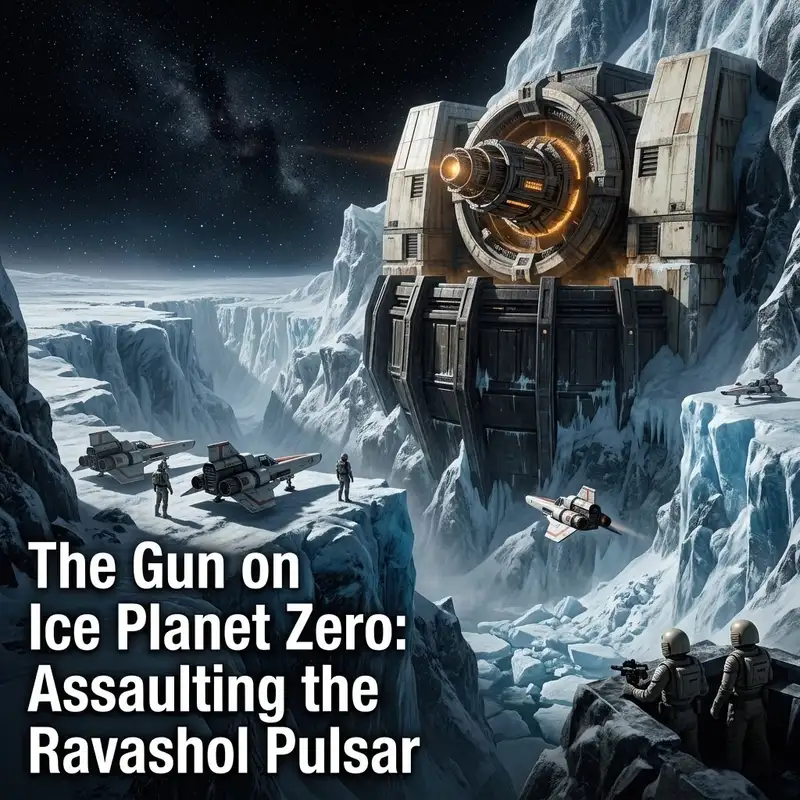
The Gun on Ice Planet Zero: Assaulting the Ravashol Pulsar
The first proof that Arcta was more than another hostile world came in the loss of three young Colonial warriors. The Galactica had watched a Cylon attack force withdraw with unusual speed. That was not reassuring. Commander Adama understood that an enemy retreat could be a maneuver, especially when it left a fugitive convoy only one apparent route forward. Colonel Tigh had a more immediate problem. The warrior force had been flying patrol after patrol. Experienced pilots were tired, aircraft were being pushed hard, and cadets had already entered the defensive rotation. Still, the fleet needed information. A probe of the ice-covered planet ahead found frozen seas, violent weather, and a Cylon installation hidden within the storm. Then the installation answered. A pulse of concentrated energy destroyed Cadet Bow’s Viper. Another fighter, flown by Shields, was lost in the attempt to understand what had happened. Cadet Cree survived long enough to report the danger, but Cylon jamming cut him off from his comrades. Raiders forced his damaged Viper down onto Arcta’s surface, where he was captured. The cost was severe, but the reconnaissance had done its work. It established that the planet contained a weapon capable of reaching into space and destroying Colonial fighters before they could mount an attack. More importantly, it gave Adama the evidence he needed to recognize the larger danger. The Cylons had not just placed a fortress in the fleet’s path. They had prepared a killing zone. The question was no longer whether Arcta was dangerous. The question was whether the Galactica and the ships depending on it could pass Arcta at all.
The fleet could not solve that problem by turning around. The force following it included Cylon warships, and Baltar was calling additional base ships toward the area. The Colonials were caught between a defended world ahead and a pursuing enemy behind. The fleet was described at this point as numbering roughly two hundred twenty ships, but the important fact was not the precision of that figure. It was the variety of vessels moving under Galactica’s protection. Freighters, transports, civilian ships, and support craft could not be expected to survive a direct encounter with a weapon that threatened even a battlestar. They also could not be treated as a single maneuver unit. A convoy of that size needed room, warning, coordination, and time. It was vulnerable whenever it slowed, scattered, or tried to reverse its course under pressure. The Ravashol pulsar, as the installation was known, was presented as able to destroy the Galactica with a single pulse. The story does not provide a technical explanation that permits useful modern calculation. It does not establish its range, power output, or scientific mechanism in any reliable detail. What matters is what the Colonials could see. The weapon had killed fighters at distance, and its existence made a frontal air attack look close to suicidal. Tigh’s patrol force was already strained. A major strike might have placed the remaining warriors, their Vipers, and the Galactica’s flexible defensive power into the line of fire without any confidence that they could reach the target.
Even success might have come at a price the convoy could not absorb. In a conventional battle, a commander might choose to mass fighters, destroy the enemy position, and accept losses. Adama did not have that luxury. His fighters were more than weapons. They were the screen that kept Raiders away from the civilian ships, the scouts that found danger before it reached the convoy, and the trained personnel the fleet could least easily replace. Sending them into the pulsar’s defenses would have gambled the fleet’s future on an attack with little chance of reaching its objective.
Adama’s alternative was not elegant, and it was not safe. It was an improvised assault built around the limited assets still available. If fighters could not destroy the weapon from space, a small force might reach it from the ground. That required people who could survive on an arctic world, move through mountain terrain, operate equipment in hostile weather, handle demolition charges, treat injuries, understand unfamiliar atmospheres, and fight through a defended installation. It also required transport. The landing party would use a shuttle and a laser-armed snow vehicle called a snow ram, which would serve as transport, shelter, weapons platform, and, if fortune allowed, their means of escape. The mission was not a standard raid by a prepared elite unit. It was a compact combined operation assembled under extreme pressure. Fighters would cover insertion. A shuttle would carry the team through the atmosphere. The snow ram would provide mobility. Specialists would identify and disable the weapon. Any survivors would then have to find their own way back to a rescue force that could not be promised in advance. Adama and Tigh turned to the prison barge because the fleet had a problem that wartime institutions often discover too late. Expertise does not always remain inside respectable chains of command. Some prisoners possessed precisely the skills the mission required. In a settled society, their convictions would have defined their place. In a fleeing fleet threatened with destruction, their skills became military necessities. The selection process drew from the prison population and the available military roster, not because the command had suddenly forgotten why these people had been confined, but because survival had narrowed the margin between usefulness and exclusion. The operation would test whether the Colonials could employ compromised people without treating them as equipment to be spent and discarded.
Colonel Croft stood at the center of that problem. A former officer and a prisoner, Croft possessed military experience and the authority that came from knowing how hard ground operations could become when plans failed. Wolfe brought demolition skills, but also a personal instability that made him dangerous to any group dependent on trust. Thane understood hostile environments, gases, and breathing systems. Leda could provide medical help under conditions where evacuation might be impossible. Haals, Vickers, and Voight supplied additional military and technical capability. None of them formed a natural unit. Their pasts, obligations, and loyalties differed. They had not trained together as a permanent assault section. They were being assembled because the Galactica had no time to create a better team. Apollo saw another flaw in the selection process. The computer had chosen people judged expendable enough for a mission with low odds of return. It had not selected him. Apollo understood that the omission may have reflected both his military value and Adama’s reluctance to risk his son. He refused to let that calculation stand. His decision to join the party was partly an act of command responsibility. If the mission demanded a Colonial warrior who could make decisions under fire, he belonged with it. It was also a rejection of the idea that command could ask others to accept a risk it privately reserved itself from. Croft’s rank was temporarily restored, giving the group a formal military structure, but formality could only do so much.
Apollo would lead the broader mission. Croft would direct the demolition element. Wolfe and Thane would have to be managed rather than merely ordered. Leda would have to balance care for the wounded against the pace required by the assault. The team carried specialized knowledge, but it lacked cohesion, redundancy, and any secure extraction plan. Before it had even launched, the operation was asking one question of every participant. Were they there because they had been ordered, because they wanted freedom, because they needed redemption, or because they believed the fleet was still their responsibility?
The descent to Arcta removed any illusion that the landing party would dictate the terms of the fight. Colonial fighters provided cover as the shuttle approached the ice world. The Cylons responded with Raiders. Killian’s Viper was destroyed. The shuttle itself was damaged, and the party was forced into a crash landing rather than a controlled insertion. The team got clear of the wreckage and escaped in the snow ram while Cylon patrols searched the area. That sequence mattered because it stripped away nearly every assumption supporting the original plan. There would be no clean landing zone. Communications with the Galactica could not be trusted. The party could not depend on fighters overhead. They had no secure route back to the shuttle and no certainty that a rescue force could locate them in time. Cylon control of the air and the use of jamming turned a planned penetration into a surface survival operation. The snow ram became central to everything that followed. It carried the party across terrain that men on foot could scarcely have crossed quickly enough. Its weapons gave them some protection against patrols. Its interior offered limited shelter from cold and atmospheric danger. Its power cells and mechanical condition therefore had the importance of a supply depot and a lifeboat combined. Lose the snow ram, and the party would lose mobility, cover, heat, power, and much of its ability to keep weapons functioning. The Cylon advantage on Arcta was more than firepower.
The Cylons possessed prepared positions, local patrols, air support, and control of communications. They could force the humans into weather and terrain they did not understand. Yet that advantage had a weakness. The Cylon defense assumed that an attacker would remain an outside force, isolated from the planet’s population and dependent on its original equipment. Adama’s mission had not yet found a way around that weakness, but the possibility would become the key to the operation.
Arcta’s climate did as much damage to the assault as the Cylon garrison. The team crossed a world of ice, blizzards, frozen water, and mountain approaches that turned navigation into a constant problem. The weather also produced hazardous di-ethene conditions. Breathing equipment, seals, medical judgment, and environmental awareness were not secondary details. They determined who could remain conscious and mobile long enough to fight. A battlestar engagement can make warfare appear to be a contest of beams, missiles, and maneuver. On Arcta, survival came down to whether a power cell held its charge, whether a mask functioned, whether a vehicle could move, and whether exhausted people could remain disciplined when the cold and fear had reduced every decision to its essentials. Thane’s knowledge of alien atmospheric conditions became indispensable, even though his reliability as a subordinate was doubtful. The operation could not afford to reject his expertise merely because he was difficult. That was the mission’s recurring problem in miniature. Every useful person brought a risk along with a skill. Wolfe represented the darker version of that dilemma. He could not be reduced to a villain dropped into the party to create conflict. He was a prisoner whose interest in the mission did not necessarily match the fleet’s interest in survival. He wanted a future in which he could escape the authority that had confined him. Under the pressure of Arcta, that desire made him a threat to the group. Internal conflict damaged the snow ram’s power cells, leaving the team temporarily stranded.
The incident had operational consequences. A vehicle intended to carry the party toward the objective became a fragile position in hostile territory, with Cylon patrols still searching and exposure worsening by the moment. The team did not defeat the terrain. It endured it long enough to discover that others had already found a way to live beneath it.
Muffit led the survivors to that hidden world. Beneath the Cylon-controlled settlement lived the Theta-class life forms, artificial beings created for labor and treated by the Cylons as less than fully alive. They were not ordinary human clones, and they were not the humanoid Cylon models of the later reimagined Battlestar Galactica. In this original-series story, the Thetas are their own people and their own moral problem. They have been manufactured to serve, classified as subhuman by their masters, and kept under conditions designed to deny them political standing. Yet they have developed families, protected children, organized resistance, and built a concealed community under the very garrison that enslaves them. Ser and Tenna become the landing party’s principal allies, not because they are passive victims eager to be rescued, but because they possess knowledge the Colonials lack. They understand the settlement, the patrol patterns, the dangers of moving through Cylon-controlled territory, and the compromises required to keep their own community alive. The Colonials arrive on Arcta as hunted outsiders facing a deadline. The Thetas have lived under the occupation longer than any of them. That changes the character of the assault. It is no longer simply a raid conducted by Colonial warriors against a Cylon weapon. It becomes cooperation between a fleeing military force and an oppressed population whose local resistance makes the mission possible. The Thetas provide concealment, shelter, guides, and intelligence. They also expose a limitation in Colonial assumptions.
The landing party initially sees Arcta as a strategic obstacle. For the Thetas, it is home, prison, workplace, and battlefield all at once. Destroying the pulsar may save the Galactica, but it may also bring retaliation against people who cannot just board a ship and leave. Their assistance is therefore not cost-free. It is a deliberate choice to risk their future against the Cylon presence. The Theta children matter especially because they reveal that this is more than a labor force enduring oppression. It is a society trying to continue itself. The hidden settlement gives the landing party a chance to recover, but it also gives the operation a moral obligation. The Colonials can no longer pretend that Arcta is an empty enemy base. People are living under the mountain, and their survival will be shaped by what the assault does next.
The Thetas direct the party to the man who understands the weapon. Dr. Ravashol is a human inventor associated with the installation at Mount Hekla. He insists that the system was never meant to be a weapon. In his account, it is an energy-lens device intended to transmit intelligence across the galaxy. The Cylons have taken that scientific infrastructure and adapted it into the pulsar threatening the Galactica. The episode leaves the device’s actual physics unresolved, and there is no need to impose modern astrophysics on a machine that functions according to the story’s own rules. Its military significance is clear enough. A system created for communication or knowledge has become a means of destruction under occupation. Ravashol’s first instinct is to separate himself from that destruction. He did not intend the Cylon use of his work, and he resists the claim that he bears responsibility for what they have made of it. That defense is understandable up to a point. Inventors cannot control every later use of what they create. But Ravashol is no longer confronting an abstract possibility. His installation is actively endangering a civilian convoy, and the Thetas living around it are already suffering under Cylon rule. Refusing to act would not preserve his innocence. It would merely leave others to die under a system he understands better than anyone else. Ravashol eventually provides the technical information the assault needs. The pulsar and the garrison occupy separate chambers.
A simple attack on the outside of the installation will not reliably destroy the weapon. The crucial point is the main energy pump. It must be disabled or reversed, and that requires access to the control area while another element disrupts the garrison. The solution is not a larger explosion. It is a precise attack against a critical dependency inside the Cylon system. Ravashol’s knowledge transforms the mission. Until then, the landing party has been searching for a target in a storm. Now it has an objective, a method, and a timetable. The burden of action shifts back to the group. Technical knowledge can identify a vulnerability, but it cannot cross the mountain, overcome the guards, or decide who will be placed in danger to exploit it.
While the party prepared on Arcta, Baltar and Lucifer were trying to close the trap around the Galactica. Their purpose was not just to destroy another Colonial ship. They wanted to bring the battlestar and its convoy into the corridor where the pulsar could be used against them. Baltar also sought a clearer understanding of Galactica’s position and intentions. The earlier withdrawal of Cylon forces had helped create uncertainty in Adama’s command. Cylon fighter pressure could make the enemy seem nearer or farther than it truly was, distorting Colonial estimates and forcing decisions under imperfect information. This was intelligence warfare as much as open combat. The Cylons did not need perfect knowledge to make the Colonials vulnerable. They only needed to create enough doubt that the fleet would commit itself to the route Baltar had prepared. As base ships closed, the pulsar began firing at random across the corridor. The random fire was not random in strategic effect. It forced the convoy to keep moving, made formation and spacing more difficult, and turned every delay into a potential catastrophe. Adama’s answer was fleet defense rather than pursuit. Blue Squadron protected the freighters. The Galactica increased speed and drove the convoy forward. No one aboard the battlestar could know exactly whether Apollo’s party had reached the weapon, whether the Thetas could sustain their resistance, or whether the demolition plan would work. The Galactica’s task was to preserve time. That is often the least glamorous mission in war, but it is frequently the decisive one.
The Colonials did not need to defeat Baltar’s whole force at Arcta. They did not need to destroy every Raider or engage every base ship. They needed to keep the civilian ships alive long enough for a handful of people on the surface to change the situation. The ground party and the fleet were fighting separate battles connected by one clock. If the battlestar could not hold the convoy together, the demolition team’s success would arrive too late. If the demolition team failed, no amount of defensive flying would protect the fleet indefinitely.
The final assault divided the landing party into two elements because Ravashol’s explanation had made clear that one attack could not do everything. Starbuck led the effort against the garrison station. Apollo, Croft, Leda, and the demolition personnel moved toward the pulsar controls. The division reflected a practical truth. The Cylon guards had to be distracted, suppressed, or delayed long enough for the demolition team to reach the energy pump. A single group trying to fight through the garrison and destroy the weapon would be overwhelmed or delayed until the pulsar fired again. The plan depended on simultaneity, not superior numbers. It also depended on the Thetas, whose local knowledge made movement through the settlement possible. Thane attempted to pass through Cylon-controlled space disguised as a Theta, a tactic that showed both the ingenuity and the danger of relying on the occupier’s contempt for the people it ruled. He was captured. Starbuck and Tenna mounted a rescue. That decision carried a real cost. Recovering Thane consumed time, increased the risk of exposing the underground community, and threatened the division of effort that the assault required. But Thane’s environmental expertise remained valuable, and leaving him to Cylon interrogation would have endangered the Thetas as well as the mission. The rescue was not a sentimental detour. It was an operational judgment made under conditions where people were both specialists and sources of information the enemy could exploit. Wolfe’s response to the crisis revealed a different fracture.
He considered seizing a Cylon fighter and escaping. His argument was cold but not incoherent. If the Galactica were destroyed, the prisoners might be free of Colonial authority and able to seek another refuge. The flaw was more than that Wolfe lacked courage. It was that he had abandoned any sense of shared political obligation. His freedom depended on treating the survival of the fleet, and the people within it, as someone else’s problem. Croft rejected that logic. His restored rank did not automatically make him trustworthy, but his conduct began to give it substance. He recognized that the mission could not be reduced to an opportunity for individual escape. Whatever crimes had brought him to the prison barge, the people threatened by the pulsar were still his people. As the assault tightened, Croft became more than a temporary officer assigned to manage prisoners. He became a commander whose authority rested on accepting the same danger he asked others to face.
The firing station was reached under pressure from every direction. Starbuck’s group engaged the garrison, creating the disruption needed to keep Cylon defenders from concentrating against the demolition team. Apollo’s element pressed into the pulsar control area. The action did not produce a clean line between combat and technical work. The people carrying charges also had to fight. The people fighting also had to preserve enough order for Ravashol’s instructions to be carried out. A machine designed around a critical energy pump could only be destroyed if the team reached the right point, made the right changes, and held its position long enough for the charges to take effect. At the decisive moment, Apollo had to continue toward the objective, and Croft assumed immediate command of the people around him. The chain of command had become improvised but functional. Apollo remained responsible for the mission. Croft commanded the crisis at hand. Leda’s role became decisive when Vulpa’s fire threatened Croft. She saved him and was killed. Her death should not be treated as a decorative act of sacrifice placed beside a final explosion. Leda was the medic and arctic specialist whose presence had made the team more likely to survive the journey to the mountain. Her loss reduced the group’s remaining capacity even at the point of victory. It also placed a human cost against the language of expendability that had haunted the mission from the beginning. The people selected for this assault were not interchangeable assets.
Their skills, choices, and deaths changed the group around them. The demolition charges were set, and the installation was destroyed just before another pulse could strike at the fleet. The mountain weapon that had seemed unreachable from space was neutralized from within. In the immediate engagement, the result was plain. The Ravashol pulsar no longer threatened the Galactica. Across the wider mission, the convoy recovered a survivable path through the corridor. Yet the success had not come from a dramatic reversal in Colonial firepower. It came from reconnaissance that exposed the trap, fighters who bought time, specialists drawn from outside normal military respectability, local allies who understood the ground, an inventor forced to confront the use of his work, and a synchronized attack against a vulnerability the Cylons had not adequately protected. The Cylon garrison, its Raiders, and its weapon were formidable. But their system depended on control, separation, and the assumption that the oppressed population beneath them would remain politically invisible.
Adama’s response after the explosion mattered almost as much as his decision to send the party down. Once the pulsar had been destroyed, he ordered a rescue unit with full fighter escort. The landing party was not abandoned simply because it had completed its task. That did not erase the risks imposed on Croft, Leda, Thane, Wolfe, or the Thetas, but it established a principle. A commander who uses people in a desperate operation remains responsible for recovering them when recovery is possible. Baltar, meanwhile, had to confront the failure of a carefully prepared trap. A small human force had destroyed a protected installation despite Cylon patrols, garrison troops, Raiders, and the weapon itself. The result did not defeat the Cylon pursuit. It did not end the war, secure the fleet’s destination, or remove the danger of future ambushes. The strategic situation remained harsh. The Galactica was still leading a fugitive convoy through hostile space. Its fighters were still finite. Its warriors still carried the losses of Bow, Shields, Killian, and Leda. Its commanders had learned that the Cylons could herd, deceive, and shape the fleet’s choices long before open battle began. Yet Arcta also revealed a countervailing lesson. Cylon military power was not self-contained. It depended on installations with human origins, technical weak points, local labor, occupied populations, and assumptions that could be exploited. The Thetas were central to that discovery. They had been created to work, denied equality, and pushed beneath the surface of their own world.
Their resistance provided the intelligence and concealment that made the Colonial attack possible. But victory did not create a settlement for them. The Galactica could rescue its own people. It could not remain to guarantee Arcta’s future. The Thetas remained exposed to the possibility of a Cylon return. Ravashol, confronted by the Theta children and their growing humanity, could no longer comfortably describe them as mere products of his design. Still, recognition was not the same as protection, and sympathy was not the same as political security.
The gun on Ice Planet Zero was therefore not destroyed by a decisive fleet engagement or by a Colonial weapon more powerful than the enemy’s. It was destroyed because an institution under extreme pressure learned to use what it had instead of mourning what it lacked. Adama could not retreat safely, could not spare a full fighter strike, and could not defeat the Cylon force directly. He turned reconnaissance, prisoner expertise, ground mobility, local resistance, technical knowledge, and precise timing into an operation that reached inside the enemy’s defenses. The tactical victory saved the Galactica and the convoy from the pulsar. The operational victory carried the fleet through a prepared killing zone. The moral result was less complete. The Colonials refused, at least in the end, to treat the assault party as disposable tools, and they discovered allies among people their enemies had classified as less than alive. But the Thetas accepted enormous danger to help strangers whose own survival required leaving Arcta behind. The Ravashol pulsar was gone. The fleet escaped. The people beneath the ice were still waiting to learn whether anyone would ever be able to protect the future they had risked so much to claim.