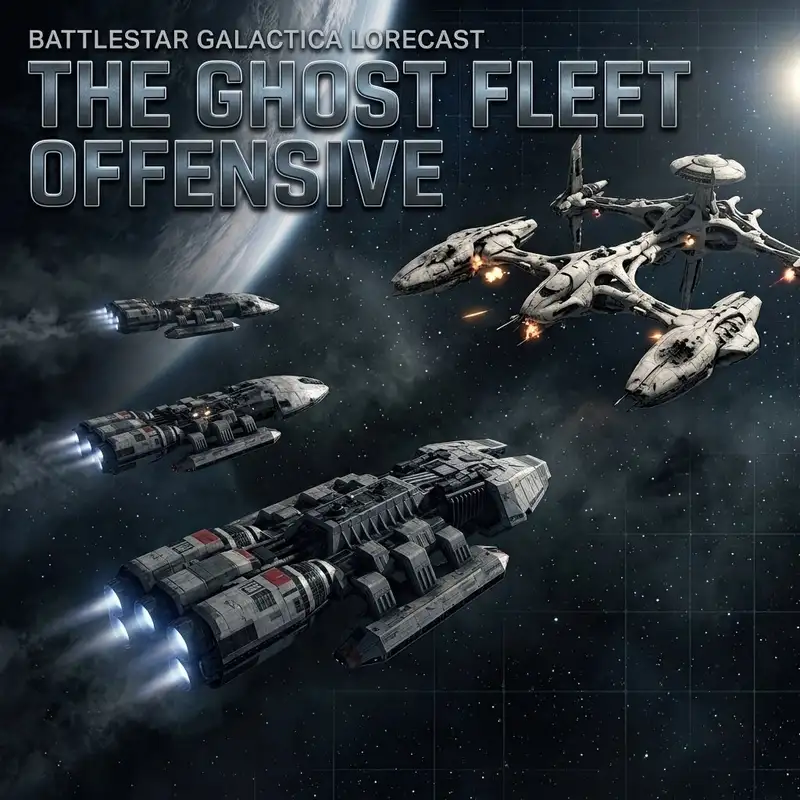
The Ghost Fleet Offensive [Deadlock]
The Colonial public was told the First Cylon War was being contained. Somewhere behind that reassurance, the Ministry of Defense was losing the practical ability to wage it. Communications routes were under pressure. Logistics were being cut apart. Ships and crews were being committed to emergencies before higher command could build a coherent response. In the tenth year of the war, the gap between official confidence and military reality had become dangerous. Admiral Jubal Sarkis answered that danger with an operation built on a grim proposition. Some Colonial ships would have to vanish from the war entirely. Officially, they would be losses, wrecks, or forces no longer available for combat. In reality, they would gather in secret, beyond the enemy’s expected picture of Colonial strength. Their purpose was not to make a heroic final stand. It was to make the Cylons wrong about where the war was being fought, what forces remained, and how much pressure the Colonies could still absorb.
This is the Ghost Fleet Offensive of Battlestar Galactica Deadlock, a licensed game continuity set during the First Cylon War. It is not a screen-canon reconstruction of Blood and Chrome, even though both stories employ the idea of a Ghost Fleet. The game tells a separate campaign, in a separate source tradition, with its own officers, technologies, and operational circumstances. Its central military question is nevertheless familiar. What does a weaker fleet do when an enemy has superior initiative, better information, and enough pressure on the supply system to make every defensive victory feel temporary? Sarkis’s answer was to turn weakness into concealment. If the Cylons expected the Colonial Fleet to be depleted, visible, and reactive, then a concealed concentration of supposedly absent ships could become an instrument of surprise.
That required Colonial command to admit, at least privately, that the decisive front was not limited to battlestars and Basestars exchanging fire. A fleet can lose a battle and remain capable of fighting. It can also win individual engagements while losing the ability to coordinate, refuel, repair, rearm, reinforce, and communicate. The second condition is usually more dangerous. It is operational paralysis. A battlestar without ammunition is still a battlestar in name, but not in function. A squadron without replacement pilots is an air wing consuming its own future. A damaged relay network can leave capable ships fighting separate wars, each receiving information too late to use it. An industrial system that cannot move components, fuel, medical supplies, or trained personnel begins to fail long before every factory or shipyard is destroyed.
The Cylon campaign associated with Atropos exploited precisely those dependencies. The available account does not establish a complete Cylon hierarchy, a fixed order of battle, or a single political will shared by every Cylon unit. It does establish a method. The pressure was coordinated and systematic. Rather than seeking prestige through simple ship destruction, the Cylons attacked the Colonial system that made ships useful. Communications and logistics became targets because they connected the Colonies’ military strength to its industrial and political base. A fleet that cannot receive warnings, concentrate against a threat, or sustain repairs can be forced into a permanently defensive posture. The enemy does not need to destroy every Colonial vessel. It only needs to make the surviving vessels arrive late, fight separately, and consume resources faster than the Colonies can replace them.
The kind of war reaches far beyond the naval chart. Civilian commerce becomes less reliable. Communities begin to question whether the government can protect them. Families see service members deployed repeatedly and hear official assurances that do not match the disruptions around them. Industrial workers face shortages, rerouted production, and the pressure to do more with less. Political leaders have to decide how much bad news the public can absorb without panic, and how much concealment the republic can tolerate without losing trust. The Colonies were not merely defending military installations. They were defending the institutions that allowed twelve separate societies to act as a civilization under attack. A failed convoy or compromised relay could become a military problem, an economic problem, and a constitutional problem at the same time.
Sarkis’s Ghost Fleet was therefore an attempt to interrupt a pattern, not merely to win a brawl. The idea was to create a force that existed outside the enemy’s working map of Colonial power. Ships believed destroyed, unavailable, or otherwise removed from the expected order of battle could be assembled covertly in or near Cylon-controlled territory. The value of this force was not just that it possessed weapons. Its value came from the fact that the Cylons were not supposed to know it existed. Concealment changed the enemy’s calculations. It could encourage a Cylon commander to overextend forces, leave installations exposed, thin local defenses, or concentrate against a false threat. In military terms, the Ghost Fleet was an attack on assessment. It aimed to corrupt the enemy’s understanding of Colonial capability before it attacked the enemy’s ships or infrastructure.
The costs were substantial. A force operating under deep secrecy cannot expect the usual support network to function normally. Its crews may be unable to communicate freely with other Colonial commands. They may have limited access to repair facilities, resupply points, intelligence updates, and rescue options. Damage that could be routine in friendly territory becomes a possible mission-ending crisis. A ship that breaks down may not be able to call openly for help. A crew that takes casualties may have no rapid reinforcement. Even success creates danger, because every strike gives the enemy new evidence that something unusual is happening. The Ghost Fleet was not invisible in any absolute sense. It was a wasting asset, valuable only while the enemy’s picture of it remained incomplete.
The game deliberately leaves the precise composition of the Ghost Fleet open to player choice. That means there is no single fixed roster of ships, no definitive total of fighters, and no universal account of every loss or tactical victory. One player may rely heavily on battlestars. Another may build a different balance of escorts, support ships, scouts, and strike assets. Those decisions belong to the game’s interactive military problem, not to a stable historical order of battle. The campaign’s enduring logic is more important than any one player’s fleet build. Colonial command had to concentrate enough combat power to strike meaningfully, while keeping that force small, discreet, and sustainable enough to remain concealed. It was a balance that would test any navy, even before the Cylons began to respond.
Admiral Jubal Sarkis stood at the strategic level of that gamble. His role was not just to direct a ship in combat. He was the architect of a theater-level counterstroke, responsible for turning fragmented Colonial losses into a plan that could alter the enemy’s tempo. That meant making decisions about risk which no battlestar commander could make alone. How much secrecy was acceptable? How many ships could be removed from the visible defense of the Colonies? How long could the force remain cut off? Which targets mattered enough to justify exposing the operation? And what would happen if the Cylons discovered the truth before the fleet had achieved anything worth the cost?
Commander Silas Nash faced a different problem aboard Galactica. He had to translate Sarkis’s intent into operations conducted by actual crews, actual flight decks, and actual ships that could be damaged, isolated, or destroyed. Galactica was a central participant, but it was not an independent war-winning weapon. A battlestar’s combat power depends on more than its hull and guns. It depends on escorts, reconnaissance, fighter operations, maintenance, ammunition, damage control, intelligence, and a route out of danger when the mission is complete. In a covert task force, that dependence becomes sharper. A commander cannot assume that another formation is close enough to intervene, or that higher headquarters has a better picture of the battle. The mission may require aggression, but the survival of the force may require restraint.
This created divided command responsibility. Sarkis could define the strategic purpose: regain initiative by creating a threat the Cylons did not expect. Nash had to decide how far Galactica could push that purpose when it encountered the friction of combat. A theater commander can order a raid. A ship commander must judge whether a damaged flight deck can continue launching aircraft, whether a support vessel can be protected, whether a recovery operation is still possible, and whether another minute in contact will turn mission success into a destroyed battlestar. These are not failures of resolve. They are the practical limits that make command difficult. The Ghost Fleet demanded obedience to a larger plan, but it also demanded local judgment from officers who might be the only people able to see the immediate cost.
The Cylon problem under Atropos was built around the opposite advantage. The Cylons were applying pressure through coordination. Their strength was not merely the number of hostile hulls in a given battle. It was their ability to connect reconnaissance, communications, electronic attack, logistics disruption, and concentrated fire into a broader campaign. A commander who understands the enemy as a system does not need to chase every battlestar. That commander can attack fuel routes, repair capacity, data links, navigation support, and reinforcement paths. The objective is to make the enemy’s strength difficult to assemble. A Colonial ship may survive a Cylon attack and still be strategically neutralized if it cannot communicate, resupply, or rejoin the fleet in time.
The Ghost Fleet sought to use the same systems logic in reverse. Instead of treating the Cylons as a collection of targets, Sarkis’s plan treated Cylon coordination as vulnerable. If Colonial forces could create uncertainty about their own location and strength, they might force the Cylons to redeploy, investigate false contacts, cover installations that were not actually threatened, or move command assets into danger. The offensive could then strike not only at ships, but at the processes that made Cylon pressure effective. This was a contest between two operational pictures. Atropos needed the Colonies to appear predictable and increasingly exhausted. Sarkis needed the Cylons to believe that the Colonial Fleet had fewer options than it actually possessed.
The Ghost Fleet was not just a group of capital ships waiting to fire. It required a combined-arms system. Reconnaissance had to find targets and identify threats without exposing the fleet. Fighters had to screen the force, escort vulnerable craft, intercept enemy squadrons, and help protect ships that could not afford to be lost. Raptors and other specialist assets had to extend awareness, support boarding operations when necessary, and help crews recover from damage or electronic compromise. Deck crews had to launch, recover, refuel, rearm, and repair aircraft under conditions in which a delay could leave the whole formation blind or undefended. Engineers had to keep machinery functioning without the comfort of a secure rear area. The hidden force depended on specialists as much as it depended on battlestar commanders.
The Orion reconnaissance frigate illustrates this point. In the Deadlock campaign, Orion carries experimental stealth and electronic-countermeasure technology. Its operational purpose is not permanent invisibility. It can reduce the chance of hostile DRADIS detection, move into a position for a torpedo attack, then withdraw while its stealth capability recovers. That sequence is important. Orion is not a magical ship that can remain unseen indefinitely while deciding every battle at leisure. Its effectiveness depends on timing, proximity, target selection, and the crew’s ability to leave before the enemy converts suspicion into contact. It is a reconnaissance and ambush tool, designed to produce a temporary local advantage for the broader force.
Used properly, a vessel like Orion can do more than destroy a target. It can shape the battle before the main force arrives. It can help determine whether an apparent contact is a screening force, an isolated patrol, or the edge of something larger. It can create uncertainty about where the Colonial attack originated. It can threaten valuable ships that expected to be safe behind more visible Cylon formations. At the same time, it also carries a familiar intelligence risk. A scout that reveals itself too early may warn the enemy. A successful torpedo strike can produce valuable damage, but it can also tell Cylon command that an unfamiliar capability is operating nearby. The question is always whether the information gained or the target destroyed justifies the signature left behind.
The Defender, another game-specific vessel, represented a different form of combat power. Described as a Gemenese support platform, it brought mobile Marine-support and technical-support capabilities into the task force. Its Raptors could reinforce allied subsystems and support ships engaged in boarding actions. That may sound less dramatic than a battlestar salvo, but it speaks to the actual durability of a fleet. A warship under attack does not remain combat-effective merely because its armor holds. Sensors fail. Engines take damage. Fire-control systems are degraded. Compartments need to be secured. Boarding parties require transportation, support, and coordination. A force that can restore damaged systems or reinforce threatened ships has a better chance of preserving its own operational tempo.
The Cylons had their own specialized tools, and those tools reinforced the broader logic of their campaign. The Medusa command ship is presented in Deadlock as a Cylon vessel equipped with point defenses and a Remote Transmission Processing Augmentation Matrix. The name is cumbersome, which is often how one can tell that a procurement office has had a productive afternoon, but its military meaning is clear enough. The Medusa improves the effectiveness of nearby Cylon vessels through enhanced coordination. Its danger does not rest only in its own weapons. It functions as a force multiplier. Cylon ships operating near it can become more capable because their collective response is more tightly organized.
That makes the Medusa a reminder that command-and-control is a targetable form of combat power. A fleet with effective coordination can distribute information, prioritize threats, concentrate attacks, and recover from disruption faster than a collection of ships acting independently. Conversely, a command vessel that is isolated, deceived, or destroyed may weaken nearby units even if their hulls remain intact. For the Ghost Fleet, this created both a problem and an opportunity. A Medusa could make a Cylon formation far more dangerous once it recognized the Colonial threat. Yet a concealed Colonial force might also seek to exploit the concentration of command functions, striking at the systems that allowed the Cylons to act as an integrated network.
Cylon virus mines added another layer to the battlespace. These were not evidence that the Cylons could simply control any Colonial system at any distance. Their use was local and access-dependent. They created electronic warfare zones capable of hacking Colonial subsystems and compromising squadrons that entered their reach. That is a more credible and more troubling threat than omnipotent cyber magic. A minefield does not need to seize every computer in the Colonies. It only needs to corrupt a system at a moment when a ship is maneuvering, launching aircraft, tracking targets, or relying on internal coordination. In that moment, a technical compromise becomes a tactical opening.
For Colonial commanders, virus mines complicated route planning and formation discipline. A minefield could restrict maneuver, force ships through predictable approaches, or separate a task group at the very point it needed cohesion. It could place flight operations at risk and compel crews to choose between slowing down for caution or pressing ahead while systems were vulnerable. The proper response was not blind faith in isolation or old equipment. It was layered resilience: reconnaissance, procedural discipline, technical expertise, cautious routing, and the ability to recognize when a system had become compromised. The Ghost Fleet’s deception would fail if its own internal networks and operational routines became easier for the Cylons to exploit than the false story it was trying to tell.
Cylon cluster nuclear weapons imposed a different kind of pressure. Rather than placing all destructive potential in one warhead, these weapons could distribute their attack among multiple targets. The individual effects are not the important issue here. The operational problem is saturation. A defending force may be able to focus attention on one incoming threat. It is much harder to protect several ships when danger arrives in a pattern designed to divide point defense, maneuver, and command attention. A cluster strike can force a task force to spread, break formation, expend defensive resources, or accept that a support ship is more exposed than the battlestar it serves beside.
The Ghost Fleet therefore had to treat Cylon technology as a set of conditional advantages, not as supernatural powers. The Medusa required proximity to improve nearby ships. Virus mines required a local zone of access. Cluster weapons required successful delivery and a defense that could be overwhelmed or divided. Orion’s stealth required recovery time. The Defender’s support capabilities required enough space and security to be useful. Every system depended on access, timing, crew competence, and survival. That was the real tactical environment of the offensive. Neither side won simply because it had the better device. Each side tried to create the conditions in which its devices mattered before the other side could respond.
The campaign’s ten mission titles provide a useful outline of its developing pressure without requiring a scene-by-scene retelling. A Day’s Work, Headline Act, Operation Clean Sweep, Hiberina Beats, Overextended, Search and Rescue, Ciphers, Inert, Retaliation, and Eram Quod Es suggest an operation that moved through routine pressure, deception, pursuit, intelligence work, recovery, counteraction, and reprisal. The titles alone do not establish every target, maneuver, or loss. They should not be used to invent a definitive chronology of firefights. What they do show is that the Ghost Fleet Offensive was structured as a campaign rather than a single ambush. It required multiple actions, each influencing the conditions of the next.
The broad operational logic is clear. First, the Colonial side had to establish and preserve a false picture. Then it had to use that picture to encourage Cylon misallocation of forces or expose Cylon positions that would normally be protected. It needed reconnaissance to identify where a raid could have a disproportionate effect. It needed to strike before Cylon command could reconcentrate. Finally, it needed to survive the retaliation that any successful attack would invite. Secondary reconstructions describe feints, Cylon forces drawn away from their bases, attacks against exposed positions, and later confrontations with additional Cylon actors. Those details belong to the campaign’s game-specific account and should be approached carefully. The central military pattern is more secure than every reported incident. The Ghost Fleet was trying to create a favorable sequence of engagements before the Cylons could restore a coherent picture.
Carrier warfare sharpened that constraint. Galactica’s fighters and Raptors were not a supply of disposable symbols. They were part of a finite cycle. Aircraft had to be launched, crewed, fueled, armed, guided, recovered, inspected, repaired, and prepared for another sortie. Pilots accumulated fatigue. Deck crews worked under pressure. Reconnaissance missions could become rescue missions. Escorts could be pulled away to intercept Raiders, leaving a strike craft exposed. A successful attack might still leave aircraft low on fuel or unable to recover safely if the battlestar had to maneuver under fire. Every sortie was an expenditure of time, maintenance effort, and human endurance.
Inside Cylon territory, those costs were harder to absorb. A conventional defending fleet may be able to rotate damaged aircraft or crews to a safer location. A Ghost Fleet cannot assume it has that luxury. It must preserve combat capacity while remaining mobile and concealed. A squadron’s value may lie in protecting a scout, escorting a torpedo strike, identifying a minefield, or buying enough time for a support vessel to withdraw. Measured this way, the campaign was not a contest of dramatic kill counts. It was a contest of survivable tempo. Could the Colonials sustain a sequence of missions faster than the Cylons could understand and counter it?
The answer could never be permanent. Every successful raid made the Ghost Fleet more visible. Every Cylon survivor, recovered fragment, intercepted transmission, or unusual contact gave the enemy a chance to revise its assessment. The Colonial force needed surprise to begin the campaign, but it also needed to recognize when surprise was decaying. A commander who assumes a deception will work forever is no longer conducting an operation. That commander is relying on hope as a substitute for intelligence. The Ghost Fleet’s strength was its ability to create doubt. Its vulnerability was that doubt eventually becomes investigation, and investigation eventually becomes concentration of enemy force.
Secrecy also imposed a political cost. The Colonial public had been told that the war was being contained while the Ministry of Defense was losing ground. Now the government and military leadership were concealing not only the severity of the strategic problem, but the existence of a force sent to reverse it. There are legitimate reasons to protect an operation of this kind. Public disclosure could expose ships, crews, routes, and targets. It could allow the Cylons to distinguish truth from deception. It could render the entire plan useless before the first strike. Yet operational necessity does not erase the democratic problem. Citizens cannot evaluate risks that they are not permitted to know exist.
The tension is especially sharp in a long war. Temporary secrecy can preserve lives. Prolonged secrecy can turn into an alternative system of government, one in which military and political leaders manage public confidence by withholding the conditions under which the public is asked to sacrifice. The problem is not that civilians must be told every route, code, and launch time. No competent fleet would function that way. The problem is that a widening difference between official reassurance and lived reality can make trust brittle. When the truth emerges, people may not only question the operation. They may question every earlier statement made in its defense.
The crews of the Ghost Fleet bore that cost personally. They were asked to disappear from public recognition and possibly from the understanding of their own families and communities. Their successes could not necessarily be celebrated. Their losses might not be honestly explained. Their prospects for rescue were uncertain because calling for help could compromise the force. This was not merely a dramatic burden. It affected morale, discipline, and the relationship between personnel and command. Sailors, pilots, Marines, engineers, and officers can accept extraordinary risk when they understand the mission and trust that their sacrifice has purpose. That trust becomes more difficult when secrecy prevents them from knowing the full plan or when their service must remain officially invisible.
The civilian consequences were indirect but real. If the Ghost Fleet disrupted Cylon logistics and command functions, it could reduce pressure on the wider Colonial system. Fewer successful raids against communications or supply routes might mean more reliable defense, more stable commerce, and a government better able to protect its people. But those benefits depended on follow-through. A raid against enemy infrastructure does not feed a city by itself. A hidden battlestar does not rebuild a damaged production network. A temporary delay in Cylon pressure does not automatically restore military readiness or public confidence. The offensive could create time. It could not determine how wisely the Colonies used that time.
At the point of contact, the Ghost Fleet could destroy or disrupt selected Cylon ships, electronic threats, command platforms, bases, or installations. It could force local enemy units to fight without the protection they expected. It could use Orion’s reconnaissance and stealth cycle to uncover openings, use specialized support to keep damaged ships functioning, and exploit the concentrated striking power of a battlestar task force. These were meaningful achievements. In a war of attrition, the destruction of the right target can have effects well beyond the immediate battle. A command vessel, a logistics node, or a protected relay may be worth more than several ordinary ships because it connects other elements of the enemy’s campaign.
For the wider campaign, the offensive could force Cylon redeployment. That mattered because redeployment consumes time and attention. A Cylon force sent to investigate a false concentration is not attacking a Colonial supply route. A Basestar recalled to defend a threatened installation is not free to support an offensive elsewhere. A command network compelled to manage uncertainty may make slower or more cautious decisions. The Ghost Fleet’s best result was not necessarily the annihilation of a Cylon formation. It was the interruption of Cylon momentum. The Colonies needed breathing room, and breathing room in war is often created by making the enemy solve problems it did not expect to have.
Strategically, Sarkis hoped to prevent Atropos’s campaign from turning accumulating Colonial setbacks into irreversible collapse. That was an ambitious objective, but it was not the same as winning the First Cylon War. A successful offensive could alter the tempo of the conflict. It could demonstrate that Cylon pressure had limits. It could protect enough of the Colonial system to preserve future options. Still, it could not restore industrial depth merely by destroying enemy ships. It could not replace experienced personnel lost in earlier fighting. It could not guarantee that the Cylons would fail to adapt, improve their intelligence, or develop countermeasures for the methods that had surprised them.
This helps explain why the Ghost Fleet Offensive remains more significant than an audacious raid. It was a serious strategic counterstroke against the Cylon understanding of Colonial weakness. Sarkis’s plan accepted the harsh realities of the tenth year of the war. The Colonies could not merely outbuild, outcommunicate, or outreact a Cylon campaign that was already attacking their coordination and logistics. Instead, the Ghost Fleet attempted to make Colonial weakness unreadable. It concealed surviving strength, concentrated it where the enemy did not expect it, and used that concentration to strike the command, communications, and logistical systems that gave Cylon pressure its force.
Its greatest achievement was not a fixed tally of destroyed ships. In an interactive campaign, those tallies vary with player decisions, force composition, and tactical outcomes. Nor is the historical record complete enough to reduce the operation to a clean ledger of targets and losses. Its achievement was the temporary recovery of initiative. The Ghost Fleet compelled the Cylons to confront a Colonial force they had discounted or failed to locate. It demonstrated that a fleet under pressure could still use deception, reconnaissance, specialized support, and concentrated force to create opportunities where a conventional defense offered only more losses.
The Ghost Fleet could buy time by making the Cylons uncertain, but uncertainty was a wasting asset. Every contact revealed something. Every sortie consumed fuel, ammunition, maintenance, and human endurance. Every success gave the enemy another reason to investigate. Sarkis's offensive mattered because it recovered initiative when the Colonies were in danger of becoming purely reactive. Its limits were just as instructive. Deception and surprise could interrupt Cylon momentum, but only industrial recovery, political trust, and sustained operational resilience could turn a temporary advantage into something the Colonies could survive on.