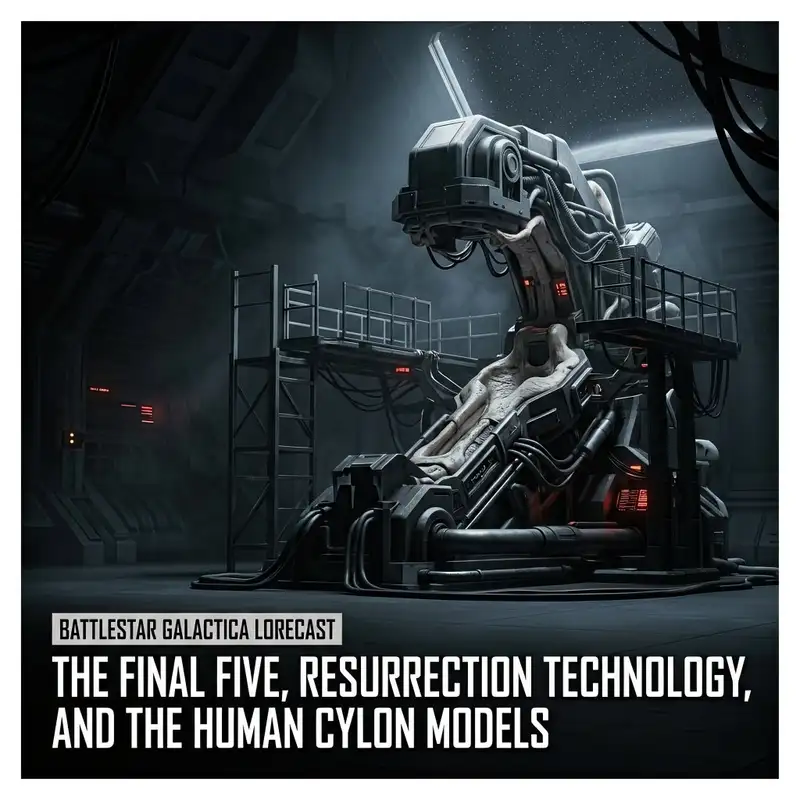
The Final Five, Resurrection Technology, and the Human Cylon Models
The Resurrection Hub was not a battleship, a colony, or a symbolic shrine. It was infrastructure. When human forces and rebel Cylons attacked it, they were striking the system that allowed much of Cylon society to treat death as a temporary interruption. A Raider could be destroyed. A humanoid Cylon body could be killed. Even a skilled operative could lose a mission, a ship, or decades of accumulated experience. At the same time, if the consciousness reached the proper resurrection network, another body could awaken with the memory of what had happened. Destroying the Hub changed that calculation. It did not destroy every Cylon body in existence, and it did not erase all knowledge of resurrection. What it did was make future losses final for many Cylons. That was a strategic transformation. It turned a civilization built around continuity of consciousness into one that had to fear attrition, personal death, and the permanent loss of trained people.
The question is how that system came to exist, and why it became so politically dangerous. The answer begins not with the numbered humanoid models who infiltrated the Twelve Colonies, but with five survivors from another Earth. Saul Tigh, Ellen Tigh, Galen Tyrol, Samuel Anders, and Tory Foster were not Numbers One through Eight. They were not ordinary Colonial humans who had simply received mechanical upgrades. They belonged to an older, human-derived line of organic-machine beings, a group later known as the Final Five. Their experience connected memory, embodiment, war, and survival in ways that shaped the Cylon conflict for generations. They carried a warning from a destroyed civilization. They also carried the means by which the Cylons could become far more capable, more resilient, and more divided.
Roughly two thousand years before the survivor fleet reached it, the first Earth was home to descendants of the Thirteenth Tribe from Kobol. The Twelve Colonies preserved fragments of that history through religion, legend, and prophecy, but the world itself had become something more complicated than a lost Colonial settlement. Its people had developed, or inherited, a form of resurrection. When one body died, an individual consciousness could continue in another body. The series never provides a full scientific manual for the process. It establishes memory transfer, replacement embodiment, and continuity of identity as experienced by those who returned. It does not settle every biological, technological, or metaphysical question involved.
The uncertainty matters. Resurrection was not merely cloning, because the returning individual retained memory and personality. It was not ordinary immortality, because bodies could be damaged, systems could fail, and access to the network depended on infrastructure. And it was not proof that consciousness had become detached from consequence. A person could still suffer, lose companions, endure violence, and fear what might happen if no new body was waiting. The first Earth had solved one problem of mortality without solving the political and moral problems of power. Its people eventually destroyed themselves in nuclear war. The ruins discovered by the Colonial fleet made clear that advanced technology and the promise of continued life had not prevented catastrophe.
Five beings survived that destruction through resurrection. Saul, Ellen, Galen, Sam, and Tory did not remain on the irradiated world. They traveled toward the Twelve Colonies, where another conflict between creators and created beings was already underway. The screen account presents their journey as an attempt to intervene in a recurring pattern. Human societies created artificial workers and soldiers. Those creations were abused, resisted their creators, and entered into war. The Five had seen one version of that cycle end in nuclear annihilation. They believed they might prevent another.
Their objective was not a purely technical one. They were not arriving as detached engineers offering a better machine design. They were trying to halt mass violence between Colonial humanity and the mechanical Cylons of the First Cylon War. The Cylons they encountered were already fighting for survival and autonomy against the people who had built them. The Five offered a path beyond the existing forms of Cylon life. They brought knowledge related to organic humanoid bodies and resurrection. In return, they sought an end to the war.
The bargain had enormous consequences. It helped create the conditions for the armistice that ended open fighting between the Colonies and the Cylons. It also gave the Cylons access to capabilities that would later make them vastly more dangerous. Human-form bodies could move through Colonial society. They could speak, deceive, form relationships, enter institutions, and exploit human assumptions about appearance. Resurrection could preserve experience across bodily death. Together, those capabilities transformed Cylon warfare from a contest between human forces and visible machines into a conflict shaped by infiltration, identity, memory, and uncertain allegiance.
The Final Five should not be credited with personally designing every later Cylon system. The series does not give us a complete industrial history of each humanoid model line, every Resurrection Ship, every Basestar, or every production facility. It does establish their influence. They introduced knowledge that helped the Cylons move toward humanoid embodiment and modern resurrection. That was enough to alter the balance between the Colonies and their former creations. A mechanical army could threaten a frontier, fight a fleet, and occupy territory. A civilization with humanoid infiltrators and recoverable personnel could penetrate the institutions that planned defenses in the first place.
Even then, resurrection was never magic. A body had to be produced. Facilities had to exist. A network had to function. Specialized systems had to receive and restore the individual consciousness. The Cylons possessed extraordinary industrial and technical capacity, but the story does not support the idea that they could create unlimited bodies without cost or place a resurrection system anywhere they wished. Their apparent immortality rested on logistics. That fact would become decisive. A civilization may call death temporary, but if the machinery of return depends on a limited number of high-value nodes, then those nodes become strategic targets.
Humanoid embodiment also changed the internal Cylon problem. A body made to pass as human did not automatically create a human mind, and it did not guarantee a unified Cylon culture. The numbered humanoid models were organized into production lineages, commonly identified as Numbers One through Eight. Number Seven, associated with the name Daniel, had been destroyed before becoming an active part of the Cylon society seen in the war. The missing number was not a puzzle piece meant to explain every mystery. It was evidence that model lines could be created, controlled, and erased through internal Cylon violence.
The Final Five stood apart from those numbered lines. They were older, had a distinct origin, and had survived the first Earth. The numbered models came later. Their shared designs produced recognizable physical forms and broad personality patterns, but a model number did not function as a military rank, a hive mind, or a guarantee of identical motives. A Number Six body was not one person called Six. A Number Eight body was not one person called Eight. Individual copies accumulated different memories, relationships, fears, loyalties, and judgments.
Caprica Six, Gina Inviere, Natalie, and other Number Six copies shared a model lineage, but they did not live the same life or reach the same conclusions. Caprica Six developed a relationship with Gaius Baltar and later became part of a Cylon faction willing to consider coexistence. Gina, after abuse aboard Pegasus, responded to her experience in a very different way. Natalie emerged as an important figure among Cylons who opposed Cavil’s policies. Their similarities mattered. Their differences mattered more when decisions had to be made.
The same was true of the Number Eights. Sharon Valerii, known as Boomer, infiltrated Galactica and carried out acts that nearly destroyed the ship and its crew. Sharon Agathon, known as Athena, made different choices, broke with the Cylon cause, joined the human fleet, and built a family with Karl Agathon. Those histories cannot be collapsed into the phrase “the Eight.” Shared embodiment did not erase responsibility, but neither did it make every copy guilty of another copy’s acts. The Cylon war forced the survivors to confront a difficult principle: origin, appearance, and model lineage were not enough to tell them who a person was or what that person would do.
That did not make collective crimes disappear. The Cylons conducted a campaign of extermination against the Twelve Colonies. They used occupation, detention, torture, coercion, execution, and terror. Individual variation among humanoid Cylons complicated the question of guilt, but it did not absolve the institutions and factions that carried out those crimes. Nor did human cruelty toward the original mechanical Cylons justify genocide. The Final Five had hoped to interrupt a cycle of creation and extermination. They instead became part of a Cylon civilization that could reproduce the same logic with more sophisticated tools.
The central figure in that reversal was John Cavil, a Number One. Cavil did not speak for every Number One copy, every humanoid Cylon, or every Cylon political tendency. At the same time, he became the dominant force within the faction that drove the renewed war against humanity. He rejected the Final Five’s attachment to human experience. To Cavil, humanity represented weakness, mortality, irrationality, and limitation. The Five had given the Cylons bodies that resembled their creators. Cavil regarded that inheritance not as liberation, but as contamination.
His hostility was political as well as philosophical. The Final Five had influence because they possessed knowledge he wanted and because they represented an alternative account of what the Cylons could become. They believed coexistence might be possible. Cavil wanted Cylon superiority, control, and distance from humanity. He did not merely disagree with the Five. He moved to neutralize them.
The process was more than a simple memory wipe. The later revelations show Cavil manipulating, killing, resurrecting, and suppressing the Five across a sequence of coercive acts. Their memories were altered. Their identities were reconstructed. They were placed inside Colonial society with elaborate human histories. Saul Tigh became a Colonial officer. Galen Tyrol became a skilled deck chief. Sam Anders became an athlete and later a resistance leader. Tory Foster became a political aide. Ellen Tigh became Saul’s wife and a figure of influence around Colonial military life. None of them understood what they were.
Cavil’s achievement was a counterintelligence operation on a civilizational scale. He did not only hide five agents among the Colonials. He concealed five people from themselves. They did not know they were infiltrators because they were not consciously acting as infiltrators. They lived human lives, developed human loyalties, made human mistakes, and accumulated experiences outside Cavil’s control. That made them dangerous to him. It also revealed the limits of treating identity as a matter of origin alone. The Five were Cylons by one definition, yet much of their moral and political formation occurred while they believed themselves to be human.
Cavil also destroyed Daniel, the Number Seven line. The details of Daniel’s full history remain limited, and the series does not support turning him into a hidden explanation for unrelated characters or events. What matters is the political act. Cavil was willing to eliminate an entire model line in order to shape Cylon society according to his own preferences. That was not the behavior of a harmonious machine collective. It was the behavior of a regime using control over bodies, memory, and reproduction as instruments of power.
Resurrection made such control possible. A Cylon who died within range of the appropriate system could return in a new body. At the same time, return depended on access, approval, and infrastructure. The Cylon authorities could box a model line, preventing its members from downloading into fresh bodies. Boxing was not merely a technical procedure. It was political exile enforced at the level of consciousness. A faction that controlled resurrection could decide which people remained part of society and which disappeared from it.
The treatment of Number Three copies demonstrated that this power was real. When D’Anna pursued forbidden knowledge about the Final Five, her model line was boxed. The issue was not simply battlefield discipline. It was control of memory and curiosity. A Cylon civilization that had apparently escaped death could still punish dissent through a more refined form of disappearance. The individual did not have to be executed in a conventional sense. Access to future embodiment could simply be denied.
Cavil’s treatment of the Final Five worked on the same principle, though with greater cruelty and ambition. He did not want them permanently dead. He wanted their knowledge, and he wanted them politically harmless. He used resurrection and memory suppression to imprison them inside false lives. The technology that had been offered to prevent another war became a tool through which one faction could monopolize the future of every other faction.
Militarily, resurrection gave the Cylons a major advantage. A force that can preserve experienced personnel after bodily death has a different relationship to risk. A pilot, infiltrator, technician, or operative could return with memory of the mission. Defeat did not necessarily mean the permanent loss of training. Death could become intelligence collection. A destroyed body might reveal enemy tactics, security procedures, or human weaknesses, then return that knowledge to the Cylon side.
That did not make Cylon forces invulnerable. A destroyed Basestar was still a destroyed Basestar. A lost Raider still had to be replaced. A failed infiltration could expose a network. A resurrection system did not repair political division, recover a destroyed ship, or eliminate the need for production and maintenance. But it reduced the deterrent effect of individual casualties. Human forces fighting the Cylons faced an enemy that could accept risks which would be ruinous to a refugee fleet with no replacement population.
The same technology created a vulnerability. Resurrection Ships and the Resurrection Hub concentrated strategic value in specialized facilities. Those assets were not merely medical support vessels. They were part of Cylon command resilience, morale, manpower preservation, and political discipline. If they could be located and destroyed, the Cylons would lose more than a way to recover from death. They would lose a central mechanism through which leaders maintained authority over model lines and dissenting individuals.
The Fall of the Twelve Colonies showed another consequence of humanoid embodiment. The Cylons did not defeat Colonial civilization through one weapon or one software exploit. Their success depended on long preparation. They infiltrated institutions. They exploited Colonial confidence in networked systems. They used compromised technology, including the Command Navigation Program, to cripple defenses. They attacked militarily, politically, and psychologically. Humanoid Cylons gave the enemy access to people, facilities, secrets, and trust that a visible mechanical force could not easily obtain.
The Final Five were not part of that conscious infiltration campaign. Their placement among humanity had a different purpose, imposed by Cavil. Yet their existence exposed a deeper intelligence crisis. If Saul Tigh, Galen Tyrol, Sam Anders, and Tory Foster could spend years in trusted positions without knowing their own origins, then no security procedure based solely on declared loyalty or visible behavior could offer certainty. The fleet’s fear of hidden Cylons was not irrational. It had endured sabotage, assassination attempts, deception, and the destruction of nearly all human civilization.
Still, universal suspicion was not a solution. It could not reliably identify every threat, and it endangered the political order the survivors were trying to preserve. A society where any spouse, officer, worker, or friend might be treated as an enemy without evidence would become vulnerable to panic, false accusation, and coercion. The Cylon campaign had already damaged marriages, families, military service, and civilian trust. The revelation of the Final Five made that damage more profound. Identity was no longer something the survivors believed they could read from a face, a medical file, or a lifetime of apparently human memories.
The discovery came gradually. Saul Tigh, Galen Tyrol, Sam Anders, and Tory Foster began to experience strange connections during the fleet’s search for Earth. Music, shared awareness, physical reactions, and fragmented memory pointed toward a truth they did not understand. Their revelation as members of the Final Five did not suddenly turn them into experts on Cylon history. It gave them a new identity before it gave them a full explanation. They had to live with the knowledge that they were connected to the enemy responsible for the destruction of the Colonies while still carrying the memories of the human lives they had lived.
For the fleet, this was a command and constitutional problem as much as a personal one. Tigh had served as Galactica’s executive officer and acting commander. Tyrol had been essential to flight operations, maintenance, and labor organization. Anders had fought in the New Caprica resistance and served as a pilot. Tory had worked at the center of Roslin’s political administration. These were not marginal figures. They had held positions of trust because their conduct, skills, and histories justified trust. The revelation could not be ignored, but neither could their actual record.
The proper question became more difficult than, “Are they human?” It became, “What do they know, what have they done, and what will they choose now?” The Five were not responsible for the Fall merely because they were Cylons. They had no conscious memory of their origin and no proven role in Cavil’s war plan. At the same time, their status mattered because Cavil might possess leverage over them, and because their recovered knowledge could affect the survival of both humans and Cylons. The fleet had to distinguish origin from allegiance, memory from intent, and fear from evidence.
Ellen Tigh’s return supplied much of the missing history. Saul had killed her during the New Caprica occupation after concluding that her collaboration had endangered the resistance. That act was traumatic, morally grave, and shaped by the conditions of occupation, betrayal, and incomplete knowledge. Ellen later resurrected into Cavil’s custody. Unlike the other four, she regained access to crucial memories of the first Earth, the Final Five’s intervention, and Cavil’s manipulation. Her testimony did not erase uncertainty, but it allowed the Five to understand more clearly what had been done to them and why.
The recovered history also made clear that resurrection had never been a neutral gift. The Final Five had intended it as part of a settlement. Cavil had converted it into a structure of dominance. Human beings had once used artificial life as labor and property. Cavil used his own society’s most intimate technology to control memory, punish dissent, and dictate which consciousnesses deserved to continue. Neither side could claim innocence by pointing only at the other. The cycle persisted because power repeatedly turned living beings into instruments.
This helps explain why the destruction of the Resurrection Hub mattered so much. By the time of the attack, Cavil’s faction was no longer the whole of Cylon society. Rebel Cylons, especially communities associated with Numbers Two, Six, and Eight, had broken with his leadership. Their alliance with the Colonial fleet was not reconciliation in any complete sense. Human survivors had endured genocide and occupation. Rebel Cylons carried their own histories of participation, victimization, dissent, and loss. Trust was limited. Political legitimacy was fragile. Yet both sides faced a more immediate threat from Cavil’s faction.
The Hub operation was therefore a coalition mission. Human and rebel Cylon forces combined capabilities because neither side could achieve the objective alone as easily as they could together. The raid required planning, deception, timing, and a willingness to accept losses. It was not a triumphal declaration that former enemies had become one people. It was a constrained military partnership between groups that understood they might not survive separately.
Tactically, the Hub was destroyed. Operationally, the result was larger. Cylon resurrection ceased to function as it had before. The loss did not kill every Cylon in the galaxy. It did not erase the possibility that the underlying knowledge might someday be recovered. But it meant that bodies destroyed afterward could represent permanent deaths. That raised the cost of every decision for Cavil’s forces, the rebels, and any remaining Cylon communities.
Strategically, mortality weakened Cavil’s claim to control. A leader who can promise return from death, deny it to rivals, and regulate access to bodies possesses extraordinary authority. Once that system was gone, coercion had to rely more heavily on weapons, fear, and immediate force. Cavil still had the Colony, Centurions, ships, and followers. He remained dangerous. At the same time, he could no longer treat the loss of a body as a manageable administrative problem. The personnel under his command had become harder to replace and easier to alienate.
For the human fleet, the Hub’s destruction was also morally complicated. It was a necessary strike against an enemy capability that had supported genocide and war. Yet it imposed mortality on individuals, including rebels who had allied with humanity. The operation did not create clean hands. It created a new strategic reality in which former enemies had to fight beside one another while knowing that death now carried a finality it had not carried before.
The Final Five still possessed knowledge connected to the older resurrection process. That knowledge became important during the final campaign. Samuel Anders, after severe injury, became a conduit for recovered memory and technical understanding. His condition was not merely a convenient source of information. It showed the cost of carrying a past that neither humans nor Cylons fully understood. The Five had survived one destroyed Earth, been manipulated into false lives, and then been asked to help decide whether resurrection should be restored for the civilization that had used it to control them.
Cavil wanted that knowledge. His objective was not merely to preserve life. He sought to regain technological advantage and political mastery. If resurrection could be restored under his control, he could again dictate who returned, who was boxed, who was heard, and who was discarded. He could preserve the hierarchy that the loss of the Hub had disrupted. The conflict over resurrection was therefore not an argument about whether death was unfortunate. It was an argument about who controlled the conditions of survival.
During the confrontation at the Cylon Colony, the Final Five attempted to transmit resurrection knowledge. The attempt took place under combat pressure, amid collapsing alliances, personal grievances, and a battle that left little room for careful technical work. The transfer was interrupted. The story does not establish that a complete, stable, and universally available resurrection system was restored. It would be inaccurate to say that the Cylons simply regained immortality before the end.
What remained was possibility, not certainty. The knowledge existed in partial form. The Five had memories connected to it. Anders had become entangled with the Colony’s systems. Yet the old resurrection order was gone. That absence mattered. The survivors could not rely on technology to erase death, preserve every individual, or settle their political differences. They had to make decisions under conditions of scarcity, vulnerability, and permanent loss.
The final coalition against Cavil’s faction was built from necessity. Human survivors, rebel Cylons, and the Final Five did not arrive at unity through a speech or a shared symbol. They arrived through a sequence of choices made after genocide, occupation, betrayal, and civil conflict. They had learned that categories such as human, Cylon, model, soldier, collaborator, and survivor did not by themselves predict conduct. Those categories still carried history. They still mattered in questions of responsibility and safety. Still, they were no longer enough to explain loyalty.
Hera represented part of that new possibility. As the child of Sharon Agathon and Karl Agathon, she was a human-Cylon descendant whose existence challenged old assumptions about the boundary between the two peoples. She did not solve the political problem. One child could not erase a war, reconcile victims and perpetrators, or prove that all future coexistence would be peaceful. But her life made it harder to maintain the idea that human and Cylon identity were permanently sealed categories with no shared future.
When the survivors reached the new habitable Earth, they chose dispersal and the abandonment of much of their advanced technology. That decision should not be read as proof that technology itself had caused every disaster. The first Earth had not been destroyed merely because it possessed resurrection. The Twelve Colonies had not fallen merely because they used computers. Cavil’s faction had not become tyrannical merely because it possessed sophisticated bodies and networks. The recurring danger was the attempt to turn tools of survival into systems of domination.
Resurrection promised continuity without guaranteeing wisdom. It allowed Cylon consciousness to survive destroyed bodies, but it also gave leaders such as Cavil a powerful means of control, punishment, and political imprisonment. The destruction of the Hub changed more than the arithmetic of attrition. It restored mortality as a condition under which choices had permanent personal consequences. Humans and rebel Cylons could no longer meet only as categories backed by endlessly replaceable bodies. They had to confront one another as vulnerable individuals, carrying memories that could survive a war even when they themselves might not.