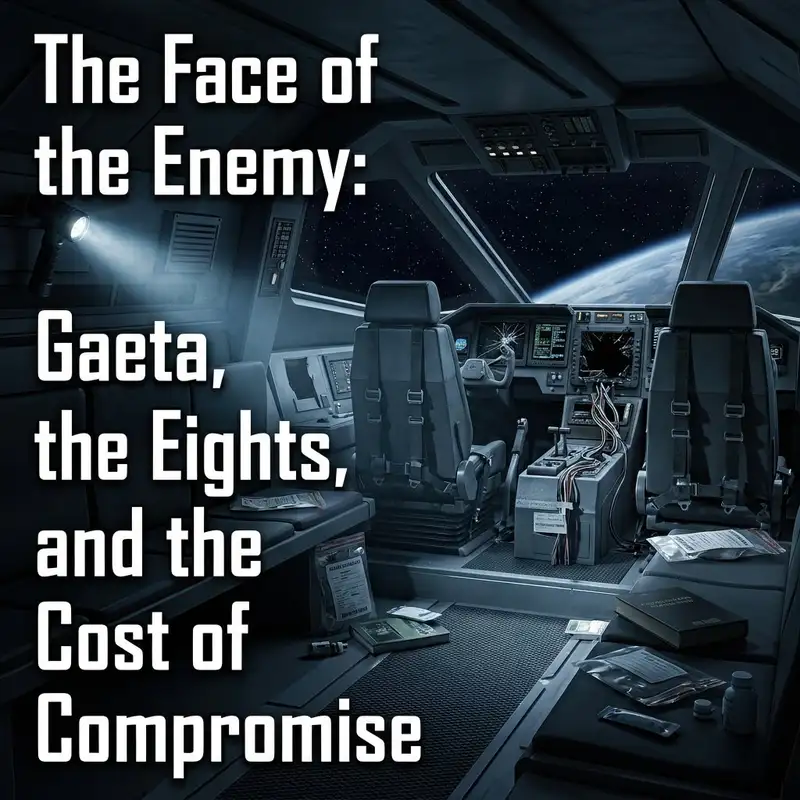
The Face of the Enemy: Gaeta, the Eights, and the Cost of Compromise
The Raptor had made the jump. That was the good news. The bad news was that it had made the jump alone.
A DRADIS contact had forced the Fleet into an emergency displacement. In the confusion, one small Colonial Raptor emerged at a point where it could not merely turn around and retrace its route. Its faster-than-light calculations had been corrupted. The crew was beyond the red line, outside the margin from which an easy return jump was considered safe. They had no clear coordinates for the Fleet, no certainty that a search would find them, and no time to solve every problem in sequence.
Inside that Raptor were two pilots, Jay Finnegan, known as Shark, and Easy Esrin. There was Brooks, a deckhand whose maintenance knowledge mattered more now than his rank. There were two Number Eights, separate individuals who happened to share the same Cylon model line. And there was Lieutenant Felix Gaeta, injured, exhausted, and carrying more history with one of those Eights than anyone else aboard understood.
The immediate enemy was not a Basestar, a Raider screen, or a Cylon boarding party. It was air. The Raptor’s carbon-dioxide scrubbers were failing. Its oxygen margin was shrinking. Its power was finite. Every repair attempt consumed time, tools, and labor. Every argument consumed concentration. In a large ship, a malfunction might become a damage-control problem. In a stranded Raptor, it became an argument about survival, authority, trust, and the value of each remaining breath.
That was why the presence of the Eights mattered so much. The passengers were not trapped in a neutral engineering emergency. They were trapped in a small compartment with an enemy species, an enemy model line, and, in Gaeta’s case, a former lover whose role in his life had never been honestly settled. The Raptor crisis would eventually reveal murders committed aboard the craft. But its deeper wound came from an earlier compromise, made during the occupation of New Caprica, when desperation encouraged Gaeta to trust a private channel that no one else could verify.
Six days earlier, the Fleet had found Earth, or what it had believed was Earth. Instead of refuge, it found ruins. The discovery shattered a destination that had organized years of sacrifice. It also destabilized the fragile political arrangement that had carried the Fleet that far. Humans and rebel Cylons were attempting an alliance at precisely the moment when many humans had less confidence than ever in Cylon promises, Cylon intentions, or the larger purpose of the journey.
Gaeta entered that period already damaged in body and spirit. He had recently been injured, had been working under strain, and had every reason to be angry at the condition of the Fleet. Saul Tigh ordered him to take leave aboard the Zephyr. The order was sensible. A fatigued operations officer with an injury is not a bottomless institutional resource. But rest does not arrive on command, especially for someone who has spent years making decisions under pressure and carrying the memory of New Caprica.
Lieutenant Louis Hoshi saw Gaeta off. Hoshi, an officer who had come from Pegasus and become Gaeta’s partner, gave him morpha for the pain. Their relationship matters here not because it explains Gaeta’s later politics, and not because it turns the story into private melodrama. It matters because it shows that Gaeta still had a human bond outside his anger. He had someone waiting for him, someone who understood that he was hurt, someone who would later have to make a command decision that placed professional responsibility against personal hope.
Gaeta also carried a reputation. He was not known as a man who found it easy to leave people behind. That quality could be admirable. In a refugee fleet, where every specialist, pilot, child, prisoner, and technician might represent part of a civilization’s remaining future, refusing to abandon people had moral force. But that instinct could also become a vulnerability. An enemy who understands that you will take risks for the missing can use the missing to control you.
The roots of that vulnerability lay on New Caprica. During the Cylon occupation, people disappeared into detention. Resistance members, suspected resistance members, civilians caught in sweeps, and people connected to underground networks could vanish into an administrative system designed to control the population through fear, surveillance, coercion, and selective violence. Families did not receive reliable answers. Friends could not trust official records. The occupation created exactly the sort of environment in which rumor became intelligence, personal contacts became lifelines, and even a small possibility of access became hard to refuse.
Gaeta had names. They were the names of people who had been detained or had gone missing. He also had access to a Number Eight who appeared able to move through Cylon systems and records in ways that a human Colonial officer could not. This Eight was later identified as Sweet Eight. She was not Sharon Agathon, known as Athena. She was not Sharon Valerii, known as Boomer. She was not a representative sample of every Number Eight, much less every humanoid Cylon. She was one individual who knew Gaeta, understood his fear, and possessed leverage that he did not.
The arrangement between them was informal, secret, and born from an occupation in which normal institutions had been bent or destroyed. Gaeta supplied lists of the detained and missing. Sweet Eight said that she could use her access to find them, perhaps to secure releases, perhaps at least to establish whether they were alive. Gaeta’s apparent purpose was rescue and confirmation. Nothing in the story establishes that he knowingly gave names to be executed. His failure was not that he openly chose murder. His failure was that he entrusted human lives to a source he could not independently validate.
That distinction is important. Intent and consequence are not the same, but neither are they unrelated. Gaeta gave information to someone operating within the machinery of an occupation. He could not audit her claims. He could not confirm releases. He could not see the detention records himself. He could not safely bring the arrangement into an open process where others might challenge, corroborate, or monitor it. Secrecy may have seemed necessary. It also removed the safeguards that might have exposed the deception.
Sweet Eight told Gaeta that some people had been freed, while others were already dead. For a man desperate for answers, that was a cruelly effective mixture of hope and grief. It gave him just enough apparent success to continue believing that the channel was real. Yet the later revelation shows Sweet Eight passing Gaeta’s list to another Eight and directing that the people named on it be killed. What Gaeta had believed was a rescue list became actionable targeting information in Cylon hands.
The victims cannot be reduced to an intelligence failure. They were detainees, resistance members, friends, family members, and people who had already been endangered by occupation. Gaeta remembers the names as people. His concern includes a child whose fate remains uncertain in his own recollection. The story does not offer a clean ledger of who survived, who died, or who was released. That uncertainty is part of the harm. Occupation does not only kill. It makes accounting difficult. It denies families evidence, denies communities burial and certainty, and leaves survivors with questions that can harden into guilt or rage.
Sweet Eight later presents her conduct as straightforward wartime logic. In her view, people valued by an enemy are useful targets. That is an explanation of her rationale, not a moral defense. It also is not proof that Gaeta secretly wanted those people dead. She understands something real about compromise under coercion. A person who accepts a secret arrangement may become invested in believing that the arrangement is helping. But she turns that insight into manipulation. She identifies Gaeta’s shame, then insists that his shame proves he shares her guilt.
That is the poison at the center of their relationship. Sweet Eight does not merely betray Gaeta’s trust. She tries to redefine him through the betrayal. If he trusted her, she implies, he must have wanted the result. If he kept the channel secret, he must have known it was corrupt. If he is horrified by the deaths, he must be horrified because he recognizes himself in her. This is an old coercive technique. It takes a compromised decision, strips away context and intent, and offers the victim only two options: deny everything, or accept the manipulator’s version of the self.
Fifteen months later, the Raptor placed Gaeta back in Sweet Eight’s company. He was already tired, in pain, and sent away from duty at a moment when the Fleet was politically unstable. The sudden emergency jump turned a leave flight into an isolation event. Shark and Easy had to confront the navigation problem. The Raptor had made its jump, but the calculations were no longer reliable enough to guide an immediate return. The craft had crossed from routine transportation into a stranded survival mission.
The air problem quickly became the defining constraint. The scrubbers were not fully working. The crew estimated that they had roughly twenty hours of survivable air at the start of the crisis, but the number was not a general statement about Raptor endurance. It was a judgment about this damaged craft, this number of passengers, this condition of life support, and this moment in time. As the Raptor lost power and repair options narrowed, so did that margin.
Brooks became essential. In a fleet accustomed to celebrating commanders and pilots, the Raptor made the quieter truth visible. Survival often rests on the labor of people whose work is noticed only when it fails. Brooks was a deckhand, but he was also the person with the tools and practical familiarity needed to attempt a repair. The distinction between combatant and support specialist can become almost meaningless when a failed fitting, a damaged cable, or a broken scrubber determines whether everyone aboard lives.
The second Number Eight joined the repair effort. She was a separate person from Sweet Eight, and the distinction matters. The fact that both had the same face did not make them interchangeable in identity, intention, knowledge, or responsibility. During the repair attempt, the second Eight was electrocuted. The insulation on Brooks’s pliers appeared damaged, immediately raising the possibility of sabotage. Yet at that point, the evidence did not conclusively establish sabotage. Tools wear out. Emergency conditions magnify ordinary failures. A crew already frightened of Cylons can turn every defect into proof of hostile action.
The death did not remain a symbolic loss. It became an air-management problem. In a sealed craft with failing life support, a body consumes space, retains heat, affects the air, and cannot be treated with the ordinary rituals of death. The crew jettisoned the Eight’s body to preserve what survival margin remained and recover whatever oxygen they could from the compartment. It was not casual disposal. It was a measure imposed by a craft that no longer had enough resources to treat the dead and the living separately.
That decision further damaged trust. To the humans aboard, the dead Eight might have been a Cylon stranger, a possible saboteur, or an unwanted reminder of the alliance outside. To Sweet Eight, she was another member of her model line, and perhaps more than that. To Gaeta, the death carried the added burden of old suspicion. Every act aboard the Raptor became entangled with the past. The crew could not agree on whether equipment had failed, whether someone had caused the failure, or whether the very act of asking those questions was evidence of panic.
Back with the Fleet, Hoshi did not treat the missing Raptor as an administrative inconvenience. He obtained permission to search. Margaret Edmondson, known as Racetrack, flew with him in another Raptor. Their mission had the familiar structure of search and rescue, even if the operating environment was unusual. They had incomplete information, uncertain coordinates, a missing craft that may have been damaged, and a shrinking chance that they could find it before air, power, or navigation limits killed everyone aboard.
Search and rescue is often described in moral language, and it should be. A military force that leaves its people without making a serious effort to recover them destroys trust in its own obligations. But rescue is also governed by risk. Every search jump puts another crew and another craft into danger. Every hour spent looking consumes fuel, time, endurance, and attention in a Fleet that cannot replace losses easily. A commander must decide how long to keep searching before the rescue mission becomes a second emergency requiring rescue of its own.
For Hoshi, that judgment was brutal because Gaeta was not an abstract missing officer. He was his partner. Yet personal attachment did not relieve Hoshi of command responsibility. It made the responsibility harder. Racetrack understood Gaeta’s character well enough to recognize that he would not easily abandon other people. That knowledge gave the search a human urgency. It did not create new coordinates or guarantee that the missing Raptor could be found.
When Hoshi finally accepted that the search could not continue indefinitely, it was not indifference. It was the tragic limit of responsible command. The Fleet’s ability to care for its people depended on refusing to turn every loss into an unlimited expenditure of additional lives. The decision was emotionally devastating precisely because Hoshi cared. A commander who feels nothing may be dangerous. A commander who feels everything but cannot make a decision may be dangerous in a different way.
Inside the stranded Raptor, the atmosphere continued to deteriorate. Brooks died from an overdose of Gaeta’s morpha. At first, the death intensified suspicion without resolving it. The drug had come from Hoshi, given to Gaeta for legitimate pain. Now it had become a possible instrument of murder. Sweet Eight was an obvious suspect to the humans, but suspicion is not proof. The Raptor’s crisis had stripped away the normal systems that might preserve evidence, secure medication, separate witnesses, or investigate a death without immediate fear.
Sweet Eight then demonstrated an ability that changed the technical balance inside the craft. She opened her palm and connected physically to the Raptor’s systems through a cable. The sight recalled previous occasions when a Number Eight had interfaced with Colonial technology, but it should not be transformed into a universal claim that every Eight possessed identical, unrestricted access to every Colonial system. The incident establishes that this individual could connect to this Raptor in this circumstance. It does not prove that she caused the corrupted jump calculations or that she could command any computer at will.
What it did prove was that Sweet Eight possessed capabilities the others could not fully inspect. In a functioning military system, that gap would demand procedures, authentication, supervision, and technical verification. In a powerless, air-starved Raptor, it became another source of dependency. The people aboard needed help from someone they feared. They also feared that accepting her help might place the craft more completely under her control.
As power reserves diminished and the air supply fell, Sweet Eight stopped pretending that survival was a shared problem. She killed Shark and Easy by slashing their throats. The murders were intimate, immediate, and final. They removed the Raptor’s pilots, its flight expertise, and two people who could challenge her. They also reduced the number of bodies consuming air. Sweet Eight later described that as part of her reasoning. She claimed she was preserving oxygen for herself and Gaeta, and protecting Gaeta from the possibility that he might have made similar choices.
That claim must be treated for what it is: the murderer’s justification. Sweet Eight did not reveal a verified hidden desire in Gaeta. She imposed her own judgment and then told him that it was really his. The fact that the Raptor faced a genuine survival constraint does not make killing the crew an inevitable or neutral solution. Scarcity can explain why a person sees murder as useful. It cannot make murder an act of rescue.
By then Gaeta was left with Sweet Eight and the consequences of every secret he had carried from New Caprica. The enclosed space of the Raptor had become an interrogation chamber without formal questions. Sweet Eight knew why he distrusted her. She knew why he feared what she might say. And she knew that he had little time, little air, and no institutional protection against the truth she had withheld for more than a year.
She told him what had happened to the people on his lists. Most had been killed. The people he had hoped to locate or save had been turned into targets. Gaeta’s effort to work through an unofficial channel had not merely failed. It had furnished an occupying power with information about people already vulnerable to detention and execution. The revelation did not mean that Gaeta had intended their deaths. But it did mean that his trust had been materially used to help cause them.
The old warning from Gaius Baltar now made sense. Baltar had previously hinted that Gaeta’s Number Eight had done something he did not understand. At the time, the warning had been opaque, one more unsettling statement from a man whose knowledge often came wrapped in self-interest, fear, or evasion. In the Raptor, Gaeta recognized that Baltar had known enough to point toward the truth. He had been carrying evidence of Sweet Eight’s deception without knowing its full meaning.
The revelation ended any possibility that Gaeta could preserve the old story about himself. He had tried to help. He had also trusted the wrong person, hidden the arrangement, failed to verify the results, and contributed information that others used to kill. Moral injury often arises in that space between intent and consequence. A person can act for a humane reason, discover that the act caused harm, and then become unable to separate responsibility from self-condemnation.
Gaeta killed Sweet Eight with a scalpel. His rage was understandable. His grief was understandable. The immediate danger aboard the Raptor was real. But the act was not a tribunal, a lawful judgment, or a full accounting for the people she had killed. It was violence committed in a moment when justice was impossible and survival had become entangled with revenge. Sweet Eight’s death ended her ability to manipulate him directly. It did not restore the dead, identify every victim, or prove what every Cylon knew.
Gaeta became the sole survivor of the Raptor. That tactical fact is stark. A craft that had carried a small group of trained Colonial personnel and two Cylons now held one injured officer, failing life support, dwindling power, and the accumulated evidence of murder. Gaeta attempted to overdose on morpha. He stopped before completing the act. The moment should not be romanticized. It was the response of a person who had reached the edge of what he believed he could bear, then did not cross it.
Raptor ten twenty nine found him. The search that Hoshi had been forced to abandon had not been pointless, even though it had reached its limit. Gaeta was recovered. In narrow operational terms, that was a success. A missing officer survived. A stranded Raptor was located. But it was a limited success. Five people were dead. The craft had nearly been lost. Search assets had been strained. A small technical failure had become an intelligence crisis, a murder scene, and a reopening of the Fleet’s most painful occupation memories.
The rescue also brought Gaeta back into an institution that did not know how much truth it could afford. The Fleet had just discovered that its long-sought Earth was a devastated world. Its military position was weak. Its population was demoralized. Its leaders were trying to hold together an alliance with rebel Cylons because that alliance offered real strategic value. The Cylons had knowledge, ships, personnel, and a shared interest in confronting Cavil’s faction. Breaking cooperation could leave both sides more vulnerable.
Saul Tigh conveyed the policy that Admiral Adama did not want an investigation into the Raptor deaths if such an inquiry might endanger the human-Cylon alliance. The record does not establish a fully documented legal cover-up order personally issued by Adama. What it establishes is a decision, communicated through Tigh, that the political and military risks of investigation were considered too high at that moment.
The calculation was not irrational. Alliances formed in wartime are often built from participants who do not trust one another, and they are especially fragile when one side has committed atrocities against the other. The human-Cylon partnership depended on humans accepting help from beings associated with the genocide of the Colonies, the occupation of New Caprica, and years of infiltration and pursuit. It depended on rebel Cylons believing that humans would not use every new accusation as grounds for collective punishment. A public inquiry into murders committed by a Number Eight could have become a broader political explosion.
But strategic necessity has an institutional cost when it suppresses accountability. Gaeta had survived an event in which a specific Eight killed Colonial personnel and exposed an earlier betrayal involving Cylon detention and executions. An investigation could have done several things. It might have established facts. It might have separated Sweet Eight’s acts from the conduct of every other Eight. It might have identified failures in navigation security, medication control, life-support procedures, or Cylon access to Colonial systems. It might have given Gaeta a formal avenue to place responsibility where evidence supported it.
Instead, Gaeta was told, in effect, that the Fleet could not safely hear the whole story. That did not make the alliance illegitimate. It did not prove that Tigh, Adama, or the rebel Cylons endorsed Sweet Eight’s crimes. But it left Gaeta with no credible process through which his experience could be recognized, investigated, or bounded. The Fleet asked him to distinguish one murderer from an entire alliance while denying him the mechanism by which that distinction might be made.
For a military institution, that is a dangerous bargain. Commanders sometimes must defer action because of broader operational priorities. Yet personnel asked to carry silence can come to believe that the institution values political convenience over their dead. When that belief takes hold, anger does not remain private. It seeks allies, language, and targets. It becomes available to anyone who can frame grievance as proof that the system itself has been captured or corrupted.
Gaeta rejected the alliance. He pointed out that Tigh himself was a Cylon. The accusation had force because Tigh’s identity was real, but it also compressed too much into one conclusion. Tigh was not Sweet Eight. Sweet Eight was not Athena. Athena was not every Eight. Rebel Cylons were not Cavil’s faction. The Fleet’s strategic problem required distinctions. Gaeta’s trauma made those distinctions harder to sustain, especially when the leadership response seemed to ask for trust without transparency.
He asked to speak directly with Adama. He also hinted to Hoshi that he had a plan. The significance of that moment is not that Gaeta’s later political choices were inevitable. Trauma does not remove agency. Betrayal does not excuse every action that follows. His legitimate outrage at Sweet Eight’s crimes and the Fleet’s refusal to investigate could still be turned toward destructive ends. Nor should later events erase the real injury that occurred here. Gaeta had been manipulated during occupation, trapped in a dying Raptor, and then told that the political needs of the moment outweighed a formal reckoning.
Around him, opposition to the Cylon alliance was already growing. Tom Zarek and others could draw on fear, grief, resentment, and the belief that the Fleet’s leaders had surrendered too much authority to former enemies. Gaeta’s experience gave that political current something especially potent: a story of personal betrayal that seemed to confirm broader fears. His anger was not invented by demagogues. But political movements can take authentic wounds and direct them toward conclusions that exceed the evidence.
The Raptor incident therefore had several outcomes at once. Tactically, one survivor was recovered from a stranded craft. Operationally, the event demonstrated how quickly a small Raptor could become dependent on fragile life-support systems, maintenance labor, uncertain navigation, and outside rescue. Intelligently, it showed the danger of unverified channels in a conflict shaped by infiltration, occupation records, and competing identities. A person with access is not necessarily a trustworthy source. A compassionate motive does not remove the need for corroboration.
Strategically, Sweet Eight’s crimes deepened human suspicion toward a Cylon alliance that the Fleet believed it needed. Institutionally, the decision to avoid investigation preserved short-term cohesion while creating a grievance that could not be tested, contained, or answered through lawful process. Civilians paid the oldest and deepest cost. The people on Gaeta’s lists remained absent, murdered, released, or unaccounted for, while those who loved them were left without a reliable record of what had been done.
Gaeta’s compromise failed because it substituted private trust for accountable verification in an environment built on coercion and deception. Sweet Eight turned a rescue effort into an instrument of killing, but the Fleet’s refusal to investigate turned that betrayal into something larger: a grievance without lawful resolution, ready to become opposition not merely to one murderer, but to the fragile alliance on which everyone’s survival depended.