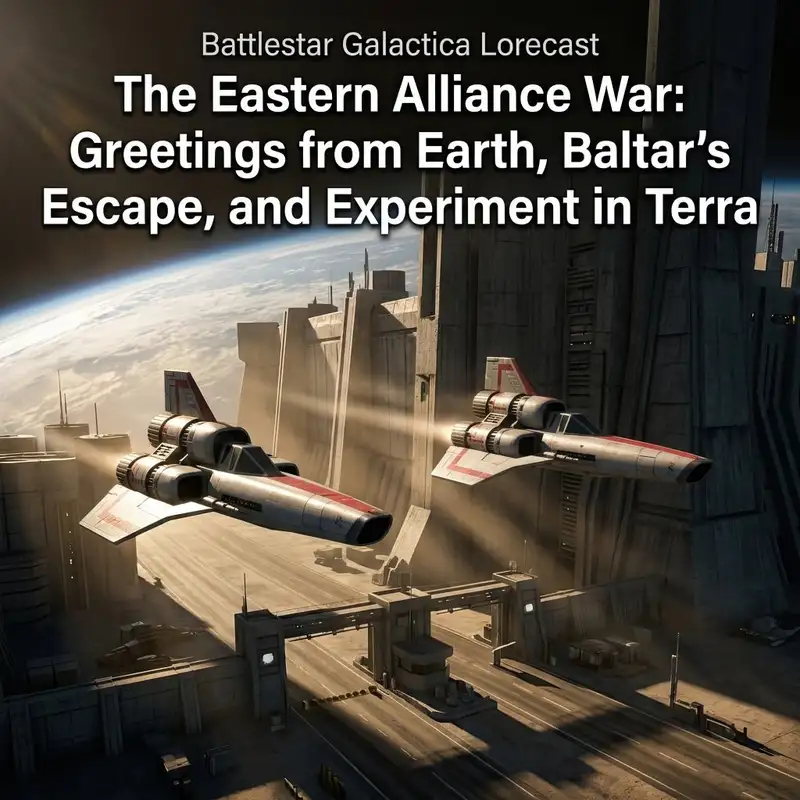
The Eastern Alliance War: Greetings from Earth, Baltar’s Escape, and Experiment in Terra
The first sign of Terra was not a beacon, a map, or a welcoming transmission. It was a small vessel drifting beyond the Colonial Fleet’s familiar routes, carrying six human beings sealed inside suspended-animation chambers. Apollo and Starbuck found the ship while on patrol. It was called the Lunar Avion, and its presence created three problems at once. It was a rescue problem, because its passengers might die if its failing systems were mishandled. It was an intelligence problem, because its design and origin were unknown. And it was a political problem, because the vessel seemed connected to a world called Terra. To Commander Adama, that name carried particular weight. In the Gemonese language, Terra meant Earth.
For a fleet that had spent its entire journey pursuing fragmentary signs of a lost ancestral world, that was enough to stir hope. But hope was not evidence. The Lunar Avion was a sublight vessel, not a Colonial ship capable of making faster-than-light jumps. Its passengers had entrusted their survival to machinery the Colonials did not understand. The immediate question was not whether Terra might be Earth. The immediate question was whether Galactica could bring the vessel aboard without killing the people inside it.
That distinction mattered. The Colonials had warships, Vipers, advanced navigation, and the remnants of a military-industrial civilization. Yet they were not masters of every human technology they encountered. Their strength lay in systems they knew how to operate, maintain, and fight with. The Lunar Avion belonged to a different technological tradition, shaped by another world’s environment, another set of medical assumptions, and another history. Treating it as familiar simply because its passengers were human would have been the kind of confidence that turns a rescue into an accident.
The discovery also put the Fleet in a familiar strategic position. Every possible clue to Earth offered opportunity, but every clue could expose the refugees to danger. The Colonial Fleet was not an exploration service with secure bases behind it. It was a convoy of survivors, pursued through space by the Cylons, carrying a reported population of roughly six thousand people. Its military escorts could investigate a mystery, but they could not do so casually. A detour consumed time. A rescue consumed medical resources. Contact with an unknown civilization could reveal the Fleet’s presence to allies, enemies, or both.
Still, six people in suspended animation were not an abstraction. They were a family and four children whose fate depended on Colonial judgment. The Fleet had lost worlds, cities, families, and most of its population. It could not honestly claim to be preserving civilization while ignoring endangered civilians simply because helping them carried risk. The Lunar Avion therefore became the first test of the Terra encounter. Before the Colonials could decide what Terra meant, they had to decide what they owed the people drifting toward it.
Once the Lunar Avion was aboard Galactica, the rescue became more difficult, not less. Doctor Salik understood the basic medical principle immediately. The sleepers’ system had been designed as a whole, and removing its occupants or altering its functions without understanding them could be fatal. Doctor Wilker, working from curiosity and urgency, attempted to examine the technology more closely. The result was the accidental revival of Michael Fowler.
Michael’s awakening did not produce a clean intelligence briefing. It produced a medical emergency. His body had been altered for life in a low-gravity environment, and Galactica’s atmosphere and gravity placed him under immediate strain. The Colonials could keep a battlestar functioning under combat conditions, but they could not just assume that their air, gravity, medicine, and life-support practices were safe for every human being they encountered. The gap was revealing. Military superiority does not equal universal scientific competence. A fleet can possess powerful weapons and still be helpless before an unfamiliar respirator, a medical implant, or a sleeper chamber built for a different world.
Michael’s wife, Sarah Fowler, and their four children remained dependent on the Avion’s systems. Their situation was more than technical. They represented a family attempting to survive the collapse of a distant political order. Michael spoke of escape, of Lunar Seven, and of a place called Terra. Sarah was less ready to trust the machinery and institutions that had transformed human life for the lunar colonies. Between them, the Fowlers offered a reminder that refugees do not arrive as clean categories. They carry arguments, fears, loyalties, habits, and different memories of the society they left behind.
For the Colonial Fleet, the family’s importance was larger than their number. Six people could not repair Galactica’s engines or reverse the destruction of the Twelve Colonies. But in a community reduced to a few thousand survivors, every child, parent, technician, worker, and caregiver had demographic and moral weight. The Fleet had become an improvised society under arms. It needed pilots and mechanics, certainly. It also needed families, teachers, medical workers, and children who could imagine a future beyond the next engagement. The rescue of the Fowlers was therefore not a sentimental diversion from the search for Earth. It was part of the reason the search mattered.
Michael’s account transformed the mission. Terra was not a peaceful destination waiting to receive distant relatives. It was a world divided by conflict. The Fowlers had fled Lunar Seven because the Eastern Alliance was extending its power outward, threatening the satellite colonies that supplied and supported Terra. Their journey had been an evacuation, not an expedition.
The information was valuable, but it was also incomplete. Michael knew what he had experienced and what he had been told. He did not provide Galactica with a complete political map, a reliable order of battle, or a full account of the Alliance’s resources. He described a struggle shaped by food, resources, military power, and political domination. On one side stood the Eastern Alliance, a force that presented strength as proof of its right to rule. On the other stood the Nationalists and other opponents of Alliance expansion. The names suggest broad political categories, but the Colonial commanders did not have the luxury of reducing Terra’s war to a simple slogan. They had one refugee’s testimony, whatever signals their patrols could gather, and the evidence they could see for themselves.
That was enough to establish a danger. The Eastern Alliance had been attacking the outer colonies. Lunar Seven was no longer safe. The Fowlers had been directed toward Paradeen, where a prepared homestead might offer them refuge. For Adama, this created a decision that was at once humanitarian and strategic. Returning the family toward Terra might place them in danger. Keeping them aboard Galactica would preserve them, but it would also leave them dependent on a ship that could not become a permanent home for every person encountered along the way. Investigating Paradeen could reveal whether Terra offered support, threat, or both.
The Colonial Fleet had often faced choices between immediate safety and longer-term survival. The search for Earth could not be conducted by charging toward every promising name. Yet neither could it proceed by refusing all contact. The Fleet needed information, resources, and a destination. It also needed to remember that its own catastrophe had begun with confidence, surprise, and an enemy exploiting assumptions that had gone untested for too long.
The Fowlers’ testimony made Terra operationally important before it became historically certain. It was a place where human beings lived. It might have some relation to the ancient trail the Colonials were following. But it was also a theater of war. That meant any Colonial approach had to begin not with celebration, but with reconnaissance, escort, and caution.
Apollo, Starbuck, and Cassiopeia took the Lunar Avion toward Paradeen. Their mission was limited in concept. They were to protect the Fowlers, determine whether the prepared refuge remained viable, and learn what they could about the surrounding region. In practice, the escort created a second problem. A Colonial military presence was difficult to conceal.
The Eastern Alliance detected the unfamiliar shuttle and diverted a destroyer commanded by Leiter to investigate. This was an unavoidable consequence of intervention. Colonial Vipers offered protection to a vulnerable refugee vessel, but they also announced that a new military actor had entered Terran space. The Colonials had faster travel, capable fighters, and a battlestar somewhere beyond immediate view. Terra’s factions did not yet understand the scale or purpose of that force. But they now knew that strangers had arrived, and that strangers possessed weapons and mobility beyond the experience of the Fowlers’ small vessel.
That exposure changed the mission from a private rescue into a political event. The Colonials had not chosen a side in Terra’s conflict, but the appearance of armed Colonial craft could be interpreted by both sides as support, threat, opportunity, or provocation. This is one of the recurring hazards of humanitarian action in a war zone. Protection is never entirely neutral in its effects. The force that escorts civilians may become a source of intelligence, a target, or a symbol around which local factions reorganize.
Paradeen gave the Colonials their first clear evidence that Michael’s warning had not been exaggerated. The Fowlers found the homestead prepared for them, maintained by the androids Hector and Vector. The presence of those caretakers suggested planning, continuity, and a hope that the family might still arrive. But nearby stood a city destroyed by neutron weapons. The buildings remained largely intact. The population did not.
The military meaning of that scene was grim. A force that can preserve infrastructure while eradicating people has made a specific choice about what it values. The episode does not provide a full doctrine of Eastern Alliance warfare, nor does it establish the number of weapons involved or the complete chain of command behind the attack. It does establish that the Alliance was willing to use mass destruction against inhabited areas. The city could not be reduced to a battlefield. It was evidence of a political order prepared to remove a population while retaining the material value of its homes, streets, and facilities.
For the Fowlers, Paradeen was supposed to be safety after flight. Instead, it revealed how far Terra’s war had already reached. For the Colonials, it ended any illusion that a familiar human world was automatically a refuge. The escort had succeeded in bringing the Avion to its destination. It had not created security. That distinction would shape every later decision around Terra.
The name Terra remained powerful because the Colonials were searching for Earth. A word from the Gemonese language, a human population, and a world connected to old traditions could not help but stir expectations. The Fleet’s journey had been sustained by fragments of history, religious memory, navigation clues, and the conviction that somewhere there might be a place where the survivors could stop fleeing.
But a name is not a destination. Terra’s existence proved that humanity, or something closely related to it, had spread farther than the Colonials understood. It did not prove that Terra was Earth. Nor did it prove that its people had escaped the political failures that had destroyed other human societies. The Fowlers’ plight and the ruins of Paradeen showed the opposite. Terra was a living civilization divided by fear, hierarchy, resource conflict, and organized violence.
That made the encounter more painful than a simple false lead. If Terra had been empty, hostile, or plainly unrelated, the Fleet could have moved on with disappointment. Instead, it found a human society recognizable enough to invite sympathy and dangerous enough to demand caution. The Colonials were forced to confront the possibility that even if they found worlds descended from the same ancient human past, those worlds might not offer peace. They might reproduce the same bargains between security and freedom, strength and domination, hope and denial.
This problem did not remain on Terra. Contact with the Eastern Alliance reached into the Fleet itself. The Colonial survivors had their own unresolved question of authority. Since the destruction of the Colonies, Adama had exercised broad military power out of necessity. Galactica was not only the Fleet’s principal warship. It was also the center of defense, intelligence, emergency response, and much of the command structure that held the scattered civilian vessels together.
The Council of Twelve had reason to worry about that concentration of authority. A people who had lost their homeworlds could not preserve constitutional government by pretending civilian institutions no longer mattered. The Council considered ending martial law and assigning Siress Tinia to work alongside Adama as a civilian envoy. This was not foolishness. It was an attempt to restore political balance and ensure that military necessity did not become permanent military rule.
Yet the timing was difficult. The Fleet was still hunted. It was now in contact with an unknown human power. And it was still carrying Baltar, the man whose betrayal had helped destroy the Colonies. The question was not whether civilian authority should exist. It was whether the Fleet could safely redistribute responsibility while its security environment remained unstable.
Baltar’s confinement aboard the prison barge should have represented control. He was a prisoner, separated from Galactica and guarded within a designated detention setting. But detention is not the same as security. A prison barge can become vulnerable when hostile personnel gain access, communications are compromised, and authority is divided among people who assume someone else is managing the risk.
Baltar recognized the opportunity. He formed a temporary alliance with Eastern Alliance personnel and the Borellian Nomen. The Nomen had appeared earlier in the Fleet’s journey as a dangerous warrior people with their own fierce hatred of the Cylons. Their willingness to cooperate with Baltar and the Alliance did not make them loyal partners. It made them participants in a narrow arrangement of convenience.
The escape plan depended on deception and access. The Nomen used their unusual ability to simulate suspended life functions, allowing them to exploit assumptions about who was alive, dead, or incapacitated. This was not a general Colonial medical technique, nor evidence that every prisoner could evade detection in the same way. It was a localized advantage used by a group with unfamiliar physical capabilities and a willingness to take risk.
The more important failure was institutional. The escapees seized communications facilities and attempted to turn the prison barge into a platform for wider action. Prisoner management, communications control, and armed security are interconnected. If hostile actors can coordinate inside a supposedly controlled facility, the problem is more than that one guard missed one warning sign. It is that the system has allowed information, opportunity, and hostile intent to meet in the same place.
The arrival of Eastern Alliance personnel made this especially serious. Terra was no longer simply a distant world under observation. Its conflict had produced people inside the Colonial convoy who could gather intelligence, make contacts, and exploit local weaknesses. The Fleet had encountered an external war and immediately discovered that it had internal consequences.
The Council’s effort to regularize civilian authority did not cause Baltar’s escape. Baltar caused Baltar’s escape, aided by willing conspirators and by security failures. But the crisis demonstrated the danger of unclear command relationships during an active threat. In wartime, civilian oversight and military coordination must work together. When they pull apart without clear responsibility, an opportunist can treat the resulting confusion as operational space.
Baltar’s larger ambition was characteristically excessive. He did more than want freedom from confinement. He hoped to use the escape operation to recover influence, seize Galactica, and restore himself to a position of power. The Eastern Alliance personnel and the Borellian Nomen were useful to him because they had weapons, mobility, and grievances against the Colonials. But they were not his followers in any dependable sense.
This was not a unified enemy coalition. Baltar wanted political restoration. The Alliance personnel wanted escape and advantage for their own side. The Nomen followed their own hatreds and interests. Such arrangements can be dangerous precisely because they do not require trust. Each participant needs only a short-term reason to cooperate. But the same lack of shared purpose makes them brittle once the immediate objective changes.
The escapees reached an Alliance destroyer. Baltar attempted to depart in a Raider, apparently seeking the freedom and leverage that would come with an independent vessel. Apollo and Starbuck intervened before he could launch successfully. Baltar remained in Colonial custody. His escape did not become the strategic reversal he wanted.
The Council responded by restoring Adama’s full authority over the Fleet. That decision should not be read as proof that civilian government had failed or that martial control was the ideal form of Colonial life. The Council had identified a real constitutional problem. A refugee people cannot remain free merely by trusting a commander, however capable or honorable he may be. But the Eastern Alliance crisis made clear that political normalization required a secure foundation. A divided command arrangement, improvised during a period of external contact and internal infiltration, had imposed costs the Fleet could not easily afford.
While the Fleet was working through that failure, Apollo’s mission on Terra had become more dangerous. He was separated from Starbuck and detained under circumstances shaped by a strange resemblance to a Terran officer named Charlie Watts. The resemblance was not treated as an ordinary case of mistaken identity. The story presents it as part of the intervention of John and the Beings of Light, entities whose nature and motives remain beyond ordinary military explanation.
What matters operationally is restraint. Apollo did not literally become Charlie Watts in a permanent physical transformation. He had not traveled backward through time, and the episode does not provide a technological explanation that converts the event into routine espionage. Apollo was placed in a position where Terrans saw him as someone they expected, and that position gave him access to a crisis already underway.
The Nationalist side of Terra’s conflict was under pressure. Brenda Maxwell and General Maxwell challenged decisions being made in the name of peace and security. Their objections placed them at risk because the political atmosphere had become hostile to warning, dissent, and inconvenient information. This was not unusual in a society facing war. Governments under threat often seek unity. The danger comes when unity becomes a reason to suppress the people who question whether official assurances match military reality.
Starbuck’s role was necessarily limited. He did not arrive with an army capable of defeating the Eastern Alliance or remaking Terran politics. He conducted reconnaissance, landed, fought through local resistance, and helped recover Apollo, Brenda Maxwell, and General Maxwell. His mission was not conquest. It was extraction, information, and warning.
That distinction defines the Colonial role throughout the Terra crisis. Apollo and Starbuck could influence events because they were present at key moments and because they brought capabilities Terra’s factions did not possess. But they could not solve the underlying conflict through individual courage alone. Their practical contribution was to gather people and evidence that might prevent a surprise attack from succeeding.
The information they uncovered was urgent. A peace agreement was being presented publicly, while Eastern Alliance leaders prepared an offensive. President Arends and the Nationalists had reason to hope that diplomacy might end the conflict. No society should be condemned for seeking peace. The failure came from treating declared peace as verified peace.
The Eastern Alliance had built its political legitimacy around a claim that strength entitled it to rule. Weakness, in that view, was not a condition requiring protection or compromise. It was evidence that the weak could be dominated. Such an ideology makes negotiation inherently unstable because agreements are judged not by mutual security but by whether they create an advantage to exploit.
The Colonials understood the military danger of this more clearly than most Terrans could. Their own civilization had been devastated after years of apparent distance from open war. The lesson was not that diplomacy is always deception. The lesson was that diplomacy without verification can become a screen behind which an opponent prepares its strike. Intelligence, reconnaissance, readiness, and credible defense are not enemies of peace. They are often the conditions under which peace can be distinguished from a pause before attack.
The warning from Apollo’s group transformed Adama’s problem. Terra was no longer only a possible historical clue or a location where refugees needed assistance. It was approaching a missile crisis. Galactica now had to consider whether it could intervene quickly enough to prevent mass destruction, and whether doing so would expose the Colonial civilian fleet to unacceptable risk.
Adama decided to take Galactica toward Terra while leaving two full fighter squadrons to defend the civilian ships. This was a serious detachment decision. The fighters gave the convoy some immediate defensive capacity. They could patrol, intercept, and provide warning. But they were not the same as having Galactica present.
A battlestar provided more than fighters. It was a command platform, a concentration of weapons, a repair and recovery base, and the Fleet’s most important military symbol. Removing it from the convoy weakened the immediate protective umbrella around the civilians. It also created a command risk. If the Fleet encountered Cylons or another hostile force while Galactica was away, the surviving squadrons would have to defend vulnerable ships without the battlestar’s direct support.
Adama accepted that risk because the Terra crisis had become both a humanitarian emergency and a security problem. Apollo was missing or endangered. The Eastern Alliance had already shown an interest in Colonial activity. A missile exchange could devastate Terra and leave the Colonial Fleet facing the consequences of a human war it had witnessed but failed to interrupt. More narrowly, if the Alliance succeeded in launching a surprise attack while Colonial forces were nearby, it would establish that the Fleet could identify danger but not act against it.
The political dimension mattered as well. The Council had just reasserted Adama’s authority after the Baltar escape. Civilian leaders were being asked to trust a unified wartime command at the exact moment when that command was sending Galactica away from the people it was primarily assigned to protect. The decision could not be justified by claiming that military leaders always know best. It could only be justified by the particular facts of the moment: incomplete intelligence, an imminent threat, a missing Colonial officer, and the belief that failing to act would carry costs of its own.
Two fighter squadrons meant the civilians were not abandoned. But they were less secure than they would have been under Galactica’s direct protection. That was the central tradeoff. Adama did not choose between danger and safety. He chose which danger the Fleet could bear.
By the time Galactica reached the crisis, the window for careful diplomacy had narrowed. The Eastern Alliance launched its attack. Nationalist defenses responded according to their own automatic retaliatory logic. The exact missile numbers, yields, and technical arrangements are not established in enough detail to reconstruct a complete Terran nuclear doctrine. What is clear is that both sides had created systems capable of turning warning, fear, and launch procedures into planetary catastrophe.
This was the final failure of the false peace. Public assurances had not reduced military readiness. They had concealed it. The Alliance’s attack was designed to gain advantage through surprise. The Nationalist response, built around automatic retaliation, ensured that one strike could trigger another. Neither side had created a structure capable of absorbing shock without escalating it.
Galactica intervened by destroying incoming missiles from both sides. The battlestar’s action prevented the immediate exchange from reaching its intended targets. The episode demonstrates that Galactica could disrupt this particular missile crisis. It does not establish that the ship possessed limitless defenses, that every weapon could always be intercepted, or that Colonial technology had solved the problem of nuclear war. The intervention worked because Galactica arrived in time, recognized the danger, and applied overwhelming force against weapons in flight.
But deterrence is not conversion. The Alliance’s request for peace did not prove that its ideology had changed or that Terra’s political divisions had been resolved. Galactica did not occupy the planet, dismantle the Alliance, supervise a settlement, or guarantee that future leaders would not rearm. The Colonial intervention bought time and prevented immediate devastation. It did not complete a campaign.
The moral result was also important. The Colonial Fleet was small, vulnerable, and still searching for its own survival. Yet it chose to protect an outside population from destruction. That choice carried risk, but it preserved something more than lives on Terra. It preserved the principle that the Fleet’s power could be used for more than self-protection. A civilization fleeing genocide could not rebuild its moral authority by watching another population disappear when it possessed the means to act.
The Terra crisis changed the Fleet’s internal politics. The Council restored Adama’s full authority after seeing how quickly unclear command relationships, hostile infiltration, and external threat could combine. That restoration was a wartime judgment, not a permanent constitutional answer. Civilian authority remained necessary because the Fleet was not just a navy. It was a people. Its civilians needed representation, law, and protection from the very emergency powers that danger made tempting.
Adama’s authority was justified in this moment because he coordinated a response to threats that crossed the boundary between military and civilian life. He had to protect the convoy, manage contact with a foreign power, recover missing personnel, and make decisions on a timeline too short for endless institutional negotiation. But the crisis also showed why military command needed political limits. Baltar’s escape had occurred in part because systems of responsibility were unclear. The remedy was more than more power. It was clearer responsibility, better security, and a government capable of acting without losing sight of what it existed to protect.
For the Fowlers, the encounter produced survival, though not the uncomplicated refuge they had sought. Paradeen had been devastated, Terra remained divided, and their future was tied to forces larger than any one family could control. For Apollo and Starbuck, the mission proved that courage and skill could save people and expose danger, but could not by themselves repair a world’s political fractures. For Baltar, the failed escape reaffirmed that ambition without dependable allies was not strategy. He remained dangerous, but he did not recover the power he imagined waiting for him.
And Terra itself was not Earth. John eventually confirmed that the world the Colonials had found was not their promised destination. There were suggestive clues of some deeper human connection, but the story does not resolve them into a complete genealogy. Terra might resemble part of humanity’s lost past without being the place the Fleet had been seeking.
That denial gave the arc its hardest meaning. The Eastern Alliance War proves that Earth cannot be defined by a familiar name, a human population, or an ancient linguistic clue. It must be a place where survival does not require repeating the surprise attacks, authoritarian bargains, and unchecked emergency powers that destroyed the civilization the Fleet is trying to preserve.