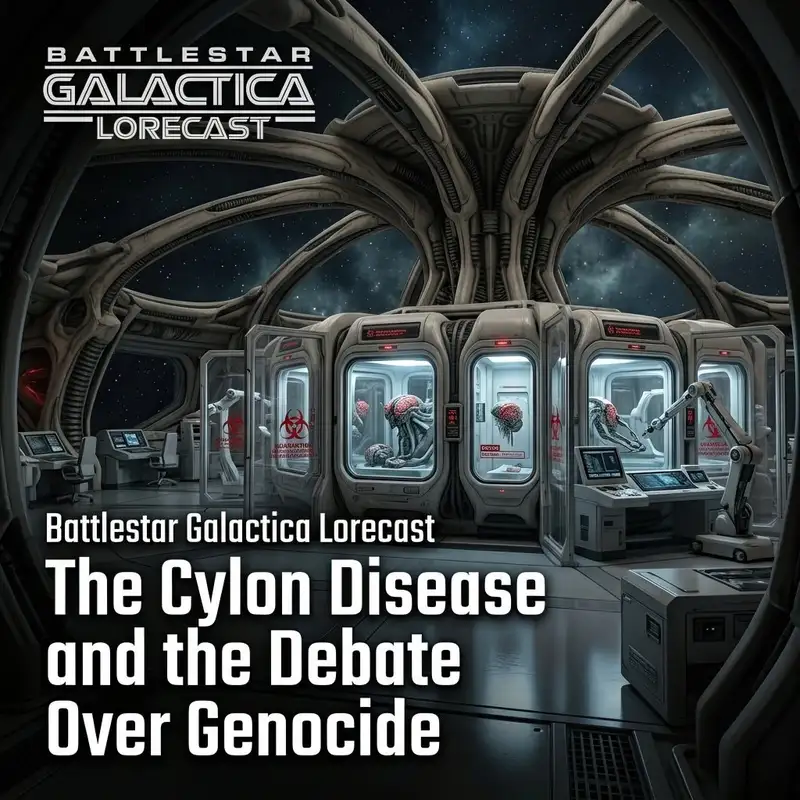
The Cylon Disease and the Debate Over Genocide
The quarantine ward aboard Galactica held a small group of dying prisoners, but no one aboard the battlestar could decide what they were. They were enemy combatants, certainly. They were also patients, intelligence sources, and evidence from an enemy ship that had died without being shot, rammed, or boarded in battle. Doctor Sherman Cottle could keep them alive, for a while, with repeated treatment. That made their survival useful. It also made their deaths useful in a far more terrible way.
The refugee fleet had escaped the Cylon occupation of New Caprica, but escape was not security. Its reported population stood at roughly forty-one thousand four hundred twenty people, a count that described a dwindling community rather than a perfect census. Those survivors had lost homes, governments, families, industries, and much of the confidence that law could protect them. They remained dependent on a handful of warships, civilian vessels, skilled workers, pilots, doctors, and political institutions that had all been damaged by the occupation. The Cylons remained stronger in numbers, technology, and industrial depth. They had already attempted to exterminate humanity once. They had found the survivors again. They could do so again.
That context made the sick Cylons difficult to see as individuals. The Colonials had not created the illness. They had not designed a pathogen in a laboratory or launched it as a weapon. But they had discovered something that might kill their enemy on a scale no battlestar engagement could achieve. The question was whether a disease could turn a handful of prisoners into the delivery system for the destruction of an entire civilization. Before that question could be answered, Galactica had to understand where the prisoners had come from, what had killed their ship, and whether the same danger threatened humans.
The basestar had been found drifting after a Cylon investigation in or near the Lion’s Head Nebula. Earlier, the Cylons had recovered an ancient beacon and brought it aboard. The object was associated, in the understanding of the people who encountered it, with the Thirteenth Tribe and with the search for Earth. That association mattered to both sides because Earth had become more than a destination. It was a possible refuge, a source of historical meaning, and perhaps the only place where the survivors could escape the strategic geometry of permanent pursuit.
But the beacon’s provenance was never fully established. The surviving evidence did not prove who made it, why it had been left there, or whether anyone had intended it to carry disease. It would be easy, and wrong, to call it an ancient weapon aimed at the Cylons. The released record supports a narrower conclusion. The beacon was brought onto a Cylon basestar. Afterward, the ship’s humanoid Cylons and organic systems began to fail. The basestar became a biological disaster site.
That fact alone was militarily remarkable. A basestar was not merely a collection of metal compartments and computer terminals. Cylon warships integrated biological systems, Raiders, a Hybrid, humanoid personnel, and machinery in ways the Colonials only partly understood. When infection moved through that environment, it did not merely sideline a few crew members. It disrupted the structure that allowed the ship to operate, recover craft, maintain coherence, and fight. The Cylons abandoned the vessel because its normal support system was collapsing around it.
For Galactica, the derelict was not a prize in the usual naval sense. It was a contaminated enemy vessel, still potentially dangerous, carrying unknown systems and unknown survivors. Yet it was also an intelligence opportunity. A dead basestar could reveal something the Colonial Fleet almost never had: direct access to the consequences of a Cylon failure. Not a damaged Raider wreckage field. Not a captured agent aboard a human ship. An entire Cylon warship rendered helpless by a threat its own creators had not anticipated.
Lee Adama led the boarding effort. Colonial Marines accompanied him, and Sharon Agathon, known aboard Galactica as Athena, went with the team because her knowledge of Cylon systems might prove useful. What they found was not a conventional battlefield. Dead Raiders lay within the basestar. Dead humanoid Cylons were scattered through it. A small number of living Cylons remained, sick enough to be helpless but not yet dead.
Athena’s presence did not provide a master key to Cylon technology. One Number Eight copy had become an officer within the Colonial Fleet, had built a family with Karl Agathon, and had repeatedly risked herself for human survival. None of that meant she could command every Cylon machine, communicate with every Hybrid, or unlock every system designed by the Cylon civilization. The basestar’s Hybrid and computer systems remained inaccessible to her. One infected Number Eight recognized Athena not as kin, but as a traitor. That was a reminder that shared design did not erase political allegiance, personal experience, or individual hostility.
The boarding party recovered the survivors and returned to Galactica. Then the ordinary disciplines of public health became part of fleet defense. Exposed personnel were isolated. The prisoners were confined. Medical staff had to determine whether the illness could cross from Cylon to human hosts. Guards had to control movement in and out of the detention area. The ship had to find room for quarantine at a moment when every compartment already had a purpose, every security detail was stretched, and every medical supply could become a future necessity.
Quarantine is rarely dramatic when it works. It is procedure made visible by fear. Separate the exposed from the unexposed. Watch for symptoms. Limit contact. Learn what can be learned before panic or rumor turns uncertainty into a second crisis. Galactica could not build a complete epidemiological system in the middle of a pursuit war, but it could impose enough discipline to prevent the derelict basestar from becoming an uncontrolled threat inside the fleet.
The immediate result was cautiously reassuring. The human members of the boarding party did not fall ill. The Cylons did. That finding did not make the situation simple. It made it more consequential. An illness that harmed both humans and Cylons would have been a shared danger. An illness that harmed Cylons while leaving humans apparently resistant looked, at least from the Colonial perspective, like an asymmetry that could be exploited.
Doctor Cottle named the condition lymphocytic encephalitis. The disease produced progressive neurological deterioration in the infected Cylons. It was not a tidy switch that turned them off. It was a process of decline. The prisoners remained alive, conscious enough to suffer, and dependent on Cottle’s treatment. His medication could suppress the illness. It did not permanently cure it. Regular injections were required to keep the infected Cylons from deteriorating.
That treatment changed the character of the prisoners’ captivity. Cottle’s medicine was not merely care. It became leverage. Galactica possessed something the prisoners needed to remain alive. The ship’s command could offer treatment in exchange for information, or withhold it as part of coercive pressure. In war, medical dependency can become a form of power long before anyone says the word weapon. The fact that the enemy had committed atrocities did not erase the uncomfortable reality that the Colonials now controlled the terms of these prisoners’ survival.
The human immunity also came with an important exception. Athena was a Cylon, yet she did not succumb to the disease. Cottle attributed her protection to antibodies associated with her pregnancy with Hera. It was a medical inference based on Athena’s particular condition, not a complete explanation of Cylon biology, hybrid biology, or future immunity. The lesson was not that all Cylons could become resistant through pregnancy, nor that every human-Cylon child would produce the same effect. The lesson was narrower and more unsettling. The disease did not distribute its effects according to any simple category of human and machine.
That complexity mattered because the Colonials were already tempted to turn the disease into an instrument of war. Before they could do so, they needed an explanation for how an illness acquired on one basestar might threaten more than the infected prisoners in Galactica’s brig. The explanation came from Simon, a captive Number Four.
Simon was an enemy source. He had reason to bargain, reason to manipulate, and reason to tell the truth selectively. His information could not be treated as a laboratory result. But it gave the Colonial command a theory that fit the evidence they had seen. The disease, he explained, carried a bioelectric component. If an infected humanoid Cylon died within range of a Resurrection Ship, the consciousness transfer that normally allowed a Cylon to return in a new body might also carry the infection.
That possibility transformed the disease from a localized outbreak into a strategic threat. Cylon resurrection was not unlimited immortality. It depended on bodies, infrastructure, ships, and conditions that allowed a dying consciousness to transfer and reappear. It altered Cylon calculations about risk and casualty, but it did not make death meaningless. A destroyed body still mattered. A missed transfer still mattered. The location of a Resurrection Ship mattered. The integrity of the system mattered.
Simon’s claim was that the Colonials could use that dependence against the Cylons. Kill infected prisoners near a Resurrection Ship. Let their consciousnesses transfer into the Cylon resurrection system. Allow the disease to contaminate the ship, and perhaps from there spread through the wider network on which the Cylon population depended. If the theory was correct, the Colonials would not need to defeat every basestar, hunt every Raider, or outbuild an enemy civilization. They might instead strike the mechanism that allowed the Cylons to recover from losses and preserve continuity across death.
The appeal of that idea was obvious. So were its uncertainties. No Colonial scientist had independently verified that infection would survive consciousness transfer. No one knew whether a Resurrection Ship could isolate contaminated systems or destroy infected bodies before a broader spread occurred. No one knew whether one contaminated ship would endanger every Cylon population or only a local group. No one knew whether all relevant Cylon forces depended on the same resurrection infrastructure in the same way. The proposed weapon was not a reliable military capability. It was a theory built from a captive’s account, a disease outbreak, and an enemy system the Colonials barely understood.
Yet in a war of near extinction, even an uncertain theory could change command thinking. Simon also revealed that Gaius Baltar was helping the Cylons search for Earth. That intelligence was deeply alarming. Baltar had been left behind on New Caprica and was now working, willingly or under pressure in ways the fleet could not yet fully measure, within Cylon-controlled space. The Colonials had believed they were searching for Earth while staying ahead of their pursuers. Simon’s information suggested that the pursuit had become a race. The Cylons were looking for the same destination.
That made the disease appear to offer more than revenge. It appeared to offer prevention. If the Cylons found Earth first, the survivors could lose their only imagined refuge before reaching it. If the Cylons remained capable of launching another extermination campaign, the fleet might not survive long enough to test its hope. The disease promised, at least in theory, the decisive removal of an enemy whose power no individual battlestar could match.
Lee Adama made the military case for using it. His argument deserves to be stated in its strongest form. He was not confronting an abstract adversary or a merely hostile neighboring state. The Cylons had attacked the Twelve Colonies with nuclear weapons and attempted to erase humanity as a civilization. They had pursued the surviving fleet. They had occupied New Caprica, detained civilians, tortured prisoners, executed resistance members, and used fear as an instrument of governance. Their military strength remained overwhelming. The Colonials had no secure industrial base, no reserve population, no reliable ally, and no guarantee that their next escape would work.
From Lee’s perspective, the infected prisoners represented a chance to prevent the next attack rather than survive it. The proposal was operationally direct, if morally immense. Galactica would place itself where Cylon forces could detect it. Its fighters and supporting craft would help attract a response. The Colonials needed a Resurrection Ship to enter range. At that moment, the infected prisoners would be killed. If Simon’s account was accurate, their transfer would carry the disease into Cylon resurrection infrastructure.
The plan operated at several levels at once. Tactically, it required the execution of prisoners. Operationally, it aimed to contaminate a specific Resurrection Ship. Strategically, it sought to cripple or destroy the Cylon civilization’s capacity to continue the war. Those levels should not be blurred. Killing the prisoners was not the same as winning the war. Contaminating one ship was not necessarily the same as contaminating all Cylon forces. But the possibility of a strategic outcome was what made the tactical act conceivable to people who otherwise might have rejected it outright.
Lee’s position was rooted in the duty to defend the fleet. He had watched civilian ships and military personnel die because the Colonials lacked the strength to dictate the terms of the war. He had watched the enemy use superior knowledge, superior numbers, and infiltration to make survival a sequence of improvisations. A commander responsible for preventing another massacre could reasonably see a unique enemy vulnerability as something close to an obligation. In that view, refusing to act was not moral neutrality. It was a choice to preserve the enemy’s ability to kill again.
But Helo did not dispute the danger. He disputed what survival allowed the Colonials to become. His objection was more than that Athena was a Cylon and his wife. That relationship made the question impossible for him to treat as theoretical, but his argument went further. The plan did not target a basestar in combat, a Raider wing, or a commander directing an attack. It aimed at the extermination of an entire people through a biological mechanism whose reach could not be controlled.
The Cylons had committed genocide. That fact was not softened by Helo’s dissent. The Twelve Colonies had been attacked as a civilization. Billions had died. The survivors aboard the refugee fleet had every reason to fear another effort at complete destruction. But Helo recognized the contradiction in preparing to condemn Cylon extermination while using extermination as the foundation of Colonial security. If the disease succeeded exactly as hoped, it would not distinguish between a Cylon who had participated in the attack on the Colonies, a Cylon who had guarded prisoners on New Caprica, a Cylon who had never encountered a human, or a Cylon who might have opposed the war.
That did not make all Cylons innocent. It did not erase responsibility. It meant that collective identity could not substitute for individual judgment. A Number Eight was not merely an interchangeable component in a Cylon machine. Athena had a history, loyalties, commitments, and choices. So did the infected Number Eight who called her traitor. So did Simon. So did the unseen Cylons who might receive the disease if the plan worked. Shared bodies and shared model lines did not make every copy the same person.
Athena herself is important precisely because she did not resolve the argument. She was loyal to Galactica. She had taken an oath. She had joined Colonial missions, endured suspicion, and built a family within the fleet. Yet she was not asked to become a representative for all Cylons, and she did not secretly sabotage the operation. Her presence made clear that the proposed weapon would not destroy a category of objects. It might destroy people who shared her origin but not her choices.
Helo’s opposition also had political force. The survivors did not merely need food, fuel, ammunition, and escape routes. They needed some answer to the question of what they were preserving. A people that survived by adopting the enemy’s program of indiscriminate annihilation might remain biologically alive, but its institutions would be altered beyond recognition. Helo saw that danger clearly. The fact that his objection came from conscience did not make it operationally irrelevant. Moral boundaries can be part of strategic resilience. They preserve the possibility of trust within a population that has already experienced what happens when power is unchecked.
The decision could not remain a wardroom argument. Galactica had a chain of command, and the refugee fleet still had civilian government. Admiral William Adama held practical control over the battlestar, its prisoners, and its fighters. He could direct operations. He could order the guard force. He could decide whether Galactica exposed itself to the Cylons. But he hesitated to authorize a species-wide biological attack on military initiative alone.
Adama required a presidential order. That insistence mattered. It did not settle the morality of the plan, and it did not make the act clean. But it recognized that the decision exceeded ordinary battlefield discretion. Deliberately killing infected prisoners in the hope of spreading disease through Cylon resurrection infrastructure was not just another tactical strike. It was an attempt to destroy a people through a mechanism that could not discriminate once unleashed.
Laura Roslin accepted responsibility. As President of the surviving Colonies, she authorized the operation. Her decision reflected the pressure of leadership after genocide. Roslin had to think not only about the prisoners before her, but about the civilians asleep aboard ships that could not defend themselves, the children born into a fleet with no permanent home, and the possibility that the Cylons might reach Earth first. She judged the threat severe enough that the fleet should take the chance.
Roslin’s authorization demonstrated civilian authority, but not moral certainty. Civilian control of the military matters because it prevents armed force from becoming its own law. Yet a civilian leader can authorize a terrible act as readily as a military commander can propose one. The value of constitutional procedure is not that it makes every decision righteous. Its value is that responsibility is named, shared, and exposed to judgment rather than hidden behind the claim that no one had a choice.
In this case, responsibility was divided. Lee argued for the plan. Adama retained control over its execution. Roslin supplied formal authorization. Helo rejected it. Athena lived within the consequences of the debate without claiming to speak for a civilization. Cottle sustained the prisoners medically, even as his treatment enabled their use as a weapon. No single participant carried the whole burden, and that was part of the danger. Complex institutions can distribute responsibility so widely that everyone sees only a portion of the act.
Once authorized, the plan became a fleet operation with all the fragility that implies. Galactica had to move into a position where the Cylons could detect it. That was a calculated risk. The ship could not summon a Resurrection Ship at will. It had to present a target, attract a Cylon force, and hope that the needed vessel arrived before the opportunity closed.
Fighters and supporting craft served the larger deception. Their purpose was not a clean victory in a conventional engagement. They had to shape the Cylon response and buy time. Galactica could not afford to remain exposed indefinitely. A battlestar could fight hard, but it could not casually invite the full attention of Cylon forces and expect to survive by firepower alone. The operation depended on timing, on the prisoners remaining alive until the right moment, on the guard force retaining control, on the Cylons behaving as expected, and on Galactica still having a path out once the trap was sprung.
The civilian fleet was not the visible target in that engagement space, but it was the reason for the risk. Galactica was not gambling its fighters and crew merely to destroy an enemy ship. It was trying to prevent another campaign against the people behind it. That distinction explains the desperation of Lee’s position. It also explains why Helo’s dissent could not be dismissed as sentimentality. The fleet’s survival was at stake, but so was the character of the civilization those civilians expected their defenders to preserve.
The final step required the prisoners to die at the exact moment their deaths might become transmission events. It was a plan built around controlled killing, controlled timing, and a mechanism no one on Galactica could prove would work. Helo chose to break it.
He sabotaged the environmental controls in the prisoners’ holding area. Oxygen was removed. The infected Cylons died before Lee could carry out the authorized execution near the Resurrection Ship. Helo did not save the prisoners. That fact matters. His act was not a rescue. It was a decision to kill them in a way that prevented their deaths from being used as the delivery system for a possible genocide.
The moral distinction is real, though it is not comfortable. Helo took lives. He acted without authorization. He violated the chain of command during a live operation. He also prevented Galactica from making the deliberate choice to use those deaths to attempt the destruction of the wider Cylon population. He substituted one grave wrong for the possibility of a larger one, then forced the command structure to confront what it had been prepared to do.
The immediate operational result was clear. The prisoners were dead. The disease was not deliberately introduced into a Resurrection Ship. Simon’s theory was not tested. The opportunity vanished, and Galactica aborted the engagement rather than remain exposed to an enemy force without the weapon it had risked itself to deploy. The battlestar escaped, but the Cylon threat remained intact.
There was also an intelligence cost. The Colonials lost prisoners who might have provided more information about Cylon movements, resurrection practices, the search for Earth, or internal command conditions. In a war shaped by ignorance, that loss was significant. Cottle’s treatment had created an opportunity to sustain the captives long enough for further questioning. Helo’s sabotage ended that possibility along with the biological attack.
Helo admitted what he had done to Athena. She understood the stakes better than most people aboard Galactica. She was a Cylon who had chosen the human fleet, a mother whose child represented a connection between peoples, and an officer who understood that military service required obedience as well as conscience. Yet she did not become a simple arbiter between Helo and the command. The crisis was larger than their marriage. It concerned what the fleet would permit itself to do when fear and opportunity aligned.
Adama reported the prisoners’ deaths as an environmental-control failure. Roslin recognized that the sabotage likely involved one of two people. Still, Adama refused to pursue a formal investigation. That was not a legally immaculate resolution. It was command discretion under extraordinary pressure. A full investigation would have required the fleet to identify Helo as the saboteur, punish him for disobedience, and reopen the argument over whether the attempted extermination had been justified.
Adama chose not to force that reckoning. His decision can be read as fatigue, compassion, moral recognition, institutional caution, or some combination of all four. What it cannot be called is simple. He had helped make the operation possible. He had insisted on presidential authorization, then acted under it. By declining to punish Helo, he quietly accepted that the fleet would not proceed across the threshold it had approached.
Roslin’s position was equally difficult. She had authorized the plan, not because she misunderstood its scale, but because she believed the survival of humanity might require it. When Adama declined to investigate, she did not compel the matter. The constitutional chain had functioned imperfectly. Civilian authority had authorized a horrifying act. Military command had prepared it. Individual disobedience had stopped it. Military command then protected the dissenter from the full consequences of breaking orders.
That sequence did not prove that the Colonial system was healthy. It showed how damaged and improvised it had become. The fleet lacked the distance, security, and institutional depth that make normal legal process easier to sustain. Its leaders were deciding questions of species survival aboard warships while fleeing an enemy. Yet the refusal to punish Helo also showed that procedure, conscience, and command discretion could still interrupt a path toward atrocity, even when none of those safeguards worked cleanly or completely.
The Cylon disease crisis therefore ended without a triumphant answer. Tactically, Galactica lost the prisoners and disengaged safely. Operationally, the planned contamination of a Resurrection Ship failed. Strategically, the Cylons remained alive, dangerous, and engaged in the same search for Earth. Intelligence officers lost a theory that might have been tested and captives who might have revealed more. The fleet gained no decisive weapon and no guarantee against another attack.
Politically, Roslin’s authorization revealed the weight of civilian responsibility in an extinction war. She could not hide behind Adama’s uniform, Lee’s operational argument, or Cottle’s medical findings. The decision was hers to approve. Adama’s later cover-up revealed something different. Formal authority can authorize a policy, but practical command retains enormous power over whether that policy is carried out, investigated, or quietly buried.
Morally, the survivors did not establish their superiority simply because Helo stopped the plan. They had considered genocide. They had prepared for it. They had placed prisoners under medical control and then intended to kill them as part of a delivery mechanism for mass destruction. Helo himself killed those prisoners. No one emerged untouched by the crisis.
But the outcome still mattered. The Colonials did not deliberately unleash the disease. Adama’s refusal to punish Helo ensured that extermination would not become the accepted foundation of fleet security. That did not make the Cylons less responsible for the destruction of the Twelve Colonies. It did not require the survivors to forget New Caprica or deny the danger ahead. It meant that fear of annihilation had not yet granted the Colonials moral immunity for annihilating others.
The disease offered no reliable road to victory. It offered a chance to make genocide look like defense, to recast species-wide killing as a necessary precaution against an enemy that had already committed the unforgivable. Helo’s sabotage did not erase the fleet’s willingness to contemplate that act. Adama’s silence did not cleanse the chain of command. Yet together, those decisions prevented the survivors from deliberately making extermination the principle on which their security depended.