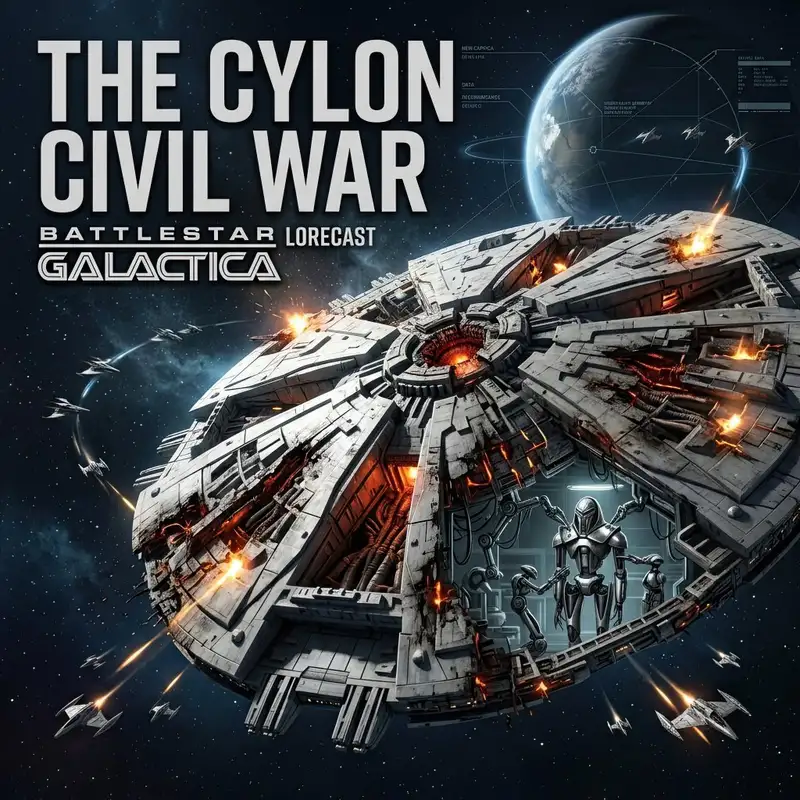
The Cylon Civil War
At the Ionian Nebula, the Cylon attack should have followed a familiar pattern. Raiders closed on the human fleet. Colonial Vipers launched to meet them. A damaged, aging battlestar tried to preserve enough fighters, fuel, and ammunition for whatever came next. Then one Raider saw Samuel Anders. It recognized him as a Cylon, broke formation, and withdrew. Other Raiders followed.
That decision was more dangerous to Cavil’s authority than a successful human counterattack. The Raider had not merely malfunctioned. It had interpreted new information, altered its mission, and acted without permission from the humanoid Cylons who had treated Raider intelligence as a military resource under higher control. In one abrupt disengagement, the war against humanity became an internal Cylon command crisis.
The immediate issue was whether Raiders could be trusted with independent judgment. The deeper issue was whether they had any right to it. Cavil’s faction saw autonomy in a subordinate machine as a defect to be corrected. The rebels saw evidence that the Cylon order was built on a contradiction. Cylons had declared themselves superior to humanity because they possessed consciousness, faith, reason, and free will. Yet when one of their own weapons platforms exercised judgment, Cavil’s response was not debate. It was reprogramming.
The Cylon Civil War grew from that contradiction. It was a conflict over the Final Five, over resurrection, over the freedom of Raiders and Centurions, and over Cavil’s right to define what counted as a person. It became a shooting war because the Cylon political system had no dependable way to protect dissent when the majority chose coercion. And it became strategically decisive because Cavil’s control of resurrection infrastructure left the rebels too weak to survive alone. Their only viable partner was the human fleet their civilization had helped nearly exterminate.
By the time of the Ionian Nebula battle, Cylon unity had already been under strain for a long time. The Cylon war machine looked centralized from the outside. It fielded basestars, Raiders, Centurions, Hybrids, humanoid infiltrators, and a resurrection system that could return many dead Cylons to new bodies. It had destroyed the Twelve Colonies with a degree of coordination that suggested a single will. But shared origin and shared technology did not create one permanent political identity.
The humanoid models differed in temperament, memory, theology, experience, and loyalty. A Number Six copy could not be assumed to think like every other Number Six. Sharon Valerii, usually called Boomer, was not Sharon Agathon, known as Athena. A Cylon body, a Raider, a Centurion, and a Hybrid all occupied different places in the system of authority. The Cylons had created layers of intelligence, then controlled those layers in different ways. Raiders could learn. Centurions could fight. Hybrids could guide basestars through faster-than-light travel and manage systems no human crew fully understood. Humanoid models voted, argued, manipulated, and sometimes imposed their will through force.
The apparent democracy of the model lines had serious limits. Consensus worked when the models broadly agreed on the objective, or when disagreement could be managed by delay, persuasion, or memory control. It worked far less well when the dispute concerned the legitimacy of the system itself. There was no visible constitutional protection for a minority model line. No independent court could decide whether boxing was punishment, medical intervention, or political disappearance. No reliable process existed for granting Centurions or Raiders a status beyond property and weapons.
The Number Threes had already exposed that weakness. D’Anna, a Number Three, pursued visions and evidence connected to the Final Five, the ancient Cylons whose identities had been hidden within Colonial society. Her search threatened Cavil’s authority and the carefully managed ignorance of the other models. The response was to box the entire Number Three line. Boxing did not solve the question D’Anna had raised. It removed the people asking it.
That was an important precedent. A political order that answers an existential disagreement by suppressing one faction may achieve short-term discipline. It also teaches every remaining dissenter that formal process is no protection. By the time the Raiders broke off at the Ionian Nebula, the Cylons had already demonstrated that their unity depended less on consent than on the ability to silence anyone who disrupted it.
Cavil’s faction treated the Raider incident as proof that the Raiders required reconfiguration. In practical terms, that meant reducing or removing the higher functions that had allowed them to make an independent decision. The language was technical. The stakes were political. Cavil did not want a military asset that could weigh evidence, recognize a member of the Final Five, and decide that an attack order no longer made sense.
Natalie, a Number Six who became the leading voice of the rebel faction, saw the same incident differently. The Raider’s recognition of Anders suggested that the Final Five were real, present, and important. It also suggested that intelligence beneath the humanoid level of command could not be dismissed as mere defective programming whenever it reached an inconvenient conclusion.
The vote divided the Cylon world. Cavil’s side included the Ones, Fours, Fives, and Boomer, the Number Eight copy whose loyalties and grievances placed her with Cavil despite the opposition of most Eights. The rebels drew support from Twos, Sixes, most Eights, and eventually Centurions freed from their control systems. These groupings were not perfect blocks of identical thought. They were wartime alignments built around a central question: would Cylon consciousness remain subject to Cavil’s hierarchy, or would it become something more dangerous and more uncertain?
Cavil won the vote. That mattered because it showed the limits of consensus without rights. A majority had authorized the effective lobotomization of a class of sentient military beings. The rebels could either accept that decision and wait for their own turn to be boxed, reset, or reconfigured, or they could reject the legitimacy of the system that had produced it.
They chose revolt.
The first armed act of the civil war was not a basestar duel. It was the liberation of the Centurions. For most of the Cylon conflict, Centurions had served as infantry, guards, laborers, and instruments of coercion. They were formidable on a battlefield, but they were not supposed to be politically independent. Their telencephalic inhibitors restricted their capacity for autonomous thought. The humanoid models had built a class of artificial soldiers and then placed restraints on them to ensure they remained soldiers.
Natalie’s faction removed those restraints from Centurions under rebel control. This was a military act because it added armed personnel to the rebellion. It was also a declaration that the Centurions were not merely equipment. The rebels could not credibly protest the forced reconfiguration of Raiders while continuing to maintain another intelligent class in permanent mental captivity.
The consequences were immediate. Centurions who had been expected to obey humanoid Cylon authority turned their weapons on Cavil’s loyalists. A conflict that had begun as a dispute over the interpretation of a Raider’s action became an internal war across ships, compartments, and command networks. Security arrangements collapsed because the very force designed to guarantee obedience had become an independent participant.
There is no reason to assume that every Centurion everywhere joined the rebels, or that all of them experienced freedom in the same way. The screen record shows a revolt within the forces available to Natalie’s faction, not a complete census of Cylon machine loyalty. But the principle was unmistakable. Cavil’s system had depended on a hierarchy of minds. Once the lowest armed tier rejected that hierarchy, the conflict could no longer be contained by a vote among humanoid models.
The rebels had made a moral and political choice. They had also made themselves vulnerable. Free Centurions could fight, but they did not replace basestars, Raiders, Resurrection Ships, or the strategic infrastructure controlled by Cavil’s faction. In civil war, a declaration of independence is only the beginning. The next question is whether the independent force can survive the response.
Cavil had the stronger position. His faction controlled Resurrection Ships and retained access to the broader resurrection network. That control gave him more than a medical advantage. It gave him strategic depth. A Cylon force that can restore dead personnel, preserve memory, and return experienced combatants to service has a different relationship to casualties than an enemy whose losses are permanent. Resurrection did not make Cylon death meaningless. Death could still involve pain, fear, interrupted plans, and the risk of failed recovery. But it altered the balance between loss and replacement.
The rebels had challenged Cavil’s authority without controlling that infrastructure. Their basestars separated from the loyalist formation, and there were attempts to negotiate or restore some kind of unity. Those efforts failed because the underlying dispute was not procedural. It was about domination. Cavil wanted the rebellious elements brought back under control. The rebels wanted a political order in which Cavil could no longer decide which forms of Cylon consciousness were permitted to exist.
Cavil answered with an ambush.
The loyalist forces struck the rebel basestars while controlling the resurrection support that the rebels lacked. They disabled faster-than-light capability and destroyed most of the rebel formation. The exact number of ships and losses is not consistently established, and the larger point does not require false precision. The rebels suffered a catastrophic operational defeat. Their force was broken, their mobility was damaged, and much of their Raider strength was gone.
Natalie’s basestar survived, but survival is not the same thing as combat effectiveness. The damaged ship had limited ability to generate raids, scout independently, defend itself, or replace losses. Without secure resurrection support, the rebel humanoids now faced risks that Cavil’s loyalists could better absorb. Their civil war had entered a new phase. The rebels remained politically defiant, but materially dependent.
That dependence explains the alliance that followed. It was not a conversion ceremony. The rebels did not suddenly become innocent because Cavil had tried to destroy them. The humans did not suddenly forget the Fall, the infiltrators, the occupation of New Caprica, or the many Cylon operations that had placed their survival in jeopardy. Both sides still had reasons to fear betrayal. Both sides had blood in the record.
But war often creates partnerships between actors who would never choose one another in peacetime. The rebels needed intelligence, navigation assistance, military support, and access to the Resurrection Hub. The human fleet needed information about Cylon command, leverage over the Final Five, and any opportunity to weaken the enemy’s ability to recover from losses. Neither side had a clean alternative.
Kara Thrace’s mission aboard the Demetrius brought that necessity into view. Her Raptor encountered a damaged Heavy Raider and a rebel Leoben associated with Natalie’s faction. The contact was dangerous from the beginning. The humans had no reason to assume that a Cylon claiming to oppose Cavil was telling the truth. The rebels had no reason to assume that Colonial officers would honor an agreement once they had extracted useful intelligence.
The immediate problem was practical. The rebel basestar could not safely make the jump it needed without assistance. Human and Cylon personnel improvised a connection between the Raptor’s faster-than-light navigation capability and the damaged basestar’s systems. It was an extraordinary act of technical cooperation, but not a magical one. The task required compatible information, functioning machinery, people willing to share access, and enough trust to remain in the same operation long enough for the jump to work.
That improvised link carried a larger meaning. The Cylon rebels had once possessed immense military power. Now they needed a small Colonial craft to help restore mobility. The human survivors, who had spent years avoiding Cylon contact whenever possible, now had to place their survival partly in the hands of a damaged enemy warship. Neither side was secure. Neither side was sovereign in the full sense. They were partners because both had been reduced to forms of dependence they found humiliating.
When the alliance reached Galactica and the civilian fleet, its military value was obvious. Its political cost was equally obvious. The Colonials had endured genocide. They had lived with the knowledge that Cylons could look human, infiltrate institutions, sabotage systems, and exploit personal relationships. Many civilians had survived occupation, detention, forced cooperation, or the loss of entire families. Asking them to accept armed Cylons as allies was more than an intelligence decision. It was a demand that they accept new risks while carrying old trauma.
Admiral William Adama and President Laura Roslin had to manage different parts of the problem. Adama had to decide whether military necessity justified operational cooperation with former enemies. Roslin had to consider whether the civilian government could grant that cooperation legitimacy without appearing to surrender the fleet’s security. Neither could treat the rebel Cylons as harmless refugees. They retained weapons, technical knowledge, their own hierarchy, and their own reasons for secrecy.
Natalie offered the most consequential intelligence of the campaign. The Resurrection Hub, she explained, was central to the established Cylon resurrection system. Destroying it would prevent the humanoid Cylons from downloading into replacement bodies through that network. It would not erase memory already stored in living individuals. It would not destroy every form of Cylon continuity. It would not explain every mystery of Cylon identity. But it would remove the infrastructure that had given Cavil’s faction a decisive advantage in a war of attrition.
Natalie’s position also evolved. Before the alliance, she and her faction had considered seizing human hostages to force cooperation. That plan reflected the rebels’ desperation and their continued willingness to use coercion. It also showed why the humans were right not to confuse shared opposition to Cavil with moral transformation. But after addressing the Quorum and confronting the implications of Cylon survival without limits, Natalie began to argue that mortality might be necessary. A life without vulnerability, she suggested, could lose consequence.
That was a profound argument within Cylon society, but it was not a universal rebel creed. Some rebels wanted freedom from Cavil. Some wanted the Final Five. Some wanted access to resurrection. Some wanted to escape destruction. Natalie’s developing acceptance of mortality did not settle those differences. It did, however, challenge the assumption that endless restoration was an unquestioned good.
The alliance fractured before it could fully stabilize. Athena believed Natalie intended to take Hera, Athena’s daughter. Hera was not only a child at the center of a family. She was also a human-Cylon hybrid whose existence carried biological, political, and religious importance for both sides. To Athena, the possibility that the Cylons might seize Hera was not an abstract diplomatic concern. It was an immediate threat shaped by years of manipulation, loss, and fear.
Athena shot Natalie.
The act was not a simple betrayal by one irrational participant. It was a decision made under conditions where trust had almost no reserve. Athena had seen Cylon plans turn human intimacy into a weapon. Natalie’s presence near Hera was enough to trigger a response that would have enormous consequences. Natalie’s death removed the rebel leader at the moment when she had begun to move toward a less coercive relationship with humanity.
The rebel Hybrid responded by jumping the basestar away. President Roslin and part of Galactica’s air wing were carried with it. A political rupture became an operational emergency. Galactica had lost personnel, aircraft, and its president into the custody of a damaged but armed Cylon vessel. The rebels had lost Natalie and any expectation that they could proceed on trust alone.
Yet the mission continued. The logic was brutal. Cavil still held the greater military power. The Hub still mattered. The Final Five remained central to the Cylon crisis. And the surviving humans had no assurance that they could defeat Cavil’s faction without exploiting the division within it. The alliance no longer rested on confidence. It rested on the fact that both sides faced worse outcomes if it failed.
The Resurrection Hub operation was the military center of the Cylon Civil War. It was not a conventional fleet battle in which one side simply brought more ships and fired more weapons. It was a joint expedition built from fragile components that had to work in sequence. Intelligence had to locate the target. Navigation had to bring the force into position. Human Vipers and Raptors had to operate beside rebel Cylon craft. The Hub had to be boarded. D’Anna had to be recovered from boxing. Nuclear weapons had to destroy the installation. Then the force had to escape before Cavil’s faction could close the trap.
Every phase depended on cooperation between people who expected one another to betray them.
Galactica’s personnel brought human operational experience, pilots, Raptor crews, command discipline, and the political authority of the surviving Colonial government. The rebel basestar brought Cylon mobility, systems knowledge, and access to Cylon procedures that the Colonials could not reproduce. Roslin’s presence mattered because the mission was not only military. The destruction of the Hub would reshape the balance of power between human and Cylon survivors. It required someone capable of making political decisions under conditions where ordinary civilian oversight was difficult.
The boarding element had to reach the Hub and free D’Anna from boxing. Her recovery was not a side task. D’Anna had pursued the Final Five before the civil war began, and Cavil had treated that knowledge as a threat. Restoring her meant restoring a voice Cavil had tried to erase. It also meant bringing back a Cylon whose motives were shaped by visions, faith, anger, and a relentless need to understand what the Final Five meant.
The nuclear strike that destroyed the Hub ended the established resurrection system. That sentence needs to be understood precisely. It did not mean that every Cylon dropped dead. It did not mean that Cylon memory vanished. It did not mean that Raiders, Centurions, Hybrids, humanoid models, and the Final Five all possessed identical forms of continuity. It meant that the network which allowed humanoid Cylons to download into replacement bodies was gone.
For Cavil’s faction, that was a strategic disaster. The loyalists had used control of resurrection infrastructure to crush the rebel fleet. Now they faced a world in which combat losses could become permanent. Discipline could no longer depend as easily on boxing, replacement, or the reassurance that death was temporary. Every operation would carry greater personal risk. Every commander would have to account for a finite pool of bodies, experience, and trust.
For the rebels, the destruction of the Hub was also an act of self-denial. They had given up access to the very system they had sought to reclaim. That choice did not make them saints. It did make their break with Cavil harder to reverse. They could no longer expect to return to the old Cylon order and resume the protections it had offered. Their autonomy now came with vulnerability.
This was the civil war’s deepest revolution. Cavil had built authority around the claim that Cylon existence should transcend human limits. He despised flesh, aging, pain, and dependency. He wanted a more purely machine existence, one less constrained by the physical world and less entangled with human moral categories. But his political order depended on controlling bodies, memories, and access to resurrection. It was an empire of immortality administered through exclusion.
The rebels learned that freedom could not be guaranteed by a system that allowed one faction to decide who would be restored, who would be boxed, and who would be altered. Destroying the Hub did not resolve every Cylon disagreement. It did remove the mechanism that made Cavil’s hierarchy so difficult to challenge. Mortality became the price of independence.
D’Anna’s release brought the Final Five question back to the center of the conflict. The Five were not ordinary numbered infiltrator models. Their history was tied to the devastated world later identified as the first Earth, to prior cycles of human and Cylon violence, and to the development of resurrection technology. Cavil’s hatred of them was personal, ideological, and political. They represented a past he had tried to erase and a form of Cylon identity that did not fit his preferred hierarchy.
The discovery of the ruined first Earth did not provide simple answers. The human fleet had hoped Earth would be refuge. Instead, it found evidence of destruction on a planetary scale and the remains of the Thirteenth Tribe. The revelation was devastating for humans who had treated the destination as promise, prophecy, or strategic objective. It was equally destabilizing for the Cylons, especially those who had tied their own beliefs to recurrence, destiny, and the Final Five.
D’Anna remained behind on the ruined world. Her decision reflected a collapse of faith as much as a tactical choice. She had spent years seeking proof that the Final Five existed and mattered. She found them, but the truth did not restore the order she had expected. The series leaves the larger metaphysical meaning of that history unresolved. What matters for the civil war is that the discovery denied both humans and Cylons an easy narrative of deliverance.
After the Hub and the discovery of the first Earth, the alliance continued because practical necessity remained. The rebels had nowhere else to go. The humans still needed mobility, intelligence, and technical assistance. Rebel Cylon technology helped improve the fleet’s faster-than-light capability. That had real operational value. Better jump performance could mean more options for evasion, scouting, rendezvous, and survival.
It also created a constitutional crisis. To accept Cylon technology was to accept new dependencies. To grant the rebels citizenship and representation was to recognize that they were not merely captured equipment or temporary military auxiliaries. The decision raised difficult questions. Could former enemies participate in the political institutions of a fleet they had once hunted? Could Cylon systems be trusted aboard human vessels? Could mixed crews operate without creating unacceptable security risks? Who would control the technology that made the alliance possible?
These concerns were not irrational. The survivors had lived through a catastrophic software compromise, Cylon infiltration, and repeated acts of deception. Civilian fear of renewed Cylon access to fleet systems was grounded in experience. The danger lay in what leaders did with that fear. A fleet facing extinction can convince itself that every dissenting voice is sabotage, or that every security concern is bigotry. Both errors are politically corrosive.
The human mutiny led by Felix Gaeta and Tom Zarek emerged from this pressure. It was not part of the Cylon Civil War. It was a separate Colonial crisis, shaped by domestic grievances, contested authority, anger over the alliance, and fear that Adama and Roslin had imposed irreversible decisions without sufficient consent. Gaeta’s concerns about Cylon integration and Cylon technology had roots in real trauma and real security problems. Zarek’s political opposition also drew strength from the belief that civilian authority had been narrowed by emergency rule.
But the mutiny crossed from opposition into seizure of force and political violence. It attempted to solve a legitimacy crisis by controlling weapons, communications, and detention. That was not a constitutional remedy. It was a rebellion within a fragile refugee society that could not afford fragmentation.
The parallel with the Cylon Civil War is useful, but it should not be forced into false equivalence. Cavil’s faction had committed genocide and maintained an order built on manipulation, coercion, and the suppression of independent minds. Gaeta and Zarek did not command a Cylon empire. Still, both crises demonstrated a common danger. Under existential pressure, institutions can lose the ability to manage disagreement. Leaders begin to see dissent as treason. Opponents begin to see force as the only route to political correction.
The Colonials survived the mutiny, but not without damage. The rebel Cylon alliance survived as well, though it remained contested and fragile. In both cases, military necessity had outrun the institutions meant to govern it. The final campaign against Cavil would depend on whether humans and rebel Cylons could continue cooperating long enough to defeat their common enemy.
Galactica, battered by years of combat and improvised repair, led the assault force. Its role was extraordinary precisely because it was no longer at the height of its strength. The ship’s age, damage, and accumulated strain mattered. A battlestar can absorb punishment only so many times before armor, structure, flight operations, and human endurance begin to fail together. Galactica went into the final battle not as an invulnerable relic, but as a vessel whose survival had always depended on crews willing to keep working after every system said they should not.
The rebel basestar did not just join Galactica in the attack. It remained with the civilian fleet, protecting the civilians while the assault force went to the Colony. That division of labor matters. The battle was not won by sending every available warship toward the enemy. The survivors still had to protect the people, ships, children, workers, and institutions that gave the mission meaning. A tactical strike against Cavil could not justify leaving the civilian fleet defenseless.
The assault itself brought human and Cylon forces into the closest cooperation of the entire war. Mixed teams entered the Colony. Colonial pilots, Marines, rebel Cylons, and the Final Five pursued overlapping objectives under conditions of extreme danger. The operation succeeded in recovering Hera and destroying the Colony. Cavil’s faction was decisively broken.
That result should not be inflated into a claim that every Cylon everywhere was eliminated. The released record establishes the destruction of the Colony and the defeat of Cavil’s organized faction. It does not provide a complete accounting of every surviving Cylon presence in the universe. What ended was Cavil’s war and the political order that had sustained it.
The fate of the Centurions provided the clearest final answer to the question raised at the Ionian Nebula. The rebel Centurions received the basestar and the freedom to determine their own future. They were not restored to the role of obedient infantry. The beings once fitted with inhibitors, used as labor, and treated as tools were allowed to leave and choose their own course.
The surviving humanoid rebels settled with the humans on the final habitable Earth. That settlement did not erase the genocide of the Twelve Colonies. It did not erase New Caprica, Cylon infiltration, human atrocities, Cylon atrocities, or the fear that had driven both sides toward violence. Coexistence was not innocence. It was a decision to live with memory rather than repeat every structure that had produced the war.
The Cylon Civil War was not won merely by superior firepower, a nuclear strike, or the destruction of the Resurrection Hub. It was decided when the rebels accepted that autonomy required vulnerability, and when the human survivors accepted that survival required cooperation with former enemies without forgetting what those enemies had done. Cavil’s order collapsed because it proved that neither immortality nor consensus could substitute for consent, responsibility, and a place for dissent.