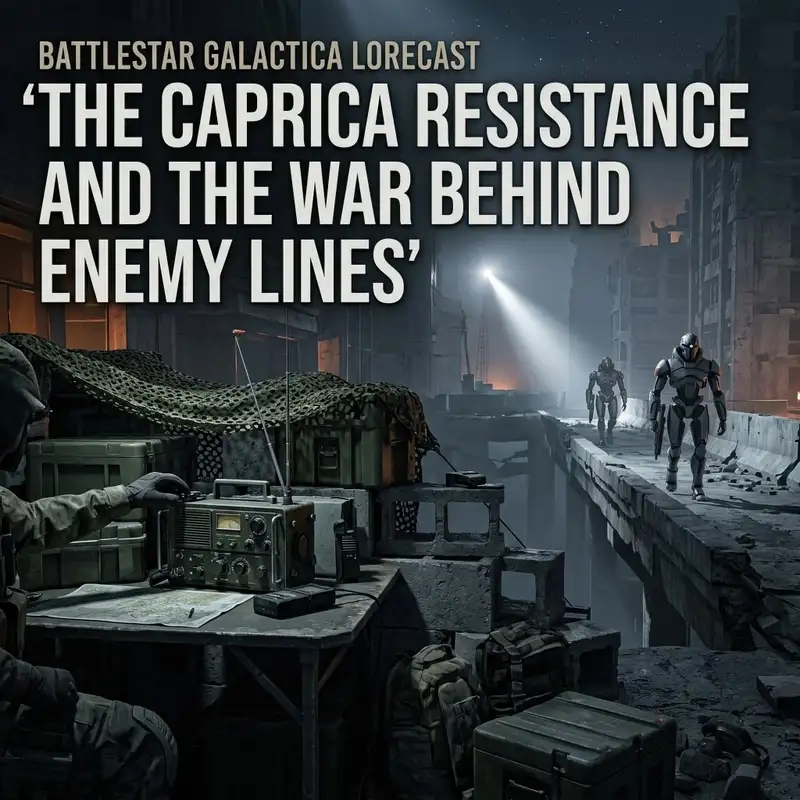
The Caprica Resistance and the War Behind Enemy Lines
The Cylon occupation of New Caprica needed more than Centurions in the streets. It needed human beings to perform the daily work of control. Curfews had to be enforced. Homes had to be searched. Prisoners had to be identified, transported, and guarded. Food, labor, housing, and permits had to be managed. The New Caprica Police were meant to make that system function with local faces, local language, and local knowledge. Their graduation ceremony was therefore more than a public display. It was an attempt to prove that the occupation was becoming normal.
The resistance answered that ceremony with a bombing. Militarily, the attack struck an institution tied directly to Cylon control. Politically, it warned every prospective police recruit that service under occupation carried danger. But the attack also guaranteed a response against the wider population. The Cylons had more weapons, more prisoners, and more ability to impose collective pressure than the underground had ways to protect civilians. That was the defining contradiction of the war behind enemy lines. Resistance could disrupt the machinery of occupation. It could make collaboration costly. It could preserve the possibility of escape. But its battlefield was not an empty plain. It was home, with families, shrines, work crews, hospitals, frightened neighbors, and people who could not just choose to leave.
That contradiction did not begin on New Caprica. It had been present from the first days after the Fall, when survivors on Caprica discovered that remaining alive was already a form of resistance. Their problem was not how to liberate a planet. No scattered group could do that. Their problem was how to avoid patrols, find medicine, keep weapons supplied, judge whom to trust, and preserve enough people to seize any chance of escape. Before resistance became an organized military effort, it was an improvised survival system.
Caprica after the Cylon attack was not merely a devastated colony. It was a society whose institutions had been shattered in hours. Government, police, hospitals, transportation, communications, and military defense no longer offered reliable protection. There were survivors, but there was no functioning rear area behind them. Radiation threatened some districts. Cylon patrols moved through others. Roads, buildings, and old military sites could provide shelter or become traps. A person carrying a weapon might be a survivor, a criminal, a Cylon agent, or someone trying to protect a family. In that environment, information was as scarce as ammunition.
The group encountered by Kara Thrace and Karl Agathon called itself the Caprica Buccaneers. They had begun as a professional Pyramid team led by Samuel Anders. Their survival was partly luck and partly location. They had been conducting high-altitude training in the mountains when the attack came. Distance from the first strikes gave them time that most Capricans never received. Time, however, is not the same as security. The Buccaneers returned to a ruined world with no prospect of ordinary resupply, no formal chain of command, and no clear way to contact surviving Colonial forces.
Anders was not a Colonial officer. His authority came from practical leadership, shared danger, and the loyalty of people who had survived beside him. The Buccaneers used Delphi Union High School as a headquarters because Cylon patrols did not regularly cover the area. That choice reveals the scale of their ambition. They had not established a liberated zone. They had found a temporary place the enemy overlooked often enough to be useful. The school could offer cover, storage, sleeping space, and a point from which to organize. It could not provide a defended base, a hospital, an airfield, or a reliable escape route.
The group raided military stores and hospitals for ammunition, anti-radiation medicine, and basic necessities. Those raids were not glamorous special operations. They were evidence of a survival economy. A resistance force needs weapons, but it also needs pain medication, clean water, food, shelter, batteries, transport, and people capable of treating injuries. A fighter with a rifle but no medicine after a wound is not merely one less combatant. He may become a burden on a group already struggling to move, hide, and feed itself. Every injured person also has friends, family, skills, and knowledge. Under those conditions, casualties reduce a community’s ability to survive as well as its ability to fight.
At one point, the Buccaneers were described as having roughly fifty-three people after suffering severe losses in an earlier ambush. That number should not be mistaken for a census of resistance across Caprica, or even a permanent strength for Anders’s own group. It is a glimpse of one armed community under pressure. The important fact is not the arithmetic. It is the absence of replacement. The Buccaneers could not call up reserves, request medevac, rotate exhausted personnel, or expect a new shipment of weapons after a costly action. Their losses were cumulative. Their victories had to be cheap enough to survive.
Their strengths were equally real. They knew Caprica. They understood local terrain, roads, weather, schools, hospitals, and the habits of their own communities. They were physically capable, accustomed to working together, and willing to disperse when a large formation would attract attention. They could scavenge and adapt. They could use the gaps in Cylon patrol patterns without imagining that those gaps meant the Cylons had lost control. An occupying force cannot stand on every street corner, especially across a damaged planet. But a patrol gap is an opportunity, not territory. The Buccaneers could move through the space between Cylon deployments. They could not reliably hold that space against a concentrated response.
Kara Thrace and Helo complicated that equation when they crossed paths with the Buccaneers. Both were Colonial military personnel. Both carried skills that the group lacked. Thrace brought combat experience, knowledge of Colonial procedures, and the instinctive confidence of a Viper pilot accustomed to acting under pressure. Helo brought military training, reconnaissance value, and a possible connection to the larger surviving force that the people on Caprica hoped still existed somewhere beyond the planet. Yet neither uniform nor bearing could establish trust.
The Cylon attack had destroyed more than ships and cities. It had destroyed the assumptions behind ordinary identification. A Colonial uniform could be stolen. A convincing story could be rehearsed. More importantly, the survivors were beginning to understand that the enemy might not always appear as a Centurion or Raider. Human-looking Cylons changed the entire counterintelligence problem. If the occupier could place agents inside human society, then recruitment, shelter, checkpoints, supply raids, and even rescue efforts became vulnerable to deception.
The Buccaneers responded with improvised authentication. They tested people through personal knowledge, local history, and shared experience. It was not a scientific method. It was a wartime method developed by people who had no secure database, no reliable communications link, and no dependable Cylon detection system. It could reduce risk. It could not eliminate it. A survivor who knew the right details might still be lying. A traumatized person might fail a test because memory and fear do not always cooperate. And a group that becomes too suspicious can destroy itself almost as efficiently as an infiltrator can.
The Buccaneers could still fight. Later material shows survivors around Anders expanding beyond the original Pyramid team to include hikers, survivalists, and others who had endured outside the occupied cities. Their growth should not be exaggerated into a planet-wide army. What it shows is that people with local knowledge and a reason to continue could begin to organize around one another. The group’s attacks remained improvised because its resources remained improvised.
One early strike used a damaged Centurion component as a concealed explosive. It was a small act compared with the destruction already inflicted upon Caprica, but its military meaning was substantial. The resistance had taken a fragment of the occupying force’s machinery and turned it into a weapon. That required observation, nerve, and adaptation. It also demonstrated desperation. An organization forced to build explosives from damaged enemy equipment is not operating from abundance. It is operating from whatever can be carried, hidden, understood well enough to use, and risked without destroying the people who assembled it.
The same period brought a second intelligence shock. The resistance encountered evidence that humanoid Cylons were operating among the occupation forces. For people who had survived a war against machines, that discovery transformed the enemy from a visible military force into a presence that could enter a room, use a human voice, and exploit familiar social patterns. The resistance did not suddenly acquire a full understanding of Cylon model lines, command structures, or political divisions. It learned only enough to become more afraid, and more careful.
That experience mattered when the survivors later reached New Caprica, but it did not create one uninterrupted underground organization stretching from Caprica to the new settlement. Caprica and New Caprica were separate worlds, separated by flight, loss, and the long uncertainty of the refugee fleet’s journey. The connection was made through people such as Anders, through habits learned under pressure, and through a common understanding that occupation could not be resisted by conventional means alone.
New Caprica began as an attempted refuge. The settlement offered exhausted civilians a chance to stop running, work land, build homes, and recover something resembling ordinary life. It was difficult from the beginning. The environment imposed limits. Infrastructure was thin. The population had few reserves. But after years of pursuit, even a harsh settlement could look preferable to permanent life aboard overcrowded ships. That hope became a vulnerability when the Cylons arrived.
Galactica, Pegasus, and a limited number of ships escaped into space. Most of the population remained on the ground. The external fleet could not merely turn around and conduct a conventional liberation. The Cylons held the orbital advantage. They had Basestars, troops, and the ability to threaten the people below. Galactica and Pegasus had fighters, Marines, and experienced crews, but they did not possess an invasion force capable of defeating the occupation while shielding every civilian settlement from reprisal. Their intelligence about conditions on the ground was incomplete. A visible attempt at rescue, made too early or without coordination, could invite mass detention, execution, or the destruction of the ships still trapped on the surface.
The Cylon occupation combined direct force with political control. Centurions provided the unmistakable threat of armed enforcement. Humanoid Cylons and administrators managed surveillance, detention, interrogations, and the daily pressure placed on civilians. Curfews narrowed movement. Weapons searches made hidden arms dangerous to possess. Arrests created fear not only for detainees but for everyone connected to them. The occupiers also sought to govern through human intermediaries, especially the New Caprica Police. That was cheaper than relying entirely on Centurions, more effective in a human population, and politically useful because it blurred responsibility.
Under occupation, civilian life became inseparable from the military struggle. Food distribution could create leverage. Work assignments could expose suspected resisters. Religious gatherings could become sources of solidarity, surveillance, or both. Housing could conceal weapons or fugitives. Family connections could provide couriers, informants, recruits, and hostages. Every institution that helped people endure could also be turned into part of the occupation system. The battlefield was not just the road outside a settlement. It was the structure of ordinary life.
Resistance emerged from networks of trust, anger, necessity, and fear. Saul Tigh became one of its central military figures. His experience gave the underground a commander capable of thinking in terms of organization, targets, security, and action. But he was not commanding a regular force with barracks, supply depots, clear uniforms, and an accepted legal framework. He was directing civilians, veterans, workers, and survivors who had to disappear into the same population the occupation sought to control.
Galen Tyrol served as both organizer and critic. He understood labor, machinery, people, and the dangers of forcing civilians into decisions they had not freely chosen. Jean Barolay became an important figure in the underground network. Anders brought experience from Caprica and a reputation formed in an earlier survival struggle. Duck carried the perspective of a former pilot and later the grief of personal loss. Jammer represented another kind of participant, someone caught between resistance, fear, resentment, and the desire to protect people from escalating violence. These were not interchangeable members of a heroic underground. They differed in authority, knowledge, pain, and moral limits.
The resistance hid weapons where occupation forces might not immediately look. Arms were concealed beneath a latrine and later inside a temple. Such choices were practical. A clandestine movement cannot store weapons in an obvious military site when the enemy conducts searches and has overwhelming firepower. But the choices also carried consequences. Civilian spaces became dual-use spaces. A temple could be a sanctuary, a center of community life, a place of worship, a meeting point, and a weapons cache. Once weapons entered that space, the distinction between refuge and military objective became dangerously unstable.
Underground organization relied on small circles of knowledge. Couriers, concealed weapons, informal meeting places, and compartmentalized plans reduced the damage if one person was detained. No individual needed to know every name, every cache, or every intended operation. That was not paranoia. It was basic survival under surveillance. Yet compartmentalization came with costs. It slowed coordination. It created suspicion between people supposedly on the same side. It made strategic oversight difficult. Leaders could order action without every participant understanding the larger purpose, while participants could take risks without commanders knowing what had been compromised.
Trust was the underground’s most valuable resource. It could not be manufactured by decree. It was built through family ties, shared labor, previous service, neighborhood reputation, and the daily decision not to betray someone despite fear. Occupation policy was designed to fracture that trust. Detention made people afraid to speak. Informants made people afraid to organize. The police force made people afraid of neighbors. Collective punishment made every hidden weapon seem capable of bringing danger to an entire block. A resistance movement had to recruit enough people to operate, but not so openly that recruitment became a map for the occupier.
The raid on the temple revealed the full cost of that dilemma. Centurions entered a place that was both religious sanctuary and covert arms storage. Civilians were killed, including Nora Farmer, Duck’s wife. The immediate human loss was not an abstraction. A family was broken. A community space became a site of bloodshed. People who had come for worship and solidarity discovered that the war had followed them inside.
Tigh’s response to civilian deaths reflected the brutal arithmetic of insurgency. He could see a strategic gain in the anger that followed the raid. To him, the occupation had already erased the normal boundaries that might govern peacetime risk. The resistance had to continue, and resistance would cost lives. That was not an absurd judgment. It was a judgment made under genuine coercion, against an enemy willing to imprison and kill. But it was not automatically wise because it was harsh. A movement that begins to count civilian deaths only as recruiting opportunities risks losing sight of the people in whose name it claims to fight.
Tyrol’s objection was not merely a softer moral instinct. It was also a strategic warning. Civilian support is not an inexhaustible resource. People may hate an occupation and still fear the underground. They may support resistance in principle while rejecting attacks that place their children, homes, or sacred places at risk. If leaders treat every civilian death as acceptable, they may gain short-term recruits while hollowing out the trust needed for long-term survival. In resistance warfare, legitimacy is not separate from effectiveness. It is part of effectiveness.
Jammer’s reaction to the temple raid made that argument personal. He did not view the dead as an acceptable entry on a military ledger. His revulsion was rooted in grief, fear, and the sense that resistance leaders were making decisions for people who would bear the consequences without having chosen the mission. Later, a Number Five questioned him and suggested that the temple attack might have been provoked or exploited by the resistance. The purpose of that claim was clear enough. It was pressure, manipulation, and an attempt to detach Jammer from the underground. The released story does not establish that the resistance deliberately planned civilian deaths. The accusation remains an instrument of occupation, not a settled fact.
The Cylons understood that coercion worked best when humans could be induced to police other humans. Jammer left detention carrying a keycard and eventually joined the New Caprica Police. It is tempting to treat that decision as simple betrayal. The occupation itself encouraged that simplification. It divided the population into obedient police and defiant resisters, then used each category to control the other. But Jammer’s motives were more complicated. He had been frightened, manipulated, angered by Tigh’s methods, and exposed to the possibility that he could reduce harm by working inside the system. Whether that belief could survive the reality of occupation was another question.
Duck’s course ran in the opposite direction. Nora’s death gave the occupation a face and a cost. His grief drew him toward the police structure for resistance purposes. That too was dangerous. Infiltration offers access to information, weapons, movement, and vulnerable points in the enemy’s system. It also requires secrecy, deception, and a willingness to stand beside people who may be enforcing the occupation. A person inside the police force could be a committed collaborator, a frightened survivor, a coerced participant, a covert source, or several of those things at different moments. The war did not sort people cleanly.
The New Caprica Police were strategically valuable to the Cylons because they understood the population. They knew names, families, neighborhoods, old grudges, work patterns, and local routines. A human officer could enter places where a Centurion would provoke immediate alarm. The police could identify resistance sympathizers, enforce curfews, transport detainees, and make occupation feel inescapably local. But that same human composition made the force vulnerable. Members could be divided by conscience, fear, ambition, revenge, or loyalty. They could carry information in both directions. An institution built to pacify a population could become a source of intelligence for the people it was meant to control.
This ambiguity would matter after the exodus. Survivors would have to decide how to judge those who had served in the police, those who had informed, those who had accepted Cylon protection, and those who had used compromised positions to aid the underground. The need for justice was real. So was the danger of revenge disguised as justice. Occupation produces records, rumors, accusations, and hidden motives. A society emerging from occupation rarely receives a clean ledger of guilt and innocence.
As the resistance escalated, it attacked Cylons and people tied to the occupation apparatus. It received intelligence about the police graduation ceremony and used that information to strike at the effort to create a dependable local security force. Such an attack could achieve several things. It could disrupt recruitment. It could demonstrate that the underground retained reach. It could force the occupier to spend more time and resources on security. It could deny the Cylons the appearance of stable governance.
But these attacks could not hold ground. They could not protect civilians from reprisals. They could not create an equal balance of military force. The resistance had no way to intercept every patrol, defend every home, or prevent the Cylons from arresting people after an attack. A bombing against an occupation-linked target may be tactically understandable without becoming morally uncomplicated. The target, the surrounding civilians, the expected retaliation, and the political effect all mattered. Underground warfare has no clean line separating an operation from the community that will live with its consequences.
The occupation responded to resistance with arrests, surveillance, searches, and collective pressure. Each escalation narrowed the space available for people who wanted only to survive quietly. Neutrality became harder when police demanded cooperation, resisters demanded silence, and every family feared being linked to one side or the other. The underground gained recruits from anger, but it also gained responsibility for people placed at greater risk because of its actions. The Cylons used that risk ruthlessly. An occupier that can make civilians blame the resistance for its own reprisals has achieved a powerful form of political control.
Intelligence became both the resistance’s greatest asset and its most dangerous vulnerability. The underground received useful information about Cylon activity and the police force. It later gained radio-frequency information that might permit contact with Galactica. Yet no clandestine source arrives with a guarantee of reliability. Information can be accurate and still be planted. A source can be sincere and still be wrong. A Cylon can provide a fact in order to shape a larger decision. The resistance had to act without knowing all Cylon intentions, all police loyalties, or all compromises inside its own network.
That uncertainty explains why the decisive contribution of the underground was not the destruction of the occupation. It was making an external rescue possible. The Cylon authorities had removed launch keys from Colonial vessels on New Caprica. Without those keys, the grounded ships could not just be started and sent into the sky when Galactica appeared. The problem was not solved by courage or by a speech. It was material. The keys were essential components of the launch process, and the survivors did not have the industrial capacity to reproduce them quickly under occupation.
This transformed the resistance from a force of harassment into an indispensable operational partner. The underground knew the ground. It knew who could move where, which sites mattered, how civilians might be warned, and where occupation institutions were vulnerable. It could search for the missing launch keys, move intelligence through local channels, and prepare people to act at the moment of extraction. Galactica and Pegasus possessed the capabilities the resistance did not: orbital reach, Vipers, Raptors, Marines, heavy weapons, faster-than-light escape, and crews trained to operate under combat conditions.
Neither contribution was sufficient by itself. Ground teams could recover keys, but they could not safely defeat Cylon forces in orbit or escort every civilian ship away from the planet. The battlestars could fight in space, but they could not locate every key, organize every launch crew, or protect civilians from immediate reprisal before the extraction began. The rescue depended on synchronization. Timing became the decisive resource.
Act too early, and the Cylons might seize the keys, arrest organizers, destroy grounded ships, or kill civilians before help arrived. Act too late, and the outside fleet might lose its window to surprise the Cylon force. Ground resistance, Marine action, flight operations, civilian launch crews, and battlestar maneuver all had to converge within a narrow period of chaos. In conventional operations, commanders seek clear communications and secure staging areas. On New Caprica, the rescue had neither. It had incomplete intelligence, compromised institutions, frightened civilians, and the necessity of moving before the occupier understood the full plan.
The exodus was therefore not a planetary liberation. It was a high-risk extraction conducted under enemy control of the surface and threat in orbit. Resistance members moved to recover the means of launch, guide people toward evacuation, and strike occupation forces at critical moments. Civilian crews had to bring ships to readiness under pressure. Raptors, Vipers, and Marines supported the effort from the fleet side. Galactica committed itself to an extraordinary maneuver in order to bring force and protection close enough to the surface. Pegasus fought to create the space needed for the evacuation to continue.
The survivors carried more than luggage and memories back into space. They carried resentment toward collaborators, anger at resistance leaders, grief for the dead, and the habits formed under surveillance. The people who had escaped with Galactica and Pegasus carried guilt of another kind. They had lived while others endured occupation. Reunification did not automatically restore trust. A fleet that had already been strained by scarcity and political conflict now had to absorb the moral wreckage of a society divided under enemy rule.
The Caprica Buccaneers and the New Caprica insurgency were not the same organization, and their goals were not the same. On Caprica, Anders led a scattered group whose immediate purpose was survival, local resistance, and the hope of escape. Their weapons were scavenged. Their headquarters was temporary. Their knowledge of the enemy was fragmentary. Their greatest achievement was refusing to disappear as isolated individuals.
On New Caprica, the resistance was larger, more organized, and tied to a specific strategic purpose. It developed clandestine networks, hidden arms caches, intelligence channels, infiltration opportunities, and contacts with the external fleet. Tigh provided a hard military center of gravity. Tyrol challenged the movement from within when its tactics endangered civilian legitimacy. Anders brought experience shaped by an earlier occupied world. Barolay, Duck, Jammer, and many unnamed civilians showed that resistance was not one role. It was a collection of choices made under unequal pressure.
The intelligence problems also evolved. On Caprica, survivors faced the terrifying revelation that Cylons could look human. Authentication became a matter of personal memory and local knowledge. On New Caprica, the challenge was often not identifying a machine in human form. It was judging human beings whose loyalties had been bent by fear, grief, coercion, ambition, or survival. A police uniform did not prove willing collaboration. A place in the underground did not prove sound judgment. An informant could be a traitor, a victim, a manipulator, or a source acting from divided motives.
The war behind enemy lines also blurred categories that people prefer to keep separate. A temple became a sanctuary and a weapons cache. A police force became an occupation tool, an intelligence target, and a possible avenue for infiltration. A neighbor could be a courier, a collaborator, a frightened bystander, or all three over the course of an occupation. Self-sacrifice could save others, or it could leave survivors to endure the reprisal. Coercion could be imposed by Cylons, but resistance leaders could also pressure civilians into dangerous roles in the name of a larger cause.
None of that makes the occupation morally neutral. The Cylons imposed the system of curfews, detention, surveillance, armed policing, and collective pressure. They made ordinary life a hostage to political control. The resistance did not create that fundamental condition. Nor does complexity make resistance futile. Without local knowledge, hidden networks, mutual aid, and people willing to act despite fear, the fleet could not have extracted the population from New Caprica when the opportunity came.
But resistance does not preserve a society automatically. It preserves the possibility of one. The Caprica Buccaneers and the New Caprica insurgents proved that an occupier cannot fully control a population that retains local knowledge, mutual obligation, and the will to organize. They also proved that survival accumulates debts. After the shooting stops, survivors must still confront the coercion, grief, compromise, and civilian harm carried out in the name of staying alive.