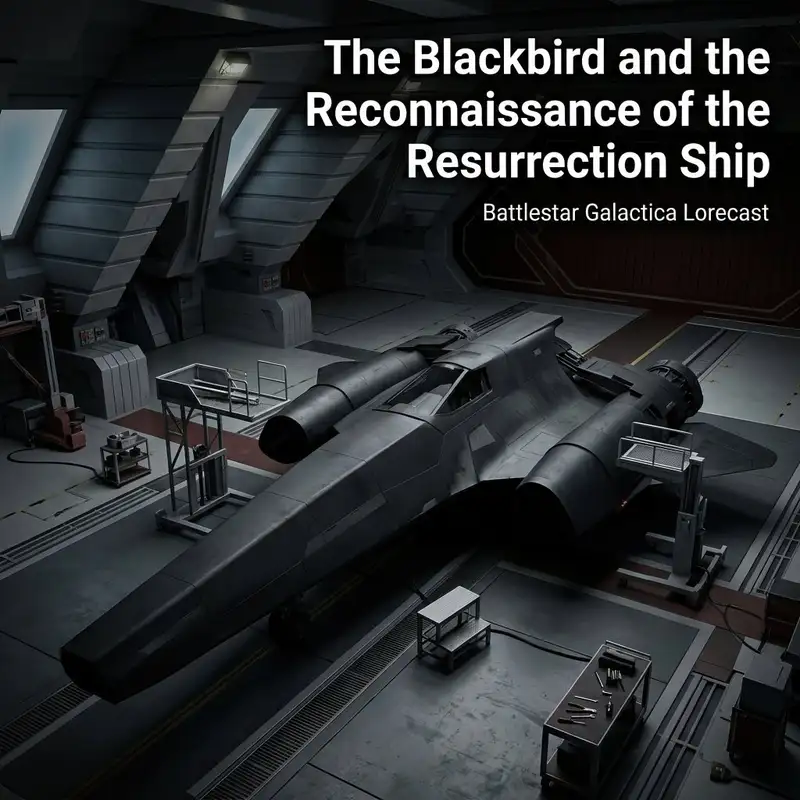
The Blackbird and the Reconnaissance of the Resurrection Ship
The photographs were not dramatic by the standards of a victory celebration. They were close, imperfect images of a Cylon formation already known to be dangerous. Two basestars. Raiders. Support vessels. And one much larger ship whose purpose Colonial commanders could not identify from a distant DRADIS contact. Yet that unknown vessel quickly became the most important object in the engagement area. A basestar could kill the fleet. The unidentified ship might explain why killing Cylons had not been changing the war. The images existed because one improvised craft had slipped close enough to see what ordinary reconnaissance could not. Before Galactica and Pegasus could attack the Cylon force, before pilots could be assigned targets, before commanders could decide what risks civilians might be asked to accept, somebody had to answer a simpler question. What was that ship, and why was it traveling under basestar protection?
The answer did not begin in a briefing room. It began in Galactica’s maintenance spaces, where the people responsible for keeping old Vipers flying confronted the most basic reality of the refugee fleet. They could repair. They could salvage. They could cannibalize damaged equipment. They could improvise parts and stretch maintenance intervals. What they could not do was call a factory, place an order, and wait for a new squadron of aircraft to arrive. The Twelve Colonies were gone. So were the shipyards, suppliers, training pipelines, engineering firms, and industrial labor force that had once made the Colonial Fleet a sustainable military institution. Every usable engine, panel, actuator, weapon component, and skilled technician had become part of a shrinking reserve.
That scarcity made Galen Tyrol’s construction project more than a hobby for restless deck personnel. It was an attempt to recover combat capacity in a fleet that had no dependable way to replace its losses. A Viper was not merely a cockpit, an engine, and a pair of guns. It represented scarce materials, maintenance labor, technical knowledge, flight-deck time, spare parts, fuel, ammunition, and a trained pilot capable of bringing it back. A damaged Viper might still be more valuable as a source of recoverable components than as the basis for an entirely new aircraft. Under those conditions, any project that diverted metal or labor from repair work had to justify itself.
The first intention was connected to the understandable desire for another combat craft. Galactica had aircraft, but not enough of them, and the fleet had learned repeatedly that a shortage of Vipers could become a shortage of time. Fighters intercepted Raiders, escorted Raptors, protected civilian ships, searched debris fields, and bought the minutes necessary for a jump calculation or a damaged freighter to get underway. But the deck crews were not working with an intact industrial plan. They were working with what the fleet had left. When conventional metal skin was unavailable because it was needed for Viper repairs, Karl Agathon suggested an alternative material: carbon composite.
That choice changed the project. The resulting craft was not just another Viper with a different skin. It became a separate, improvised aircraft whose most important feature was not conventional combat performance, but a reduced DRADIS signature. The carbon-composite construction made it difficult for Cylon systems to detect in the way they might detect a more conventional Colonial craft. The story does not establish an exact sensor threshold, an invulnerable radar profile, or a magic cloak that made the aircraft disappear under every condition. It established something much more useful and much more believable. The Blackbird could approach more closely than a normal craft might be able to approach before the enemy understood it had company.
That was an extraordinary capability for the surviving fleet, precisely because it was so limited. Galactica could not manufacture a wing of Blackbirds. The ship did not possess the materials, time, machine capacity, or surplus personnel for a stealth-fighter program. The construction effort was an example of adaptation under collapse. Skilled people looked at an impossible requirement, found a material constraint, and changed the question. They stopped asking how to rebuild the prewar air wing and began asking what one new craft could do that the existing air wing could not.
Kara Thrace’s test flight made clear that the answer was not routine fighter service. The Blackbird was difficult to handle. Its design favored speed and low detectability over the familiar behavior of an ordinary Viper, and it did not offer the pilot the forgiving margins that make a craft useful for repeated carrier operations, patrols, and dogfights. Thrace had the confidence and skill to fly it, but that did not make it a broadly practical aircraft. A fleet can admire exceptional pilots without confusing their individual ability with a durable doctrine.
The Blackbird also acquired a ceremonial identity. President Laura Roslin named it Laura, an act that attached civilian symbolism to a military improvisation. The crew’s operational name, Blackbird, was more revealing. It was less a tribute than a description of function. A small, dark, difficult-to-detect craft had been assembled from a civilization’s leftovers. It represented hope, certainly, but not the easy kind. It was hope built out of reclaimed parts, stressed workers, and the knowledge that every successful innovation might still be lost in its first real mission.
That first real mission arrived when the fleet faced a Cylon force that was following its movements. Pegasus had recently joined the survivors, bringing badly needed combat power, more aircraft, more personnel, and a second battlestar’s ability to fight. It also brought a second commander, Helena Cain, whose authority claims and command practices were already creating a crisis inside the human force. Material strength had increased. Political unity had not. The fleet now possessed two battlestars, but it did not possess a settled and legitimate combined command arrangement.
A Pegasus scout identified the Cylon presence. The force included two basestars and a substantial Raider screen, with a large vessel moving under their protection. At range, the Colonial forces could establish that the ship mattered. They could not establish what it did. In war, a contact report is not the same thing as intelligence. A commander who knows that something large is present still has to decide whether it is a command platform, a logistics vessel, a weapons carrier, a transport, a sensor asset, or something entirely different. Those distinctions determine target priority. They determine whether an attack should aim to destroy, disable, isolate, evade, or observe.
The initial reconnaissance problem was therefore severe. Sending an ordinary Raptor close to a force protected by basestars and Raiders risked exposing the scout before it could collect useful information. A Raptor was versatile, but it was not designed to be casually sacrificed for a closer photograph. It carried trained crew, valuable electronics, and capabilities that the fleet needed for navigation, electronic warfare, search and rescue, and jump coordination. A failed reconnaissance sortie would not merely cost an aircraft. It could alert the Cylons, reveal Colonial interest, and leave the commanders with less information than before.
The Blackbird offered a narrow answer. It could get closer. That did not make the mission safe, and it did not eliminate the need for judgment. Thrace’s use of the craft stretched the normal boundaries of command control. Her initiative was characteristic of a pilot who had often been rewarded for acting fast when institutions moved slowly. In this case, the risk produced intelligence the fleet needed. But the method also exposed a continuing problem aboard Galactica and Pegasus. A military force facing extinction often becomes dependent on exceptional people who can solve immediate problems by bending rules. That dependence can save lives. It can also make disciplined command harder to preserve.
Thrace’s task was not to win a battle. It was to enter the Cylon formation, observe the unknown vessel closely enough to document it, and return with evidence that others could assess. That last requirement mattered as much as the approach. Reconnaissance does not succeed merely because a pilot sees something. The observation has to reach the people who can interpret it and act on it. A scout that penetrates deeply but fails to return has risked an asset without necessarily changing the commander’s understanding of the battlefield.
The Blackbird came back with usable images. The photographs reduced uncertainty. They did not answer every tactical question about the Cylon formation, but they transformed the unknown ship from an abstract contact into a specific intelligence problem. The vessel was not merely large. Its design and role could now be investigated. That was the Blackbird’s first significant victory. It did not destroy a Raider. It did not score a spectacular kill. It brought home information that allowed the fleet to revise its target list before the battle began.
The person who supplied the crucial interpretation was Gaius Baltar. His knowledge did not come from an official intelligence system or from a clean chain of custody. It came through Gina Inviere, the Number Six Cylon held aboard Pegasus. Gina was an individual Cylon copy with her own experiences, trauma, and relationship to Baltar. She was not a neutral briefing officer, and Baltar was not a neutral analyst. Both were compromised by secrecy, fear, manipulation, and personal need. Yet intelligence is often imperfect in precisely that way. Commanders do not get to choose whether vital information comes through ideal channels. They have to judge whether it is credible, how much confidence to place in it, and what consequences follow if they ignore it.
Baltar identified the vessel as a Resurrection Ship. At that point in the war, the Colonials understood Cylon resurrection as a decisive asymmetry. A Cylon body could die, but its consciousness might be downloaded and transferred into a new body. The process did not mean that Cylon casualties were meaningless. It depended on functioning infrastructure, available bodies, and the ability to complete the transfer. But it changed the operational cost of combat. A Colonial pilot killed in a Viper was a permanent loss to a population already too small to replace its specialists easily. A Cylon destroyed in combat might return with memories intact enough to continue fighting.
The Resurrection Ship mattered because it supported that system at a distance from Cylon-held territory. It accompanied the pursuing force as a mobile enabler of renewed Cylon manpower. The Colonial commanders did not possess a complete technical history of resurrection, nor did they know every facility or contingency the Cylons might have elsewhere. They did not need to. They knew enough to understand that the vessel gave the local Cylon force an important resilience advantage. If it could be removed, enemy losses in the coming engagement would become more consequential.
That insight changed the operation’s purpose. The Colonial Fleet was no longer planning only to survive an encounter with two basestars. It had the opportunity to strike an asset that made those basestars and their Raiders harder to wear down over time. The Blackbird’s photographs had not won the battle, but they had made the correct battle visible. This was the difference between firing at the nearest threat and identifying the system that allowed the threat to regenerate.
The resulting plan required more than stealth. It required deception, timing, and the cooperation of military and civilian ships that had different capabilities and different stakes. The fleet appeared to be conducting mining activity. That presentation had to look plausible enough to draw Cylon attention without immediately revealing the larger trap. When the Raiders launched, Galactica and most of the civilian fleet jumped away. A selected group of civilian ships remained behind, seeming to suffer from faster-than-light drive trouble and attempting to escape at sublight speed.
The decoy ships were not expendable scenery. They carried people whose survival was the entire reason Galactica existed. They were civilian crews and civilian passengers being asked to participate in a military deception because the fleet’s military survival and civilian survival could not be separated. Their apparent vulnerability was meant to draw the Raiders away from the basestars and the Resurrection Ship. If the Raiders pursued, the Cylon formation’s protective screen would thin. If the Raiders did not pursue, the operation might fail before the battlestars arrived.
This was a calculated risk, but it was not a clean one. The decoys had to trust that the Cylon force would behave as expected, that the Raiders would prioritize what appeared to be crippled prey, and that the Colonials could return before the civilians were overwhelmed. A decoy plan is always an argument about enemy perception. It works only if the enemy sees what the planner wants it to see. The civilians were not merely lending their ships to a clever tactical scheme. They were accepting danger because their leaders believed that the risk might reduce a larger and more persistent threat to the entire population.
Once the Raiders committed to the pursuit, Galactica and Pegasus could jump into the battlespace. Their arrival was the heavy blow of the operation. The two battlestars would engage the basestars, launch and recover strike craft, coordinate Vipers and Raptors, and create the pressure necessary to keep the Cylon force from organizing a simple withdrawal. The plan depended on speed, but not merely the speed of ships or fighters. It depended on the speed of decisions. Jump calculations had to be correct. Command centers had to share the same picture of the engagement. Pilots had to know their assignments. The battlestars had to arrive with their limited aircraft and weapons committed to the right targets at the right moment.
The Blackbird had a different job. Its stealth characteristics made it valuable, but its role was not to destroy the Resurrection Ship alone. Lee Adama, flying the craft in the final operation, was tasked with disabling the ship’s faster-than-light drives. The purpose was to deny the Cylon vessel its escape route. If the Resurrection Ship could jump away, the opportunity created by the deception would disappear. The Colonials might inflict damage on the basestars and Raiders, but the key target could leave the fight and preserve the resurrection capability that had made it strategically valuable.
This was a mission shaped by the limitations of the Blackbird as much as by its advantages. The craft could gain access, but it could not absorb sustained punishment. It was not a platform for a prolonged dogfight against Raiders. It was not an armored strike fighter meant to remain near the target while every available enemy weapon searched for it. Its value lay in doing one thing at the decisive point of the operation: reaching the Resurrection Ship and making it unable to flee before the larger Colonial attack could finish the task.
The decision to target the drives rather than attempt a direct nuclear attack also reflected a realistic appreciation of exposure. Carrying a nuclear weapon into launch range would have imposed its own detection and survivability problems. A Blackbird had only a narrow margin for surprise. The better use of its access was to cripple mobility and let the battlestars, Vipers, Raptors, and other strike assets exploit an immobilized target. The Blackbird would open the trap. It would not be asked to perform every part of the kill chain.
That division of labor is important. It is easy to remember the Blackbird because it was unusual, handmade, and flown by major characters. But the operation succeeded because specialized capabilities were integrated. Deck crews created the craft. Thrace demonstrated that it could penetrate close enough to collect intelligence. Baltar and Gina supplied an interpretation of the target. Civilian ships helped shape the deception. CIC personnel coordinated the moving parts. Galactica and Pegasus brought the firepower. Viper and Raptor crews defended the force and prosecuted the battle. Lee Adama used the Blackbird where its unique advantage mattered most. No single element was sufficient by itself.
Adama reached the Resurrection Ship and succeeded in disabling its ability to jump away. The operation had turned an intelligence discovery into a tactical condition the Cylon force could not easily reverse. A ship that might have escaped was now fixed in the engagement area. The Colonial attack could concentrate against it while the battlestars fought the broader battle. The Resurrection Ship’s destruction would still require effort and risk, but its most important defensive option had been removed.
Then the Blackbird paid the price of being unique. A damaged or disabled Colonial Raptor collided with the craft. The collision destroyed the Blackbird and forced Lee Adama to eject. In an ordinary air wing, the loss of one experimental aircraft would already be unfortunate. In the refugee fleet, it was the disappearance of a capability that existed nowhere else. There was no warehouse holding another airframe. There was no production line waiting to restart. The labor that had created the Blackbird could not just be summoned again without cost to every other repair and maintenance priority aboard Galactica.
The immediate concern was Lee Adama. Ejection in space was not a dramatic pause between action scenes. It was a survival emergency. His suit was damaged. Oxygen became a finite and rapidly diminishing resource. The battle continued around him, and recovery required a Raptor, crew, communications, search coordination, and time that the Colonial force did not have in abundance. A search-and-rescue mission during combat always imposes a second problem on a commander. The force must continue fighting the enemy while committing people and equipment to recover one of its own.
Galactica’s combat information center and flight operations personnel had to track distress information, direct the rescue effort, and keep the larger attack coherent. The fleet could not abandon a pilot simply because the tactical situation was dangerous. Nor could it disregard the danger to the recovery crew. The rescue of Adama was therefore part of the battle’s operational meaning. The Colonial Fleet’s strength was not only that it could launch fighters. It was that, even under pressure, it tried to preserve the people whose skill and experience could not be replaced.
Adama was found and revived. The Blackbird was not. That contrast defined the limits of improvisation. The fleet could save the pilot, but it could not restore the platform. Its specialized reconnaissance capability disappeared at the very moment it had proven its worth. The loss did not erase the success of the project. It confirmed that the project had been necessary. But it also showed the danger of relying on a single exceptional asset. Innovation can solve a specific problem without becoming a durable institution. A prototype can change one battle and still leave no repeatable capacity behind it.
The larger battle ended in a significant Colonial victory. The Resurrection Ship was destroyed. At least one basestar was destroyed as well. The remaining Cylon forces withdrew by jumping away. Tactically, the fleet had eliminated major enemy vessels and recovered Lee Adama after his ejection. Operationally, it had removed the mobile resurrection support accompanying the pursuing Cylon force. Cylon casualties in that area now carried a more permanent weight than they had before the battle.
Strategically, the result gave the refugees breathing room. It did not guarantee safety, and it did not settle the wider war. The Colonials had not destroyed every Cylon resurrection capability. They had not made every Cylon everywhere mortal. They had destroyed one critical mobile asset and changed the immediate balance between a pursuing force that could replace its fallen and a refugee fleet that could not. That difference mattered. It gave the humans a chance to continue moving, planning, and surviving without the same immediate pressure from a Cylon force supported by that vessel.
Yet victory did not produce the things the fleet needed most. It did not create a secure base. It did not replace pilots, technicians, medics, engineers, or civilians killed since the Fall. It did not restore the factories that could have built more Vipers or another Blackbird. It did not repair Galactica’s aging systems or erase the fleet’s dependence on mining, refining, rationing, repair, and the cooperation of civilian ships. The battle removed a threat. It did not rebuild a civilization.
The command crisis surrounding the operation made that distinction even sharper. Galactica and Pegasus could fight together, but their commanders were close to fighting each other. Cain had asserted authority over the combined force and had created a climate aboard Pegasus in which brutality could be treated as discipline. The immediate conflict involved the treatment of Gina, the attempted sexual assault against Sharon Agathon by Pegasus personnel, and the killing of Lieutenant Thorne by Tyrol while he intervened to stop that assault. Cain ordered the execution of Helo and Tyrol. Adama and Roslin regarded the proceedings and the punishments as intolerable.
The crisis was not merely personal hostility between senior officers. Marines from Pegasus were positioned aboard Galactica. Two battlestars possessed enough weapons and personnel to turn a dispute over law, prisoners, and command authority into a catastrophic internal battle. Cain suspended the executions until after the Cylon operation, which allowed the military action to proceed. But the suspension did not resolve the underlying issue. It postponed it.
At the same time, both sides moved toward assassination. Cain ordered Thrace to participate in a plan against Adama. Adama and Roslin supported a plan for Thrace to kill Cain. The fleet had reached a point at which leaders who understood the Cylon threat and the fragility of the civilian population were considering murder as a way to preserve command unity. Their fears were not imaginary. Cain’s conduct posed a real danger. Adama’s resistance could be interpreted by Pegasus personnel as a threat to their commander and their ship. But the willingness to solve a constitutional crisis through covert killing revealed how badly lawful authority had already deteriorated.
Cain’s death after the battle removed the immediate confrontation. Gina killed her, and Colonel Jack Fisk succeeded to Pegasus’s command. That succession allowed the human force to avoid open conflict between its two battlestars. But it did not transform the preceding events into a lawful or healthy resolution. The combined fleet had won a demanding operation against the Cylons while demonstrating that its own command structure could not safely contain its disagreements. Military necessity had held the coalition together for a few critical hours. It had not restored trust, due process, civilian oversight, or a stable understanding of who possessed legitimate authority.
That institutional fracture belongs in the history of the Blackbird because the craft’s success depended on a fleet able to cooperate despite itself. The photographs had to be believed. The target analysis had to be accepted. Civilians had to consent to decoy risk. Battlestars had to coordinate their arrival and their fire. Pilots had to fly missions under commanders who were contemplating violence against one another. The Blackbird demonstrated technical ingenuity, but technical ingenuity only becomes strategic power when institutions can use it without destroying the people and principles they are trying to defend.
The Blackbird’s legacy was therefore not that it introduced a wonder weapon. It did not. It was not a standard stealth fighter, a replacement Viper, or a design that could be reproduced across the fleet. Its importance came from the way Galactica’s people identified a narrow intelligence gap and built a specialized answer from scarce materials. The craft reached the Cylon formation closely enough to expose the Resurrection Ship. Later, it denied that ship an escape route long enough for the larger Colonial force to destroy it.
That success came at a cost. Skilled labor had produced one irreplaceable aircraft. Kara Thrace’s exceptional ability had been needed to prove it useful. Lee Adama nearly died while employing it in combat. Civilian ships accepted danger as decoys. The fleet’s two battlestar commanders coordinated a major attack while their political conflict threatened to become civil war. The Blackbird created a momentary advantage against a stronger enemy, but it could not make that advantage permanent.
Its final lesson was harder and more valuable. A refugee fleet survives through more than firepower. It survives when deck crews, pilots, analysts, civilian crews, commanders, and political leaders can convert limited resources into a shared plan. The Blackbird bridged industrial adaptation and operational intelligence, but its destruction showed that ingenuity alone is not enough. Survival depended on building institutions capable of turning rare acts of brilliance into lawful, repeatable collective action.