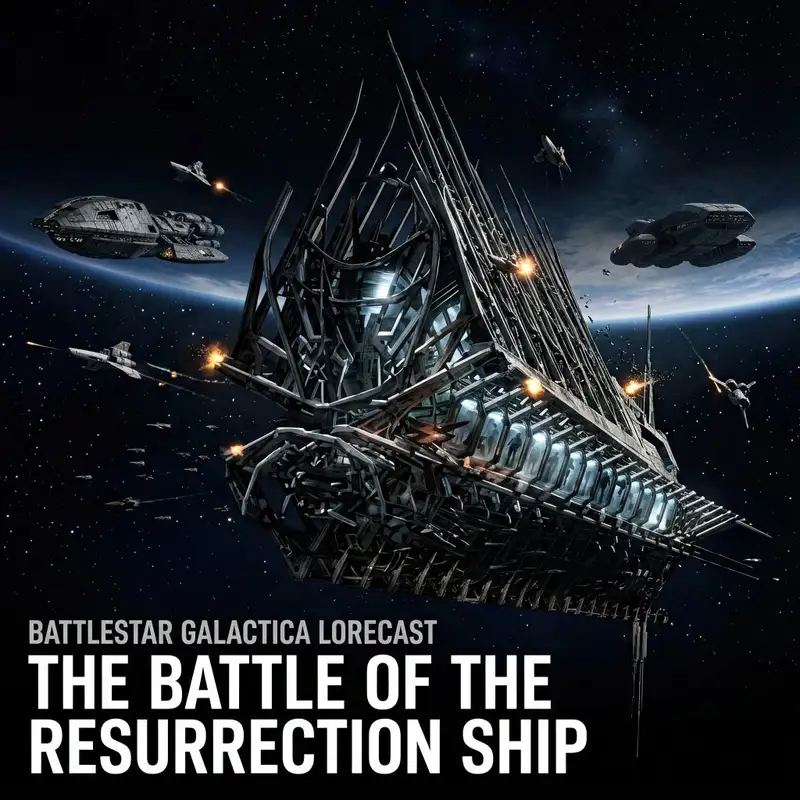
The Battle of the Resurrection Ship
Galactica and Pegasus faced one another with weapons ready, and the immediate question was not whether the Cylons would strike first. It was whether the last two surviving Colonial battlestars would. Admiral Helena Cain intended to execute Karl Agathon and Galen Tyrol aboard Pegasus. Their offense began when Tyrol intervened to stop Lieutenant Thorne’s abuse of Sharon Agathon, a Number Eight Cylon held in custody. Thorne died in the struggle. Cain treated the matter as murder and a challenge to her authority. Commander William Adama treated the planned executions as proof that Cain had become a danger to the people both ships were supposed to protect. Roslin, still the civilian President, saw the same danger. Cain held senior military rank, but seniority did not settle the larger constitutional question. The Colonial government had survived the destruction of the Twelve Colonies in fragile form, and it could not survive if every battlestar commander became judge, legislature, and executioner.
The confrontation was more than a clash between two proud officers. Cain commanded a ship with greater material strength, a larger surviving military establishment, and an aggressive culture shaped by continued war after the Fall. Adama commanded the battlestar that had protected the civilian fleet from the first hours of the catastrophe. Cain believed discipline, offensive action, and a hard chain of command were the only means of survival. Adama believed military necessity still had limits, especially when the military was now responsible for the last functioning civilian community. Neither view was free of fear. Cain had seen civilization collapse and had responded by narrowing her definition of who deserved protection. Adama had seen the same collapse and concluded that survival without law would become another form of defeat.
Before either commander made the irreversible decision, an unidentified contact appeared. Both battlestars initially read it as a possible Raider. It was Starbuck, returning in the Blackbird after an unauthorized reconnaissance mission against the Cylon force Pegasus had been tracking. The near-misidentification was more than an awkward interruption. It demonstrated how little margin remained. A stealthy Colonial craft, transmitting as it came home, had been mistaken for an enemy at the precise moment when two human commands were already prepared to interpret almost any movement as hostile. The Blackbird’s return brought intelligence that neither Cain nor Adama could ignore. It also gave them a reason, however temporary, to stop aiming their anger at each other.
Pegasus had been shadowing a substantial Cylon formation. The screen evidence establishes two basestars, accompanying support vessels, and a much larger unidentified ship. The force was too strong for careless attack and too valuable to disregard. In the refugee period, a Cylon formation of that size was not just a collection of targets. It was a mobile operational system. The basestars carried Raiders and Cylon personnel. The escorts complicated approach and escape. The larger vessel, whose purpose was unknown at first, suggested that the Cylons were doing more than pursuing the fleet. They were sustaining their ability to pursue it.
Starbuck’s Blackbird reconnaissance mission supplied the essential intelligence. The craft had been assembled from salvage and designed to reduce its detectability. It was not magical invisibility, and it did not establish that Colonial forces had discovered a universal answer to Cylon sensors. Starbuck was able to approach close enough to photograph the unfamiliar vessel without being detected by the Cylon force. That was an intelligence success, but it depended on a particular craft, a particular approach, and a particular moment of Cylon inattention or limitation. It did not mean the Blackbird could safely perform every mission, or that every enemy sensor system was blind to it.
The return flight made the limits equally clear. Once the Blackbird transmitted, it became visible enough in the electromagnetic sense to create confusion among friendly forces. The lesson was not that stealth had failed. The lesson was that concealment and communication often pull in opposite directions. A craft that wants to remain unseen must restrict what it emits. A craft that wants to rejoin a fleet must identify itself, coordinate, and accept the risk of being found. In a conflict defined by infiltration, compromised systems, and uncertain contacts, that tension could be fatal.
The photographs raised a question that guns alone could not answer. What was the large Cylon vessel, and why did the Cylons protect it with such a formidable force? The answer came through Gina Inviere, the captive Number Six aboard Pegasus. Gaius Baltar, whose scientific and political usefulness had repeatedly been tangled with his personal cowardice and self-protection, sought information from her. Gina identified the ship as a Resurrection Ship.
That identification changed the operation. The Resurrection Ship was not merely a large support vessel or an unusually valuable command platform. It was a local facility that enabled Cylon resurrection. In practical military terms, that meant Cylon death near the fleet did not necessarily carry the same permanence as Colonial death. A destroyed Cylon body could be replaced if the relevant resurrection infrastructure remained available. That altered risk, morale, punishment, intelligence, and battlefield decision-making. A Cylon pilot or boarding party might be willing to accept losses that would be intolerable to a human force with no equivalent system. A commander could spend personnel more aggressively if death was understood as interruption rather than final loss.
But resurrection was never unlimited immortality. It required infrastructure. It had operational conditions. It could be disrupted, denied, or lost. The presence of a Resurrection Ship near the pursuing Cylon force meant that the Cylons possessed local support for that advantage. Destroying the ship would not destroy Cylon civilization, eliminate every resurrection facility, or end the war. Later events establish that Cylon resurrection depended on more than this one vessel. There were other elements of that system elsewhere. But this ship mattered because it was present now, near the Colonial fleet, supporting the forces that hunted it.
Gina’s testimony also carried a more personal meaning. She wanted permanent death. That desire emerged from her treatment aboard Pegasus, where captivity had become abuse under a command climate that allowed dehumanization to become routine. Her knowledge of the Resurrection Ship did not make her an objective spokesperson for all Cylons, or all Number Sixes, or every Cylon strategic decision. It revealed what one individual knew, suffered, and wanted. Yet her information was enough to transform an unidentified contact into the most important target the Colonials had encountered since Pegasus joined the fleet.
The Resurrection Ship offered Adama and Cain a reason to cooperate. It did not give them a reason to trust each other. Galactica and Pegasus brought different strengths to the coming fight. Galactica was older, battered, and adapted to the improvised mission of protecting refugees. Its crew had learned to operate under shortages, political pressure, and the constant demand to keep civilian ships alive. Pegasus was newer, more powerful, and more oriented toward offensive military action. Its surviving personnel had endured a separate campaign after the Fall, one marked by harsh discipline, scarce trust, and Cain’s belief that civilian obligations had become secondary to preserving a fighting force.
Together, the battlestars could combine their guns, air wings, reconnaissance assets, and faster-than-light mobility. Separately, each faced a Cylon force built around two basestars and a protected strategic asset. Neither commander could safely assume that a lone battlestar attack would produce victory. Even a successful strike against one Cylon vessel could leave the other ship exposed, its fighters overextended, its flight deck damaged, or its civilian fleet uncovered. The problem was not merely how to destroy a target. It was how to do so without losing the remaining military force required to protect tens of thousands of civilians afterward.
The civilians made the political stakes unavoidable. Galactica and Pegasus were warships, but they had become more than warships. They were the armed shield of a refugee society. Their pilots, engineers, Marines, doctors, deck crews, and officers could not be replaced easily. Their ammunition, aircraft, fuel, spare parts, and repair time were finite. If the battlestars fought each other, the Cylons would not need to win through superior tactics. They could allow the Colonials to consume their own irreplaceable strength.
Cain and Adama therefore agreed to a truce. It was a military agreement, not a reconciliation. They would coordinate against the Cylon force, destroy the Resurrection Ship if possible, and settle the larger dispute later. On the surface, this was disciplined command behavior. Two officers facing an enemy force had recognized that internal conflict had to yield to a common operational objective. Beneath the surface, both were preparing to resolve their disagreement through political murder.
Adama assigned Starbuck to kill Cain after the battle. Cain directed Colonel Jack Fisk and loyal Marines to terminate Adama’s command. The language mattered. Neither side announced a formal transfer of authority, presented evidence to a court, sought a ruling from the civilian government, or declared an open military rebellion. These were covert plans to remove rival leadership by force. They were not completed coups, because neither assassination order was carried out. But the fact that they were contemplated revealed how thoroughly constitutional order had been strained by extinction.
Adama’s decision is not excused by Cain’s conduct. He had compelling reasons to fear her. Pegasus had been shaped by decisions that placed military preservation above civilian rights and human dignity. Cain’s command had stripped surviving civilian ships of equipment, personnel, and faster-than-light capability. Her people had abused prisoners. Her response to Tyrol and Helo’s actions showed that she was prepared to use execution as an instrument of control. From Adama’s perspective, allowing Cain to dominate the combined fleet could mean losing the civilian character of the Colonial remnant.
Yet authorizing an assassination crossed a line that Adama had spent much of the refugee journey trying to defend. It acknowledged that the lawful institutions available to the survivors were too weak, too slow, or too endangered to resolve the crisis through ordinary means. Roslin supported the removal of Cain because she saw Cain as a threat to the fleet’s survival. But Roslin was not directing the battle or issuing tactical fire orders. Her role was political and constitutional. She represented civilian authority trying to reassert itself over military power, even while relying on military officers to contain another military officer.
Cain’s order was equally revealing. She did not trust Adama to accept her authority after the battle. She understood that Galactica’s crew, Roslin’s government, and the civilian fleet would resist a Pegasus-centered military regime. Her contingency plan treated Adama’s command as an obstacle to be removed. It preserved the outward form of joint operations while accepting that the partnership was only a pause before internal violence.
Starbuck stood at the center of this dangerous arrangement. She had once served under Adama and was now acting as Pegasus’s commander of the air group. Cain valued her ability. Adama trusted her loyalty. Neither relationship was simple. Starbuck could recognize Cain’s competence as a commander while also seeing the cruelty and fear within Pegasus’s command climate. She could remain loyal to Adama while understanding that he had asked her to become an instrument of political violence. Her position made her essential to the operation and exposed her to the moral cost of the decisions around her.
The attack plan used the civilian fleet as both responsibility and weapon. The civilian ships would appear to suffer mechanical difficulties. The main fleet would prepare to jump away, leaving the apparent stragglers exposed. The purpose was to create a target the Cylons would find difficult to ignore. Raiders would be drawn away from the basestars and the Resurrection Ship, moving toward the vulnerable civilian vessels. Once the Cylon fighters were separated from their capital ships, Galactica and Pegasus would jump into close range, engage the basestars with concentrated fire, and send their fighters against the Resurrection Ship.
It was an effective design because it attacked the Cylon formation as a system rather than treating every enemy vessel as an isolated target. Raiders provided defense, scouting, interception, and pressure on Colonial aircraft. The basestars protected the larger operation and carried the means to sustain pursuit. The Resurrection Ship reduced the permanent cost of Cylon casualties. If the Colonials could pull the Raiders away, they could temporarily weaken the Cylon formation’s ability to defend its most valuable asset. If they could damage or destroy the basestars at close range, they could create the opening required for fighters to attack the Resurrection Ship.
The plan depended on timing. Faster-than-light movement allowed the Colonials to reposition suddenly, but it did not make coordination effortless. The ships needed reliable calculations, functioning drives, clear communications, and a common understanding of when each phase would begin. The civilian vessels had to look sufficiently vulnerable to draw attention while still retaining a path to escape. The battlestars had to arrive close enough to bring their guns to bear without appearing in a position that allowed the Cylon formation to concentrate its own defenses. Fighters had to launch, navigate, identify targets, and survive amid a rapidly changing battle.
No screen evidence provides a complete order of battle. We do not know a precise count for every Colonial Viper, Raptor, Raider, escort, or support vessel involved. That uncertainty does not weaken the historical meaning of the operation. It clarifies it. Commanders rarely make decisions with perfect inventories, especially in a refugee war conducted after genocide. What mattered was not a clean table of forces. What mattered was whether the Colonials could create local superiority at the decisive point before the Cylons recovered from the deception.
The civilian ships were not passive scenery in this plan. Their crews were asked to participate in an operation built around their apparent vulnerability. Even if the expectation was that they would jump away before the decisive engagement, the risk was real. A mistimed jump, failed drive, delayed calculation, or Cylon decision to press the attack could turn a deception into a massacre. The military logic was sound. The moral burden remained. Refugees who had already lost homes, families, and worlds were being asked to serve as bait because the fleet lacked safer ways to shape the battle.
The deception worked. The Cylon Raiders moved toward the vulnerable civilian ships, separating themselves from the basestars and the Resurrection Ship. This was the turning point of the operation. The Raiders did not need to be destroyed in detail. They needed to be pulled away from the space where their presence most protected the capital ships. The Colonials had created a temporary weakness in a superior force.
Galactica and Pegasus then jumped into close firing range. The arrival was not a simple display of firepower. It was an act of calculated exposure. Battlestars at close range could bring heavier weapons to bear, but they also accepted the danger of return fire, collision, missile attack, internal damage, and a fight that could overwhelm flight operations. The two Colonial ships concentrated their fire against the basestars. The objective was to damage the escorts, disrupt the Cylon formation, and hold open the corridor through which Colonial fighters could reach the Resurrection Ship.
The battle suggests that the basestars were vulnerable once their Raiders had been diverted. Their apparent inability to stop the combined battlestar attack effectively may reflect the specific circumstances of this engagement: surprise, close range, divided attention, damage, and the loss of fighter cover. It should not be treated as a universal rule that every basestar lacked defensive capability or could be defeated by any battlestar that approached aggressively. The Colonials won this opening because their plan created conditions favorable to them, not because Cylon capital ships had suddenly become harmless.
For Galactica and Pegasus, the gun duel was necessary but incomplete. Damaging the basestars did not achieve the mission if the Resurrection Ship could simply jump away. The target’s ability to withdraw was the central tactical problem. A ship that could leave the engagement would remain a strategic enabler even if its escorts were weakened. The Colonial fighters therefore had to do more than attack. They had to prevent escape.
Lee Adama, flying the Blackbird, carried that burden. His status at the time made the mission emotionally charged. He had been demoted and was serving under Pegasus authority, caught between his father’s command, Cain’s expectations, and the wider fracture between the ships. Yet his role in the operation was not symbolic. The Blackbird’s reconnaissance value now became strike value. Lee’s assignment was to use precision missiles against the Resurrection Ship’s faster-than-light drive.
The attack succeeded in its immediate purpose. Lee struck the drive and disabled the ship’s ability to escape. He did not destroy the Resurrection Ship. That distinction is important. Precision attack often creates the conditions for victory rather than delivering victory by itself. The missile strike converted a mobile strategic asset into an immobilized target. Once the ship could not jump away, the Colonial force could shift from denial to destruction.
Lee’s mission did not end cleanly. The Blackbird collided with a damaged Raptor. He ejected into open space, where his flight suit was punctured and his oxygen began to run out. Around him, the battle continued. The scene is often remembered as an intimate crisis inside a large fleet engagement, and that is exactly what it was. A campaign can depend on battlestars and basestars, but it is fought by individuals whose bodies remain vulnerable to pressure loss, debris, exhaustion, and fear.
Lee later admitted that he had not wanted to survive. The episode presents profound despair and a dangerous passivity in the moment when he could have struggled harder for life. It should not be casually reduced to a confirmed suicide attempt. The circumstances were chaotic, traumatic, and shaped by accumulated conflict with his father, his own damaged sense of purpose, and the pressure of serving between two hostile commands. But the admission matters. It shows that trained pilots are not interchangeable pieces of equipment. A fleet can recover a person from space and still have to reckon with the injury that cannot be patched by a medic.
The search-and-rescue Raptor that recovered Lee was therefore part of the victory, not an afterthought. The refugee fleet could not casually lose experienced pilots, officers, or specialists. Every rescue consumed time and risked additional personnel, but every recovered survivor preserved knowledge, training, and human connection that the fleet could not manufacture quickly. The operation’s success depended on fighters striking the target, battlestars holding the line, civilian crews playing their assigned role, and rescue crews refusing to treat a drifting pilot as expendable.
With the Resurrection Ship immobilized, Vipers from both battlestars attacked it directly. Their fire entered the ship’s structure and destroyed it. At least one basestar was also destroyed in the engagement. The surviving Cylon forces withdrew or jumped away. The Colonials had achieved an operational victory against a force that, before the battle, seemed too strong to confront directly.
The visible destruction was dramatic, but the battle’s meaning lies in what that destruction changed. Tactically, Galactica and Pegasus had survived a high-risk engagement and eliminated priority targets. The combined force had used reconnaissance, deception, faster-than-light maneuver, capital-ship gunfire, fighter operations, and precision strike in coordinated sequence. The plan worked because every phase enabled the next. The Blackbird reconnaissance identified the target. Gina’s information explained its value. The civilian deception pulled away the Raiders. The battlestars damaged the escorts. Lee’s missile strike prevented escape. The Vipers destroyed the immobilized ship.
Operationally, the battle proved that two battlestars could overcome a larger Cylon formation under favorable conditions. It did not prove that either ship could repeat the result at will. The operation required surprise, accurate intelligence, a deception the enemy accepted, coordinated jumps, functional flight operations, and a target whose escape route could be closed. It also depended on the temporary restraint of Cain and Adama. If their conflict had become open combat, the Colonial fleet would have entered the engagement divided, and perhaps not at all.
The strategic effect was real but limited. The battle did not end Cylon resurrection throughout their civilization. It did not destroy every Resurrection Ship or every component of the larger system. It did not stop the Cylon pursuit, restore the Twelve Colonies, or give the refugee fleet a secure industrial base. The Colonials remained badly outnumbered, dependent on finite supplies, and unable to replace every lost aircraft or trained crew member. The Blackbird was gone. Lee had nearly died. Both battlestars had expended ammunition, sustained stress on their systems, and added to their maintenance burden. A successful battle did not erase the arithmetic of attrition.
The victory also demonstrated the value and cost of civilian participation. The bait operation helped create the opening that made the battle possible. But it confirmed a hard truth about the refugee fleet. Civilians were not outside the war. They were inside its operational design. Their ships carried labor, families, food, medical capacity, political legitimacy, and the remnants of Colonial society. Using them as bait was not the same as treating them as expendable. The plan relied on getting them away safely. Yet the fact that they could be used in that role showed how little separation remained between military survival and civilian danger.
As the Cylon force withdrew, the concealed human conflict remained unresolved. Starbuck did not kill Cain. Fisk did not launch an assault on Adama’s command. The two assassination plans dissolved not because either commander had discovered a new respect for law, but because the moment passed without the final order being given. That restraint mattered. A contemplated act and an executed act are not morally identical. Still, the willingness of both commands to prepare decapitation strikes could not just be forgotten because the battle had gone well.
Cain’s death came from a different direction. Gina escaped confinement with Baltar’s assistance and killed Cain aboard Pegasus. The killing was not a lawful resolution to the command crisis. It was not an operation ordered by Adama, Roslin, or Starbuck. It did not transform Gina into an agent of Colonial justice, and it did not absolve those who had privately planned assassination themselves. Cain’s death ended her personal command, but it left behind the conditions that had made that command possible.
The military funeral that followed carried its own ambiguity. The fleet honored Cain’s service and rank. It recognized that she had commanded a battlestar through the destruction of civilization and had brought Pegasus into the refugee fleet. But ceremony could not settle the moral record of her authority. Her tactical skill and operational aggression were real. So were the abuses committed under her command, the treatment of prisoners, the coercive culture aboard Pegasus, and the readiness to place military power above civilian life. A funeral can mark loss. It cannot convert contested authority into innocence.
Roslin promoted Adama to Rear Admiral, confirming that unified command over Galactica and Pegasus now rested with him. The promotion was not merely a reward. It was an institutional repair. The surviving Colonial government needed a clear military chain of command, and the military needed an authority structure that did not invite another confrontation between battlestars. Adama now commanded more force than any surviving Colonial officer. That increased the fleet’s security, but it also increased the danger inherent in concentrating armed power. The promotion worked because Adama still accepted, however imperfectly, that his role existed beneath civilian legitimacy rather than in place of it.
Pegasus remained with the fleet. That was the most immediate political and military gain after the battle. Losing Pegasus to internal conflict would have been catastrophic. The ship represented rare combat power, trained personnel, flight capacity, maintenance resources, and a second platform from which the Colonials could defend their civilians. Preserving it meant the fleet had not traded one Cylon victory for self-inflicted strategic weakness.
But Pegasus was not remade by Cain’s death. Command culture survives commanders. It survives in personnel, habits, silences, resentments, and assumptions about whose suffering counts. Colonel Fisk had stopped the retaliatory beating of Helo and Tyrol after the confrontation over Sharon Agathon. That action mattered, but it should not be mistaken for a complete humanitarian conversion. Fisk acted to restore order within a military institution. His concern was discipline and control. Those can coincide with the protection of individuals, but they are not the same thing as a principled defense of universal rights.
The survivors aboard Pegasus carried the record of their ship’s separate war. Some had endured Cain’s methods. Some had benefited from them. Some had learned to survive by remaining silent. Some believed that Galactica’s concern for civilian process was softness that would get everyone killed. Others had seen what happens when fear removes every restraint from armed authority. Bringing Pegasus into the fleet preserved a vital asset, but it also imported a political and moral wound into an already damaged society.
Sharon Agathon’s perspective offers another complication. In conversation with Adama, she connected Cylon hostility to the Colonials’ own history of violence against the beings they created. That observation deserves attention. Human exploitation, fear, and brutality toward artificial life helped shape the world from which Cylon rebellion emerged. It is relevant to understanding why some Cylons viewed humanity with hatred and why the war became more than a machine uprising. But Sharon’s account was one individual Cylon’s interpretation. It was not a complete explanation for every Cylon decision, and it did not justify the extermination of the Twelve Colonies.
That distinction is central to the Battle of the Resurrection Ship. The Colonials were not innocent in the long history that preceded the war. The Cylons were not innocent in the genocide that followed. Cain’s abuse of prisoners did not make the Cylon attack defensible. Cylon atrocity did not make every Colonial emergency measure lawful or wise. The battle placed these truths in the same operational space. A Colonial fleet fighting for survival depended on a cooperative Cylon’s intelligence, used civilians in a dangerous deception, and nearly collapsed into internal assassination before it could attack the enemy.
The battle was therefore not a clean triumph. It was a narrowly achieved victory in which discipline held for just long enough. Galactica and Pegasus destroyed a local Cylon advantage because their crews carried out a sophisticated combined operation despite the distrust above them. They prevented the Resurrection Ship from escaping, imposed permanent risk on nearby Cylon forces, and avoided an immediate war between the last Colonial battlestars.
What survived was not merely two warships. What survived was the possibility that the refugee fleet could remain one political community, with civilian authority, military command, and moral limits still capable of restraining one another. That possibility was fragile, compromised, and repeatedly endangered. But at the Resurrection Ship, it proved more valuable than either battlestar alone.