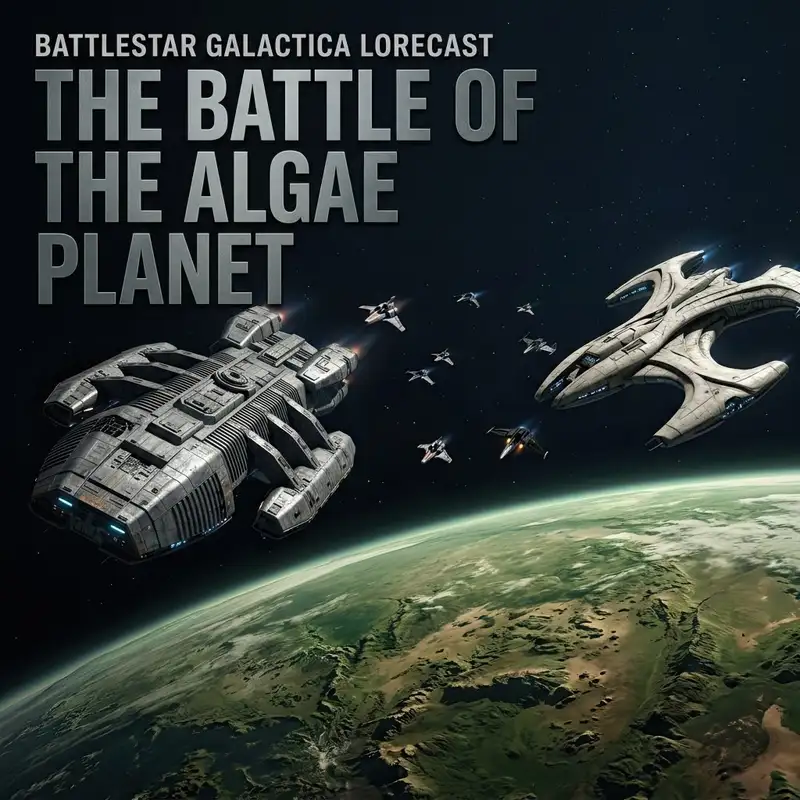
The Battle of the Algae Planet
Galactica prepared nuclear missiles against a planet where its own people were still working, digging, and trying to stay alive. Above them waited four Cylon basestars. The imbalance was obvious. Galactica could not expect to win a conventional fight against that force, and Admiral William Adama knew it. Yet neither side opened fire. The reason was a ruined temple on the surface and a question neither civilization could afford to leave to the other. Somewhere in the relationship between that temple and a dying star lay a possible route to Earth. Adama’s missiles were not meant to win the battle. They were meant to deny its prize, even if denial meant destroying it.
The planet had not been discovered in a search for prophecy. It had been found because the survivor fleet was hungry. A contamination crisis had damaged the fleet’s food-processing capacity, and a refugee population cannot live on faith, speeches, or the remains of old stores. It needs food that can be harvested, processed, transported, and distributed across dozens of ships with different equipment and different living conditions. The planet’s algae offered an emergency answer. It was not a permanent agricultural system, but it was edible, available, and worth the considerable risk required to reach it.
That risk had already shaped the operation. The route to the planet crossed a radioactive stellar region hazardous enough to disrupt navigation and expose crews to serious danger. Raptors guided civilian ships through the passage because the fleet could not merely plot a route, press a button, and assume every vessel would emerge safely. Faster-than-light travel gave the Colonials strategic mobility, but it did not remove the need for accurate calculations, functioning drives, trained crews, and a plan for ships that might fall behind or lose contact. By the time the Cylon force arrived, the Colonials had spent roughly two weeks gathering algae. What began as an urgent logistical expedition had become a temporary lifeline for a civilization that no longer possessed farms, ports, factories, or secure supply lines.
Then Chief Galen Tyrol found the temple. It was a massive ancient structure, apparently connected to the Thirteenth Tribe’s departure from Kobol. Its location, its symbols, and its age made it more than an archaeological curiosity. For President Laura Roslin, who had spent much of the fleet’s journey balancing political responsibility with the claims of the Sacred Scrolls, the discovery carried obvious religious weight. For the fleet as a whole, it carried a practical possibility. If the temple contained a clue to Earth, it might offer direction where maps, astronomy, and military intelligence had failed.
The object associated with the temple was called the Eye of Jupiter, but nobody initially knew what that phrase meant in operational terms. It might have been a marker, a hidden device, a pattern, or a religious metaphor attached to something real. The Colonials did not possess a clear technical manual left by the Thirteenth Tribe. They had fragments of scripture, archaeological remains, personal intuition, and the possibility that several traditions were describing the same destination in different languages. Tyrol’s connection to the site seemed unusually strong, and his father’s religious life gave that response personal meaning. But the evidence did not settle whether Tyrol was following inherited belief, recovering something buried in his own past, or simply recognizing an ancient structure that fit the clues before him.
The temple changed the mission because it gave the Cylons a reason to care about a place that otherwise had little military value. A planet rich in algae might matter to a starving human fleet. It did not explain the arrival of four basestars. Their presence meant that the question of Earth had become a contested intelligence objective. If the Cylons wanted the site intact, then they believed it might reveal something they did not already know. That restraint became one of Adama’s most important pieces of intelligence.
His first obligation was to the civilians. He ordered the civilian fleet to jump to emergency coordinates, removing it from the immediate danger zone while Galactica remained behind with the surface team. It was an operationally necessary decision, but it was not painless. The refugee fleet was temporarily separated from its principal military protector. Galactica, already worn by years of combat, repair, and improvisation, was left to hold position against a superior enemy while protecting people on the ground. The reported fleet population at that point stood above forty-one thousand survivors. Whatever the precision of that figure, the strategic fact was clear. Every ship that escaped the orbit of the algae planet carried irreplaceable people, skills, families, and pieces of a civilization that could not be rebuilt from a single battlestar.
The Cylons offered negotiation before battle. Gaius Baltar came aboard Galactica with D’Anna Biers, a Number One copy commonly called Cavil, and the Number Eight copy once known among the Colonials as Boomer. Their shared arrival did not make them a unified political delegation in any deep sense. Baltar wanted survival and leverage. D’Anna wanted knowledge. Cavil wanted control over information and Cylon order. Boomer had her own attachment to Hera Agathon, the human-Cylon child she had taken. Their temporary cooperation concealed differences that would become decisive.
The Cylon proposal was straightforward in form. The Colonials would surrender the Eye of Jupiter, and the Cylons would permit safe passage. Baltar’s presence was also part of the bargaining structure. He had been president of the Colonies’ survivors on New Caprica, then a captive and collaborator under Cylon occupation, and now a man whose value changed depending on who believed they could use him. The offer treated the temple as though it contained a prize that could be handed over. Adama refused to accept that framing.
His answer was a threat of nuclear denial. If the Cylons attempted to land and seize the temple, Galactica would destroy the site and the surrounding region. It was a terrible threat because Colonial personnel remained on the surface. It was also a credible one because Adama had the weapons, the authority, and the evident willingness to prevent Cylon possession of whatever the temple revealed. This was not a claim that nuclear missiles would let Galactica defeat four basestars in open battle. It was a narrower calculation. If the objective was knowledge preserved in a specific location, then destroying that location could make Cylon victory worthless.
That is the harsh logic of deterrence. It does not require a force to be stronger in every category. It requires the threatened loss to matter enough that the opponent changes behavior. Adama was gambling that the Eye meant more to the Cylons than the political cost of allowing Galactica to remain alive. He was also gambling with the lives of his own people. The order placed command responsibility in its clearest and ugliest form. A commander may have to threaten a position held by friendly forces, but the necessity of the threat does not make its human cost disappear.
For a brief period, the threat held. But it held only against Cylons who accepted Cavil’s discipline and Adama’s credibility. D’Anna did not intend to remain inside those limits. While the senior figures negotiated aboard Galactica, she initiated a covert effort to seize the temple from below. The Cylon force did not need to win the orbital fight if it could establish a foothold on the planet, isolate the defenders, and reach the structure before the Colonials understood what was happening.
Major Lee Adama took command of the surface defense. His force was a mixture assembled under emergency conditions: Marines, pilots, engineers, technicians, and civilians drafted because Galactica did not have enough trained infantry to secure an entire temple complex against a Cylon landing. This was not a professional army deploying according to a rehearsed planetary-defense plan. It was a refugee fleet converting workers into defenders because there were no reserves waiting over the horizon.
Samuel Anders was placed in charge of many of the civilian personnel. His experience in the New Caprica resistance made him useful, but it did not turn untrained civilians into infantry overnight. Resistance warfare had taught Anders how to work with limited weapons, irregular fighters, concealment, and political fear. A static defense against Centurions required different disciplines. Positions had to be chosen. Ammunition had to be distributed. Fields of fire had to be coordinated. People who had never expected to fight had to understand where to stand, when to move, and how not to endanger one another in the confusion.
The surface force prepared as well as time allowed. They established observation posts, organized firing positions, and used improvised tylium mines to slow advancing Centurions. These were not evidence of some vast Colonial engineering stockpile. They were expedients, assembled from the materials and expertise available on a remote planet. Their purpose was not to destroy an entire Cylon landing force. Their purpose was to delay it, create local obstacles, and buy time for the people working inside the temple.
Tyrol’s team prepared a second line of denial. Charges were placed around the temple’s central structure, intended to destroy the site if the Colonials could no longer hold it. In military terms, this was the ground version of Adama’s nuclear threat. The Colonials could not guarantee possession, so they prepared to prevent enemy use. But demolition plans are only as reliable as the people, communications, and physical access needed to execute them. The Cylon operation would soon expose each of those weaknesses.
The most immediate weakness was information. D’Anna’s forces used wireless jamming to isolate the surface defenders and interfere with their ability to communicate with Galactica. The jamming did not prove that Cylon communications were universally superior or that the Colonials could never communicate under enemy pressure. It demonstrated something more specific and more damaging. In a confined operation, at the moment decisions had to move quickly between orbit, aircraft, and ground forces, the Cylons could disrupt the links that turned separate groups into one defense.
A Heavy Raider inserted Centurions onto the planet, and the Cylon landing force established a surface-to-air missile position. That emplacement changed the air war immediately. Colonial Raptors had been essential in reaching the planet, guiding ships through the radioactive passage, and supporting the algae operation. They were now needed for reconnaissance, transport, communications, and rescue. A single aircraft was not just a vehicle. It was a scarce combination of airframe, trained crew, sensors, maintenance labor, and mission capability.
Kara Thrace took a Raptor to investigate the threat. The reconnaissance mission located the missile position, but the aircraft was hit and forced down. Thrace suffered serious burns to her hands, and the Raptor itself was damaged. The loss of a Raptor under those conditions mattered far beyond the immediate crew. The ground force could not afford to lose eyes overhead. Galactica could not casually replace an aircraft or a trained pilot. Every damaged craft represented deck work, spare parts, repair time, and the possibility that the next mission would have to be flown by someone less prepared.
Anastasia Dualla’s attempt to reach Thrace became an improvised search-and-rescue operation. Dualla was more than adding another pilot to a routine sortie. The fleet’s shortage of qualified aviation personnel meant that people had to assume roles they might not have chosen in normal circumstances. Rescue under fire demands navigation, timing, situational awareness, and the willingness to place another scarce aircraft at risk for a crew already down. It also requires people on the ground willing to hold off the enemy long enough for recovery to happen.
Sergeant Omar Fischer was killed during the rescue effort. The battle does not establish a complete and precise casualty record for every defender, but Fischer’s death shows the cost of a mission that might otherwise be remembered only for its prophecy and its Cylon politics. The surface battle was fought by people whose names would never become strategic symbols. They held positions, carried ammunition, moved wounded personnel, and tried to preserve an escape route. In a fleet that could not replace trained Marines easily, every such loss carried institutional weight.
The Cylon covert landing bought D’Anna access to the planet, but it also pushed the conflict beyond Cavil’s complete control. Cavil could negotiate from a position of orbital strength. He could regulate what the other models knew. He could present a common Cylon purpose to the Colonials. What he could not do was make D’Anna abandon her private obsession with the Final Five once she believed the temple might reveal them. Cylon unity had always depended on more than shared manufacture. It depended on obedience, managed memory, ideology, and the willingness of individual copies to accept limits.
The orbital crisis sharpened when Cylon Heavy Raiders moved toward the planet in greater numbers. Their purpose was to protect the landing and test whether Adama would really destroy the temple. Galactica armed several nuclear missiles. The preparations were detected. The Cylons now had to decide whether the gains from a direct seizure outweighed the risk that the site would be ruined before they could exploit it.
Most of the Heavy Raiders withdrew. That withdrawal was the clearest proof that Adama’s threat had worked. No missile was launched. No nuclear blast consumed the temple. The deterrent succeeded because it altered Cylon behavior before the weapon was used. Such success is always conditional. It depended on the enemy valuing the objective, believing the threat, and retaining enough command cohesion to respond rationally. A deterrent cannot compel an opponent who does not care about what is threatened, or one whose internal factions are willing to accept catastrophic loss for a separate goal.
One Cylon element remained committed because the Number Three faction had already moved beyond Cavil’s preferred plan. That did not mean every Number Three copy held identical motives, nor did it mean D’Anna controlled the whole Cylon force. It meant that the Cylon command structure had fractured at precisely the point where control of knowledge mattered most. Adama eventually rescinded the nuclear launch order when the immediate tactical situation changed. He had demonstrated willingness without carrying out the strike. That restraint mattered. A threat can preserve options, while a nuclear detonation would have destroyed them.
Above the planet, escalation had been checked. On the ground, the defenders were still losing time. Centurions pressed toward the temple through a defense built from limited ammunition, improvised explosives, and people who had not been trained to fight together. The Colonial positions could impose losses and force the Cylons to move carefully. Mines could delay an advance. Cover could create brief local advantages. Concentrated fire could stop an individual Centurion. None of that changed the larger balance. A fixed force with finite ammunition could not hold indefinitely against a Cylon landing operation able to reinforce itself from orbit.
The civilians in Anders’s command did not become instant soldiers because they carried weapons. They extended the available manpower. That was valuable, but it also exposed them to a type of danger for which the fleet had few substitutes. The choice to arm civilians reflected necessity, not a doctrine that civilian militarization was cost-free. Every person assigned to a defensive line was also a worker, parent, technician, patient, or citizen removed from another task. The battle’s immediate military need competed with the long-term need to preserve the social fabric that made the fleet more than a collection of armed survivors.
The demolition plan failed when the Cylon team removed the detonator caps. That small technical act had large consequences. The Colonials lost their cleanest means of denying the temple to the enemy. They still had defenders, air support, and Adama’s larger threat from orbit, but the ground force could no longer guarantee destruction of the structure at the moment of capture. The battle therefore became a race shaped by contingencies beyond Lee Adama’s control: the rescue of downed personnel, the approach of Centurions, the decisions of Cylon factions, and the coming death of the star itself.
While the temple defense fought for time, Athena learned that Hera was alive. The child had been taken by Boomer, the Number Eight copy who had once served aboard Galactica under the name Sharon Valerii. Athena was also a Number Eight, but she was not Boomer. Their shared model line did not erase their distinct histories, loyalties, or claims on Hera. Athena was Hera’s mother. Boomer had become attached to the child through a mixture of love, possession, guilt, and conviction that she could provide a place Athena could not.
Hera was seriously ill aboard the Cylon force. For Athena, the information transformed the battle. The conflict was no longer only about algae, a temple, or a route to Earth. Her child was nearby, beyond the reach of a conventional Colonial boarding operation. Galactica did not have a simple way to storm a Cylon vessel, seize Hera, and return before the enemy reacted. The Cylon advantage in space, combined with the complexity of the wider standoff, made that approach nearly impossible.
Athena therefore chose to use resurrection as an operational method. A Resurrection Ship was close enough for her consciousness to transfer after death. She arranged for Karl Agathon, known as Helo, to kill her so that she could awaken aboard the Cylon vessel and reach Hera from within. The decision was tactically logical because the necessary infrastructure was nearby. It was not proof that resurrection made death meaningless. Helo still had to pull the trigger. Athena still had to trust that the transfer would occur. Their family still faced the terror of separation and the possibility that the plan could fail.
Resurrection changed the geometry of the rescue, but it did not remove risk. It gave Athena access, not control. Once aboard, she had to find Hera, avoid Cylon security, and escape with a sick child. The plan also depended on the same Cylon system that had made the war so difficult for the Colonials to fight. Resurrection allowed Cylon bodies to be replaced under the right conditions, but its existence also created vulnerabilities when a person could use that system against the Cylon command.
Caprica Six became Athena’s ally. This was not a generic act by a Number Six model line. Caprica Six had her own experience with humans, her own moral development, and her own willingness to resist Cylon expectations. She helped Athena reach Hera, placing herself against Boomer and against the Cylon hierarchy that regarded the child as uniquely valuable. Her choice did not erase her past, but it demonstrated again that Cylon identity could not be understood through model number alone.
Boomer refused to surrender Hera. She threatened the child rather than allow Athena to take her. Caprica Six killed Boomer to prevent that threat from becoming reality. Boomer’s death was not the end of every Number Eight, and it did not settle every question about her responsibility or her attachment to Hera. It was the death of one individual copy at a moment when her possession of the child had become immediately lethal. Athena escaped with Hera and returned to Galactica, where Doctor Cottle treated the child.
That conflict was not resolved by declaring one side entirely right. Roslin had reason to fear what public knowledge of Hera might produce. Adama had reason to demand that an admiral responsible for the fleet’s security not be kept ignorant of an issue that could shape Cylon behavior. Athena and Helo had reason to see the matter first as the survival of their child, not as a presidential secret or military bargaining chip. The battle forced those claims into the open because Cylon action had made Hera impossible to hide any longer.
At the temple, D’Anna, Baltar, and Cavil reached the illuminated mechanism after the demolition failure. By then, the Eye of Jupiter had ceased to be merely a navigational prize in D’Anna’s mind. She believed the temple could reveal the Final Five, the hidden Cylon figures whose identities had been withheld even from the numbered humanoid models. Her need to see them became stronger than the Cylon command’s official effort to control the site.
Cavil tried to stop her. His concern was not only military security. The Final Five represented a threat to the hierarchy he had helped maintain. Knowledge can be a strategic resource, but it can also be destabilizing. A secret that defines who has authority, who has been deceived, and who belongs to a hidden category cannot be safely shared if the existing regime depends on ignorance. D’Anna’s pursuit therefore became a rebellion against Cylon information control.
Baltar killed that Cavil copy. It is important to be precise. The act did not destroy every Number One, nor did it collapse the entire Cylon command structure. It removed one individual Cavil at a critical moment and showed how Baltar’s instinct for survival could align temporarily with another person’s search for knowledge. Baltar was not acting as a Colonial intelligence officer or as a reliable ally. He was a frightened and opportunistic participant in a conflict whose terms he only partly understood.
D’Anna entered the temple’s illuminated space and saw five figures. She recognized at least one of them, but she died before she could provide a full explanation. The experience confirmed something profound to her. It did not provide the Colonials, the Cylons, or the audience with a complete objective briefing. The temple offered revelation in the most dangerous possible form: partial, personal, and difficult to communicate before death interrupted it.
D’Anna later resurrected, carrying the memory of what she had seen. Cavil responded by ordering the Number Three line boxed. Boxing was not ordinary punishment. It was a form of enforced suspension and memory control directed at an entire model line. The move showed how fearful Cylon leadership had become of unauthorized knowledge. It also deepened the divisions that would later make Cylon unity increasingly fragile. A civilization built partly on shared memory and centralized control discovered that not all memories could be managed without political cost.
The answer to the Eye of Jupiter arrived not as an artifact recovered from the temple floor, but as an astronomical event. The dying star near the planet went nova. Its light passed through the ancient structure in a pattern that made the temple’s meaning visible. The Eye was not a portable object waiting to be carried away by whichever side won the ground fight. The temple was an interpretive mechanism. The star was the phenomenon that activated or completed that pattern. Earth remained a distant destination, not a hidden world beneath the algae fields or inside the temple itself.
The nova forced both sides to withdraw. This was not a triumphal evacuation. It was a withdrawal under an environmental deadline. A stellar catastrophe does not care who held a better defensive position, who won an argument, or who believed more strongly in prophecy. Galactica had to recover its people, retrieve survivors from the surface, bring its aircraft home, and leave before the expanding danger consumed the area. The Cylons had to do the same. The battlefield disappeared because the conditions that made it usable disappeared.
Felix Gaeta interpreted the revealed pattern as pointing toward the Ionian Nebula. That interpretation gave the fleet a new waypoint in its search for Earth. It was a navigational gain, but not a final answer. The event could be read as providential, engineered by an ancient people, consistent with prophecy, or some combination of those possibilities. The released record does not provide a complete mechanism. What mattered militarily was that people acted on the information. Belief became operational when it changed where the fleet would go next.
The Battle of the Algae Planet produced no conventional battlefield victory. The Colonials did not annihilate the Cylon force. The Cylons did not capture Galactica, seize the temple intact for their own exclusive use, or destroy the refugee fleet. The surface defense delayed the Centurions but could not have held forever. The nuclear missiles were armed but not fired. The planet was not conquered. Its decisive feature, the dying star, ensured that neither side could occupy the ground and claim enduring control.
Operationally, Galactica held its position long enough to support the temple mission, protect the possibility of Hera’s recovery, and keep the Cylons from obtaining uncontested control of the site. The civilian fleet had already been moved away, preserving the population from the immediate confrontation. But the separation also showed the vulnerability of a refugee force whose warship and civilians could not always remain together. The fleet survived because commanders accepted temporary separation, uncertainty, and risk.
Strategically, the Colonials emerged with gains far larger than the ground battle alone would suggest. They recovered Hera. They captured Baltar and Caprica Six. They obtained a clue leading toward the Ionian Nebula. They prevented the Cylons from turning the Eye into secure, exclusive intelligence. None of those gains meant the war was over. They did mean that the Colonials retained direction, hope, and a set of assets the Cylons had tried to control.
For the Cylons, the battle revealed a different kind of weakness. Their orbital power was overwhelming, but their command system was not. D’Anna’s search for the Final Five diverged from Cavil’s demand for control. Boomer’s possession of Hera diverged from Athena’s maternal claim and Caprica Six’s moral choice. Baltar remained useful to the Cylons only until his survival depended on acting against them. The Number Three line’s boxing contained D’Anna’s knowledge, but it did not erase the political cost of suppressing it.
The algae itself remained important after the temple and nova had taken center stage. The fleet had come to the planet because it needed food. That practical need did not vanish because the Colonials received a navigational clue. A route toward Earth could sustain morale and guide strategic movement, but it could not fill empty stores, repair damaged ships, train replacement pilots, or feed children on the next day. The survivor fleet’s search for destiny was always inseparable from its struggle to keep people alive long enough to reach whatever destiny might exist.
The battle also exposed the danger of secrecy in a population under extreme pressure. Roslin protected Hera through concealment, but the concealment damaged trust with Adama, Athena, and Helo. Adama protected the temple through nuclear coercion, but that protection required threatening a site occupied by his own people. Cavil protected Cylon hierarchy through repression, but that repression proved how fragile the hierarchy had become. Every leader in the crisis had information others wanted, feared, or believed they had the right to control.
The algae planet mattered because it forced both civilizations to reveal what they would risk for survival, knowledge, and the future. The Colonials left without conquering the planet, and the Cylons left without controlling its revelation. But the refugees preserved their people, recovered Hera, found a direction toward Earth, and survived long enough for Cylon divisions to matter. Seen that way, the battle’s decisive achievement was not the destruction of an enemy force, but the preservation of choices that neither missiles, prophecy, nor military power could settle alone.