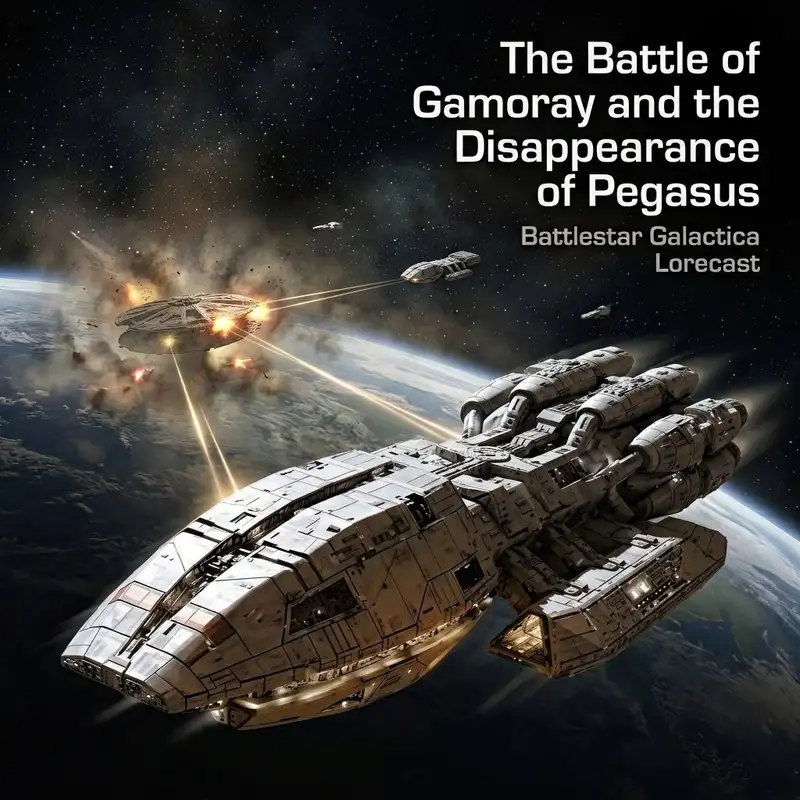
The Battle of Gamoray and the Disappearance of Pegasus
Two hundred and twenty civilian ships cannot live on courage. They need fuel. Fuel means propulsion, power, life support, the ability to change course, and the ability to jump away before an enemy force closes in. For Commander Adama, that arithmetic governed every decision. His fleet was carrying the remnants of Colonial society through hostile space, and its military escort was painfully thin. Nearby, three Cylon basestars threatened to turn a logistics problem into an extinction event. Then another battlestar appeared, a ship believed lost with the Colonial Fifth Fleet. Its commander, Cain, offered Adama something the refugee convoy desperately needed: striking power. He also brought a different theory of war. Adama believed survival depended on avoiding the battle that could destroy the convoy’s last defenses. Cain believed survival depended on taking that battle before the Cylons could choose the time and place.
The immediate objective was Gamoray, rendered as Gomoray in much of the surviving episode material. It was not presented as a Colonial world waiting to be liberated, nor as a prize whose territory could be held. It was a Cylon supply and fuel base, built at a former Delphian installation. The episode describes Delphia as a society that once held roughly fifty million beings. Whether that number was exact is less important than what it conveys. Gamoray stood on the ruins of another civilization already absorbed into the Cylon war machine. Its fuel stores supported Cylon operations in the region, and those same stores might keep the Colonial convoy mobile. That made the installation valuable to both sides. It also made it dangerous. A fuel source is not useful if acquiring it costs the warships needed to protect the people who will use it.
Adama’s problem was more than that the fleet needed fuel. It was that fuel scarcity narrowed every future choice. A convoy with diminishing reserves cannot evade indefinitely. It cannot choose safer routes merely because they are longer. It cannot scatter and rendezvous freely. It cannot sustain a defensive posture if ships must conserve power or lack the mobility to respond to danger. A battlestar may be formidable, but it cannot protect hundreds of civilian vessels that cannot maneuver, jump, or recover from damage at the same pace. The civilian fleet was therefore the center of the operation, even when the fighting shifted toward Gamoray. The military objective was never conquest. It was to keep the convoy alive, moving, and capable of making another decision tomorrow.
Adama’s first instinct was accordingly limited and practical. Rather than seize the Cylon base outright, he considered intercepting or ambushing fuel tankers. Such an operation offered less glory and perhaps less fuel, but it also exposed the battlestars to less concentrated enemy fire. It was the logic of an escort commander. Preserve the convoy’s shield. Take what can be taken. Avoid allowing an urgent shortage to dictate a battle on enemy terms. Colonel Tigh understood the danger in plainer military language. Three basestars were in the area, and Gamoray possessed its own defenses and fighter strength. A raid against tankers might be unsatisfying. It might also keep Galactica and the civilian fleet from becoming fixed targets.
Cain saw the same situation and reached the opposite conclusion. To him, Gamoray was vulnerable precisely because the Cylons did not expect a Colonial counterattack. Their forces were pursuing the Colonials. Their attention was divided. A supply base that normally served as an enemy advantage could become a trap if struck before its defenders reorganized. Cain’s view did not come from ignorance of risk. He was a commander shaped by a war in which hesitation had often meant annihilation. But his calculations began with the enemy, while Adama’s began with the convoy. Cain asked what damage could be done to the Cylons. Adama asked what losses the Colonials could no longer replace.
The difference became sharper because Pegasus was not supposed to exist. Apollo and Starbuck encountered two Colonial pilots, Sheba and Bojay, and learned that they came from the battlestar believed destroyed at the Battle of Molecay. That battle, roughly two yahrens earlier, had been understood as the destruction of the Colonial Fifth Fleet. Pegasus had survived. Cain had gathered survivors aboard his ship, withdrawn into deep space, and continued to strike at Cylon positions independently. The episode does not provide a complete record of those operations, nor does it establish every ship or person Cain may have saved. What mattered at the moment of reunion was simpler. A battlestar had returned from the presumed dead.
That return changed the military balance, but it changed morale as well. Galactica had become the visible armed refuge of a civilization in flight. Pegasus proved that resistance had not been reduced to one ship and one commander. Its arrival gave the fleet another flight deck, another hull, another experienced command staff, and another body of personnel who had survived the destruction of the Colonial forces. It also brought a legend. Commander Cain was known as an aggressive and successful fighting officer. In a refugee fleet, that reputation had real force. People who have lost their worlds look for evidence that the enemy is not invincible. A surviving battlestar could provide that evidence before it fired a single missile.
Sheba gave the reunion a personal dimension without changing its central military meaning. She was a Pegasus pilot and Cain’s daughter. Her presence made Cain’s decisions more than matters of doctrine or command authority. They would be witnessed by someone who knew the commander not only as a legend, but as family. Bojay, another Pegasus survivor, represented the practical experience Cain’s people brought from the Fifth Fleet’s destruction and their later operations. Neither pilot turned Gamoray into a simple family story. Their importance lay in what they knew, what they could contribute to the raid, and what Pegasus had already cost them. Every surviving specialist in this force carried both a professional role and the memory of a vanished institution.
The reunion also created an awkward command relationship. Adama commanded Galactica and bore the practical responsibility of safeguarding the civilian fleet. Cain commanded Pegasus. Their goals overlapped, but Cain could not be reduced to a junior officer reporting to Adama for routine direction. He had kept his ship and survivors alive through a separate campaign, and he arrived with an established crew, a reputation, and a strong belief in his own judgment. In a formal military hierarchy, unity of command matters because divided authority can turn operational friction into disaster. Yet the Colonial survivors were no longer operating in a stable war structure with secure communications, reinforcements, and higher headquarters. Two commanders had met in a crisis, each possessing indispensable assets and each responsible to people who trusted him.
Adama could not just dismiss Cain’s argument. Pegasus gave the Colonials the capacity to attempt more than a tanker ambush. Two battlestars could divide tasks. Galactica could remain the anchor of convoy defense and command coordination. Pegasus could move aggressively against the Cylon force. Vipers from both ships could scout, strike, escort, and suppress defenses. But adding a second battlestar did not double the fleet’s security. It created a choice about where scarce combat power would be most useful. A battlestar committed to attacking Gamoray was not simultaneously screening the civilian ships. A Viper launched toward the installation was not available to intercept Raiders moving toward the convoy. Every offensive action created a temporary opening elsewhere.
Cain believed that opening was acceptable because Gamoray offered a fleeting opportunity. The three basestars pursuing the Colonial force created danger, but they also created an opening. If the Cylons were concentrated on pursuit, they might not expect a direct attack against their own fuel base. Cain’s proposal was not a crude frontal assault. It depended on first disabling Gamoray’s anti-assault defenses. Only then could the battlestars approach closely enough to strike the installation and load fuel with some prospect of success. The plan recognized that capital ships cannot just absorb every fixed defensive weapon an enemy has emplaced around a strategic base. Before fuel could be moved, the defenses had to be made unable to stop the move.
That requirement produced a combined operation. A ground team would insert by shuttle and parachute onto Gamoray. Its task was narrow but essential: destroy a munitions depot and disable the command center controlling the anti-assault batteries. The Vipers and battlestars could then exploit the opening. This was not a case of ground troops capturing a world. Nor could fighters alone replace the demolition mission. The Colonial force needed people on the ground because the objective involved fixed systems, command facilities, and defenses that had to be reached and destroyed. The raid would not win the battle by itself. It would make the larger battle possible.
The operation also rested on incomplete intelligence. The Colonials knew Gamoray was valuable. They knew it was defended. They knew Cylon forces were nearby. They had enough information to identify an opportunity, but not enough to guarantee that the enemy would respond on schedule or in predictable strength. That uncertainty was central to the risk. A raid against a fortified fuel base depends on timing. The ground party must get in, complete its task, and get out. The battlestars must exploit the resulting gap before the defenses recover or enemy reinforcements arrive. Fuel loading must happen quickly enough that the convoy does not become trapped. A plan like that can fail even when each part is reasonable in isolation.
Apollo and Starbuck joined the ground team alongside Boomer, Sheba, Bojay, and Cassiopeia. Their mixture of roles says something important about the fleet’s condition. Apollo and Starbuck were combat pilots, but the Colonial force needed them for a mission that crossed the boundary between aviation and ground assault. Sheba and Bojay brought familiarity with the target area and the kind of practical knowledge that can matter more than a perfect briefing when a team is moving through an enemy facility. Cassiopeia joined as a medical specialist. Her presence was not decorative. A force that cannot replace trained personnel easily cannot separate combat, rescue, and medical expertise as neatly as a large peacetime institution might prefer.
The parachute insertion made the team vulnerable from the beginning. Once on the ground, they had limited time, uncertain support, and no assurance that every part of the original plan would survive contact with the enemy. The episode does not provide a full tactical map, exact casualty figures, or a detailed order of battle for the installation. It does establish the result. The Colonial team reached the critical targets, destroyed the munitions depot, and knocked out the anti-assault battery command center. Those were more than dramatic explosions. They changed the operational environment. The depot’s destruction damaged the base’s ability to sustain its defense, while the loss of battery control removed a barrier that could have made a battlestar approach prohibitively costly.
The raid also illustrates why small teams can carry strategic weight without becoming magical commandos. The ground party did not defeat the Cylons alone. It did not occupy Gamoray. It did not somehow make the base harmless. Its success created a temporary condition that Galactica and Pegasus could exploit. That is often what special operations, sabotage, or raiding parties are asked to do in a larger campaign. They open a door. The main force must still pass through it, use the opportunity, and survive the enemy’s reaction. At Gamoray, the Colonials had opened the door just as the wider battle became more dangerous.
The Cylon command problem was complicated by the arrival of the Imperious Leader. The leader was visiting Gamoray for a ceremonial dedication, placing Cylon political authority at a military installation precisely when it came under attack. Baltar initially saw a different opportunity. With the Colonial battlestars committed near Gamoray, the refugee convoy appeared exposed. A commander focused only on destroying Galactica and the civilian fleet might have pressed that advantage. But the threat to Gamoray and the presence of the Imperious Leader changed the calculation. Baltar now had to consider not only how to destroy the Colonials, but how to defend a politically sensitive installation and protect the leadership visiting it.
Lucifer’s reports underline the fact that the Cylon response was neither omniscient nor perfectly synchronized. Information arrived. Forces moved. Priorities changed. Baltar had to decide whether to pursue the vulnerable convoy, defend Gamoray, or preserve the basestars under his command. The Cylons retained immense military power, but superior force does not eliminate the burden of command. A base under attack, a visiting leader, and a suddenly aggressive enemy created competing demands. The Colonials were not defeating a machine that always knew the correct move. They were exploiting delay, divided attention, and the friction that affects any military system.
Once the ground raid disabled the anti-assault defenses, the battle entered its air and fleet phase. Galactica launched Vipers against Gamoray. Pegasus moved into the offensive role against the Cylon response. The Vipers could not be reduced to there to add spectacle. They had several practical functions. They could strike exposed installations, intercept Raiders, screen larger ships, and force the enemy to react to threats it could not ignore. Their actions bought time and created decision space for the battlestars. In carrier operations, fighters often matter because they shape the battle before the larger ships can use their weapons effectively. They identify threats, disrupt attacks, and protect the units whose survival matters most.
But Vipers were also a finite resource. The episode makes clear that Colonial fighters suffered losses, even if it does not establish a precise count. That mattered because the surviving fleet had no secure industrial base producing endless replacement airframes, missiles, or trained pilots. Every loss reduced future options. A pilot killed in an attack on Gamoray was not just one fewer cockpit for the current engagement. It was one fewer person available for reconnaissance, convoy escort, interception, and the next emergency. Cain’s aggressive doctrine was therefore not costless even when it achieved results. The battle had to produce enough fuel and enough disruption of Cylon operations to justify the depletion of assets the Colonials could not casually replace.
Galactica’s role remained tied to the convoy. Even as Vipers attacked Gamoray, Adama could not allow the broader mission to dissolve into a contest over the base. The fleet needed fuel, but it also needed protection while that fuel was acquired. The civilian ships remained slow, vulnerable, and dependent on the battlestars for warning and defense. This was the central problem of the battle. The Colonials needed to attack in order to survive, but they could not afford to become so committed to the attack that they forgot what survival meant. A victory measured only in destroyed Cylon ships would be hollow if the convoy were left unable to move or exposed to a renewed Raider assault.
Pegasus, under Cain, provided the force’s offensive edge. The ship engaged the Cylon response and drew the enemy’s attention toward itself. That was useful to Adama’s plan as long as it remained a controlled diversion. A battlestar that forces the enemy to concentrate on it can give fuel crews time to work, can relieve pressure on a vulnerable convoy, and can create openings for fighters. Yet the value of a diversion depends on the commander’s willingness to end it. If the decoy remains in contact too long, it ceases to be a calculated risk and becomes a sacrifice. Cain had not told Adama where he intended to draw that line.
As the battle intensified, Cain began evacuating wounded and nonessential personnel from Pegasus by shuttle. That decision revealed that his purpose was larger than protecting the fuel operation. He was preparing the ship for a final maneuver against the three basestars. The evacuation did not remove every danger, nor did it make the people remaining aboard expendable. It demonstrated that Cain understood the scale of the risk and had chosen to reduce the number of people exposed to it. But he had made that choice without giving Adama the opportunity to weigh Pegasus’s probable loss against the fleet’s other needs.
Adama objected because he saw what Cain was placing at risk. Pegasus was not only a weapons platform. It was the second surviving battlestar, a source of trained personnel, a symbol of resistance, and an asset that might protect the civilian fleet through future crises. Its loss could not be repaired by recovering more fuel from Gamoray. Nor could the death of its remaining crew be treated as an acceptable accounting entry because they were volunteers or soldiers. Adama’s responsibility required him to see the longer campaign. A force reduced to one battlestar might survive the current engagement and still become less able to survive the next one.
Cain’s answer was equally strategic, though more ruthless in its assumptions. If the Raiders could refuel and return, they could resume attacks against Galactica and the civilian fleet. The basestars were not just targets. They were the platforms supporting the enemy’s ability to bring fighters, weapons, and pressure back into the pursuit. Cain wanted to remove that capability while the Colonial force had the chance. In his view, simply taking fuel and withdrawing would leave the essential threat intact. It would preserve Pegasus in the short term while allowing the Cylon force to regroup, refuel, and hunt the convoy again.
Adama proposed a different solution. Pegasus could drive the enemy into a defensive reaction, force the Raiders to burn fuel and abandon their pursuit, then withdraw before crossing the point of no return. That approach sought the benefits of Cain’s diversion without accepting the probable destruction of the ship. It reflected Adama’s larger philosophy. A refugee fleet lives by preserving options. The enemy need not be annihilated in every engagement. Sometimes it is enough to delay, disrupt, and escape. Cain rejected that limit because it left the basestars alive. He did not believe a temporary reprieve was sufficient when the opportunity existed to strike at the Cylon force directly.
Their argument was not a contest between bravery and fear. Both men were prepared to fight. Both understood the danger the Cylons posed. Both intended to protect the Colonial survivors. The disagreement was over which irretrievable asset mattered most. Adama thought the fleet had to preserve its warships because the civilians could not survive without them. Cain thought the fleet had to destroy the enemy’s ability to pursue because the warships could not protect civilians forever against an intact Cylon force. Each position had a grim logic. The tragedy was that the battle did not allow an easy compromise once Cain had committed Pegasus forward.
Cain’s secrecy made the command problem worse. Surprise can be a legitimate military advantage. An enemy who believes a battlestar will withdraw may be caught unprepared when it attacks. But concealment from allies carries a different cost. Adama could not coordinate the larger operation fully if he did not know Cain’s true intention. He could not make an informed decision about fighter support, convoy movement, rescue planning, or the acceptable risk to Pegasus. In a unified command, a commander may choose a costly mission after weighing its consequences. At Gamoray, Cain effectively made that choice for the broader Colonial force.
Adama had limited ways to stop him. He could protest. He could order Cain to withdraw. He could threaten to relieve him. But attempting to impose that authority in the middle of a fleet engagement might have fractured the very force they needed to keep together. Pegasus’s crew trusted Cain. Galactica’s people respected Adama. A public struggle between the two commanders could have undermined coordination at the worst possible moment. The episode therefore presents a familiar wartime dilemma. Unity of command is essential, but it cannot always be manufactured by an order when authority is contested and the battle is already underway.
Cain drove Pegasus toward the basestars. Baltar’s own vessel withdrew, while two basestars remained in position to confront the Colonial battlestar. The geometry of the final action mattered. Pegasus could not just approach two enemy capital ships without exposing itself to their weapons and the Raider screen around them. It needed a corridor, however brief, through which it could bring its missiles to bear at close range. That corridor would not emerge by accident. It required the surviving Colonial pilots to strike the enemy’s flank missile launchers and reduce the immediate fire threatening Pegasus’s path.
Apollo and Starbuck returned to the fight and attacked the basestars’ flank defenses. Their role was not to destroy the enemy ships alone. They were supporting the decisive movement by Pegasus. This is an important distinction. Fighter pilots are often remembered for individual skill, but their most consequential work may be enabling another unit to complete its mission. By suppressing the launchers along the flank, Apollo and Starbuck helped create the narrow opening Cain required. They were not making Pegasus safe. No one could do that. They were reducing the danger long enough for the battlestar to pass where it otherwise could not.
Pegasus then moved between the two basestars and launched missiles at extremely close range. The tactical logic was brutal. Closing distance reduced the time available for the enemy to respond and placed Pegasus’s weapons in a position where escape was no longer the main concern. Cain had converted his ship from an offensive platform that might survive into a weapon whose mission took priority over its own preservation. The result was confirmed. Two basestars were destroyed. The Cylon force had suffered a major blow, and the immediate ability of those ships to support renewed pursuit was shattered.
In the immediate fight, this was a clear Colonial success. Two basestars were eliminated. Across the wider operation, the strike disrupted the Cylon force threatening the fuel operation and the refugee convoy. Raider activity had been diverted, fuel had become available, and the enemy’s ability to resume coordinated pressure had been damaged. For the larger campaign, the Colonials gained the chance to keep moving. They had not won the war, reclaimed the Colonies, or secured a permanent refuge. But they had preserved mobility for a population whose survival depended on it. That was victory enough.
It was also a victory purchased at a cost no one could yet measure. After the explosions, smoke and debris obscured the battlefield. Apollo and Starbuck searched for Pegasus but could not locate it. Approaching Raiders forced them to withdraw rather than continue looking through the wreckage. What the episode shows is absence, not confirmation. There is no identified wreck of Pegasus. There is no recovered body of Cain. There is no final transmission establishing the ship’s destruction. But there is also no clear visual proof that Pegasus escaped. The battlefield had become too dangerous and too obscured for the pilots to know what had happened.
Adama offered Sheba that possibility. Cain might have maintained radio silence and withdrawn into deep space, just as he had once disappeared after Molecay. Starbuck supported the same hope. Their words mattered because they did not claim certainty they did not possess. Adama was not issuing a false official report that Pegasus had survived. He was recognizing that the available evidence did not compel the conclusion that Cain and his ship were gone. In a fleet built from survivors, that distinction carried emotional weight. Hope could be necessary. It could also become dangerous if it hardened into a comforting fiction.
For Sheba, the missing ship meant the possible loss of her father. Yet it also meant the disappearance of the commander whose choices had shaped Pegasus’s identity. Her grief could not be separated from the battle’s military meaning. Cain had chosen the final strike. He had accepted the risk to the people still aboard. He had made a decision that saved the fleet from one immediate danger while placing his own ship beyond reliable contact. That did not make the choice meaningless, nor did it remove the pain from those left behind. Military history often treats ships as units on a chart. For their crews and families, a missing ship is an unanswered question that can last longer than a battle.
Pegasus itself had become more than a battlestar. It was proof that Colonial resistance could endure outside the visible remnant gathered around Galactica. Its return had restored confidence. Its apparent loss threatened to turn that confidence into another chapter of mourning. This is the burden of military legend. Legends sustain exhausted people, but they can also turn commanders and ships into symbols too large for ordinary judgment. Cain was a brilliant and determined officer. He was also a commander whose decision denied Adama full control over a risk borne by the whole Colonial cause. To call him a legend is not to settle whether every choice he made was wise.
Adama’s response was more restrained. He had opposed the final maneuver because he believed Pegasus remained vital to the convoy’s future. Once the ship disappeared, he did not use the moment to condemn Cain before the fleet. Nor did he turn uncertainty into certainty. That restraint was part of command. A refugee civilization requires morale, but it also requires leaders who do not manipulate grief for convenience. Adama understood that Pegasus’s sacrifice, if it had been a sacrifice, had helped preserve the civilian ships. He also understood that no victory over the Cylons could erase the loss of the people who may have gone down with her.
The original broadcast story leaves Pegasus’s fate unresolved. It does not confirm destruction. It does not establish escape. Later literary continuations and adaptations have offered their own uses for Cain and Pegasus, but those are separate accounts and cannot close the record of the original nineteen seventy-eight screen continuity. Within that record, the battlestar disappears into the debris of the battle after destroying two basestars. The ambiguity was also useful from a production standpoint, leaving room for a possible return, but that fact does not provide an in-universe answer. The surviving characters knew only that they had lost contact.
The Battle of Gamoray was a Colonial victory because it secured the fleet’s immediate survival, destroyed two basestars, and disrupted the Cylon forces that threatened to resume pursuit. But Pegasus disappeared because Cain defined victory more broadly than Adama could afford to: not just escaping with fuel, but removing the enemy’s ability to strike again. The episode leaves open whether that gamble destroyed Pegasus or carried it beyond contact, and that uncertainty is the point. For a refugee civilization, even a successful battle can end with the loss of the very symbol that made survival seem possible.