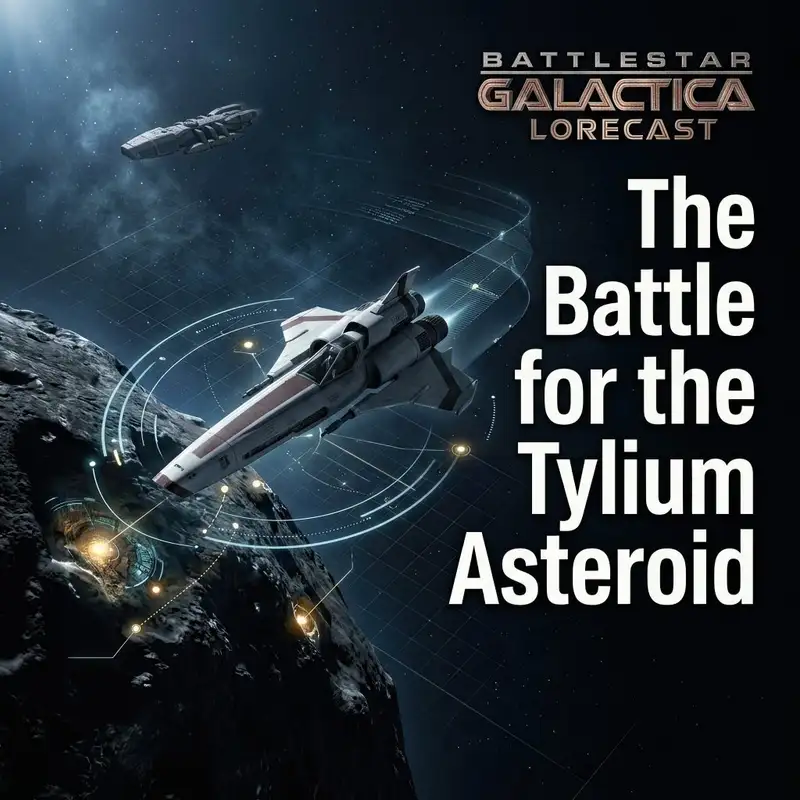
The Battle for the Tylium Asteroid
President Laura Roslin’s announcement was brief, public, and strategically alarming. The refugee fleet had fuel for roughly two more jumps. That did not mean two more chances to escape danger in any simple sense. Each faster-than-light jump required a destination, coordination, functioning drives, and tylium fuel. With reserves nearly exhausted, every jump became a choice between immediate safety and whatever future remained beyond it. A fleet that could no longer move was not merely delayed. It was fixed in place for the Cylons to find, surround, and destroy at their convenience.
Tylium was therefore more than fuel. It was maneuver, uncertainty, and political survival. It allowed Galactica and the civilian convoy to refuse battle when refusal was wiser than combat. It allowed them to leave a bad position, evade pursuit, search for supplies, and keep the civilian government alive aboard a collection of ships that had no secure territory. Without it, the fleet would become a convoy without roads, a navy without a sea lane, and a government without a place to govern.
Galactica sent Raptors to scout nearby systems for a usable source of tylium. The search itself carried risk. Reconnaissance consumed fuel, exposed small crews to interception, and could return nothing but another empty report. Lieutenant Sharon Valerii and Lieutenant Alex Quartararo, known as Crashdown, found what the fleet needed: an asteroid rich in tylium ore. In any ordinary industrial context, that discovery would have begun with survey teams, contracts, mining schedules, safety inspections, and arguments over ownership. The Colonial survivors had neither the time nor the luxury.
The asteroid was already occupied. The Cylons had established a refinery installation there, turning the discovery from a supply opportunity into a military problem. The fleet had found fuel, but the enemy was processing it first. That mattered for two reasons. First, the refinery gave the Cylons a defended position with local infrastructure, fighter support, and a reason to hold ground. Second, it meant the Colonials could not just approach, load ore, and depart. They had to decide whether to spend their remaining fuel continuing a blind search or attack a known Cylon installation with finite aircraft, finite pilots, and a civilian fleet that could not absorb a major defeat.
Commander William Adama chose to attack. It was not a retaliatory raid, and it was not an attempt to prove that Galactica could still strike back after the destruction of the Colonies. The objective was more practical and more severe. The fleet needed to deny the Cylons use of the refinery, preserve the asteroid’s tylium, and create enough security for civilian mining and refining crews to begin work. The desired outcome was not a spectacular explosion. It was restored mobility.
Roslin’s role remained important even though she did not direct the strike. The President was the civilian authority of the surviving Colonies, and the fuel emergency affected every ship under her government’s protection. Her public acknowledgment of the shortage made clear that the operation was not merely Galactica’s private venture. It was a fleet-wide act of survival, conducted by the military but justified by the needs of civilians whose ships, labor, and political consent would determine whether the victory could be used.
The decision also marked a change in posture. Until then, the fleet’s central strategy had been flight. It jumped, concealed itself where possible, avoided Cylon concentrations, and preserved what remained. That was sensible. Galactica was one aging battlestar protecting a civilian convoy against an enemy that had already destroyed a civilization. But evasion is not a complete strategy when the resources needed for movement are running out. At the asteroid, the fleet accepted that survival sometimes required selective offensive action.
Colonel Saul Tigh and Galactica’s staff approached the task as military professionals. They had reconnaissance imagery, a known industrial target, an enemy presence, and a limited strike force. The obvious plan was to attack directly, use Galactica’s Vipers to engage the Raiders, and strike the refinery before Cylon defenders could overwhelm the attackers. There was nothing foolish about that logic. Direct assaults are often built from the assets a commander actually has, not the assets he wishes he had.
The problem was that a direct attack was also predictable. The Cylons had local defenses, Raiders available to intercept, and a refinery worth protecting. A visible Colonial approach would concentrate the enemy’s attention exactly where the Colonials expected it to be. The fleet could still fight that battle, but it would do so on terms chosen by the defender. Galactica would be asking scarce pilots and aircraft to force their way through a prepared defensive system while preserving enough strength for recovery and withdrawal.
Adama therefore looked for an idea that was less conventional. Lieutenant Kara Thrace, Starbuck, offered one. Her contribution mattered partly because she was unable to fly. A knee injury from an earlier mission had not healed enough for her to be sent into combat. In a force with few experienced pilots, that was not a minor personnel inconvenience. It removed one of Galactica’s most capable aviators from the flight roster at the moment the ship needed every reliable pilot it could field.
Starbuck’s injury changed her role, but it did not remove her from the operation. She could still think as a combat pilot, assess what an enemy might expect, and identify an alternative to the most obvious attack pattern. Her value was not mystical intuition and not a suggestion that disciplined planning had failed. Tigh’s staff had produced a sound starting point. Starbuck’s contribution was to recognize that a Cylon defense built to repel Galactica might be vulnerable if Galactica made the enemy look in the wrong direction.
The revised plan used civilian vessels as part of the deception. Mining and transport ships would approach the asteroid from one axis. Galactica, accompanied by a visible Viper force, would approach from another. To the Cylons, the battlestar and its fighters would appear to be the principal threat. That was a reasonable conclusion. Galactica was the fleet’s obvious warship, its air wing was its most recognizable offensive instrument, and a formation of Vipers was difficult to mistake for anything other than an attack.
The actual strike force would be concealed aboard the civilian vessels. Once Cylon Raiders shifted toward Galactica and the visible Vipers, the hidden element would launch and drive toward the refinery. Captain Lee Adama, Apollo, would lead that element. The plan did not require the Cylons to be stupid. It required them to make a decision under pressure. Defenders with limited time and incomplete information must allocate attention and aircraft. By creating two potential threats, the Colonials hoped to force the Cylons to commit to the wrong one before recognizing where the true attack would fall.
That made the plan morally and operationally demanding. The civilian crews were accepting exposure to a defended Cylon position, but they were not being thrown away as a distraction. Their ships had a defined role in the battle and an indispensable role in the aftermath. Without them, Galactica might destroy the refinery and still lack the means to capitalize on the destruction. The operation depended on a partnership between combat power and civilian labor. Neither could accomplish the strategic objective alone.
The deception also required careful timing. If the concealed Vipers launched too early, the Cylons could identify the threat and redirect their defenses. If they launched too late, the visible force might be overwhelmed before the strike reached the refinery. If the civilian ships appeared too detached from the battle, their approach would attract suspicion. And if Galactica committed too much of its air group to the visible action, it could leave itself exposed to Raiders while trying to protect the fleet.
The same was true of the people who kept the Vipers flying. A successful sortie was the visible end of a long chain of labor. Mechanics had to keep old aircraft serviceable. Deck crews had to move, arm, launch, and recover them under combat conditions. Command personnel had to maintain enough awareness to decide which threats required interception and which assets had to be held back. A battle could be won in the moment and still impose a cost that weakened the fleet for the next emergency.
Apollo’s assignment carried a personal dimension, but it was not merely a father testing a son. Commander Adama trusted Lee with the concealed strike because the mission demanded judgment after the plan met reality. The pilots might lose communications. The intended target might be obscured. The defenses might prove heavier than expected. A pilot leading that element had to know when to continue, when to improvise, and when a mission was no longer worth the lives being spent on it.
Lee also operated in the shadow of Starbuck’s reputation. She was widely recognized as a formidable combat pilot, and her inability to fly left an absence that everyone understood. Yet the operation did not require someone to imitate Starbuck. It required Apollo to lead the force available, execute the deception, and make decisions without the reassurance of perfect intelligence. In a small fleet, command trust often rests less on identifying the single best individual than on knowing which officer can carry responsibility when the plan begins to break apart.
Galactica’s visible attack drew the expected response. Cylon Raiders moved to engage the battlestar and its Vipers, while the refinery’s defenses prepared to protect the installation. The Colonials had succeeded in shaping the first phase of the battle. That was not the same as winning it. The enemy still possessed aircraft, fixed defenses, and the advantage of fighting near a position it already controlled. Deception bought time and divided attention. It did not make the refinery undefended.
The refinery itself was more than a fuel depot. It was an industrial target with a military function. It processed a strategic resource, supported the Cylon presence at the asteroid, and sat within a defensive system designed to prevent exactly the kind of attack Galactica had launched. The Colonials did not need an exact map of every defensive position to understand the basic problem. Any approach to a fixed installation would expose attacking aircraft to fire while forcing pilots to identify critical systems quickly.
The Raiders had their own problem. They had to respond to Galactica’s visible threat without knowing immediately whether the battlestar was conducting a straightforward assault or masking another effort. The Colonial plan worked because defensive resources are finite even for a technologically superior enemy. Raiders committed to a fight against Galactica could not simultaneously form a perfect screen around every approach to the refinery. The defenders were compelled to make choices before they possessed a complete picture.
The concealed Viper element launched from the civilian ships and moved toward the actual objective. At that point, the operation depended on speed, surprise, and the ability to strike something important before the Cylons could reorient their defenses. Yet the Colonials still faced a crucial question. What exactly should they destroy? The fleet needed tylium. A brute-force attack against the asteroid, or a nuclear strike against the refinery, risked contaminating or ruining the resource that justified the mission.
Gaius Baltar provided the technical interpretation that shaped the targeting decision. He recognized that the preferred target was not the ore itself but part of the refinery’s processing system. If the Colonials could ignite or destabilize the volatile material being handled by the installation, they could destroy the Cylon refinery without deliberately poisoning the tylium source with radioactive fallout. It was a sensible objective. The difficulty was that Baltar did not possess a full technical blueprint of the facility.
Reconnaissance imagery can identify structures, equipment, and patterns. It cannot always reveal the precise function of every storage tank, processing chamber, conduit, or protected compartment. Baltar could make an informed assessment, but he could not identify the correct target with certainty. The battlefield record therefore does not support the idea that the Colonials had suddenly solved the Cylon technical problem or gained complete knowledge of the refinery. They had a plausible target, an urgent need, and a limited opportunity.
For Baltar, the successful choice acquired a larger meaning. He and the version of Number Six visible to him interpreted the result through a religious frame. In that interpretation, the correct target was not merely selected by luck or professional judgment. It was revealed or guided. The operation does not provide a laboratory demonstration of divine targeting assistance. It shows a man confronted by coincidence, fear, responsibility, and an outcome he understands through belief.
Even Baltar’s target selection did not solve the immediate tactical problem. Guided Colonial missiles were disrupted by Cylon jamming. The planned standoff strike could not be executed as intended. This was the hinge of the battle. The attackers had built their approach around the hope that they could strike the refinery from a relative distance, reducing the time their Vipers spent inside the defensive envelope. Jamming took that option away.
The Cylon electronic-warfare success should be understood carefully. It demonstrated that the refinery could interfere effectively with the Colonial guided weapons used in this attack. It did not prove that the Cylons could control every Colonial system, override any computer at will, or make human pilots irrelevant. The effect was local and operationally specific. But it was enough. A weapon that cannot guide itself to the target is not a precision advantage. It becomes wasted ordnance, false confidence, and a warning that the attack must change.
The Vipers now had to close in. That meant entering more dangerous airspace, facing anti-aircraft fire, and making manual delivery decisions at short range. The shift placed greater weight on pilot judgment. It also increased the importance of every aircraft that had survived the earlier fighting. A force already too small to trade casually with Raiders could not afford to discover that its weapons were ineffective only after it had crossed into range of fixed defenses.
Apollo found that alternative in a mining or conveyor tunnel associated with the refinery. The passage offered an approach route that avoided at least part of the external defensive problem. It was not a routine Viper maneuver, and it should not be treated as proof that Colonial fighters were designed for industrial tunnel flight. The route was an improvisation, chosen because the intended method had failed and the mission still had to be completed before the Cylons recovered their balance.
Flying into that confined space required Apollo to accept risks no briefing could fully calculate. A tunnel designed for industrial movement was not a prepared combat corridor. The Viper had little room for error. A collision, a blocked passage, or a defensive response inside the route could have destroyed the aircraft and ended the attack. Yet the alternative was to remain outside, exposed to defenses that had already defeated the guided strike. Apollo used the available opening because it was the only opening that offered a credible path to the target.
Once inside the refinery complex, the mission narrowed to its essential purpose. The Vipers had to place explosive charges near the volatile processing or storage area identified as the most vulnerable target. The objective was not to demolish every structure. It was to trigger a chain reaction severe enough to destroy the facility and remove it as a functioning Cylon base. In a battle defined by scarce fuel, the attackers had to preserve the resource while eliminating the installation that controlled it.
The resulting explosion was immense. The event was compared in the story to a nuclear-scale yield, but the refinery was not destroyed by a nuclear weapon. The destructive force came from the chain reaction within the facility and its fuel-processing materials. There is no need to turn that comparison into a precise engineering calculation. Its meaning is operational. The refinery was obliterated, and the Cylon position on the asteroid lost the industrial center it had been defending.
The blast changed the local battle quickly. Without the refinery, the Cylons no longer possessed the same protected foothold or logistical purpose at the asteroid. Raiders still had to be dealt with, but their defense had been disrupted and their base of support removed. Galactica and the surviving Colonial Vipers could press the engagement, eliminate or drive away the remaining Cylon aircraft, and establish enough security for the civilian ships to approach the asteroid safely.
That was the tactical result. The Colonials had deceived the Cylon defenders, inserted a concealed strike element, adapted after their guided weapons failed, and destroyed the refinery. The mission result was more specific. They had denied the Cylons the processing site while avoiding the use of a nuclear strike that might have made the tylium unusable. These are related successes, but they are not identical. A fleet can destroy an enemy position and still fail its larger objective if it ruins what it came to obtain.
The true work began after the explosion. Tylium in an asteroid is not the same thing as fuel in a ship’s tanks. The ore had to be extracted. It had to be moved by civilian vessels. It had to be processed through refinery capacity. It had to be stored, allocated, and distributed to ships whose survival depended on it. Each stage required machinery, skilled labor, time, and protection. The battle had created access. It had not created an instant reserve of finished fuel.
This is why the civilian ships were central to the operation from the beginning. Their crews had helped make the deception possible, but their greater importance emerged after the shooting stopped. Mining personnel knew how to recover ore. Transport crews moved it. Refinery workers turned raw material into something the fleet could use. Engineers had to keep the necessary systems functioning without the support network that had existed before the Fall. Their labor converted a military success into operational endurance.
The asteroid’s tylium was expected to sustain the fleet for years. That expectation represented a major strategic reprieve, not an invitation to forget scarcity. The fleet still had to consume fuel to jump. Ships still needed maintenance. Vipers still required parts, ammunition, and trained pilots. Food, water, medical supplies, sanitation, and housing remained difficult problems. The destruction of one refinery did not restore the Twelve Colonies or recreate the industrial civilization that had been lost.
What it restored was freedom of action. The fleet could move again without counting every jump as one of its last. It could search for routes, evade Cylon pursuit, investigate possible refuges, and make decisions that were not dictated entirely by the next fuel gauge reading. Mobility gave Adama more military options, but it also gave Roslin’s government more political options. A stationary population facing destruction has little room for law, debate, or consent. A fleet able to maneuver can still argue about its future.
The battle also demonstrated that Galactica could do more than run. That did not make the battlestar equal to the Cylon forces that had destroyed the Colonial Fleet. It did not mean that every Cylon outpost could be attacked or that offensive operations could become routine. Galactica remained old, damaged by history, dependent on scarce personnel, and responsible for protecting civilians who could not fight for themselves. But it proved that the fleet could identify a specific objective, shape an engagement, and impose costs on the enemy when the circumstances justified the risk.
The operation also complicated the relationship between military expertise and civilian authority. Roslin did not need to stand on Galactica’s bridge and direct Viper formations in order to matter. Her government gave the wider survival mission political meaning. Adama did not need civilian permission for every tactical adjustment in combat, but his military command existed within a population that had not agreed to become a permanent military dictatorship. The asteroid battle worked because those roles remained distinct and interdependent.
Adama’s decision to attack rested on military judgment. He had to weigh fuel scarcity, enemy defenses, pilot availability, civilian risk, and the chance that a failed raid would leave the fleet worse off than before. Roslin’s role was to preserve the civilian framework within which that judgment was being made. The President represented people whose contribution was not limited to being protected. Civilian crews carried out the industrial work that made the mission worthwhile. Civilian ships took part in the deception. Civilian survival was the strategic objective.
Starbuck’s role illustrates the same point. She could not fly because her injury imposed a real limit. The fleet did not ignore that limit simply because it needed talented people. But she still influenced the battle by challenging the most predictable approach. Her contribution was not individual heroism detached from the institution. It became useful because Galactica’s command was willing to hear an unconventional idea, integrate it into a larger plan, and assign other people the responsibility to execute it.
Tigh’s role matters for the opposite reason. The conventional staff plan was not useless simply because it required revision. It defined the problem, organized the available assets, and established the operational framework within which deception could work. Military organizations need disciplined planning, especially when lives and finite resources are at stake. They also need enough intellectual flexibility to recognize when an enemy will expect the disciplined answer. The asteroid battle succeeded because it used both habits rather than treating one as the enemy of the other.
Apollo’s tunnel flight became the operation’s most dramatic act, but it should not obscure the structure that made it possible. He flew that route because reconnaissance had found the asteroid, because Adama had chosen to attack, because Roslin’s fleet needed fuel, because civilian ships carried the concealed Vipers, because Galactica drew away Cylon attention, because deck crews launched aircraft, and because pilots held the line long enough for the strike element to reach the refinery. A single decision under fire mattered enormously. It did not stand alone.
Baltar’s target selection belongs in that same framework. His technical judgment helped identify the type of target that could destroy the refinery without intentionally contaminating the tylium. His uncertainty remained real. The correct choice can be understood as luck, informed inference, providence, or some combination the surviving record cannot resolve. What matters militarily is that Baltar did not possess certainty and that the pilots did not possess a guaranteed path to the target. The battle’s success did not erase the uncertainty that preceded it.
For Baltar, however, success deepened an already significant religious interpretation of events. That belief had consequences beyond private comfort. In the Colonial fleet, religious claims could influence morale, legitimacy, decision-making, and personal responsibility. The asteroid battle showed how easily a military outcome can become part of a larger argument about destiny. A target chosen under uncertainty was hit. A fleet facing fuel exhaustion survived. To some, that would be evidence of intervention. To others, it would be evidence that disciplined risk had paid off.
The stronger historical conclusion is not that one explanation cancels the other. People acted. They planned, flew, calculated, feared, repaired, loaded, mined, and refined. The result also carried meanings the participants could not reduce to a technical after-action report. Battlestar Galactica’s survivors did not live in a universe where faith could be separated cleanly from strategy, politics, or identity. But faith did not absolve anyone of command responsibility. A belief in guidance could not refuel a ship by itself. Someone still had to recover the ore.
The Cylon defense also revealed a limit in the enemy’s apparent superiority. The Cylons remained dangerous. Their Raiders engaged Galactica, their refinery defenses forced the Colonial strike into close range, and their jamming disrupted the planned missile attack. Yet advanced systems do not eliminate the problem of attention. The Cylons had to decide what to defend first. They had to respond to the threat they could see. A defender can be technologically capable and still be vulnerable to an opponent who changes the shape of the decision.
This did not mean the Colonials had discovered a permanent formula for defeating the Cylons. The deception depended on the circumstances of this target, the available civilian vessels, the structure of the refinery defense, and the timing of the attack. It could not just be copied onto every future battle. Nor did the loss of one refinery reverse the strategic imbalance created by the Fall. The Cylons still possessed far greater forces, more secure infrastructure, and the ability to continue pursuing the refugee fleet.
What the operation denied them was an easy victory through exhaustion. Before the asteroid was found, the fleet’s dwindling fuel reserves threatened to make pursuit unnecessary. The Cylons could have allowed the survivors to consume their last means of escape. By taking the asteroid, the Colonials restored their ability to maneuver and forced the conflict to continue on less predictable terms. That was a strategic success even though it did not end the war.
There was also a quieter lesson about heroism. The operation is remembered for Vipers, Raiders, an explosion, and Apollo’s flight through the refinery tunnel. Those images are memorable because they are visible. But the battle’s real achievement depended on people whose work was less dramatic. Raptor crews found the asteroid. An injured pilot helped design the deception. Civilian crews carried the concealed strike force. Deck personnel made launches possible. Engineers kept aging systems functioning. Miners and refinery workers turned raw ore into usable fuel.
In a refugee fleet, these were not supporting roles in the casual sense. They were the foundation of military power. A battlestar without fuel is a drifting hulk. Vipers without technicians are temporary assets. A strategic resource without civilian labor is only a promising image on a reconnaissance screen. The survivors could not divide themselves cleanly into warriors and noncombatants because everyone lived within the same system of shortage, danger, and dependence.
The Battle for the Tylium Asteroid was not a conventional victory over a Cylon outpost. It was the successful conversion of civilian need into military purpose. Galactica bought access through deception, disciplined risk, and courage under fire, but the fleet survived because commanders, pilots, civilian crews, and industrial workers turned that access into fuel, mobility, and another chance to remain a self-governing people rather than a convoy waiting to be found.