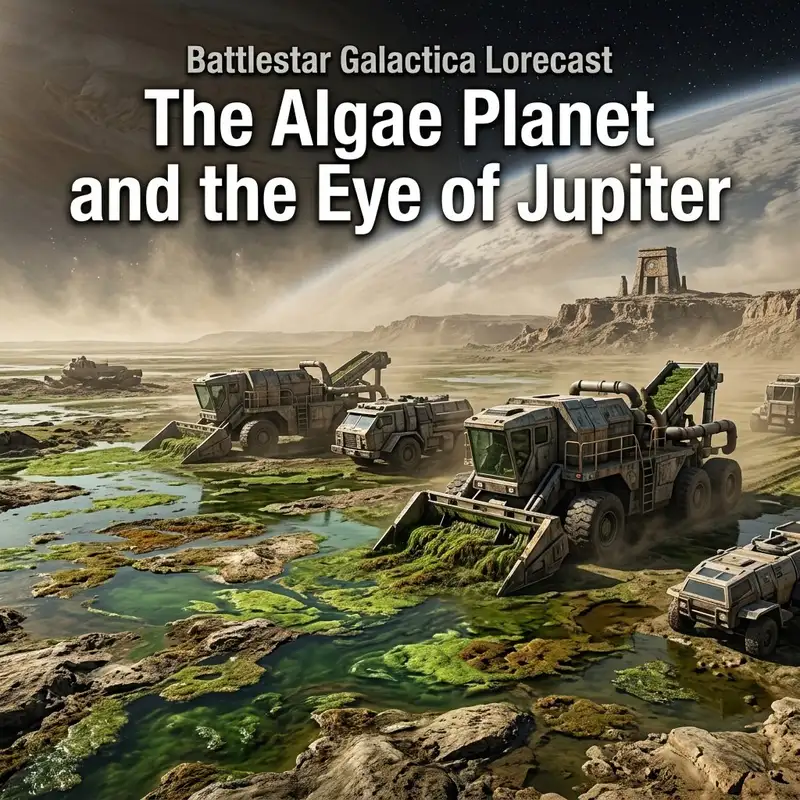
The Algae Planet and the Eye of Jupiter
The fleet had found food, and that was the problem. The algae lay on a planet beyond a radiation hazard severe enough to blind the navigation systems of the civilian ships needed to harvest it. The remaining food-processing system had become contaminated, and the fleet’s stores were reported to offer only roughly a week, perhaps ten days, before hunger became decisive. There is no evidence that the contamination was a Cylon attack. It was the kind of failure that becomes catastrophic after civilization loses its farms, factories, supply depots, laboratories, and reserve capacity. A food source was useless unless the fleet could reach it, process it, and return with enough ships and people intact to turn raw algae into meals.
That distinction mattered. The fleet had not discovered a convenient supply depot. It had discovered protein-rich material that Doctor Cottle considered deeply unpleasant but potentially lifesaving. Algae could sustain people. It could not sustain them unless someone harvested it, transported it, processed it, rationed it, and kept the machinery running long enough for distribution. Those jobs belonged mostly to the civilian fleet. Galactica could defend the operation and provide specialized crews, but it could not replace the industrial and human functions carried by the civilian ships. In a refugee society, a freighter, refinery, agricultural vessel, or processing ship was not an accessory to the warship. It was part of the strategic center of gravity.
The food emergency therefore exposed the real character of the survivor fleet. Galactica was the fleet’s principal military shield, its aviation platform, its command post, and often its final reserve of technical competence. But the battlestar did not contain a self-sufficient nation. It depended on civilians for labor, trade, food production, maintenance specialties, families, political legitimacy, and the simple fact that there would be people left to protect. The algae mission required the fleet to accept a dangerous truth. The vulnerable ships would have to move toward the resource themselves. They could not remain safely behind Galactica and expect the military to solve starvation on their behalf.
That requirement turned a logistics mission into an aviation and navigation operation. The planet lay beyond a region of intense radiation, represented in the fleet’s planning as a passage through a dangerous stellar environment. Inside that hazard, civilian navigation systems would fail. Crews would have only a limited opportunity to orient themselves, receive the information required for the next jump, and leave before their ships became lost or disabled. The series does not provide a precise astrophysical explanation, and none is needed. The operational fact was clear enough. A civilian ship could enter the passage with a destination and a plan, then lose the tools needed to complete either.
Galactica’s radiation-resistant Raptors became guide craft. This was not glamorous fighter work. It was convoy navigation under conditions where the convoy could not rely on its normal instruments. A Raptor had to lead civilian ships through the danger, use visual navigation when electronic systems became unreliable, relay the next jump information, and maintain enough awareness to know whether the ships behind it were still present. Every guide mission imposed costs. It consumed fuel, flight hours, maintenance labor, and the attention of pilots who were already operating within a fleet that could not replace experienced aircrew easily.
The civilian populations were moved temporarily aboard Galactica while skeleton crews took their ships through the passage. That reduced the number of people exposed on each transit. It also crowded the battlestar and concentrated risk aboard the one ship whose loss would have been militarily and politically catastrophic. The arrangement made sense because the civilian ships needed only enough personnel to operate and navigate. But it also demonstrated the narrow margin under which the fleet lived. Protection meant moving people into tighter quarters, relying on a warship’s life-support systems, and trusting a small number of crews to guide vessels carrying the fleet’s future food supply through an environment designed to punish error.
The plan was rational. It was not safe. Refugee fleets rarely receive a choice between safety and danger. They choose among dangers, then discover that the most dangerous part of the operation is often what the planning staff could not see. The route through the radiation field did not merely threaten hulls and electronics. It threatened coordination. A guide craft could survive and still lose its convoy. A civilian ship could be structurally intact and still fail to receive the next instructions. A crew could understand the mission perfectly and still be defeated by timing, confusion, exposure, or a navigation failure that offered no second chance.
The first loss made that point with brutal clarity. Brendan “Hot Dog” Costanza’s Raptor could not locate the civilian ship Adriatic. In another setting, a missing contact might have triggered a larger search effort, a relay of additional aircraft, or a pause while the convoy regrouped. The passage did not permit that luxury. Search time was exposure time. The rescue impulse had to compete with the need to move every remaining ship before the fleet’s food margin disappeared. Adriatic was not just a missing hull on a tactical plot. It represented people, workers, equipment, living space, and whatever specialized function that ship had contributed to the fleet’s fragile economy.
The loss of Carina under Louanne “Kat” Katraine’s guidance deepened the crisis. Kat remained in the radiation field looking for the missing vessel and absorbed more exposure than the mission could safely tolerate. It would be easy, and wrong, to reduce the failure to a pilot’s mistake. The passage was built from degraded systems, dispersed ships, incomplete information, strict time limits, and a hazard that made every delay more dangerous. Convoy operations often reveal a hard truth about command. The guide is responsible for the formation, but responsibility is not the same thing as control. A Raptor pilot could lead ships into the passage. She could not make damaged instruments work, make a lost vessel reappear, or suspend the physical cost of remaining too long in the radiation.
For the survivors, each lost ship carried a meaning beyond the immediate casualties. The fleet’s reported population count could change from one point to another, but it was never a perfect real-time census. People died, disappeared, were transferred, were hidden, or were simply counted late. More important than the arithmetic was the effect. A lost civilian ship reduced the fleet’s labor pool and its material base. It could remove mechanics, farmers, processors, electricians, teachers, medics, or children who would have become all of those things in time. It could remove storage space, machinery, or a community that had learned how to live together under pressure. The fleet could mourn a ship, but it could not manufacture another one.
The passage also exposed a separate vulnerability in the personnel system. Kat had become one of Galactica’s most capable pilots, a veteran trusted with a difficult guide mission. Then Enzo recognized her as Sasha, the identity of a woman who had died shortly before the Cylon attack. Kat had assumed that identity after a previous life connected to drug running, using the dead woman’s credentials to enter Colonial Fleet pilot screening. The deception was real. It was not minor, and it raised serious questions about screening, records, and the capacity of a military institution to know who had entered its ranks.
But the revelation did not mean that Kat’s service had been imaginary. The false identity opened a door. It did not fly the missions for her, endure the training, make command decisions in combat, or establish the trust of people who had watched her work under pressure. Kat had become a competent and valued pilot. The problem for Kara Thrace was therefore not a simple choice between exposing a fraud and protecting an innocent institution. The institution was already damaged by extinction. It needed qualified pilots, and one of the pilots it needed had entered through deception. Kara had to weigh formal integrity against immediate survival, knowing that neither choice would erase the underlying failure.
That is the kind of problem desperation creates. In a stable military, false credentials demand investigation because standards protect lives, readiness, and trust. In a collapsing society, standards still matter, but their enforcement occurs against a shrinking pool of people capable of doing dangerous work. The fleet could not afford to pretend that identity fraud was harmless. It also could not afford to discard every person whose past was compromised before the Fall. The issue was not whether Kat deserved a clean moral verdict. It was whether a fleet built from survivors, improvised records, and emergency promotions could preserve enough accountability to remain an institution rather than a collection of armed necessities.
Kat’s radiation exposure made the dilemma immediate. She continued flying despite her worsening condition, and she exchanged radiation badges with Karl “Helo” Agathon to conceal the extent of what she had absorbed. That act was itself a breach of the medical and command safeguards meant to keep pilots alive and commanders informed. It also reflected the emotional arithmetic of the mission. Kat believed she was still needed, and she was not entirely wrong. The fleet had already lost ships. It still needed guide pilots who understood the route, the procedures, and the fear that came with flying into an environment where the normal rules of navigation no longer applied.
By the final transit, the operation had become a test of Galactica as much as of the civilian vessels. The battlestar’s heavier protection and more robust systems gave it a better chance of enduring the passage, but it was not immune. Heat-related decompression failures struck aboard Galactica itself. The ship could take more punishment than the civilian fleet. It could not take unlimited punishment. Damage control, compartmentation, and trained crew action allowed it to keep functioning, but every failure demonstrated that the fleet’s central warship was being worn down by the same crisis it was supposed to manage.
Kat stayed behind long enough to locate the last civilian ship, Faru Sadin. The decision saved the transit. It allowed the mission to achieve its most basic purpose, bringing the final vessel through the passage and preserving the fleet’s ability to exploit the algae planet. It was also a decision with a foreseeable personal cost. Kat returned alive, but fatally irradiated. Her final mission was tactically successful because she found the ship. It was operationally successful because the convoy completed the passage. It was strategically necessary because food could now be harvested. Yet none of those categories cancels the human cost. The fleet preserved a civilian vessel and lost a pilot whose experience could not be replaced by a requisition form or a training syllabus.
Kat’s death in sickbay was handled by those around her as neither a triumph nor a disciplinary case. She had suffered grievously from the exposure. Kara helped her obtain the means to end that suffering. The act should not be romanticized. It was a bleak response to a death already imposed by the mission and by Kat’s determination to complete it. The emotional burden fell not only on Kat, but on the people who had trusted her, argued with her, flown beside her, and had to decide what her service meant after learning that part of her identity had been false.
Admiral Adama’s response was institutional as well as personal. He recognized that Kat’s past did not erase the service she had rendered. Her placement at the top of the pilot organization chart, restoring her standing as commander of the air group, was not a claim that she would somehow return to active duty. It was a memorial judgment. The fleet acknowledged that she belonged among the people who had carried its air operations through impossible conditions. In a conventional force, records are supposed to preserve the order of service. In the survivor fleet, the records had become part of the struggle to decide who still belonged to the civilization being saved.
That mattered for morale, but it mattered for legitimacy as well. A military organization cannot survive only by enforcing rules. It must also explain how courage, sacrifice, failure, and redemption are remembered. Kat had broken the system before she served it. She had also become one of the people who kept it alive. Adama did not erase the fraud. He refused to let the fraud become the only fact in her life. In a fleet that had lost so much, that distinction was not sentimentality. It was an attempt to preserve a culture in which service had moral weight, even when the people performing it were compromised and the circumstances were merciless.
The passage delivered the fleet to food. It did not deliver peace. Roughly two weeks into the algae harvest, Galen Tyrol was drawn toward something hidden in the planet’s terrain. What he found was not another industrial installation or a useful geological formation. It was the Temple of Five, a large domed chamber built around a central spire and five surrounding obelisks. The structure became known in the fleet’s religious language as the Eye of Jupiter. It transformed the planet from an emergency food source into an archaeological and strategic objective.
Tyrol’s discovery mattered because it brought different kinds of evidence into contact. Carbon dating placed the temple at approximately four thousand years old. That age was broadly consistent with Colonial religious tradition concerning the Thirteenth Tribe’s departure from Kobol in search of Earth. The dating did not independently verify every account in the Sacred Scrolls. It did not prove that every priestly interpretation had been correct, nor did it produce a complete route to the destination the fleet sought. But it established that the temple was ancient, deliberate, and connected in some meaningful way to a story that had guided Colonial identity for generations.
For President Laura Roslin, the site had obvious religious importance. For Adama, it had strategic importance whether or not every religious interpretation was true. A clue that might lead toward Earth could alter the fleet’s long-term survival prospects. Earth, in the fleet’s imagination, represented more than a navigational destination. It represented the possibility of land, population, security, and a future beyond perpetual flight. That possibility had military consequences. It affected morale, political authority, willingness to take risks, and the difficult question of whether the fleet should continue seeking a permanent refuge or settle for temporary survival wherever it could find it.
The Eye of Jupiter was therefore not merely a sacred relic. It was intelligence of uncertain quality. It could be meaningful without being self-explanatory. It could point in a direction without functioning as a complete map. It could support an old tradition without resolving the mysteries of Kobol, the Thirteenth Tribe, or Earth. Commanders had to act under that uncertainty. They could not wait for a laboratory-grade answer before deciding whether to protect the site, study it, or deny it to an enemy that clearly believed it held something of value.
The Cylons arrived before the Colonials could resolve those questions. Four basestars took position in orbit. Their presence made the danger unmistakable, but their initial behavior was unusual. They did not immediately bombard the planet or launch a straightforward assault. Instead, they demanded the Eye and offered to withdraw peacefully if the Colonials surrendered it. Cavil added another inducement. The Cylons would also take Gaius Baltar. The proposal revealed that the artifact mattered to them enough to become an object of negotiation, and that Baltar remained valuable enough to be included in the bargain.
The Cylon interest had grown out of its own religious and existential crisis. Number Three, D’Anna Biers, had repeatedly died and resurrected in an effort to see what lay between death and rebirth. Resurrection had not made those deaths meaningless. She experienced something that disturbed and compelled her, glimpses she believed were connected to the previously unknown Final Five Cylons. Her drawings remained indistinct. Her interpretation was incomplete. What she had seen might have been revelation, memory, or a fragment of knowledge she could not yet understand. The important fact was that D’Anna acted as though the mystery mattered more than the ordinary caution of Cylon command.
Baltar followed the question for reasons that were never entirely pure. He wanted knowledge, but he also hoped that he himself might belong to the Final Five. If that were true, it would transform his position among the Cylons and perhaps answer the question of why he had survived so much. The Hybrid’s cryptic statements connected the visions to the Eye of Jupiter and the Temple of Five. But Hybrid speech was not a staff briefing. It was not a clean chain of evidence. The Cylon search had direction, not certainty, and its participants were willing to risk lives and alliances to pursue an answer they could not fully explain.
The basestars did not represent a unified Cylon will. D’Anna had acted without fully informing the other models. Cavil preferred a colder strategic logic. He favored destroying Galactica and allowing the remaining humans to fade, disappear, or be located later. To him, the Eye was less important than eliminating the surviving military threat. Caprica Six was disturbed by D’Anna’s unilateral actions. Baltar sought status and meaning. The Hybrid offered fragments of guidance without a conventional explanation. The Cylon coalition was powerful, but it was divided by theology, fear, ambition, and competing judgments about what survival required.
That division gave Adama room to resist, although it did not make his position comfortable. Cavil’s offer asked the Colonials to surrender both a possible route to Earth and a man whose value to the Cylons was impossible to separate from their own internal struggle. Adama refused. He also made clear that Galactica possessed a more extreme option. If the Cylons attempted to seize the temple, the battlestar would use its remaining nuclear weapons to destroy the site and the surrounding region rather than allow the Eye to fall into Cylon hands.
This was not ordinary tactical firepower. Nuclear weapons in this context were instruments of denial and coercion. Galactica’s stockpile was limited. Every remaining warhead carried strategic weight because the fleet could not assume it could replace one. The threat was credible precisely because Adama was willing to consider destroying something the Colonials themselves valued. He was not threatening to use the weapons because the temple was worthless. He was threatening to use them because its possible value was too great to surrender. The logic was grim. If the Eye represented a path toward humanity’s future, then letting an enemy control it might be worse than losing it entirely.
Adama then made the decision that revealed how much New Caprica still governed the fleet’s command judgment. He ordered the civilian fleet to jump to emergency coordinates while Galactica remained behind with the harvest teams and the people investigating the temple. Militarily, the choice was dangerous. The civilian ships would move without their principal protector. Galactica would remain within reach of four basestars. The fleet would be divided at the very moment the Cylons had shown unusual interest in the planet. Yet Adama refused to repeat the experience of leaving people on the ground because their rescue was inconvenient to the larger formation.
The decision was shaped by responsibility as much as by tactics. New Caprica had taught Adama that strategic survival could be morally hollow if it required abandoning those who depended on the fleet’s protection. But memory does not make a risky decision automatically correct. Galactica could be overwhelmed. The civilian fleet could be threatened at its rendezvous point. The harvest and archaeological teams could become trapped between a Cylon assault and their own admiral’s denial plan. Adama did not know exactly what the Cylons would do. He knew only that protecting the people on the planet would require the battlestar to accept danger rather than transfer it entirely to civilians and ground personnel.
The confrontation soon became a ground-defense problem. Cylon jamming disrupted communications, stripping away the easy coordination on which a dispersed force normally depended. The Colonials adapted by using hardwired observation posts, preplanned defensive positions, ammunition discipline, and small fire teams. These were modest measures against a vastly more powerful enemy, but they reflected a basic military principle. When communications are degraded, a force survives through preparation, local initiative, and a shared understanding of the mission. The defenders did not need a perfect picture of the battlefield. They needed to know what they were protecting, where the enemy might come from, and how long they had to hold.
Lee Adama assumed practical command of the ground defense. Samuel Anders brought resistance experience from New Caprica, where survival had required organizing people with limited weapons against an occupying force. Dualla, Tyrol, Starbuck, and the harvest personnel filled roles according to what the operation demanded rather than what peacetime job descriptions might have assigned. This was not a conventional Colonial ground campaign with a large Marine formation, detailed maps, and reliable reinforcement. It was a defensive perimeter assembled from people who had survived occupation, flight operations, engineering crises, and civic collapse.
The Colonials possessed one advantage. The Cylons wanted the Eye intact. That requirement restrained them. They could more than reduce the temple to rubble from orbit without risking the destruction of the object they had crossed the stars to obtain. The artifact’s importance gave meaning to observation posts, terrain, mines, and small-unit defense. It did not make the defenders safe. It merely forced the Cylons to accept a more complicated approach. A Heavy Raider and Centurions moved to infiltrate the planet while avoiding early detection. The battlefield became a contest between defenders trying to preserve time and attackers trying to seize knowledge without destroying it.
Starbuck’s reconnaissance flight located the Cylon Centurions, confirming that the threat was no longer confined to orbit or negotiations. Her Raptor was shot down. The immediate question became whether the defenders could spare people to rescue her. Anders wanted to mount the effort. Lee refused. The decision was personal for both men. Anders was Kat’s husband and had already watched the passage consume someone he loved. Lee carried his own long and complicated history with Starbuck. But the central issue was force allocation. Every person sent to recover a downed pilot was a person removed from the defensive line around the temple.
That choice exposed the cruelty of scarce manpower. In an ideal force, a rescue element would be ready, protected, and supported without weakening the principal mission. Galactica’s people did not have that luxury. The defenders had limited personnel, uncertain communications, an advancing Cylon force, and a site whose loss could change the fleet’s strategic future. Lee’s refusal did not mean that Starbuck mattered less than the temple. It meant that command sometimes requires choosing between obligations that cannot both be fulfilled with the resources available. The emotional cost of such a decision can be immediate. The institutional cost can last much longer.
While the ground defense tightened around the temple, another concealed truth began to surface. Boomer, a Number Eight copy distinct from Sharon “Athena” Agathon, told Athena that Hera was alive but ill aboard a Cylon basestar. Athena initially had reason to doubt her. The Cylons had used manipulation, false information, and personal vulnerability as weapons throughout the war. But Roslin later admitted to Adama that Hera’s death had been faked. The secret had been intended to protect the child. Its effect was to damage trust between the civilian president, the military commander, and Hera’s parents.
The revelation belonged to the larger crisis because it showed how secrecy corrodes a coalition already under pressure. Roslin had acted from fear and from a belief that Hera required protection beyond what open procedure could provide. Yet the people most directly affected had been denied the truth. Adama’s choice to tell the Agathons recognized that secrecy had reached a point where preserving it would do further damage. A fleet cannot function when every leader is expected to know every intelligence secret. But it also cannot retain legitimacy if emergency concealment becomes a substitute for accountability, especially when the secret concerns a child, a family, and the future of human-Cylon relations.
At the same time, the temple crisis remained unresolved. The Cylons were closing in. The defenders were holding positions under jamming and pressure. The archaeology team was still trying to understand what the Eye of Jupiter might reveal. Galactica remained between four basestars and a civilian fleet that had been ordered away for its own protection. Adama’s nuclear threat had moved from diplomatic leverage toward possible action. He authorized the missiles, accepting that the fleet might have to destroy the very clue it had sacrificed so much to preserve.
That was the final contradiction of the algae planet campaign. The fleet had come for food, because people cannot pursue prophecy, democracy, military strategy, or reconciliation on empty stomachs. It had crossed a lethal passage by relying on civilian crews, Raptor pilots, damaged ships, and sacrifices it could not easily absorb. It had secured algae, then uncovered a relic that might point toward Earth. But the discovery brought the Cylons, revived religious hopes, exposed Cylon division, and forced Galactica to defend a future it could not yet understand.
The operation succeeded in the narrowest and most important sense. The fleet gained food and preserved a possible path toward Earth. It also lost ships, exhausted pilots, exposed failures in personnel screening, fractured political trust, and placed Galactica in a confrontation where nuclear weapons might be used to deny humanity its own history. Algae, missiles, and prophecy each mattered. None was sufficient alone. Survival depended on whether the fleet could keep treating its civilians, pilots, secrets, and sacred past as parts of the same civilization, rather than expendable tools for surviving the next emergency.