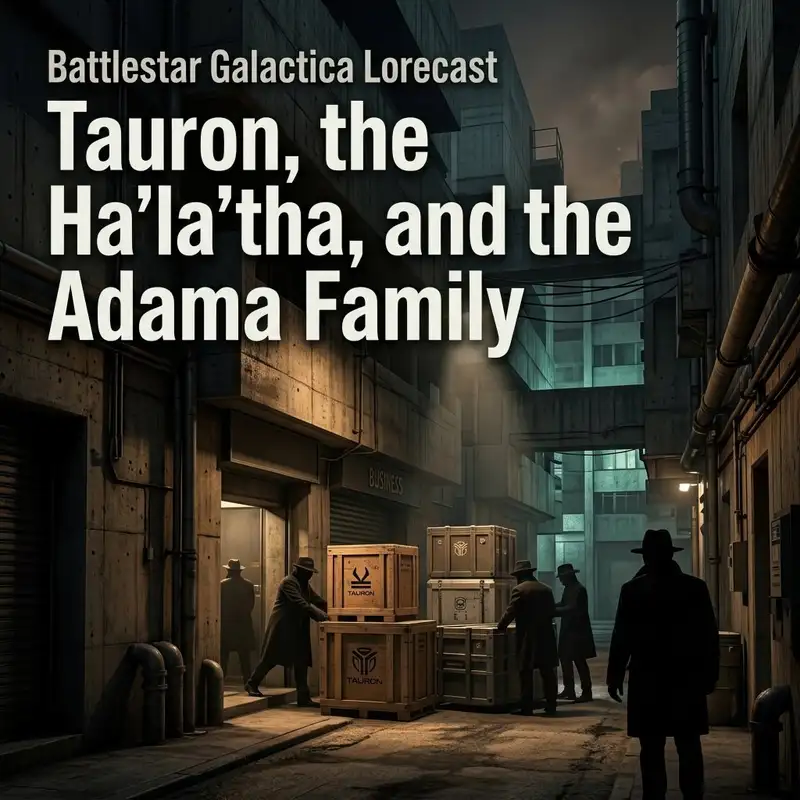
Tauron, the Ha’la’tha, and the Adama Family
On occupied Tauron, two boys sat with the dead weight of a family catastrophe settling around them. Their parents, William and Isabelle Adama, had been caught in a campaign of repression after attacks on grain silos. The available screen evidence does not tell us whether either parent held a formal place in the resistance. It tells us something more immediate. They lived in a household exposed to the consequences of resistance and occupation, where food infrastructure had become a target, armed retaliation reached civilian homes, and children could not be protected from political violence. Before his death, William asked his older son, Joseph, to perform a final act of mercy according to Tauron ritual. Joseph did so. Then, facing his younger brother Sam, he completed the first tattoo that marked the boy’s connection to the Ha’la’tha. He explained that the word meant faithfulness to the soil. At the same time, he added a more important lesson. Brotherhood came first. That distinction mattered. To Joseph, at least in that moment, the symbol was not a license for criminal power. It was a promise that displaced people would not abandon one another. The trouble was that the organization claiming that symbol would later demand the same loyalty, and would define loyalty in far harsher terms. The Adama family’s history begins here, not with a battlestar command deck or a Colonial uniform, but with an older brother trying to give grief a structure before grief gave his younger brother a weapon.
Tauron, in this period, was not simply an ancestral homeland remembered through food, tattoos, and family stories. It was a place under severe political pressure. The conflict shown in the Adama childhood flashback turns on grain silos, sabotage, reprisals, patrols, and frightened households. That detail about the silos is strategically important. Grain is not scenery. It is food, employment, transport, storage, and the material basis of civilian survival. An attack on food infrastructure can inconvenience an occupying power, damage a local economy, or impose costs on a military administration. It can also invite retaliation against communities that depend on the same system. The Heracleides forces shown in the flashback respond to resistance violence with coercion that reaches directly into family life. The result is familiar to historians of occupation. Armed resistance does not remain separate from civilian society when the occupier treats a population as the environment from which resistance grows. Families become suspects, roads become checkpoints, warehouses become targets, and children learn that political power can enter the home without warning. The released material does not provide a complete Tauron order of battle, a stable chronology of the uprising, or a neat map of every faction. It should not be made to carry that burden. What it establishes is enough. Tauron’s displaced communities were formed by a conflict in which national identity, economic survival, and personal security had become inseparable. The Adama brothers did not inherit an abstract pride in their homeland. They inherited a homeland associated with loss, fear, endurance, and an obligation to remember those who did not escape it.
The brothers eventually reached a refugee camp, and there the Ha’la’tha entered their lives in a more organized form. Sam, still young and hungry for some form of control, tried to pick the pocket of the Guatrau, the organization’s leader. Joseph reacted differently. He recognized both danger and opportunity. His restraint, intelligence, and ability to read the situation impressed the older man. The Guatrau took an interest in the two boys, and that interest became the foundation of a relationship that was at once protective, affectionate, political, and profoundly unequal. For refugees, institutions like the Ha’la’tha could fill real gaps. A displaced family needed information, introductions, money, transport, work, legal assistance, and protection from predatory outsiders. It also needed a community that understood its language, losses, customs, and humiliations. Formal institutions on Caprica did not always provide those things equally, especially to Tauron immigrants marked as poor, foreign, or suspect. The Ha’la’tha could provide them quickly because it operated through personal obligation rather than public process.
That made it powerful, but not benign. The Ha’la’tha was more than a criminal syndicate in Tauron colors. It was a diaspora network, a political broker, a protection structure, a keeper of cultural memory, and a criminal organization capable of bribery, intimidation, and murder. Those functions reinforced one another. A network that could move people and money could also move contraband. A leader who settled disputes could also impose his will. A patron who paid a refugee family’s bills could later demand political obedience. A community that protected its members against prejudice could become suspicious of anyone who refused its hierarchy. The Guatrau’s relationship with Joseph and Sam carried all of those meanings. He could seem like a surrogate father to boys whose father had been killed. Yet his care was inseparable from ownership. He did not merely help the Adamas survive. He acquired a claim on their future. That was the moral and political trap of patronage. It offered stability where public authority had failed, but it made survival conditional on someone else’s permission.
As adults, Joseph and Sam inhabited different positions inside that same survival structure. Joseph became a criminal-defense attorney in Caprica City. Sam became an enforcer and assassin for the Ha’la’tha. The contrast is easy to overstate. Joseph wore suits, argued cases, negotiated with judges, and moved through respectable institutions. Sam carried out the direct violence that made the organization feared. At the same time, their work was connected. Joseph helped make formal systems negotiable. He understood how influence could shape charges, hearings, access, and outcomes. Sam represented the informal power behind the negotiation, the knowledge that some people could not safely refuse the Ha’la’tha. One brother worked through law. The other made clear where law ended.
That does not mean Caprica’s courts were merely theater, or that every official was bought. It means that the legal system shown in this period was vulnerable to unequal access. Wealth, social connections, ethnic prejudice, corporate influence, and organized crime could all affect whose rights were protected and whose problems were ignored. Joseph’s talent as an attorney was real. So was his participation in a structure that used corruption and coercion to protect favored clients. His later association with civil-liberties law should not erase that record. If anything, it makes his development more complicated and more interesting. Joseph had seen how law could become an instrument of privilege, how due process could be bent for people with the right patrons, and how easily public institutions abandoned those without leverage. He learned to operate in that world before he tried, however imperfectly, to work against some of its abuses. Sam made a different adaptation. He embodied the Ha’la’tha’s protective promise and its violent claim. To him, loyalty was not an argument in a courtroom. It was a debt written into the body.
The Adama family also faced a quieter form of pressure: the demand to become less visibly Tauron. Joseph adopted the more Caprican surname Adams. The decision was practical. A name could affect how a client, employer, neighbor, official, or schoolmate received a person. For an immigrant family, assimilation was often not a matter of rejecting one heritage in favor of another. It was a calculation about safety, opportunity, and exhaustion. How much of yourself could you reveal without making life harder for your children? Joseph’s later restoration of the name Adama was therefore not a simple rejection of Caprica. Caprica had become his home, his workplace, and the place where his family lived. Restoring the old name was an assertion that public belonging should not require cultural surrender.
His first son, William, called Willie, inherited that tension without choosing it. Willie was born on Caprica. Tauron was family memory, adult grief, stories, rituals, and the social world represented by his uncle Sam. Joseph wanted a different future for him, one with more distance from the Ha’la’tha. Yet distance from the organization could also look like distance from Tauron itself. Sam offered Willie an immediate, physical sense of belonging. Joseph offered him a more cautious and conflicted version of identity, shaped by work, respectability, and an effort to stay out of the Guatrau’s reach. A fishing trip meant to reconnect father and son instead exposed the strain between them. When Willie encountered the slur dirt eater, he responded with violence. The insult was aimed at Tauron identity, but it landed on a child already carrying the unresolved conflict of his father and uncle. His anger was understandable. It was not harmless. Prejudice had turned a family inheritance into a trigger. Willie was not a smaller version of Sam, nor a rehearsal for the man his younger half-brother would become. He was a child trying to decide what it meant to be Tauron in a society that treated Tauron identity as something to mock, fear, exploit, or conceal.
Then the family suffered another rupture. A Maglev bombing killed Joseph’s wife Shannon and their daughter Tamara. The attack did not only remove loved ones from Joseph’s life. It shattered the fragile arrangement he had built between respectability, family, grief, and Ha’la’tha obligation. Joseph had already survived the destruction of one household on Tauron. Now, on Caprica, a different form of political violence took his wife and daughter in a public attack. The losses connected him to Daniel Graystone, another father consumed by bereavement after the same bombing. Their partnership became one of the central links between private grief and public power in the history of Caprica.
Graystone was not a Ha’la’tha figure, and the Adamas did not create the technology that would become central to the Cylon story. Daniel Graystone’s industrial work, Zoe Graystone’s virtual identity, the meta-cognitive breakthrough, and the corporate machinery of Graystone Industries have their own history. But Joseph’s alliance with Graystone mattered because it brought the Adama family’s old survival network into contact with a new and dangerous kind of power. The Ha’la’tha understood money, influence, violence, and political leverage. Graystone Industries offered access to advanced artificial intelligence and industrial production. Together, those worlds revealed how quickly private technology could become strategic technology when fear, profit, ideology, and criminal patronage converged. Neither Joseph nor Daniel began with a complete plan for the future. Both were men attempting to master unbearable loss. Yet grief can make people vulnerable to alliances they would otherwise question, and powerful institutions are often willing to turn personal desperation into usable leverage.
The Ha’la’tha’s involvement with Graystone Industries demonstrated that it had become more than a neighborhood protection network. It could affect corporate control, political decisions, and the movement of emerging military capabilities. Graystone needed the organization’s support in his struggle to regain authority within his company and continue work tied to the avatar and Cylon projects. The Guatrau saw an opportunity. Cylon units were valuable not because the Ha’la’tha understood every implication of synthetic consciousness, but because any new technology that could supply labor, force, intimidation, or political advantage was worth controlling. The organization did not invent the Cylons. It did not independently design the technology or establish the full industrial system that would later make Cylon war possible. Yet it could influence who received units, who gained access, and which conflicts acquired new tools.
That influence became morally decisive when Joseph and Sam learned that the Guatrau was selling Cylon units to the Soldiers of the One rather than supporting the Tauron cause he claimed to champion. The betrayal was larger than a business dispute. The Guatrau had used the language of displaced identity and communal obligation while treating military technology as a commodity for his own power. A movement rooted in the memory of occupation had become willing to arm actors whose goals were not the liberation of Tauron. This is how survival institutions decay. They do not always abandon their symbols. Often they retain the language of soil, family, sacrifice, and heritage while changing the practical meaning of loyalty. The old promise was that the Ha’la’tha would protect Taurons in a hostile world. Under the Guatrau, protection had become a market position. The organization’s history of resistance and displacement could now be used to justify whatever transaction preserved the patron’s authority.
The strategic implications were serious, but they must be kept in proportion. The available screen record does not establish how many Cylon units were sold, how they were used in detail, or whether they altered the balance of power in any particular campaign. It does not show the Adamas arming an entire rebellion or directly setting the First Cylon War in motion. What it does show is the dangerous fusion of industrial capacity, organized crime, political extremism, and unresolved colonial conflict. Once artificial labor and artificial soldiers could be transferred through private networks, they were no longer simply corporate products. They became instruments in struggles over identity, revenge, and control. That was enough to make the Guatrau’s decision a threat to both Tauron and the Adama family.
Joseph and Sam responded by breaking with their patron. They diverted and smuggled Cylon units to Tauron rebels. On one level, this was an act of political defiance. The brothers believed the Guatrau had betrayed the people whose loyalty he demanded. On another level, it was personal revenge. His conduct had exposed the emptiness of his paternal claims. The boys he had once taken in had grown into men capable of challenging him, and they intended to use the same networks he had taught them to navigate. The operation was also logistical. Materiel had to be redirected, relationships exploited, routes secured, and secrecy maintained. Moving a Cylon unit from one political client to another was not just a gesture of loyalty. It changed who held force in a conflict where force could reshape local power.
Yet the brothers’ action also revealed the limits of rebellion inside a patronage system. Joseph and Sam knew how to use Ha’la’tha methods because the Ha’la’tha had trained them to survive. Their resistance to the Guatrau depended on secrecy, personal ties, illicit transport, and the threat of retaliation. They were not stepping cleanly outside the world that had formed them. They were turning its tools against its leader. Tactically, they redirected valuable assets. Operationally, they challenged the Guatrau’s authority and created a direct threat to his control over the organization. Strategically, their influence remains unclear. The screen story does not allow us to treat their operation as the decisive factor in Tauron’s broader struggle. Still, for the Adamas, it was a line of moral and political separation. They could no longer preserve Tauron identity by obeying a man who treated Tauron loyalty as property.
The Guatrau answered as patrons of this kind often do when affection proves weaker than control. He ordered Joseph and Sam killed. The resulting attempt to escape brought the organization’s violence directly into the next generation. Willie was shot and died in Joseph’s arms. This was the decisive tragedy of the Adama family’s Ha’la’tha history. Joseph had tried to protect his son by holding the criminal world at a distance. Sam had tried to protect the family through the very world Joseph feared. Both approaches failed in the moment that mattered most. The network that had once offered two refugee boys protection had followed them into adulthood, into their homes, and into Willie’s life.
Willie’s death cannot be understood only as a plot device in the biography of the future commander of Galactica. Willie was not that commander. He was a child of Caprica and Tauron, a boy caught between a father’s desire for lawful respectability and an uncle’s fierce ethnic loyalty. He never received the chance to choose what Tauron identity would mean in his adult life. He did not decide whether to become a lawyer, an enforcer, a soldier, a dissident, or someone who wanted nothing to do with any of it. His future was taken by an institution that claimed family as one of its highest values. That is the deepest indictment of the Guatrau’s rule. The Ha’la’tha’s rhetoric of brotherhood did not prevent it from making a child pay for adult defiance. In fact, the rhetoric made the betrayal worse. It converted relationships of care into channels of coercion.
There is a civilian lesson here as well. Violence within political and criminal organizations is often described as an internal matter, a contest among men who understand its rules. Families know better. Retaliation travels outward. It reaches children, spouses, workplaces, schools, and neighborhoods. It transforms ordinary life into a set of security calculations. Can a child visit an uncle? Can a father take his son on a trip? Can a family use its own name in public? Can grief be expressed without exposing a vulnerability? The Ha’la’tha had promised the Adamas insulation from a hostile society. Instead, its internal discipline made the family permanently vulnerable to the private decisions of its leader.
Joseph and Sam eventually killed the Guatrau. In the immediate sense, the act removed the man responsible for Willie’s death and for the order against the brothers. It was a personal reckoning, but it was also a political intervention. Killing a powerful patron can trigger broader conflict when his authority rests on interconnected families, obligations, and fears. Fidelia Fazekas, the Guatrau’s daughter, became the new leader of the Ha’la’tha. Her role was not simply ceremonial succession. It represented an effort to prevent one family’s vendetta from becoming a wider war among Tauron networks. In that narrow sense, the transition achieved something important. It contained the immediate crisis and preserved a degree of internal stability.
Still, removing the Guatrau did not dissolve the system that had made him powerful. Decapitation can stop a particular order, punish a particular leader, or create room for a new political arrangement. It does not automatically dismantle the networks of money, fear, ethnic solidarity, illicit commerce, and informal justice that sustain a patronage organization. Joseph and Sam had destroyed the man who claimed ownership over them, but they did so through the same violent logic that had governed his rule. Their survival came at a cost. They could prevent a larger feud, but they could not recover Willie. They could alter leadership, but they could not make the Ha’la’tha harmless. They could reject the Guatrau’s betrayal, but not erase the years in which both brothers had served his system.
The ambiguity is central to Joseph Adama’s legacy. He was neither a clean reformer who had always stood outside corruption nor a criminal incapable of change. He was a man shaped by institutions that had failed his family more than once. On Tauron, occupation and repression had killed his parents. In refugee life, public systems had not offered enough security to keep the Ha’la’tha unnecessary. On Caprica, ethnic prejudice encouraged him to hide part of himself behind the name Adams. In the legal world, he learned that access to justice could be bought and manipulated. In the Ha’la’tha, he learned the price of allowing protection to become ownership. His later public reputation as a criminal-defense and civil-liberties attorney cannot absolve his earlier choices. It can, however, be understood as an incomplete effort to build a different relationship between law and the vulnerable. Someone who has watched informal power corrupt courts may come to value legal restraint not because he is innocent, but because he knows what replaces it when law is reserved for the well-connected.
After the crisis, Joseph and Evelyn had another son. They named him William, often called Bill, in memory of both Willie and the boys’ father, William Adama. The name carried grief across generations, but it did not make the child a replacement. Bill was not Willie returned. He was not a vessel for Joseph’s unfinished hopes, and he was not predetermined by his grandfather’s death on Tauron. Naming is one of the ways families refuse erasure. It says that the dead remain part of the living record. Yet remembrance can become burdensome if it demands that a child fulfill someone else’s lost future. The Caprica epilogue offers a more restrained image. The family maintains a ritual of remembrance. Its losses are not hidden, yet neither are they allowed to end the family story.
The distinction matters because the future William Adama would become a Colonial Fleet officer and, much later, commander of Battlestar Galactica. It would be tempting to draw a straight line from the Guatrau’s tyranny to every decision made by that commander. The record does not support that kind of certainty. It does not tell us that Bill consciously based his military judgment on stories of the Ha’la’tha, or that every later concern with command, law, duty, and family came directly from Joseph’s past. People are formed by more than one inheritance. Training, service, marriage, parenthood, war, loss, and individual temperament all matter. A family history can illuminate a life without becoming its single explanation.
Still, the connection has meaning. Bill Adama came from a family that had learned how fragile institutions could be. His grandfather’s household had been crushed between occupation and resistance. His father had survived refugee displacement through a network that offered protection but demanded obedience. His older half-brother had died because that network could not tolerate independence. Joseph later passed a lighter to his son Lee, and Lee carried it into a moment of military danger many years afterward. The object is small, and it should not be turned into a secret archive of everything the family endured. Lee did not necessarily inherit the full Ha’la’tha story through it. At the same time, it represents a quieter truth about the Adamas. Their history was carried forward not only in public records or military ranks, but in remembered objects, names, habits, and obligations.
Tauron gave the Adama family a language of soil, memory, and endurance. The Ha’la’tha gave displaced Taurons practical means to survive in a society that often treated them as outsiders. It also gave the family a model of power built on secrecy, hierarchy, retaliation, and debts that could never quite be repaid. Joseph and Sam did not escape that inheritance cleanly. Sam remained the brother most willing to express loyalty through action and force. Joseph tried to use law, negotiation, and public respectability, even while benefiting from corruption he later had reason to oppose. Their break with the Guatrau was necessary, but it was not pure. It used the methods of the world they wanted to resist.
The Adamas never escaped Tauron's past, and the story does not require them to. Joseph and Sam carried occupation, exile, prejudice, family loyalty, and Ha'la'tha violence into their adult lives. What changed was the meaning they tried to give that inheritance. They preserved names, ritual, memory, and the bond between brothers, while learning at terrible cost that protection can become ownership and loyalty can become coercion. The William Adama who would one day command Galactica inherited a family name marked by that history. The more important inheritance was the unfinished task of remembering the dead without allowing their grief to dictate the choices of the living.