Suicide Bombing and the Battle Over the New Caprica Police
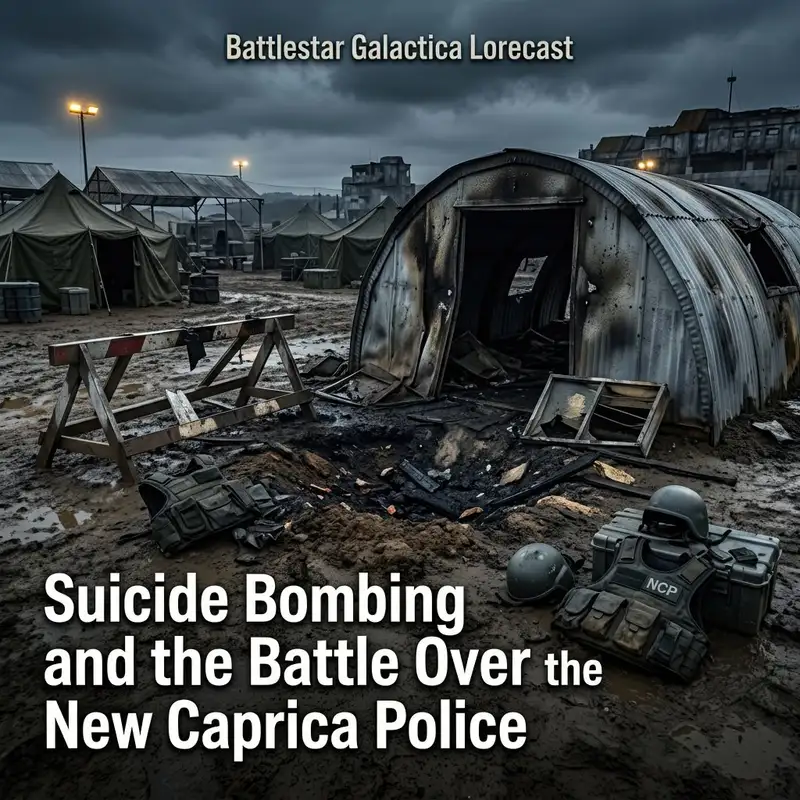
The graduation ceremony was meant to show that New Caprica had rules again. Human recruits stood in uniform and armor beneath the eyes of their Cylon overseers. The New Caprica Police was being presented not as a foreign army’s auxiliary, but as the beginning of local order. Its cadets would police human streets, search human homes, and arrest human suspects. President Gaius Baltar was expected to attend. Then Tucker Clellan, known as Duck, detonated a bomb inside the ceremony.
Baltar was not there. The reported dead included thirty-three police cadets and numerous Cylons. Captain James Lyman survived. Duck did not. At the immediate tactical level, the attack destroyed recruits and shocked the occupation security apparatus. At the political level, it struck something larger. The New Caprica Police had become the Cylons’ argument that occupation could be administered through human institutions. Duck’s bomb declared that any institution serving the occupation would be treated as part of the battlefield.
That does not make every victim at the ceremony equally responsible for what the police force had done or would do. Some recruits may have joined for protection, food, status, fear, or the hope that human police could be less brutal than Centurions. Others may have embraced the work. The masks and armor made those distinctions difficult to see. That was part of their purpose. The occupation had turned individual human choices into an anonymous apparatus, and Duck’s attack answered that apparatus with indiscriminate violence of its own.
New Caprica was not occupied simply because the Cylons had more weapons. They held the settlement because the Colonial fleet had departed, leaving much of the population behind under the pressure of a Cylon arrival. The Cylons imposed curfews, conducted weapons searches, detained suspects, and used armed force to control movement. But military power alone could not solve the daily problem of governing a frightened human population.
Centurions could guard a checkpoint. They could raid a building, intimidate a crowd, and carry out an execution order. What they could not easily do was understand every family connection, workplace dispute, old grievance, hidden weapon cache, or whispered rumor in a settlement made up of survivors from many ships and colonies. Nor could a Centurion make coercion look like civic administration. A machine with a rifle is unmistakably an occupier. A human officer with a warrant, a list, and a local accent can make the same coercion appear procedural.
That was why the New Caprica Police mattered. It was not an ordinary municipal police department operating under an independent government and a recognized legal system. It was a human security force operating beneath Cylon authority. Its duties mixed policing, intelligence collection, detention, raids, intimidation, and counterinsurgency. The Cylons retained ultimate power. The police supplied local reach, local knowledge, and a human layer between the occupation’s decisions and the people forced to live under them.
The uniforms and masks carried their own political message. They protected officers from immediate recognition and retaliation. They also removed accountability. A resident whose home had been searched, whose relative had been taken away, or whose neighbor had been beaten might know that humans had done it, but not which humans. The occupation transformed a community into a pool of possible informants, possible police recruits, possible resisters, and possible suspects. In that environment, anonymity was not merely a security measure. It was a method of rule.
The resistance developed because New Caprica’s civilians did not accept that rule as legitimate. The early occupation left little room for conventional opposition. There were no secure bases, no open supply lines, no artillery, and no reliable sanctuary beyond Cylon reach. Weapons had to be hidden. Meetings had to be compartmented. Every new participant created both manpower and risk. A person who knew the location of a weapon cache might be an asset, a frightened civilian, an informant, or all three at different moments.
Saul Tigh emerged as the resistance’s central operational leader. Galen Tyrol, Samuel Anders, Jean Barolay, Jammer, and others became essential to its work, though they did not always agree about tactics or goals. A planning discussion referred to roughly eleven hundred and fifty armed resistance personnel. That was a working estimate, not a complete order of battle. Even if the figure was broadly accurate, it did not mean the underground possessed eleven hundred and fifty trained fighters ready to move as one force. It represented people spread across a watched settlement, with uneven weapons, uncertain loyalties, and little freedom of maneuver.
The resistance faced the classic problem of an underground movement confronting a stronger power. Open battle would favor the occupier. A sustained firefight risked bringing Centurions, Raiders, or Cylon reinforcements against civilians who had no bunkers and nowhere to evacuate. The underground therefore depended on concealment, access, timing, and the ability to make the occupier spend resources faster than it could identify the people responsible.
Penetrating the New Caprica Police offered a rare form of access. A police officer could move through checkpoints, see detention procedures, hear orders, and learn which homes were being watched. The same access, however, came at a price. To gain the trust of the institution, an infiltrator might have to wear its uniform, follow its orders, and become associated with its crimes. In an occupation, collaboration and resistance can sometimes occupy the same person. That does not make the moral burden disappear. It makes the burden harder to judge from the outside.
Jammer was the clearest example. He entered the police force while retaining ties to the resistance. His position gave the underground information and later gave him an opportunity to intervene when detainees faced execution. But he also became part of an organization conducting raids and arrests on behalf of the occupation. The fact that Jammer could later act courageously did not erase the damage done by the system he helped sustain. It did show why the New Caprica Police could not be understood as a single, unified political body.
Captain James Lyman provided the force with visible human command. Yet the practical chain of authority ran upward through the Cylons. Cavil and other Cylon leaders directed the occupation’s broader security policy. Human officers could carry out arrests, organize formations, and manage personnel, but they did not possess final independence from the power that armed and supervised them. The police had human faces and human voices. Its sovereignty was Cylon.
Some people joined that force because they believed human policing might limit unnecessary violence. That belief was not irrational. A human officer might recognize a neighbor, hesitate before firing, or prevent a Centurion from escalating a routine search into an execution. But the promise contained a trap. Once the police made the occupation more effective, more legible, and more sustainable, it also made the occupation harder to resist. A less visibly brutal apparatus can be more durable than one that rules through naked terror alone.
Other recruits had fewer choices than they appeared to have. Occupation creates pressures that do not always look like a gun held to the head. A family may need food, protection, work, or access to a detained relative. A person may fear being treated as a suspect if he refuses recruitment. Another may seek status or power in a society where ordinary institutions have collapsed. Still another may believe that Cylon victory is inevitable and decide that survival requires accommodation. Those motives do not carry equal moral weight. They do explain why the police force could recruit humans without ever becoming a legitimate human institution.
Duck Clellan entered that world through grief. Before the occupation hardened around him, he had been reluctant to join the resistance. His relationship with Nora Farmer anchored him to a more private hope of survival. That hope ended when Nora was killed during a Cylon raid on a temple. Duck’s loss did not reveal every fact about who informed on her, who made the raid possible, or who bore direct responsibility for her death. The surviving record leaves those questions unresolved. What it clearly shows is that grief pushed him toward action.
Duck joined the New Caprica Police as an infiltrator, seeking access to the system that had killed Nora and to the people he believed might know why. That choice placed him inside the occupation’s human security arm. It also made him useful to the wider resistance. His personal vengeance and the underground’s military needs began to overlap. The result was the graduation bombing.
It would be too simple to describe Duck’s attack as only revenge. A suicide bomber can be driven by personal loss, ideological commitment, coercion, despair, loyalty to comrades, or a belief that no other weapon remains. Duck carried his own grief into the ceremony, but the target also had operational and political value. Destroying newly trained police cadets weakened a force designed to identify and suppress the underground. Killing Cylons at a public event demonstrated that the occupation could not trust its own security arrangements. And the attack told every resident that the police uniform did not make its wearer safe.
Suicide bombing appealed to the resistance because it compensated for weakness. The underground lacked aircraft, artillery, armored formations, secure headquarters, and freedom to mass forces. A bomber could carry an explosive device through a checkpoint or into a protected gathering where a larger unit could never get close. One person could strike a target beyond the reach of the resistance’s ordinary weapons. In purely tactical terms, it was a way to trade an irreplaceable individual for access and surprise.
For Tigh, the calculation was broader than a single ceremony. The resistance needed to disrupt the occupation before a possible rescue operation. Every security alert could force the Cylons to divert personnel toward checkpoints, raids, guard duty, and infrastructure protection. Every uncertainty about police loyalty could make the New Caprica Police less effective. Every attack could create time, and time was the one resource the underground could not manufacture.
That did not make the tactic strategically sound in every circumstance. Suicide bombing can impose fear on an occupier, but it can also spread fear through the population the resistance claims to defend. It gives the occupier a rationale for larger raids, broader detention lists, and more collective pressure. It can alienate civilians who oppose the occupation but do not accept attacks that expose bystanders to death. And it can turn a liberation movement into an organization that measures success primarily by the enemy’s casualties rather than by the political future it hopes to build.
Tigh argued that a bomber who knowingly accepted death was not fundamentally different from a pilot sent on a mission with little expectation of return. It was an argument born of military urgency. Pilots, Marines, and resistance fighters all risk their lives in war. But Roslin rejected the equivalence, and she had reason to do so. A military mission may be dangerous without being designed around the deliberate death of the person carrying it out. The target, the method, the consent, and the foreseeable risk to civilians all matter.
The disagreement was not between people who opposed the Cylons and people who accepted occupation. Roslin supported resistance. Tigh was trying to create the conditions for liberation. The dispute was over what resistance meant. Was the objective simply to make the occupier suffer and withdraw? Or was it to preserve enough moral and political restraint that liberation would still have a lawful society waiting on the other side?
Tyrol expressed a related concern when attacks threatened civilians near a marketplace. He understood better than most that the resistance depended on people who did not carry weapons. Those civilians supplied information, hid equipment, endured searches, and absorbed the occupation’s retaliation. A bomb near a crowded civilian area might hurt the Cylons. It might also tell the people of New Caprica that they were expendable to both sides.
Roslin’s confrontation with Baltar made the political stakes even clearer. Baltar wanted her to condemn the bombings. From his position, a public denunciation by the former president could help separate ordinary civilians from the resistance and restore some authority to the occupation’s human government. Roslin refused to give him that endorsement. But she also refused to celebrate the attacks. She would not pretend that suicide bombing was morally clean, and she would not allow Baltar to pretend that New Caprica’s problems began with the resistance.
She named the reality of arbitrary arrests, torture, detention, and coercive policing. Baltar’s government had not become a neutral administration trying to protect civilians from violence. It operated under Cylon domination. Its officials could be threatened, overruled, and used as instruments of repression. Roslin’s position was difficult precisely because it rejected the slogans available to both sides. The Cylons could not claim that security measures were ordinary law enforcement. The resistance could not claim that every act committed against the occupier was beyond moral scrutiny.
The second major bombing made that tension impossible to ignore. It was not Duck’s attack at the graduation ceremony. This time, the target was a power substation. The reported results were severe. Four humans were killed. Twenty-three Cylons were critically wounded, and fourteen of those were later euthanized. Roughly half the city lost power. Repairs were expected to take at least two weeks.
Those numbers should be treated as the occupation’s reported immediate assessment, not as a complete census of everyone harmed. They do establish the operation’s scale. The attack inflicted real damage on Cylon personnel and on infrastructure needed to sustain occupation control. It forced security and engineering attention onto a critical site. It demonstrated that the resistance could strike something more valuable than a patrol or a single police ceremony.
At the same time, a power station serves civilians as well as occupiers. Its destruction did not leave only Cylon offices dark. It affected homes, medical needs, sanitation, food storage, work, communications, and the ordinary routines that help a population endure occupation. New Caprica was already a hard settlement before the Cylons arrived. Its environmental and material limits had not vanished. A blackout was not an inconvenience in a secure, wealthy city. It was another layer of hardship imposed on people with few reserves.
This was the central operational contradiction of the bombing campaign. Resistance attacks could weaken the occupation and still worsen daily life for civilians. An underground movement cannot escape that contradiction by insisting that the occupier bears ultimate responsibility for the war. The occupier did bear responsibility for imposing the system of control. But resistance leaders still had to decide which targets were worth the predictable civilian cost, what precautions were possible, and when the military advantage no longer justified the harm.
The Cylons answered the bombings with a crackdown. Their response revealed how the occupation was designed to work. Direct Cylon force remained available at every level. Centurions could conduct arrests and guard prisoners. But the occupation also relied on human police, detention procedures, executive orders, informants, and paperwork. Repression gained a different kind of power when it could claim to be legal, local, and signed by a human president.
Number Three brought Baltar an order for executions. Baltar resisted. The scene did not show a free president considering a difficult policy choice under normal constitutional conditions. It showed a compromised official trapped inside a coercive regime. Number Five threatened him. During the confrontation, Doral shot Caprica Six after she defended Baltar. The Cylons were not emotionally or politically uniform. Caprica Six’s intervention mattered. Number Five’s escalation mattered. Doral’s violence mattered. None of them can be reduced to a single generic Cylon motive.
Baltar eventually signed the order. Coercion does not make that signature meaningless. His office had been stripped of independence, but it still possessed political value. The Cylons wanted the executions to carry a human governmental form. Baltar’s name could be used to tell New Caprica that its own president had authorized punishment. His fear and constraint help explain his conduct. They do not remove his role in giving terror an official seal.
The crackdown also stripped away some of the New Caprica Police’s remaining claim to humane mediation. The more the force became associated with mass detention, forced searches, and execution procedures, the less it could plausibly claim to be protecting civilians from Cylon excess. The occupation had created the police to humanize control. The bombings pushed the Cylons toward measures so direct that the human façade began to collapse.
Large-scale arrests followed. Laura Roslin was detained. Cally Tyrol was among those taken. Their arrests showed the weakness of occupation intelligence. Counterinsurgency systems often expand suspicion because uncertainty is intolerable to the people running them. A list of detainees can look precise. It may still include people whose connection to resistance activity is uncertain, indirect, fabricated, or invented by someone trying to settle a private score. The more the police needed results, the more dangerous such lists became.
Cally’s detention brought Jammer’s divided position into the open. As an embedded member of the police, he had access to the prisoner transfer. When the detainees faced the prospect of Centurion execution, Jammer chose to free Cally. That act placed him against the institution he had entered. It also placed him in immediate danger from the Cylons and from fellow officers who could no longer assume where his loyalty lay.
Jammer’s decision did not turn the New Caprica Police into a resistance organization. Nor did it erase the harm done by police raids before that moment. It demonstrated something more unsettling. The police force was a contested institution. Some of its members carried out occupation policy. Some may have believed they were reducing the violence of a worse alternative. Some were compromised by fear. Some were looking for a chance to resist from inside. The Cylons needed the force because it was human. That humanity made it useful, but it also made it unreliable.
The resistance intervention around the detainees further weakened police cohesion. An occupation security force depends on confidence. Its members must believe that their orders will be enforced, their identities protected, and their Cylon patrons able to keep them safe. Once officers begin to suspect infiltration, once prisoners can be freed during transfer, and once raids become opportunities for resistance action, the force begins to consume itself with distrust.
That erosion mattered far beyond the streets of New Caprica. The police battle was becoming part of the preparation for evacuation. Admiral William Adama had not abandoned the people left behind. From the surviving fleet, he considered a return to rescue them. But the operation was not merely a matter of bringing Galactica into orbit and ordering transports down to the surface.
The grounded Colonial ships on New Caprica could not be launched immediately because the Cylons had removed their launch keys. The problem was not one that the resistance could solve by sending a few mechanics to a warehouse. The keys and their specifications were specialized enough that developing replacements would take time the resistance did not have. Recovery, infiltration, and coordination mattered more than improvising a new industrial system in the middle of an occupation.
The Cylon perimeter had been reduced to five Basestars. That created an opportunity. It did not create safety. Five Basestars remained a powerful defense, especially against a battlestar returning to a planet where the enemy controlled the ground, the skies, and the civilian population. Any obvious weapons drop or premature contact with the underground risked exposing the rescue plan. The Cylons could reinforce the planet, alter their patrol patterns, or move more aggressively against suspected resistance networks.
This was why Tigh wanted the pressure campaign. Bombings and sabotage could distract the occupation, pull security resources away from launch preparations, and force Cylon leaders to concentrate on immediate internal threats. But the same campaign could also make the Cylons more suspicious, more violent, and more likely to detect the connection between the resistance and the fleet. Tigh was operating under a real deadline. He was also gambling with the population he intended to save.
The strategic argument continued aboard the fleet. Lee Adama objected to risking the people who had already escaped New Caprica. Approximately two thousand civilians were outside the occupied settlement. They represented a surviving fragment of humanity, and Lee feared that a rescue attempt could jeopardize them as well. His concern was not cowardice or indifference to those left behind. It was the grim arithmetic of extinction. A commander responsible for the whole surviving population had to ask whether one rescue operation might destroy the refuge that remained.
Adama made the opposite choice. He would return for those on New Caprica, but he adjusted the plan. Galactica would go back toward the occupied planet while Pegasus remained with the civilian fleet. The decision recognized both duties. Galactica would accept the military risk of rescue. Pegasus would preserve a protective force for the civilians already beyond Cylon control. It was not a clean solution. It was an attempt to prevent one act of loyalty from becoming a second catastrophe.
Sharon Agathon became essential to the plan. A Number Eight who had earned a place in the Colonial Fleet through painful experience and difficult trust, she was sent to establish contact with the resistance. Her mission was politically sensitive and operationally practical. A humanoid Cylon could move through parts of the occupation environment in ways a human infiltrator could not. Yet her presence also required the resistance to accept help from someone whose body, face, and origin belonged to the enemy that had occupied them.
That mission did not resolve the larger human-Cylon conflict. It did, however, exploit a specific weakness in the occupation’s assumptions. The Cylons had built a security system around their own authority and around human intermediaries. They had not eliminated division among themselves. Sharon’s ability to reach the underground depended on trust being extended where it would once have been impossible, and on the occupation’s machinery being less unified than it appeared.
By the time the rescue moved toward execution, the New Caprica Police had failed in its most important political mission. It had not normalized Cylon rule. Instead, it had become evidence that the occupation could not govern without recruiting humans into their own repression. The graduation bombing exposed that dependence. The subsequent attacks and arrests deepened it. The police force became more militarized, more fearful, more implicated in detention and violence, and less capable of claiming that it represented a restored civic order.
The resistance achieved real gains. It disrupted the police force, imposed costs on the Cylons, weakened confidence in the occupation’s local institutions, and helped create operational space for evacuation. Those were meaningful successes. But success came with civilian deaths, power loss, mass fear, retaliation, and a bitter argument over whether the methods used were compatible with liberation.
After New Caprica was liberated, the problem did not disappear with the departure of the Cylons. Captain Lyman and other collaborators faced punishment. Some survivors formed the Circle and carried out secret judgments against people they believed had betrayed the community. Later, Roslin pardoned many collaborators. These responses reflected the same unresolved question that had haunted the police force under occupation. Who had acted freely? Who had acted under coercion? Who had used fear as an excuse for cruelty? And who had the authority to decide?
Liberation created a second policing crisis. The survivors needed security, courts, detention rules, and a way to address genuine crimes. They also needed to resist the temptation to turn trauma into permanent emergency justice. The Circle’s actions revealed how quickly a community brutalized by occupation could reproduce the methods of unaccountable power. The later pardons acknowledged that collaboration was not one thing, even if they could not erase the suffering caused by it.
The New Caprica Police became both an instrument of occupation and a site of resistance because the Cylons could not rule humans without human intermediaries. Suicide bombing exposed that dependency and helped open operational space for evacuation, but it also deepened civilian suffering and compromised the movement that used it. The battle over the police did not end when New Caprica was freed. It passed to the survivors, who still had to decide whether justice after occupation would be governed by law, revenge, or another emergency.