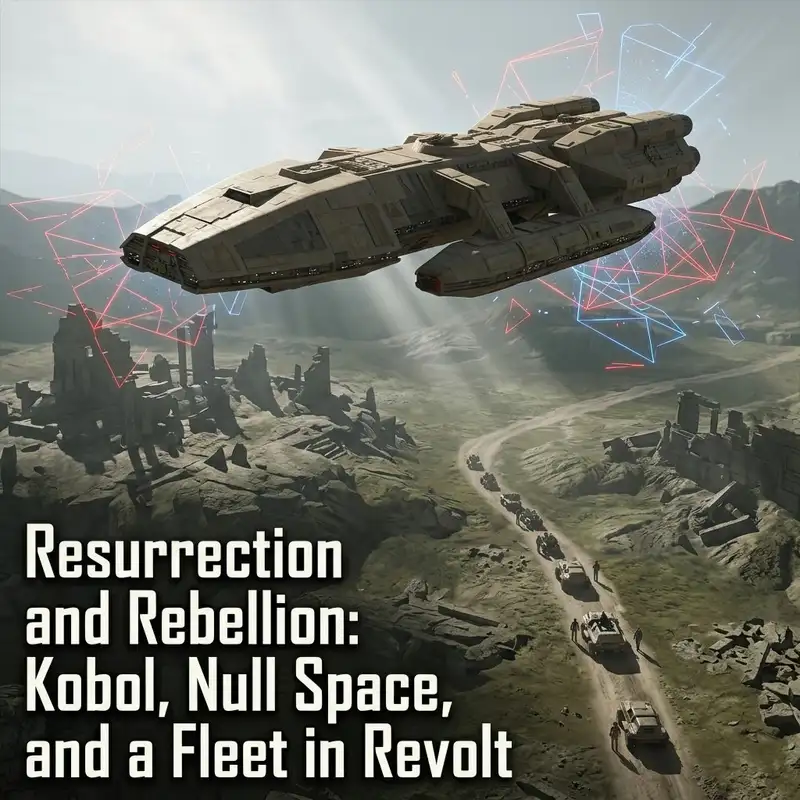
Resurrection and Rebellion: Kobol, Null Space, and a Fleet in Revolt [Hatch Continuation]
The bomb aboard Rising Star did not destroy the ship. That was almost beside the point. It killed at least forty refugees, wounded more, and proved that the fleet’s crisis had moved inside its own pressure hulls. The device was assembled from ordinary ship components, the sort of materials a desperate population could find without access to a weapons depot. Rising Star was full of civilians already living on diminished rations, uncertain of their destination, and trapped in a place where stardrives could no longer carry them away. In that setting, the bombing was more than an atrocity. It was political warfare conducted against a society with nowhere to disperse, nowhere to retreat, and no reserve population from which to replace the dead.
Apollo faced the kind of command problem that military officers often describe too simply. He had to stop sabotage, locate the people making threats, defend the fleet against enemies outside the hull, and preserve enough public trust for civilians to accept orders during a catastrophe. Those objectives could conflict. A harsh security response might reduce immediate danger while confirming the belief that military command had become detached from civilian suffering. A weak response might preserve legal appearances while inviting more attacks. The fleet was not a battlestar with passengers. It was a mobile remnant of a civilization, and every command decision now reached into food distribution, medical care, representation, fear, and grief.
This crisis belongs to Richard Hatch’s continuation-novel branch of the original Battlestar Galactica characters. It follows the events of Warhawk and unfolds across Resurrection and Rebellion. It is not the future imagined by Galactica nineteen eighty, and it is not the later reimagined television continuity. Its Cylons, spiritual forces, political institutions, and technologies follow their own path. That matters especially here, because the word resurrection carries a very different meaning. It does not describe a machine process of copying consciousness into a new body. It describes literal return, recovered ancestral knowledge, spiritual possibility, and the harder question of whether a fleet repeatedly damaged by war can renew its political life.
The rebellion in the Ur cloud did not arise from a single bomb or a single demagogue. It had been gathering force through hunger, exhaustion, inequality, and a growing disagreement about the purpose of the journey. Before the fleet entered null-space, it had already survived fighting with both Cylons and the Chitain. Ships were damaged. Food and fuel were short. Wounded personnel imposed demands on limited medical stores and on the people needed to maintain vessels, fly patrols, and repair combat damage. Under those conditions, Apollo’s determination to continue the search for Earth became more than a navigational policy. It became a decision about who would bear risk, who would wait for relief, and who had the right to decide that survival required continued movement.
The immediate precursor was the fleet’s encounter with quantum-shift technology linked to the holocube and to the long search for the lost Thirteenth Tribe. The technology offered an extraordinary possibility. It could move ships by means beyond the ordinary stardrive methods available to the Colonials. But it was not a mature fleet system, and it was not distributed evenly across every vessel. The fleet had not built its operations around it. Crews had not spent years refining procedures for coordinating civilian traffic, reconnaissance, repairs, and recovery after a quantum shift. In military terms, Apollo was placing a damaged force on an experimental line of retreat because the established line was closing behind him.
That decision had a clear operational logic. The fleet was under pressure from enemies capable of trapping and destroying ships if it remained predictable. A conventional withdrawal might have been impossible, or simply too slow. An exceptional movement method could create surprise and break the enemy’s immediate pursuit. But a commander who accepts uncertainty in order to survive the next hour also accepts responsibility for what happens after arrival. The question is never just whether a force can escape contact. It is whether it can reassemble, communicate, protect its noncombatants, and resume some coherent mission after the escape.
Commander Cain understood that problem differently from Apollo. Cain’s view could not be reduced to personal opposition to the younger commander. She saw a force worn down by repeated movement, depleted stores, and dependence on mysteries it did not control. From that perspective, the search for Earth risked becoming an endless operational gamble. Cain favored consolidation, defensive preparation, and a willingness to make a stand rather than continually pursue the uncertain route associated with the holocube. Apollo believed that stopping without a permanent refuge would turn the fleet into a stationary target. Their disagreement was therefore strategic. One commander feared attrition through movement. The other feared destruction through immobility.
Neither position offered safety. A fleet that stops must defend a place, feed itself, repair itself, and explain why the place is worth defending. A fleet that moves must calculate jumps, preserve fuel, keep its civilian ships together, and accept that every new destination may create fresh hazards. The deeper problem was institutional. Apollo held supreme military command, but Cain possessed stature, experience, and an independent center of loyalty. In a healthy political system, such disagreement might be resolved through formal civilian authority, planning, and accountable debate. In a refugee fleet under attack, the process was strained by urgency. Every delay looked dangerous. Every dissenting voice could be portrayed as either necessary caution or fatal disunity.
Apollo ordered the quantum shift to escape the Cylon trap. The fleet survived the immediate danger, but it did not reach the destination it expected. Instead, it was displaced across the galaxy and returned to Kobol, the ancestral world of the Kobollian race. In this continuation branch, Kobol had been destroyed by the Cylons roughly twenty yahrens earlier. Its return was therefore not a homecoming in any ordinary sense. It was the arrival of refugees at the ruins of a civilization whose destruction resembled their own. The fleet found no secure capital waiting to receive it. It found evidence that the past remained dangerous, contested, and far less dead than Colonial memory had assumed.
Kobol’s underground structures were more than ruins. They contained caretakers, systems, and technological knowledge beyond the fleet’s recently acquired quantum-shift capability. The contrast mattered. Colonial forces had treated quantum shift as a desperate breakthrough, a means of escaping annihilation. Kobol suggested that earlier civilizations had known far more, and had still failed to preserve themselves. For Apollo, this knowledge could strengthen the search for Earth and reveal a route forward. For others, it could look like another temptation to gamble lives on ancient promises. Superior technology does not settle political disputes. It often intensifies them by raising the stakes of who controls access, interpretation, and use.
The Kobol material also joins archaeology to religion. Apollo and Athena are connected in the novels to the House of Kobol, a heritage that gives their presence symbolic weight in the struggle against Count Iblis. But ancestry is not a constitutional document. A lineage may inspire loyalty, explain a prophecy, or shape a character’s sense of obligation. It does not automatically grant the right to command civilians who are hungry, frightened, and expected to obey. The fleet’s problem was not that it lacked sacred history. It was that sacred history could become another source of authority at the very moment ordinary political authority was weakening.
Count Iblis occupies a different category from the fleet’s military enemies. He is more than a Cylon commander with a larger force of Raiders or a more advanced base star. In this literary mythology, he is an ancient adversary whose conflict with Apollo, Athena, and the House of Kobol has personal, ideological, and metaphysical dimensions. That makes him strategically important, because people act on what they believe he represents. Yet his nature is not reduced to a technical briefing. The books do not offer a clean scientific explanation for every spiritual event associated with him. The fleet can observe effects, confront threats, and make decisions. It cannot turn mystery into reliable doctrine.
That restraint also applies to Talen and the Beings of Light. Talen is associated with Serina’s spirit or manifestation, but the association remains deliberately ambiguous. The story invites the characters and readers to consider continuity beyond death, but it does not provide a laboratory demonstration of exactly what Talen is. Such ambiguity is not a weakness in the fleet’s record. It is part of the pressure under which command operates. Apollo must make choices in a world where some evidence is material, some is historical, some is religious, and some may be beyond any category his officers can verify. A wise commander can respect the meaning of such experiences without pretending they have become engineering data.
Cain measured the same events through a more immediate military lens. Ancient technology, sacred revelations, and a revived sense of destiny did not repair hulls, replenish food, or restore combat readiness. Her concern was that Apollo’s strategy relied too heavily on continuing forward through hazards that the fleet could neither predict nor control. That concern did not make Cain incapable of ambition, and it did not make every challenge to Apollo disloyal. It identified a genuine fault line in the fleet’s strategy. Was the search for Earth a mission that justified extraordinary risk, or had it become an idea too powerful to question even as the material foundations of the fleet eroded?
The Kobol conflict did not resolve that dispute. The available account makes clear that Cain and Pegasus were lost in the wider struggle, but it does not support a precise reconstruction of every maneuver, weapon exchange, or final command decision. What matters most is the institutional result. The fleet lost a legendary commander and a rival center of military authority. That reduced one form of dissent, but it did not remove the underlying disagreement. When a command system loses a powerful critic in battle, the survivors may gain temporary unity. They may also lose the person most willing to articulate risks that others would prefer not to confront.
Against that background came Starbuck’s return. He had been believed dead after the events of Warhawk. In Resurrection, he comes back alive. Within this continuation branch, his return is literal, connected to the Beings of Light and to the mythology surrounding Kobol. It is not a Cylon resurrection mechanism, not a technological duplicate, and not evidence that death has become routine or reversible for the fleet. The distinction is essential. The people aboard the ships still lose comrades permanently. They still bury the dead, mourn missing pilots, and watch resources disappear. Starbuck’s return changes the emotional and spiritual atmosphere of the fleet precisely because it is extraordinary.
Starbuck’s altered outlook after contact with the Beings of Light also creates a counterweight to the narrow arithmetic of military survival. A fleet commander has to count fuel, hull damage, fighter losses, and food. Without those calculations, everyone dies. But a population cannot live by calculation alone. It must decide why it is preserving itself, what memories and loyalties it will carry, and whether the future it seeks is more than a place to hide. Starbuck’s return offers hope, but hope can be misused. It can encourage courage, patience, and reconciliation. It can also tempt people to confuse spiritual renewal with material recovery, as though a resurrected pilot could somehow replace medicine, spare parts, or political legitimacy.
The escape from Kobol brought no stable sanctuary. Instead, the fleet entered the Ur cloud, also described as null-space. It was a pocket or realm outside ordinary space and time, but the story does not define its physical laws with precision. What the fleet knew was operationally devastating. Stardrives no longer functioned normally. Navigation instruments became unreliable. Ships could not just calculate a course and depart. A force that had survived by movement found movement itself stripped away. In ordinary space, the fleet could make difficult choices about where to go. In null-space, it had to confront the possibility that no destination could be reached at all.
That changed the nature of strategy. A battlestar can fight with guns, Vipers, trained crews, and a chain of command. A refugee fleet also requires food, fuel, medicine, maintenance, sanitation, and labor. Those needs become decisive when escape is impossible. Every day in the Ur cloud turned stored supplies into political questions. Who received treatment first when medical resources declined? Which ships received fuel for patrols or power? How much could be spent on reconnaissance? How long could pilots fly uncertain missions before fuel, airframes, and experienced personnel became too scarce to risk? The fleet had become a convoy trapped in an environment that denied it the usual advantages of mobility.
The civilian ships faced different vulnerabilities from the battlestars. Some carried families, workers, and essential stores. Some had less ability to maneuver or protect themselves. Some depended on the military for defense while also fearing that military priorities would consume resources needed for civilian survival. This was not ingratitude. It was the basic politics of a society under siege. The people asked to accept danger wanted a voice in deciding what dangers were necessary. Apollo could not answer that demand simply by pointing to the Cylon threat. The threat was real, but so were the empty food stores and the wounded who needed care.
Even Baltar’s experience in the Ur cloud carries this double quality of fact and interpretation. The cloud appears to interrupt Count Iblis’s mental influence over him, giving Baltar a period of apparent freedom from that control. Within the story, that experience matters psychologically and morally. But it does not establish a complete technical theory of Iblis, the cloud, or the human mind. Baltar remains a compromised and distrusted figure, not suddenly a neutral intelligence source. The fleet cannot afford either blind faith in him or the luxury of ignoring information merely because its source is contaminated. Null-space makes every source difficult to assess, including one’s own perceptions.
The Nameless Ones emerged from this environment of deprivation and political exclusion. Their grievances were not invented. Civilians had reason to fear starvation, unequal rationing, and an endless pursuit of Earth conducted at a cost they were expected to pay. Many wanted settlement rather than another hazardous movement toward a destination no one could prove was near. They believed that military command had too much power over rations, risk, and the fleet’s future. Such concerns were politically credible. A government that cannot hear them will eventually discover that hunger is not just a logistical condition. It is an argument about authority.
Jinkrat, a former member of the Quorum, gave that argument organization. He was not just a criminal hiding behind civilian anger. He understood the fleet’s political institutions and knew how to present the case that Apollo’s command had exceeded its proper limits. Yet Jinkrat’s movement crossed a line when it adopted bomb threats, hostage pressure, and the Rising Star attack. The grievances of hungry civilians did not make the bombing legitimate. Killing refugees to compel political change turns the people one claims to represent into hostages as well. It also gives military authorities a powerful reason to treat dissent as a security threat, even when much of that dissent remains nonviolent and justified.
The danger, however, was that the bombing could erase distinctions Apollo needed to preserve. The Nameless Ones did not represent every civilian. Not every critic of the Earth search supported violence. Not every person who feared rationing inequality wanted to overthrow the military chain of command. A command response that treated the entire civilian population as a hostile bloc would have made Jinkrat’s political narrative stronger. Counterinsurgency inside a refugee fleet is not primarily a matter of force. It is a matter of separating violent conspirators from frightened civilians without turning ordinary political disagreement into evidence of treason.
Sire Aron added another dimension to the crisis. He used emergency Quorum action to challenge Apollo’s authority, and there was opportunism in that effort. But opportunism does not make the constitutional question unreal. Civilian government existed to represent interests that military command could not fully represent, especially when the military controlled security, information, and the means of coercion. The Quorum may have been imperfect. Its members could be ambitious, factional, or disconnected from ordinary refugees. Still, the alternative was not a clean choice between responsible soldiers and irresponsible politicians. It was a struggle over who could decide destination, sacrifice, rationing, and the limits of emergency power.
Apollo stood at the center of those competing claims. He possessed formal command responsibility for fleet defense. He had to respond to sabotage and prepare for external attack. Athena’s support and Tigh’s willingness to carry his orders showed that his authority rested on an operating command structure rather than personal charisma alone. But that institutional support also carried a burden. If the military used its cohesion to override civilian participation whenever crisis intensified, then every emergency would teach civilians that their rights existed only until the next threat appeared. In a fleet permanently threatened by Cylons, that could become a permanent condition.
The arrival of external enemies made the choice more acute. Cylon and Chitain forces appeared within the Ur cloud, transforming an internal political crisis into an immediate defensive emergency. Apollo declared martial law. The operational argument was strong. Sabotage, bomb threats, fractured authority, uncertain navigation, and an approaching enemy could not be managed through prolonged debate while ships and civilians faced attack. A battlestar requires unity of command in combat. Orders must move from bridge to launch bay, from flight crews to defensive positions, without competing chains of authority delaying every decision.
But martial law was also a legitimacy trap. It restored operational unity while appearing to confirm the accusation that Apollo had become a military dictator. The timing could not have been worse. Civilians already believed that their deprivation was being treated as secondary to a mission they had not chosen. Now the commander who controlled the fleet’s armed power was formally limiting civilian authority. It is possible for an emergency measure to be necessary and still damage the institution it is meant to save. That is the central contradiction of Apollo’s order. Its military logic did not automatically settle its political legitimacy.
Apollo did not respond by treating every civilian as an enemy combatant. He continued to negotiate with Jinkrat even after declaring martial law. That mattered. It recognized that the fleet’s conflict could not be solved by arrests and patrols alone. Security required dialogue with constituencies that had real grievances, even when some leaders had chosen coercive violence. Negotiation did not excuse the bombing, nor did it make Jinkrat an equal military commander. It acknowledged a harder truth. A civilian population cannot be commanded into trust by force. It must believe that its burdens are seen, that its voice has consequence, and that emergency rule will not become the fleet’s permanent constitution.
At the same time, survival required action. Troy, Trays, and Dalton flew reconnaissance through the Ur cloud in search of a thin point, a possible exit from null-space. Their mission was not an ordinary patrol and not a straightforward fighter engagement. Their instruments were unreliable. Distance and direction were difficult to judge. Fuel remained finite. A flight that went too far could become a permanent loss, and every lost Viper meant more than one aircraft gone from the order of battle. It meant the loss of trained personnel, maintenance effort, weapons, and a future pilot who could not be easily replaced.
The reconnaissance flights demonstrate why the fleet’s crisis could not be reduced to politics alone. Without reliable intelligence, the Quorum could not vote its way out of null-space, and Jinkrat could not feed the civilians by making demands. The fleet needed someone to find a path. Yet the mission also demonstrates why politics could not be dismissed as a distraction. The pilots taking those risks came from the same shrinking population whose food, medical care, and representation were contested. Every command decision about reconnaissance was also a decision about whose labor and lives would be spent to create options for everyone else.
The Chitain attack on the Cylons created an accidental opening. It was not an alliance with the Colonials, and it was not proof that the humans had somehow gained control of the three-way conflict. The Chitain had their own hostility toward the Cylons. Their attack diverted pressure from the fleet and forced the two enemy forces into mutual destruction. For Apollo, this was the kind of battlefield condition commanders must exploit without misunderstanding. An enemy fighting another enemy can create time. It does not create trust, and it does not turn chance into strategy. The Colonials still had to defend their ships, locate an exit, and move civilians through it before the situation changed again.
The danger was not confined to open space. Cylon boarding forces attacked Galactica while the wider battle continued. That made the battlestar’s multiple roles unmistakable. Galactica was a combat vessel and a carrier for Vipers, but it was also the fleet’s command center, communications hub, security perimeter, repair base, and political symbol. If boarders seized its bridge, disrupted its launch areas, or broke its internal defenses, the result would reach far beyond one ship. The fleet could lose coordinated command just as it needed to guide civilian vessels through a dangerous escape route.
Athena and Tigh defended command continuity on the bridge. Apollo organized resistance in the launch bay. Starbuck, Boomer, Gar’Tokk, returning pilots, deck personnel, and other defenders fought where they could. The details matter less than the pattern. A battlestar under boarding attack does not rely on one heroic officer. It depends on people who know their stations, understand the ship’s vulnerabilities, and can keep essential functions operating under pressure. Deck crews are more than support personnel when an enemy reaches the launch area. They become defenders of aircraft, access routes, weapons, and the capacity to launch the next mission.
The battle also shows the difference between winning a firefight and preserving a fleet. The bridge had to remain functional. The launch bay had to remain usable. Pilots had to return, refuel, and receive new orders. Civilian ships had to be protected while their crews prepared for passage. Damage had to be controlled before it disabled the systems needed for escape. The fleet could not afford to concentrate every available person on killing boarders if doing so meant leaving navigation, communications, medical care, or civilian coordination unattended. Military survival is often a matter of maintaining enough functioning systems at once.
The opportunity for escape widened when a damaged Cylon base star detonated internally, destabilizing the Ur cloud. The event did not provide a neat rescue. It created a temporary and dangerous change in an environment that had already defied ordinary navigation. Apollo then used captured Cylon fuel cells against the massed Chitain formation. This was battlefield improvisation, an attempt to exploit enemy matériel under conditions where conventional options were failing. It should not be mistaken for a standardized Colonial weapon or a reusable doctrine. Improvisation is what forces do when preparation has been overtaken by circumstance. Sometimes it saves them. It also reveals how few dependable tools remain.
The evacuation through the unstable boundary required coordination at a scale larger than a single combat maneuver. Vipers led the passage and helped identify the route. Civilian vessels followed individually, each facing its own navigation and maneuvering constraints. Galactica and Daedalus required coordinated transit because their greater mass and operational role made passage more difficult. The fleet could not just issue a general order to jump and assume every ship would emerge together. The escape was a convoy extraction under extreme uncertainty, with the armed vessels attempting to create enough order for the vulnerable ships to pass.
Cain died from wounds connected to the wider conflict. Her death was personal for Sheba and institutional for the fleet. A commander with formidable experience, strong loyalties, and a distinct strategic vision was gone. That removed the most visible rival to Apollo’s command, but it did not settle the question Cain had raised. The fleet still had to decide whether constant movement toward Earth was sustainable, how much risk experimental technology justified, and whether military authority could continue to make such decisions without stronger civilian consent. A dead rival cannot answer those questions. Sometimes the absence of dissent only makes them harder to hear.
The fleet emerged at Paradis, where it found repair facilities, apparent local inhabitants, and an ancient book bearing Galactica’s seal. Paradis offered respite, replenishment, and a new mystery. It did not restore the industrial depth of the lost Colonies. Repair facilities can mend damaged ships and perhaps extend a fleet’s endurance. They cannot instantly recreate the factories, agricultural systems, trained population, and secure territory destroyed in the Cylon attack. The discovery of the book was equally suggestive. It connected Galactica to an older history, but it did not prove that every event had been predetermined or that the search for Earth was complete.
Apollo and Jinkrat achieved enough reconciliation to develop new protocols for civilian-military cooperation. That was not a sentimental ending, and it was not proof that hunger, inequality, and distrust had vanished. It was an attempt at institutional repair. The fleet had learned that command could not just issue orders and expect civilian sacrifice to remain politically sustainable. Civilians, in turn, had seen that coercive violence could endanger the very population whose welfare they claimed to defend. Cooperation required more than goodwill. It required procedures, representation, communication, and some shared understanding of how emergency power would be constrained.
Several questions remained open. Cassiopeia’s pregnancy and its possible connection to Iblis were not resolved. The nature of Talen and the Beings of Light remained beyond simple verification. The ancient book at Paradis promised another thread in the fleet’s long history without providing immediate answers. Starbuck’s return remained a source of hope and unease. The search for Earth continued. Those mysteries matter because they keep the fleet from imagining that it has escaped uncertainty. But they do not remove the more immediate obligations of command: feed people, repair ships, treat the wounded, distribute danger fairly, and preserve institutions capable of governing survival.
Resurrection and Rebellion therefore present survival as something more demanding than defeating Cylons or navigating through an impossible cloud. The fleet escapes Kobol, discovers buried knowledge, regains Starbuck, survives null-space, and reaches a place where it can repair. Yet it nearly breaks because civilian deprivation is treated for too long as a problem beneath the grand strategy rather than the political center of it. Apollo’s emergency authority helps preserve the fleet during immediate catastrophe, but military authority alone cannot decide where that population should go, how its burdens should be distributed, or what political order it is trying to save.