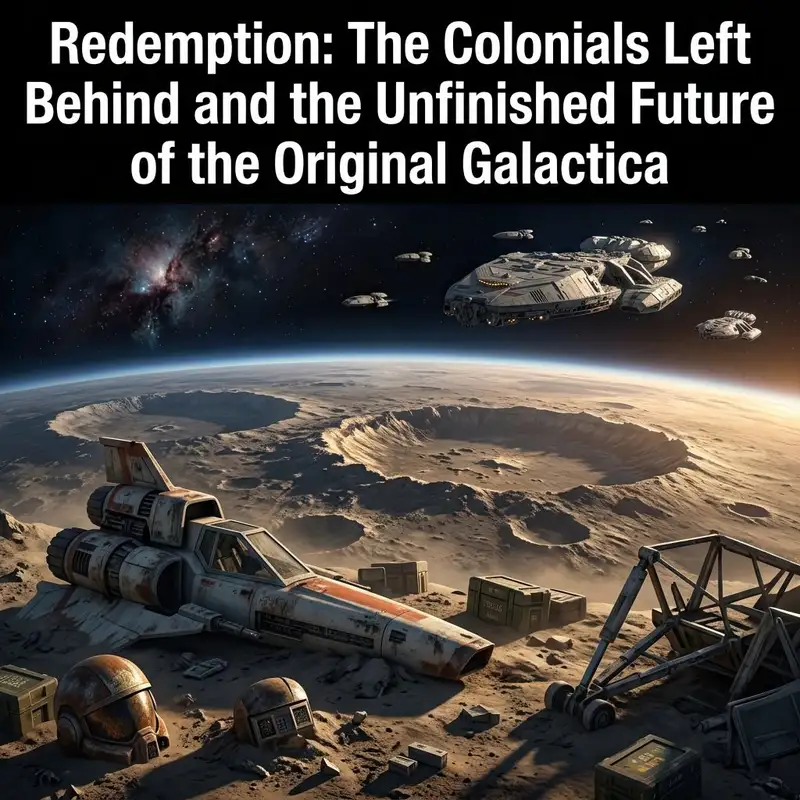
Redemption: The Colonials Left Behind and the Unfinished Future of the Original Galactica [Hatch Continuation]
Paradis was supposed to be a reprieve. After decades of flight, battle, loss, and improvisation, the Colonial fleet had found a place where damaged ships could be rebuilt, worn systems could be repaired, and exhausted people could imagine something more durable than another jump into the unknown. But repair is not restoration. The Colonies were gone. Their shipyards, farms, schools, medical systems, and reserve manpower were gone with them. A fleet that had survived by cannibalizing its own machinery could make some vessels serviceable again. It could not make every hull fit for another deep-space passage. When the fleet prepared to leave Paradis, mobility became a test of worth. Some ships could continue. Others could not. And attached to those ships were people whose future was being decided by engines, structural damage, provisions, and calculations they had not made.
This is the world of Richard Hatch’s continuation novels, a separate literary future for the characters of the original Battlestar Galactica. It does not follow Galactica nineteen eighty. It does not share the later reimagined series’ history of Cylons, Earth, or Colonial institutions. In this branch, the search for the Thirteenth Tribe and Earth remains unfinished decades after the original exodus. Redemption, published in two thousand five, is the seventh and final published novel in that sequence. It begins after the fleet’s departure from Paradis, but its true subject is more than the next stage of the journey. It is the cost of deciding who gets to make that journey at all.
The novels describe what became known as the Great Selection. Available accounts suggest that roughly eight hundred people, associated with perhaps fifteen ships judged unable to continue, were left behind. Neither figure should be treated as a perfect census. The Hatch continuation has an unstable internal chronology and sometimes inconsistent fleet details. The larger fact is secure. A substantial group of Colonials was separated from the main fleet because the fleet lacked the capacity to carry every person and every damaged vessel onward. It was a logistical decision, but logistics in a refugee civilization are never merely technical. A ship’s failed drive becomes a family’s sentence. A fuel calculation becomes a political judgment. A maintenance report becomes a decision about whose children are included in the future.
The selection process is presented as a collective necessity, a lottery or allocation system meant to distribute an intolerable burden rather than conceal it behind command privilege. That matters. A transparent lottery is morally different from a commander quietly assigning the weakest ships to die. But procedure does not remove coercion. The people chosen to remain did not receive a meaningful choice between two safe futures. They were selected because the fleet could not preserve everyone in motion. The Great Selection gave the crisis a form of legitimacy. It did not give it justice. The main fleet might have had sound operational reasons to continue. It still left people behind because the alternative appeared to be risking everyone.
Apollo refused to leave the selected Colonials alone. Sheba remained with him, as did Koran. Their decision gave the separation a different moral character. The fleet’s leaders were no longer asking others to accept abandonment while reserving mobility for themselves. Apollo, one of the best known Warriors in the fleet and a central heir to its military tradition, chose to become commander of the people left behind. Sheba, who had already spent years navigating the burdens of war, command, and family, accepted the same danger. Koran’s choice carried its own weight. The next generation was more than inheriting stories of sacrifice. It was being asked to live inside the consequences of one.
Voluntary leadership did not erase the inequality of the Great Selection. Apollo and Sheba could choose to stay because they possessed authority, skill, and a degree of agency that many ordinary civilians did not. Their courage mattered, but it could not transform every person left behind into a willing participant. What it did provide was something more practical and more necessary than a gesture. It gave the stranded population command figures who shared its fate. In a crisis where formal institutions had been divided by distance, Apollo’s legitimacy rested heavily on presence. He would eat from the same limited stores, face the same uncertain shelter, and be exposed to the same threats. That is not a substitute for constitutional government. It is, however, one of the few foundations available when a population has been cut loose from its larger political structure.
Apollo’s responsibilities changed immediately. He was no longer simply a Warrior operating within a fleet that had battlestars, established command relationships, and a larger support system. He was responsible for a stranded community. That meant security, food, medical care, order, morale, and the management of despair. It meant deciding how much hope to offer when no reliable rescue timetable existed. It meant recognizing that every civilian was also a possible worker, caretaker, mechanic, teacher, or future recruit. The stranded group could not be treated as surplus population. It was a small society, and societies cannot survive on heroic speeches or fighter sorties alone.
The departing fleet faced its own form of desperation. Athena carried major responsibility for the force moving onward, while Tigh and other senior officers exercised authority within an arrangement the novel does not always define consistently. It is wiser to see this as a distributed and strained command system than to impose a clean modern chart upon it. Galactica remained the military center of gravity, but no battlestar could solve the fleet’s underlying problem. The Colonials were preparing for another passage through hyperspace with food already becoming a strategic concern. Medical accommodations were expanded. Civilian spaces were reorganized. Some civilians were moved onto battlestars to reduce the number forced to remain behind. Every available hull had to be reconsidered as shelter, transport, hospital, warehouse, or defense platform.
The projected journey offered no secure promise of arrival. The fleet expected at least weeks of travel, perhaps longer, toward another system. In such conditions, food was not a background concern. It shaped every command decision. A battlestar can protect a convoy from attack, but it cannot manufacture an agricultural base out of empty space. Medical ships can be repurposed, but that does not create more trained personnel. Civilian ships can be crowded, but overcrowding carries its own health, sanitation, and morale costs. The fleet had preserved mobility by leaving people behind, yet it had not escaped scarcity. It had simply converted one immediate crisis into another that would unfold along the route.
Starbuck remained with the main fleet, carrying the emotional burden of separation alongside the ordinary pressures of survival. His concerns for Apollo, Cassiopeia, and the people left behind were more than personal. They reflected a larger fracture in the Colonial community. The fleet was no longer one body moving together. It had become two populations joined by memory, obligation, and uncertainty, but divided by distance and material capability. That division made every later discovery on Paradis more consequential. If the people left behind could find a way to survive, the Great Selection might become something other than a death sentence. If they could not, the main fleet’s escape would carry a permanent moral debt.
The destruction of Paradis revealed an unexpected possibility. Hidden within or made accessible by the planet’s ruin was an ancient Kobolian ark. For a population that had just been classified as unable to continue, the ark appeared almost impossibly fortunate. It was habitable. It offered shelter. More than that, it contained preserved human beings, ancient writing, and evidence connected to the long-lost Thirteenth Tribe. The stranded Colonials had expected to become a remnant abandoned beside a failed world. Instead, they found a vessel from an earlier civilization, one that seemed to contain both practical refuge and historical answers.
The discovery changed Apollo’s mission. He still had to preserve food, order, security, and morale. But now he also had an intelligence problem. The ark might be a shelter. It might be an archive. It might hold direct evidence about the people the Colonials had pursued through legend, scripture, rumor, and fragmentary records. For generations, the Thirteenth Tribe had represented both ancestral memory and strategic destination. If these preserved figures were connected to that tribe, then the ark could alter the fleet’s understanding of its own past and perhaps offer a path toward Earth.
Apollo’s response was recognizably humane. He ordered efforts to revive viable survivors. A commander facing rows of preserved human bodies could not easily choose to leave them dormant forever, especially when those bodies might be living witnesses to the Colonial people’s oldest historical question. The decision also had practical logic. More survivors could mean more knowledge, more skills, more labor, and perhaps a direct link to an older civilization’s navigational record. But it was a decision made under incomplete intelligence. The Colonials had discovered an archive, not a fully translated briefing room. They did not know the ark’s complete history. They did not understand every warning embedded in its inscriptions. And they lacked the medical knowledge to treat ancient hibernation as a routine procedure.
Gar’Tokk became indispensable because he could read what others could not. As a Borellian Noman, he brought linguistic knowledge and a spiritual tradition that the stranded Colonials did not share. His work was not decorative mysticism appended to a military expedition. It was operationally decisive. The ark’s inscriptions contained a warning. One of the preserved inhabitants carried a plague, a disease connected to the devastation of the ancient Kobollians. That infected person was not to be revived until a cure could be found. The message turned the ark’s promise inside out. What had seemed to be a chamber of survivors was also a sealed record of catastrophe.
But the warning arrived too late. Medical personnel, including Doctor Du’bah, had already interfered with the hibernation process. The danger was no longer confined to a translated inscription or a single preserved body. Exposure had begun. It would be easy to reduce this moment to individual recklessness, to identify one doctor or one technician and declare the case closed. The novel supports a broader reading. The failure involved access control, translation timing, medical authority, expedition security, and the pressure to act before the group possessed a complete threat assessment. In a functioning state, dangerous discoveries might pass through layers of quarantine, scientific review, and civilian oversight. Apollo’s contingent had none of those systems in depth. It had urgency, limited expertise, and a population looking for a miracle.
The ark became a medical emergency zone. Apollo, Sheba, Boomer, Gar’Tokk, and others were exposed. The precise boundaries of infection and the full casualty record are not cleanly established, but the strategic threat is unmistakable. A plague in a small stranded population cannot be reduced to a threat to named heroes. It is a threat to social continuity. The sick include workers who maintain shelter, people who care for children, specialists who interpret alien equipment, and younger Colonials who might one day carry the defense of the community. In a diminished civilization, every loss has more than one consequence.
Apollo faced the kind of command problem that does not yield to courage alone. He needed medical judgment, security discipline, reliable information, and enough public trust to keep fear from breaking the group apart. Quarantine is not just a medical term. It is a political act. It restricts movement, separates families, and asks frightened people to accept decisions made by authorities who may not fully understand the threat themselves. A commander who conceals too much invites rumor. A commander who reveals uncertainty without offering a plan risks panic. Redemption does not turn this into a detailed public-health procedural manual, but it understands the basic fact. Disease attacks institutions as much as bodies.
The ark’s status changed accordingly. It was no longer just a refuge from the Great Selection. It became a test of whether the stranded contingent could create order under pressure. The people left behind had already been told, in effect, that their ships and futures were less viable than those of the departing fleet. Now they faced a second form of abandonment, this time biological. The plague threatened to confirm the cruel logic of the original separation. The fleet had moved on. The people who remained had found an ark. And even the ark seemed to contain a mechanism for their destruction.
Gar’Tokk’s infection and survival introduced a measure of hope, though not a simple cure. Through a Borellian Noman practice involving a near-death or regenerative ordeal, he endured what appeared fatal. This is one of the Hatch continuation’s distinctive crossings of bodily experience, religious tradition, and unexplained possibility. It should not be treated as a standard Colonial medical technique. It does not mean that every infected person could be saved by repeating the ritual. Nor does the novel provide a complete scientific account that turns Gar’Tokk’s survival into a reproducible treatment plan.
What it did provide was evidence. The plague was not necessarily absolute. Gar’Tokk’s survival preserved the one figure most capable of translating the ark’s warnings and guiding the group through its historical mysteries. It also reminded Apollo that a population’s knowledge may reside in people whose value is not obvious from a military roster. Gar’Tokk could not be reduced to an interpreter. In the middle of a crisis, language, ritual, memory, and cultural knowledge became as important as weapons expertise or flight training. A civilization that loses its translators may survive physically while becoming unable to understand the dangers and opportunities placed before it.
The need for a cure drove Apollo toward another bitter paradox. The knowledge required to save Colonial lives appeared to exist aboard a derelict Cylon basestar. The basestar was associated with research involving Count Iblis and human DNA, areas of knowledge that lay at the intersection of enemy science, manipulation, and ancient terror. The stranded Colonials could not independently reproduce the research they needed. Their medical emergency forced them to enter hostile infrastructure and search through the technological inheritance of an enemy that had hunted them for decades.
Boomer’s technical contribution mattered here, but this is the Boomer of the original Galactica tradition carried forward through the Hatch novels, not a figure from another continuity. He is part of the group attempting to make sense of Cylon systems that remain dangerous even when their original operators are absent. A derelict basestar is not harmless because it is abandoned. Its records may be incomplete. Its machinery may be incomprehensible. Its defenses, experiments, and internal logic may outlast the battle that left it behind. The mission to retrieve the research was therefore not a straightforward raid. It was an intelligence and survival operation conducted in an environment where the Colonials possessed neither full technical mastery nor reliable context.
The deeper problem was that Cylon knowledge had become indispensable. The Colonials wanted freedom from Cylon power, yet their survival depended on material and scientific traces left by that power. This is not unusual in war. States often inherit the infrastructure, weapons, industrial methods, and even medical discoveries of enemies they despise. But the Hatch continuation gives the problem a sharper edge. The Cylons are more than an opposing military force. Their technology is bound up with human history, ancient experiments, manipulation by Iblis, and the long struggle to define what humanity is becoming. To use Cylon-derived material was not to trust the Cylons. It was to admit that the Colonials no longer had the luxury of rejecting every tool touched by their enemy.
The cure was synthesized from that recovered knowledge. It was not introduced as an effortless miracle, and its effects were not guaranteed in advance. Apollo accepted the first injection himself. The act has an obvious heroic quality, but its importance is more specific than simple bravery. Formal institutions were thin. Medical certainty was limited. The people under Apollo’s command had reason to fear that they had been abandoned twice, first by the fleet’s departure and then by the ark’s plague. By taking the first dose, Apollo assumed the risk he was asking others to accept. He used his own body as a pledge of command responsibility.
Sheba’s survival mattered personally to Apollo and politically to the stranded group. Her presence represented more than one commander restored to duty. She embodied continuity between the older fleet that had fled the Colonies and the smaller community trying to endure after the Great Selection. Yet the cure did not restore the world that existed before the plague. The ark remained a dangerous place. The contingent remained separated from the main fleet. The abandoned ships did not suddenly regain deep-space capability. The Great Selection had not been reversed. Mission success was real, but it was limited. The group had survived a crisis. It had not reached Earth, reunited with the fleet, or secured peace.
The novel’s title also belongs to Baltar. In this continuation, Baltar is dead, yet he appears intermittently to Apollo in a spectral or astral form. His communications are difficult and incomplete. He directs Apollo toward Gar’Tokk and toward the information that may lead to the cure. The mechanism is unresolved. It is not Cylon resurrection. It is not a technological duplication explained by a later screen continuity. Nor should it be reduced automatically to a conventional image of the afterlife. In the Hatch novels, the astral realm is part of a wider metaphysical conflict involving memory, guilt, manipulation, and forces that cannot be neatly placed on a military map.
Baltar’s presence does not make him innocent. Redemption does not ask the reader to forget what betrayal cost the Colonials. The character’s history carries guilt that cannot be dissolved by one useful warning, one act of assistance, or one posthumous appearance. What changes is the question of what a guilty person can do with whatever agency remains. Baltar cannot undo the harm already done. He can choose to use his knowledge in the service of people he once endangered. That is atonement in the narrow and difficult sense. It is action after guilt, not retroactive absolution.
The novel’s metaphysical elements do not all carry the same moral weight. Gar’Tokk’s survival offers ambiguous hope. Baltar’s appearances suggest the possibility of atonement. Count Iblis represents something darker. Cassiopeia struggles with her young son, a child whose behavior is unnervingly precise and emotionally disturbing. Iblis appears and claims that the boy is his son rather than Apollo’s. He also claims that the child is destined for extraordinary civilizational importance, perhaps even for a salvific role in the future. These claims arrive in the language of revelation, but they come from a manipulator with every reason to shape fear, identity, and loyalty.
Iblis also suggests that disasters Cassiopeia blamed on the boy were caused by outside forces rather than by the child himself. That assertion may complicate her fear, but it does not settle the matter. The novel does not provide the reader with a reliable judicial record of Iblis’s statements. His purpose is to exploit uncertainty. By claiming special parentage and future destiny, he attempts to transform a vulnerable family crisis into a matter of cosmic authority. The child becomes not just a child, but a potential instrument of prophecy and control.
The younger generation remains important throughout this crisis. Troy, Rhaya, Dalton, Bojay, Caran, Koran, and others represent a people that can no longer rely entirely on the original generation of Warriors and leaders. Decades into exile, experienced personnel age, die, change roles, or become exhausted by burdens that never end. New recruits cannot be reduced to replacements for lost pilots. They are successors to an entire civilization whose institutions were destroyed. They must learn defense, maintenance, medicine, governance, and memory under conditions far harsher than those that formed their parents.
That demographic pressure gives the Great Selection additional force. The people left behind are not an excess population produced by a healthy society. They are part of the shrinking reservoir from which every future function must be drawn. A young person may be a potential Warrior, but also a teacher, a technician, a parent, or a caretaker. An older person may no longer serve in combat but still hold irreplaceable knowledge. The arithmetic of fleet survival is therefore always misleading when it treats bodies as cargo. The Colonials do not need only passengers who can fit aboard a ship. They need a living network of skills, relationships, and memories.
The ark crisis demonstrates how quickly that network can fail. An infection removes caregivers and specialists. A quarantine divides families and weakens trust. A translation delay turns historical discovery into mass exposure. A shortage of medical authority creates room for unauthorized action. The novel’s setting may be fantastic, but the institutional lesson is familiar. Small societies are often most vulnerable when they appear most unified. They depend heavily on a few indispensable people. When those people are sick, absent, or divided, the whole structure begins to shake.
Apollo’s contingent survives because it finds ways to resist that collapse. It does not do so through superior firepower. There is no final fleet battle that resolves the crisis. The key actions are interpretive, medical, and moral. Gar’Tokk reads the warning. Boomer helps navigate the Cylon technological problem. Medical personnel synthesize and administer the cure. Apollo accepts risk publicly. Sheba endures and survives. Baltar, from beyond ordinary life, offers incomplete guidance. Each contribution matters because the group cannot afford the illusion that one kind of expertise is enough.
The main fleet remains a shadow over all of this. Athena, Tigh, Starbuck, and the others moving onward are not villains for departing. They carry a separate population through its own food crisis and uncertain journey. But their departure gives the stranded group’s struggle its meaning. Apollo’s people are not isolated by accident. They are isolated by a decision made under strategic pressure. That decision may have preserved the larger fleet’s chance of survival. It also created a population whose safety depended on its own ability to turn abandonment into community.
Redemption does not answer these questions with a final settlement. It gives partial answers through conduct. Apollo remains. Sheba remains. Koran remains. The group investigates the ark rather than merely waiting to die. The plague is confronted rather than hidden. The Cylon basestar is entered because survival requires knowledge the Colonials do not possess. Baltar assists, not as a forgiven hero, but as someone attempting to direct what remains of himself toward life rather than destruction. These acts do not make the past clean. They keep the future morally open.
Yet the future is not secured. In the closing movement of the novel, Baltar encounters the Imperious Leader on the astral plane. The meeting does not provide a complete explanation of Cylon strategy, cosmic hierarchy, or the machinery of the afterlife. It restores threat rather than resolving it. Imperious Leader has a fourth brain surgically attached, an alteration that implies a new capacity or a new stage in an unfinished design. He suggests that Baltar’s knowledge may help advance that design. The scene is not a victory lap for the Colonials. It is a warning that the forces threatening them have not vanished simply because one stranded group found a cure.
The fourth-brain image is important precisely because it remains unclear. The novel does not offer enough information to turn it into a reliable technical specification. It should not be treated as proof that the Cylons have solved every limitation, gained perfect foresight, or acquired an invincible new weapon. Its narrative function is more immediate. The Imperious Leader remains active. Cylon ambition remains adaptive. Knowledge, including Baltar’s knowledge, can still be exploited. The Colonials have survived a medical disaster, but they have not escaped the long war of memory, technology, and manipulation that surrounds them.
The final encounter also darkens Baltar’s attempt at atonement. His guidance to Apollo has helped preserve life, but he remains entangled in forces he cannot fully control. Redemption, in this sense, is not a state one reaches and possesses. It is a struggle conducted under conditions where old guilt, old enemies, and old systems continue to exert pressure. Baltar may act differently. He may seek to serve rather than betray. But the world around him does not automatically release him from consequence, and it does not stop trying to use him.
Here, the publication history becomes part of the story’s meaning. Redemption was the seventh published Richard Hatch continuation novel. It was not designed to close the entire narrative. A planned eighth volume, Discovery, was reportedly conceived as part of a larger two-book conclusion. But Discovery was never published. The available record does not allow a confident claim that a finished manuscript exists, who might control it, or whether it could ever have appeared in the intended form. What is certain is simpler and more consequential. Readers never received the continuation that the ending promised.
That absence leaves the Hatch branch in a peculiar historical position. Its Colonials survive, but readers do not see the final outcome of the threat implied by Imperious Leader’s return. The ark’s relationship to the Thirteenth Tribe remains incomplete. Earth is not found. No final reconciliation between Colonials and Cylons is achieved. Apollo’s stranded population is preserved in part, but not delivered into a secure future. Baltar’s attempt at atonement remains active but unresolved. Cassiopeia’s child remains surrounded by Iblis’s dangerous claims. The future exists as a promise, a threat, and an unwritten destination.
That does not make their choices meaningless. In fact, it makes them more demanding. If redemption depended on a guaranteed ending, it would be little more than a reward. In this novel, redemption is the decision to keep accepting responsibility when the future cannot be secured in advance. Apollo’s contingent matters because its leaders refuse to accept that damaged ships and selected civilians are disposable. The cure matters because survival is worth pursuing even when it cannot restore what was lost. Baltar’s service matters because guilt does not become innocence, yet neither does it remove the possibility of choosing differently.
The Hatch continuation ends, at least in published form, with a civilization still alive, still divided, still threatened, and still unable to see the full shape of the road ahead. That is not the resolution the title appears to promise. It is the burden the title finally defines. Redemption is not escape, cure, prophecy, or absolution. It is the refusal to abandon moral duty when survival systems have already classified some people as expendable.