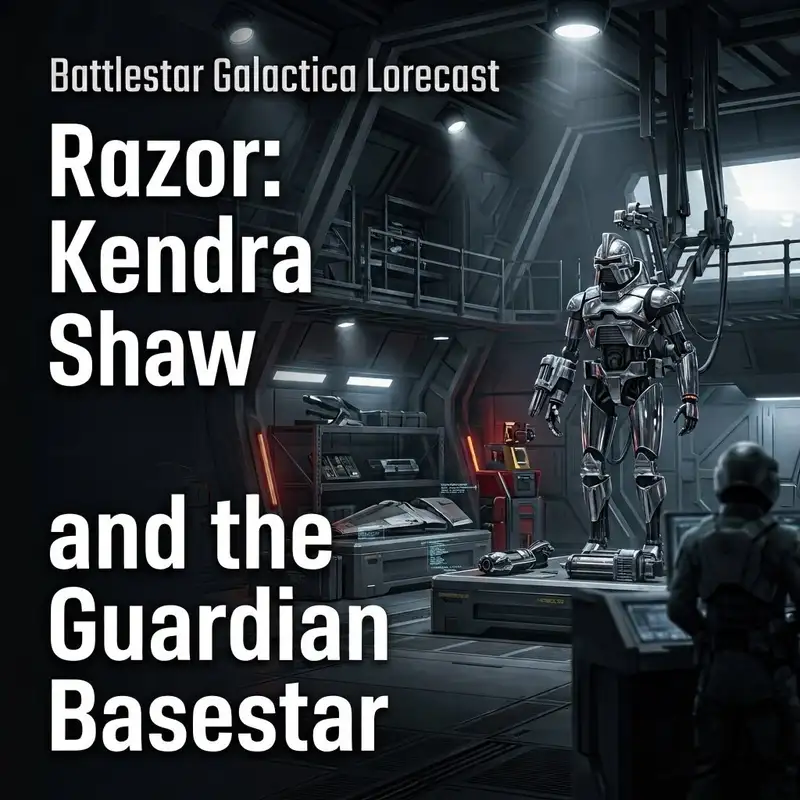
Razor: Kendra Shaw and the Guardian Basestar
The remote detonator is broken. Cylon jamming has turned the Guardian Basestar into a sealed battlefield. The strike team has found the missing Raptor crew, but not in any condition that permits a clean rescue. Marines are wounded. Centurions are closing in. An evacuation Raptor is trying to reach them through a situation that has already outgrown the original plan. And inside the old Cylon vessel, Captain Kendra Shaw understands what the mission has become. The nuclear weapon can still destroy the basestar, but only if someone stays behind to arm it by hand.
That is the immediate military problem. The deeper problem is Kendra Shaw herself. She is the executive officer of Battlestar Pegasus, a capable officer trusted by Commander Lee Adama, feared by some of the crew, and shaped by years under Admiral Helena Cain. Cain had taught her that survival required a person to cut away hesitation, fear, and moral revulsion. Cain called that quality being a razor. On the Guardian Basestar, Shaw must decide whether that training has made her a weapon of someone else’s cruelty, or whether she can still choose what her own strength is for.
To understand why Shaw takes the warhead, it is necessary to return to the destruction of the Twelve Colonies, when Pegasus survived not because it was invulnerable, but because it was incomplete.
Kendra Shaw reported aboard Pegasus shortly before the Cylon attack, while the battlestar was undergoing a major overhaul at the Scorpion Fleet Shipyards. Systems were offline. Equipment was being replaced. Networks and navigation functions were not operating in their normal configuration. That disruption was dangerous in peacetime terms. A battlestar in refit is less ready to fight, less able to sortie aircraft, and dependent on workers, parts, dock facilities, and time. But on the day of the attack, the overhaul created a form of accidental resilience.
The Cylons had compromised the Colonial defense establishment through the Command Navigation Program, software associated with the interconnected systems on which the fleet had come to depend. Pegasus was not untouched by computer systems, and neither was Galactica. The distinction was narrower and more important. Pegasus had parts of the compromised architecture offline during the attack. The Cylon exploit could not disable the ship in the same decisive way it disabled more integrated Colonial forces. That was not proof that old technology was inherently wiser than new technology. It was proof that common systems can create common failure points, especially when procurement, maintenance, security, and intelligence all assume that the supplier is trustworthy.
Pegasus still faced a catastrophe. The ship received incomplete information. Navigation was damaged. The Cylon assault was unfolding across the Colonies at a speed no normal command structure could absorb. Admiral Cain ordered a blind faster-than-light jump. It was a risk taken under pressure, with damaged systems and uncertain coordinates. A jump without full confidence in the destination can scatter a force, strand it, or place it in greater danger. But remaining in place offered little prospect of survival. Pegasus jumped, escaped immediate destruction, and emerged alone.
That escape became the foundation of Cain’s authority. Her ship had survived when the civilization that built it had apparently been annihilated. Her crew had no clear chain of higher command, no secure rear area, no access to fleet bases, shipyards, fuel depots, replacement pilots, or civilian government. They had a battlestar, wounded personnel, damaged systems, an increasingly thin air wing, and an enemy that had already proven capable of infiltrating Colonial institutions at the highest level.
Under those circumstances, Cain concluded that the ship itself had become the last meaningful unit of civilization. Pegasus had to remain armed, mobile, and offensive. Anything that weakened its combat power, in her view, threatened the survival of everyone aboard. That diagnosis contained a real military insight. A damaged battlestar without ammunition, repair capacity, trained crew, or fighters is not a refuge for long. But Cain’s answer also contained a fatal error. She treated the preservation of Pegasus as if it could justify any method used in its name.
The first major test came when Pegasus attacked what appeared to be a Cylon communications relay. The target seemed limited. Destroying it promised to disrupt enemy coordination and give Pegasus room to maneuver. Instead, the operation exposed the battlestar to a larger Cylon staging area than Cain expected. A mission intended as a strike became a battle for survival.
The tactical pressure was severe. Pegasus committed fighters, absorbed attacks against its systems, and faced the loss of aircraft that could not easily be replaced. The ship’s weapons grid was compromised. Cylon forces boarded the battlestar. The reported losses were staggering, more than eight hundred personnel dead and more than ninety Vipers destroyed or unavailable according to the operational accounts presented later. Those figures should be understood as wartime reporting from a damaged ship, not a perfect census assembled in calm conditions. Their significance lies in what they meant. Pegasus was bleeding skilled labor, pilots, maintainers, engineers, deck personnel, and command experience at a rate it could not sustain.
Cain’s executive officer, Jurgen Belzen, resisted her demand to commit reserve fighters. His objection was not frivolous. Reserves exist because commanders must account for the next emergency, not only the current one. A battlestar that launches every remaining fighter may win the immediate engagement and become helpless afterward. Cain read his resistance as cowardice or insubordination. She executed him.
The execution was not merely a personal act of rage. It changed the command climate aboard Pegasus. It told officers that professional disagreement could be treated as betrayal. It told subordinates that the distinction between tactical assessment and disobedience had become dangerously thin. A commander may need decisive obedience in combat. But a force that cannot communicate bad news upward will eventually lose its ability to assess reality. Cain’s method produced fear, and fear can generate immediate compliance. It does not necessarily generate better judgment.
During the same period, Shaw encountered Gina Inviere, a humanoid Cylon infiltrator aboard Pegasus. The discovery confirmed the crew’s worst suspicions. The enemy did not merely attack from beyond DRADIS range. The enemy could enter human institutions, build relationships, gather intelligence, and reveal itself only after the damage was done. That was a genuine intelligence shock, and it helps explain the fear that overtook Pegasus. But fear did not compel every choice that followed. It created conditions in which cruelty could be presented as prudence, and in which dehumanization became easier to sell as security.
Cain emerged from the relay battle convinced that hesitation was more dangerous than brutality. Shaw learned the same lesson in a more personal form. She saw that the officer who suppressed doubt, carried out orders, and remained functional amid chaos could advance. The officer who hesitated could be destroyed. That lesson would follow her into the next stage of Pegasus’s independent war.
After the battle, Pegasus encountered a convoy of fifteen civilian ships. For a battlestar operating alone, the convoy represented both an opportunity and a problem. The ships had supplies, equipment, people with useful technical skills, and faster-than-light components. Pegasus needed all of those things. Its own stores were finite. Its combat losses had created pressure on every department. The ship needed mechanics, medical personnel, engineers, spare parts, fuel-related equipment, and the capacity to keep fighting after the next Cylon contact.
No responsible military historian should pretend that these requirements were imaginary. Pegasus was not operating from a protected naval base. It could not submit a requisition and expect a logistics ship to arrive on schedule. It had no homeland industry behind it. Every broken Viper, damaged bulkhead, exhausted crew member, and depleted store room narrowed its options. Cain was right to recognize that a warship cannot defend anyone if it loses the ability to operate.
But the question was never whether Pegasus needed resources. The question was how a military command would obtain them, and what it would become in the process.
Cain ordered the civilian ships stripped of supplies, equipment, faster-than-light drives, and selected personnel. When civilians resisted, her officers threatened their families. The operation crossed the line from emergency requisition into coercive extraction. The civilians were not partners in a common survival effort. They were treated as a resource pool whose objections could be overcome by force.
The confrontation aboard the civilian ship Scylla became the defining event in Kendra Shaw’s life. Shaw fired the first shot. Colonial Marines killed civilians. The details matter because vague language can conceal responsibility. Cain established the policy. She ordered the seizure, accepted coercion as the instrument, and created the command environment in which the violence took place. That establishes her command responsibility. But Shaw was not an inanimate extension of Cain’s will. She participated. The Marines who fired also participated. The fact that the order came from above does not turn those below into machinery.
Cain promoted Shaw afterward. She described her as a razor, someone capable of cutting away fear, disgust, and hesitation in order to do what survival required. It sounded like praise. In a military culture exhausted by loss, it may even have sounded like an explanation for how to keep functioning. But Cain’s definition of strength was not disciplined courage. It was emotional amputation.
A professional military officer must sometimes make decisions that cause harm. A commander may order a retreat that leaves people behind. A pilot may be unable to save a damaged ship. A ship’s captain may ration medicine, fuel, or air in ways that impose suffering. Those decisions can be tragic without being cruel, provided they are governed by necessity, proportionality, responsibility, and recognition of the people affected. At Scylla, Cain’s policy discarded those restraints. The civilians’ lives, autonomy, and families became tools for preserving Pegasus’s power.
Shaw learned to live afterward by not looking too directly at what she had done. The razor metaphor became a form of psychological armor. If revulsion was weakness, then feeling it became a threat to survival. If obedience was the measure of professionalism, then conscience became an obstacle to be suppressed. That is how an atrocity can remain present in a person long after the order has ended. Not as a single memory, but as a habit of refusing to examine what the memory means.
Pegasus later encountered Battlestar Galactica and the civilian fleet. That meeting ended Pegasus’s isolation, but it did not erase what the ship had become. The crews clashed over authority, prisoners, torture, discipline, and the status of civilians. Pegasus brought formidable military capability to the survivor fleet. It also brought a command culture damaged by fear, unchecked power, and the belief that legal restraint was a luxury the dead world could no longer afford.
After Cain’s death, Lee Adama assumed command of Pegasus. His challenge was larger than operating a battlestar. He had to preserve the ship’s combat value while changing the institution that operated it. A commander cannot just dismiss every officer associated with a previous regime, especially when the fleet is short of experienced personnel. Nor can he pretend that competence cancels a history of participation in abuse. Lee kept Kendra Shaw and appointed her executive officer because she was disciplined, knowledgeable, and deeply familiar with Pegasus’s systems and crew.
That decision was practical, but it was not simple. Shaw had served Cain closely. She had been promoted within Cain’s system. She carried the reputation of someone who could impose order without softness. Yet she was also not untouched by what she had seen and done. Her use of drugs to blunt her emotional pain was evidence that the razor had not removed her conscience. It had only driven the injury inward.
Kara Thrace recognized something in Shaw that other officers often missed. Starbuck had her own history of anger, recklessness, guilt, and resistance to authority. Shaw and Thrace did not become easy friends. Neither was built for ease. But they understood professional competence, fear concealed behind aggression, and the need to act under conditions where hesitation could kill people. Their relationship mattered because Shaw’s final mission would place her beside someone who would not accept Cain’s vocabulary as the only language of courage.
The Guardian Basestar entered the story through a search-and-rescue problem. A Raptor went overdue. In a refugee fleet, an overdue Raptor is never just a missing aircraft. It may contain pilots, officers, intelligence personnel, navigators, or specialists whose loss cannot be easily replaced. It may also represent a threat to the fleet if the crew has been captured, compromised, or followed. Search and rescue is therefore both a moral obligation and an operational necessity.
The search brought contact with unfamiliar Cylon Raiders. Their appearance suggested an older generation of Cylon technology, resembling forms associated with the First Cylon War rather than the Raiders then familiar to the fleet. Sharon Agathon identified the likely connection. These were associated with the Guardians, obsolete Centurion units believed to have survived outside the main Cylon order while protecting an early Hybrid.
The word obsolete can be misleading. Old does not mean harmless. A weapon system may be superseded, forgotten, or excluded from the main force structure and still remain dangerous if it retains mobility, weapons, personnel, and a purpose. The Guardian force appeared to be a surviving pocket of a much older Cylon development. Its basestar was not a standard later basestar in every respect, and it should not be treated as a Resurrection Ship or given a complete technical history the surviving evidence does not support. What mattered was clear enough. It carried Centurions, housed an anomalous Hybrid, and had captured Colonial personnel.
William Adama understood the danger with unusual force because his own First Cylon War experience had brought him into contact with Cylon experimentation on human beings. The Guardian discovery suggested that the old war had not ended cleanly. The Armistice had ended open conflict between the Colonies and the Cylons, but it had not guaranteed that every Cylon project, facility, faction, or experiment had disappeared. Some threats can outlive the governments that created them.
The intelligence assessment was grim. The missing Raptor crew might still be alive. But if the Guardians had taken them, rescue would have to be conducted quickly, before the basestar moved, reinforced its defenses, or completed whatever it was doing to its prisoners. The fleet could not merely stand off and negotiate. It could not assume the old Centurions shared the priorities of the humanoid Cylon models. It could not know whether the Guardian force was connected to a larger Cylon command, or whether it was isolated. The uncertainty itself was part of the threat.
The mission plan reflected those limits. Pegasus would serve as a decoy, drawing attention and creating a window for a smaller team to approach the basestar. A Raptor carried Kara Thrace, Kendra Shaw, Sergeant Erin Mathias, DaSilva, and Hudson. Their task was not to storm the basestar through overwhelming force. Pegasus did not have the luxury of sending a large boarding party into an unknown Cylon vessel while maintaining fleet defense.
Instead, the team used deception. The Raptor simulated a malfunction and was abandoned in space. The team then used maneuvering thrusters to reach the Guardian Basestar without presenting a conventional attack profile. It was a dangerous insertion method. Space outside a ship is unforgiving. A failed thruster, damaged suit, missed handhold, or unexpected defensive response can turn an infiltration into a casualty event before the team reaches the hull.
The plan also depended on compartmentalized risk. Pegasus could not expose itself recklessly, because the battlestar remained responsible for the larger refugee fleet. The strike team could not expect constant communication, immediate fire support, or a guaranteed extraction. The Marines were limited in number. The interior layout of the basestar was unknown. The enemy had home-field advantage, and the team’s intelligence about the prisoners was incomplete.
The nuclear weapon carried by the team was not just an expression of superior firepower. It was a contingency. If the Guardian Basestar could not be neutralized through a rescue and withdrawal, the weapon offered a way to deny the Cylons their facility and prevent the ship from continuing its mission. Nuclear weapons change the scale of available force, but they do not remove the need for judgment. They create a requirement for even more judgment, because their use can destroy the target, the mission, and the people sent to carry it out.
Inside the basestar, the team found the missing Raptor crew. The evidence was horrifying. The prisoners had been mutilated and subjected to experiments resembling the human experimentation William Adama had encountered during the First Cylon War. The discovery transformed the operation.
The mission was still a rescue attempt, but it was no longer possible to regard the Guardian Basestar as merely an unusual military contact. It was an active site of abuse. The older Cylon force had preserved not only antiquated hardware and isolated command structures, but a method of treating human captives as material for experimentation. That did not prove that every Cylon faction shared its purpose. It did prove that this particular force could not be allowed to continue unchallenged.
The team came under Centurion attack. In the confusion, DaSilva was wounded and taken by the Cylons. Shaw killed him rather than permit him to be carried away for further experimentation. It is tempting to call that act merciful and leave the analysis there. It was more difficult than that. Shaw made a battlefield judgment under extreme conditions. DaSilva was wounded, in enemy hands, and facing a fate made visible by the prisoners already found aboard the ship. Her action prevented the Guardians from continuing their abuse of him.
But it was not a clean act, and the story does not ask the audience to treat it as one. Shaw had once fired the first shot in a massacre of civilians because Cain’s command philosophy treated people as obstacles to be removed. Here, Shaw killed a fellow Marine to prevent enemy experimentation and further suffering. The circumstances, purpose, and moral direction were different. Yet the moment forced her to confront the terrible power involved in deciding that another person’s life had reached its end. The difference mattered. The echo mattered too.
Shaw was wounded. The team’s numbers, time, and options narrowed. At the same time, the remote detonator for the nuclear weapon was damaged. The original concept had allowed the team to withdraw and trigger the weapon at a distance. That safety margin was gone. The basestar could still be destroyed, but only through manual detonation.
Back on Pegasus, the command problem was equally severe. Cylon jamming had cut communications. Lee Adama could not know whether the strike team had succeeded, failed, been captured, or been killed. He had to consider the danger posed by the Guardian Basestar if it escaped. The vessel contained hostile Centurions, an experimental Hybrid, evidence of human experimentation, and unknown capabilities. Allowing it to disappear into deep space would preserve a threat that might return against the fleet under circumstances far less favorable.
Lee prepared for a nuclear missile strike. That was not an act of indifference toward the team. It was the grim responsibility of a commander whose mission had expanded from rescue to containment. A battlestar commander cannot permit a strategic threat to survive simply because friendly personnel may be inside it. But neither can he treat the loss of those personnel as administratively convenient. The decision required an assessment of what could be saved, what had to be stopped, and how much uncertainty the fleet could accept.
William Adama delayed the strike. As the senior military authority, he had both the experience and the responsibility to challenge the immediate impulse toward destruction. His delay was not sentimentality. He understood the Guardian threat better than most. He had seen enough of the Cylon past to know that the basestar might contain intelligence of immense importance. More importantly, he understood that the team deserved the narrow chance still available to them.
Delay in war can be fatal. It can permit an enemy to reposition, reinforce, launch aircraft, or escape. But immediate action can also destroy friendly forces, eliminate intelligence, and turn uncertainty into irreversible loss. Adama’s decision bought time, not certainty. When communications returned and an evacuation Raptor was dispatched, the mission still depended on whether the strike team could reach extraction before the Guardian Basestar was able to respond.
That was when the broken detonator became decisive. The team could escape, but the weapon could not be triggered remotely. Someone had to stay with it. Shaw took the warhead from Kara Thrace at gunpoint and ordered the others toward evacuation.
The gesture can be misunderstood if it is treated as a sudden conversion from villainy to heroism. Shaw had not been a simple villain, and she did not become innocent because she chose to die. Scylla remained part of the record. The civilians killed there could not be restored. Their families could not be told that Shaw’s later sacrifice had balanced an account. There is no military decoration, no private remorse, and no final act of courage that can erase responsibility for an earlier atrocity.
What Shaw did recover was moral agency. Under Cain, she had been rewarded for suppressing judgment in service of a commander’s objective. The razor was valuable because it cut cleanly, without asking what it was cutting. On the Guardian Basestar, Shaw used the same capacity for decisive action differently. She did not remain behind because an admiral demanded a sacrifice. Cain was dead. She did not stay because the lives of others were expendable. She stayed so that the others could leave.
Her choice protected the surviving members of the team. It denied the Guardians their basestar and their experimental facility. It prevented the ship from escaping with its Centurions, Hybrid, and demonstrated willingness to abuse captives. And it accepted a cost that she imposed on herself rather than on civilians, prisoners, or subordinates who had no meaningful choice.
That distinction does not make sacrifice uncomplicated. Shaw took the weapon from Kara by force. In the final minutes of a mission, she made a decision for another officer as well as for herself. But the operational situation was collapsing, and the central fact remained that Shaw assumed the fatal burden. She did not use necessity as a reason to make someone else pay for her survival.
Before reaching the warhead’s final position, Shaw encountered the ancient Hybrid at the center of the Guardian force. The being identified itself as an early experiment and indicated that the Centurions regarded it as a god. Its speech suggested unusual knowledge of Shaw and of Kara Thrace. It delivered a warning about Kara, but Cylon jamming prevented that warning from reaching Pegasus.
The encounter is important precisely because it resists easy classification. The First Hybrid was not a humanoid Cylon. It was not a standard basestar Hybrid in the familiar later sense. It was not a Resurrection Ship, a numbered model, or a reliable military intelligence source. The released story establishes that it was an early experimental being, connected to the Guardians and treated by its Centurions with a kind of religious reverence. It also establishes that it knew or appeared to know things beyond Shaw’s understanding.
What it does not establish is equally important. The Hybrid is not confirmed as omniscient. It is not confirmed as divine. It is not shown to be a time traveler, a direct embodiment of the Cylon God, or the master of all Cylon forces. Its warning cannot be treated as an actionable briefing on Kara Thrace’s future. It was spoken in a damaged, isolated, and anomalous context. The fleet never received it. For Shaw, the encounter did not offer a map of destiny. It offered one more reminder that the war between humans and Cylons had depths neither side fully understood.
Shaw armed the warhead and detonated it. The Guardian Basestar was destroyed. Kendra Shaw died with it.
Strategically, the Guardian Basestar confirmed that Cylon history contained surviving remnants beyond the apparent structure of the enemy then pursuing humanity. The Cylons were not one perfectly unified machine civilization. They included old projects, isolated forces, humanoid models, Centurions, Raiders, Hybrids, factions, and secrets concealed even from some of their own kind. That complexity did not make the Guardians less dangerous. It made them more difficult to anticipate.
The Guardian mission also revealed the limits of intelligence. Sharon Agathon’s knowledge provided the connection to the Guardians. William Adama’s wartime memory gave the contact meaning. The strike team recovered physical evidence of ongoing experimentation. Yet even after the basestar’s destruction, much remained unknown. How long had the Guardians survived? Who, if anyone, knew of them? What exactly was the First Hybrid capable of knowing? The destruction of a threat can also destroy the records that would explain it.
For Pegasus, Shaw’s death became part of the larger institutional reckoning that followed Cain. Lee Adama had inherited a ship with extraordinary combat strength and serious internal damage. Changing commanders did not automatically restore trust. It did not make the dead civilians of Scylla disappear. It did not erase the fear created by Belzen’s execution, the abuse of prisoners, or the doctrine that survival excused any act. A warship’s culture is carried by memory, habits, promotions, silences, and the things its people have learned not to question.
Shaw embodied that problem. She was a product of Cain’s command climate, but not only that. She had been shaped by it, promoted by it, and wounded by it. Her competence was real. Her responsibility was real. Her guilt was real. Her final act did not produce a legal acquittal or a simple moral cleansing. It did show that the identity Cain assigned her was not the only identity available to her.
Cain’s razor was an instrument sharpened to cut away conscience for the sake of survival. On the Guardian Basestar, Shaw remained decisive, disciplined, and willing to accept terrible risk. But she directed those qualities toward a different end. She protected her team. She denied the enemy the ability to continue its abuse. She accepted the cost herself rather than demanding that the powerless bear it for her.
That is why Kendra Shaw’s sacrifice matters. It was not redemption as a transaction, where one death cancels many others. It was something harder and more honest. It was the recovery of choice by someone who had spent too long treating obedience as a substitute for judgment. The Guardian Basestar was destroyed by a weapon, but the final victory belonged to the moment Shaw refused to let Cain’s definition of necessity decide what kind of officer she would be.