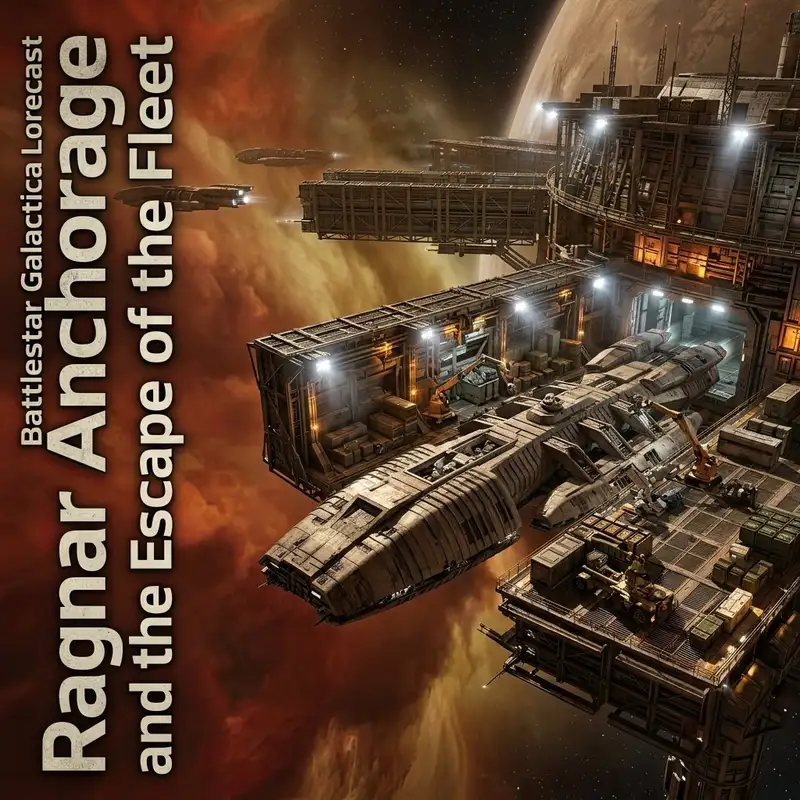
Ragnar Anchorage and the Escape of the Fleet
Roughly sixty civilian ships had gathered in the first confused movement away from the ruined Twelve Colonies. That number was only an operational estimate, assembled from transmissions, rendezvous points, and whatever ship captains could report while systems failed and rumors outran facts. About forty of those ships possessed faster-than-light drives. About twenty did not. The difference was not a technical footnote. It was a dividing line between communities that could escape an approaching enemy and communities that could not. A functioning jump drive meant a chance to carry passengers, food stores, medical supplies, records, mechanics, children, and skilled labor into the unknown. A sublight ship carried equally valuable people, but it could not keep pace with a war that had suddenly become a series of jumps.
Laura Roslin had become president through the legal machinery that remained after the attack. She was forty-third in the line of succession, an extraordinary fact that reflected the scale of the disaster rather than any broad political mandate. Yet succession mattered. The Colonial government had not just vanished because its senior officials were dead. It survived in a diminished form through an office, an oath, and a civilian leader trying to find citizens before the Cylons found them. Roslin’s immediate instinct was rescue. Her convoy moved through the wreckage of a civilization, collecting ships and people wherever it could. That effort was humane, legally defensible, and strategically dangerous. Every additional rescue took time. Every minute in one location increased the chance that a Raider would identify the convoy and bring heavier Cylon forces down upon it.
The civilian ships were not a fleet in the naval sense. They did not share a common training system, chain of command, readiness standard, or mission. Some carried passengers. Some carried cargo. Some contained stores that might later prove vital. Some had crews who understood their own engines and little else about military movement. Their captains answered first to their own passengers, owners, and obligations. They had unequal fuel states, unequal maintenance problems, unequal life-support margins, and unequal ability to survive a long flight. Calling them a fleet was an aspiration before it became a fact. At that point, they were a collection of frightened vessels moving under emergency coordination, with no secure destination and no assurance that any military force could protect them.
Their only plausible shield was Battlestar Galactica. That ship had survived the opening destruction of the Colonial military not because it was the most modern warship in service, but because it was old, isolated, and inconveniently out of step with the systems around it. Galactica was being decommissioned and converted into a museum. Its crew had been reduced or reassigned. Its readiness had declined with its peacetime role. The ship’s older and less integrated computer architecture limited the damage done by the Cylon compromise of the Colonial defense network. That was resilience, but it was not superiority. Galactica still used computers. It still required communications, maintenance, trained crews, ammunition, fuel, damage control, and aircraft that could be launched, recovered, repaired, and armed.
The same isolation that helped Galactica survive also imposed costs. The ship had not been maintained for an extended independent campaign. It lacked the convenience of a modern integrated force and carried the burdens of age. Its machinery required attention. Its air group could not absorb endless losses. Its crew had to relearn a wartime rhythm while coping with casualties, grief, and the knowledge that their homes might already be gone. An old battlestar could resist one kind of vulnerability and still be painfully unprepared for the war that followed. Galactica had survived the first blow. It had not acquired the means to reverse it.
With senior Colonial Fleet leadership reported dead, Commander William Adama became the senior surviving military officer available to act. His first instinct was recognizably military. Surviving forces should concentrate, rearm, assess the enemy, and prepare to fight back. A navy that disperses under attack often dies in fragments. A force that cannot replenish ammunition cannot sustain combat. A commander who accepts permanent flight too soon may turn a temporary defeat into a strategic collapse. Adama therefore directed surviving Colonial units toward Ragnar Anchorage, a remote military depot that offered the possibility of weapons and a defensible pause.
Ragnar was valuable precisely because it was not merely a hiding place. The anchorage contained stored munitions. It lay within a harsh natural environment that interfered with Cylon systems. And it offered Galactica an opportunity to stock weapons before attempting any further major action. In the immediate aftermath of the Fall, that combination made Ragnar unusually important. A battlestar without ordnance was an armored target with a flight deck. A battlestar with supplies could at least impose costs on an enemy, protect nearby ships, and decide when to take risks. Ragnar could not restore the Colonial Fleet, revive the government, or replace destroyed planetary industry. But it could give one surviving warship enough endurance to matter.
Even reaching the anchorage involved risk. The normal sublight route was too slow, and Cylon forces stood between Galactica and its destination. Adama ordered a faster-than-light jump, despite the fact that the battlestar had not conducted that kind of maneuver in a long time. The armistice era had changed readiness. A jump was not merely a command to disappear and reappear. It required calculations, functioning equipment, and confidence that the ship would emerge somewhere survivable. A bad destination could place a vessel in danger from terrain, debris, hostile forces, or its own navigation error. Galactica jumped because the alternative was worse. The mission required accepting navigational danger in order to avoid predictable interception.
That decision captures the condition of the surviving military. Galactica could still perform extraordinary actions, but every such action exposed how far the institution had fallen from its former assumptions. There was no broader battlestar group to provide scouting, reserve aircraft, relief crews, or depth in the line. There was no secure rear area where a damaged ship could retreat for overhaul. There was no national industrial base waiting to replace losses. Ragnar was not the opening of a counteroffensive. It was an emergency attempt to make one old battlestar combat-capable enough to avoid being killed before it found a mission worth serving.
Roslin’s convoy had a different problem. Its ships were scattered across a wide emergency search area, and its priority was still collecting survivors. Adama ordered Captain Lee Adama, known as Apollo, to break off those rescue operations and bring the civilian ships toward Ragnar Anchorage. Lee’s position made the disagreement personal, but its importance was institutional. He was a military officer operating among civilians, receiving orders from the commander of Galactica while flying in support of the newly sworn president. Roslin refused to stop the rescue effort merely because military command wanted concentration. Her argument was not that military necessity did not matter. It was that the people still waiting to be found were the reason any surviving military force should exist.
Adama’s position was equally grounded in the brutal logic of the moment. Every scattered ship was vulnerable. Every detour increased exposure. A convoy could not be defended if it refused to assemble, and an assembled convoy could not be defended by an unarmed battlestar. The president saw people who might still be saved. The commander saw a growing target set, operating without a reliable screen or destination. Neither leader possessed enough information to prove the other wrong. The Cylons had destroyed the old strategic framework so completely that every decision now imposed a different category of loss.
This was the first major civil-military conflict of the refugee era. Roslin held lawful civilian authority, however fragile its practical reach. Adama commanded the only major surviving warship available to protect the civilians. Neither could perform the other’s task. Civilian government could not order Raiders away from the convoy. Military command could not decide, by force alone, what population it existed to protect or what legal authority would govern that protection. The future relationship between Roslin and Adama began here, not as a settled constitution but as an argument conducted under pursuit. The president needed the battlestar. The battlestar needed civilians, because a warship without a people to defend had become an armed remnant of a dead state.
Then a Cylon Raider found the convoy. The argument over rescue ceased to be theoretical. A detected sublight ship was not merely delayed. It was exposed to an enemy that had already demonstrated the ability to destroy cities, fleets, and governments with overwhelming force. Roslin had to decide whether to remain with the ships that could not jump, attempt transfers where possible, or save the vessels capable of immediate escape. None of the options preserved everyone. The available faster-than-light ships could take some people from the slower vessels, but no hurried transfer could absorb every passenger, every crew member, and every piece of equipment from every stranded community.
The decision that followed was rescue triage at the scale of a civilization. People were moved where space and time allowed. The faster-than-light capable ships departed. The sublight vessels remained behind, facing an enemy they could neither outrun nor defeat. Later accounts describe more than twenty slow ships as lost in the attack that followed, though the record does not provide a complete ledger of every person aboard them. The absence of a precise casualty count does not reduce the meaning of the loss. Those ships were homes, workplaces, and communities. They carried technicians, cooks, nurses, deckhands, teachers, families, elderly people, and children. They may also have carried supplies and industrial knowledge that the survivors would spend years trying to replace.
One of the vessels left behind was a botanical cruiser. Its destruction mattered for more than sentimental reasons. In a population displaced into space, agricultural capability is strategic capability. Plants, seeds, horticultural labor, and controlled growing space are not civilian luxuries when food production has become a question of endurance. Losing such a ship meant losing future options. The same was true of every vessel whose specialized function would later become apparent only after the fleet had exhausted its emergency stores. The Cylon attack had already turned faster-than-light propulsion into a privilege. The abandonment of the sublight ships made that inequality fatal.
It is tempting to describe Roslin’s choice as either an unforgivable betrayal or the only rational decision. Neither description is adequate. She did save people. The ships that escaped would have been lost as well if they had waited under attack. But the people left behind were not abstract losses on a plot board. Their abandonment became part of the moral foundation of the survivor fleet. The new community would be built by people who knew that survival had begun with a decision about who could be carried forward and who could not. No legal succession, no military necessity, and no later success could make that wound disappear.
The civilian ships reached Ragnar Anchorage looking for protection, but even their approach revealed how unstable the situation remained. Galactica initially treated the incoming contacts with caution. In the aftermath of a coordinated Cylon surprise attack, any unknown formation could conceal a threat. Identification mattered. Authentication mattered. Yet the surviving Colonials had little time to establish reliable procedures, and much of their old confidence in networks and systems had been shattered. The arrival of the civilian ships gave physical form to a refugee fleet, but it did not instantly create mutual trust, common discipline, or a settled command structure.
Roslin asked Galactica for protection. Adama, even after seeing the civilian ships arrive, still regarded rearmament and a return to the fight as his central duty. He had spent his professional life serving a military built to defend the Twelve Colonies. It was difficult to accept that the Colonies might no longer be defendable. His impulse toward counterattack was not simple revenge. It came from the responsibilities of command and from the fear that flight would surrender every remaining initiative to the Cylons. But Ragnar forced a different question. If the old state had been destroyed, what did military victory mean? Destroying enemy ships would matter only if it preserved the people, institutions, and capacity to continue.
The anchorage’s protective cloud added another complication. Its environment disrupted Cylon systems in ways the humans did not yet fully understand. Within the cloud, Galactica and the civilian ships gained concealment and time. The Cylon force outside could not operate there as easily. That made Ragnar a sanctuary of sorts, but only a temporary one. A sanctuary that cannot produce food, build ships, replace personnel, or sustain a population is not a destination. It is a pause in a pursuit. The cloud reduced one danger while introducing others, including the risk that the survivors would mistake temporary protection for security.
The Cylon known as Leoben Conoy exposed the most important intelligence consequence of Ragnar. Leoben had appeared to be human. Inside the anchorage’s environment, he became ill. His reaction gave Adama direct evidence that the enemy possessed a form the Colonials had not anticipated: Cylons able to pass among humans. The story identified the damage in terms of Cylon silica pathways, but the operational meaning was clearer than the mechanism. The Colonies had not merely been attacked by machines visible across a battlefield. They had been infiltrated by an enemy that could use human appearance, conversation, access, and trust as weapons.
That discovery altered the war immediately. Until then, the Colonial understanding of the Cylons had centered on Raiders, Centurions, Basestars, missiles, and compromised systems. Those were terrifying enough. But an enemy capable of appearing human made every ordinary security practice suspect. A stranger could be an infiltrator. So could a familiar official. A conversation, photograph, memory, or confident assertion of identity might no longer be enough. The threat expanded from fleet defense into counterintelligence, policing, political suspicion, and private fear. The survivors had not yet developed a reliable method for identifying such infiltrators. They had only learned that their assumptions were dangerously incomplete.
Ragnar’s cloud did not solve that problem. Leoben’s illness was a specific observed vulnerability under specific conditions. It did not prove that every Cylon would react in the same way, that exposure would always be immediate, or that the anchorage offered a portable detection system. The human survivors knew too little about the new enemy to make such broad conclusions. But in a crisis, limited evidence often drives large decisions. Adama now had reason to believe that the Cylon threat could exist inside human spaces, and that knowledge would shape every later act of trust and exclusion.
While the intelligence picture became more alarming, Saul Tigh concentrated on the practical military value of the depot. He identified stored supplies that included Class-D nuclear warheads, missiles, and small-arms ammunition. These were not symbols. They were the material means of survival. A Viper could not defend a convoy without fuel, maintenance, weapons, and a place to recover. Galactica could not fight without ammunition. Marines and security personnel could not protect a ship merely through determination. Ragnar gave the battlestar a chance to replenish enough ordnance for a defensive operation and to restore some flexibility to a crew that had been surviving from one emergency to the next.
Yet a weapons depot is not an industrial base. Ragnar could provide stored munitions, but it could not replace a destroyed battlestar. It could not train a new generation of pilots overnight. It could not recreate the shipyards, factories, refineries, laboratories, universities, farms, and administrative institutions that had existed across the Twelve Colonies. It could not give Galactica unlimited aircraft or restore exhausted deck crews. A missile used in the coming withdrawal would not just be replaced by ordering more from a secure arsenal. Every round, warhead, and spare part now belonged to a shrinking inventory with no guaranteed source of renewal.
The distinction mattered because it defined the limits of Adama’s original counterattack instinct. Galactica could rearm enough to fight. It could not rearm enough to wage a war of national recovery alone. The ship’s arsenal would be valuable not because it enabled the destruction of every Cylon force encountered, but because it might buy time at a decisive point. Ragnar converted ammunition into options. It did not convert one battlestar back into a navy.
The discovery of humanoid Cylons created an immediate internal-security crisis aboard the anchorage. Aaron Doral, a civilian official who had been present around Galactica, became the subject of suspicion after contradictory information and the growing realization that appearances could no longer be trusted. Tigh eventually left Doral behind at Ragnar with basic provisions. In later knowledge, Doral’s nature is no longer ambiguous. But at the moment of the decision, the Colonial officers lacked a dependable screening system. They had an accusation, circumstantial evidence, and a frightening new fact about their enemy.
That difference is important. Leoben’s physical reaction inside Ragnar offered direct evidence that he was not human. Doral’s case involved uncertainty. Tigh’s decision was therefore an act of exclusion under wartime pressure, not a triumph of reliable counterintelligence. It may have protected the fleet from a genuine infiltrator, but it also demonstrated how quickly fear could erode ordinary standards of proof. Once the enemy could resemble a human being, every security decision carried two risks. Fail to act, and an infiltrator might destroy lives from inside the fleet. Act on weak evidence, and innocent people might be detained, abandoned, or punished because panic had become more persuasive than facts.
This was one of Ragnar’s lasting consequences. The fleet did not leave with a clean security solution. It left with a new category of fear. Military command would now have to protect civilians from an external enemy while avoiding the creation of an internal regime of accusation and arbitrary suspicion. Civilian government would need to preserve legal legitimacy while recognizing that the old assumptions of trust had been compromised. In that sense, the Cylon infiltration threat was not only a technical or intelligence problem. It was a constitutional problem. A society under extinction pressure can damage itself by treating uncertainty as proof.
Outside the cloud, Cylon forces waited. The anchorage had hidden the survivors and disrupted the enemy’s operations, but it had not removed the enemy from the theater. The longer Galactica remained inside Ragnar’s protection, the more likely it was that the Cylons could establish a blockade-like position and dictate the terms of any escape. Concealment had bought time. It had not created a permanent defensive line. Adama had to decide whether to remain protected and slowly become trapped, or leave the cloud and force an opening for the civilian ships.
That was the decisive transformation of Galactica’s mission. The ammunition gathered at Ragnar would not be used to begin a campaign to retake the Colonies. It would be used to cover an evacuation. The battlestar would move into danger so that the civilians could calculate jumps, spool their drives, and depart. Its Vipers would not be seeking a final victory over the Cylons. They would intercept Raiders, disrupt attacks, defend local space around vulnerable ships, and delay the enemy’s ability to strike the convoy. Galactica would serve as the rear guard of a population in flight.
That mission was militarily modest compared with the old Colonial Fleet’s purpose, but it was strategically profound. A covering action does not require the destruction of every enemy unit. It requires holding the enemy off long enough for a larger force, a vulnerable force, or a politically essential force to move. The measure of success is time gained and people preserved. For Galactica, the critical objective was not to occupy Ragnar, seize Cylon territory, or annihilate the force outside the cloud. It was to let civilian ships leave without being destroyed before their faster-than-light drives could carry them away.
The battlestar emerged from Ragnar’s protection and engaged. Its remaining Viper force, including pilots such as Kara Thrace and Sharon Valerii, became part of a larger system of defense. Their skill mattered, but no individual pilot could solve the problem alone. Fighters required launch crews, maintenance personnel, ammunition, fuel, recovery space, communications, and a command structure able to decide where limited aircraft would do the most good. A Viper pilot’s task in such an engagement was not only to destroy enemy craft. It was to create local moments of safety around the convoy, force Raiders away from vulnerable targets, and prevent the Cylon attack from collapsing the evacuation timetable.
The civilian ships had their own work to do. A jump by one vessel did not automatically carry every other ship with it. Each needed functioning systems, calculations, coordination, and enough confidence in the destination to take the risk. A ship delayed by mechanical failure, confusion, or damage might become a separate emergency. The convoy’s vulnerability lay in this unevenness. Some ships could execute the escape rapidly. Others needed time, information, and protection. Galactica’s guns and fighters were therefore defending not just hulls, but the process by which those hulls became capable of leaving.
The engagement unfolded as a withdrawal. Galactica accepted exposure outside the cloud. Vipers fought to reduce immediate pressure and keep the Cylon force from concentrating freely on the civilian ships. The civilian vessels jumped away as opportunities appeared. Then Galactica had to recover its surviving fighters and depart before the Cylon attack destroyed the ship that had made the escape possible. This was a demanding sequence even without exact tactical details. A battlestar cannot merely abandon every aircraft launched into combat. A pilot left behind is a human loss, a trained military loss, and a loss to the fragile institutional future the fleet is trying to preserve.
The operation succeeded in its immediate purpose. The faster-than-light capable civilian ships escaped. Galactica survived and rejoined them. But success needs careful definition. The Colonies were still lost. The Cylon threat was still intact and pursuing. The sublight ships abandoned earlier were not recovered. No counteroffensive had begun. No secure base had been established. The surviving population had gained a few weapons, one battlestar’s protection, and the chance to continue moving. That was not victory in the old sense. It was survival under conditions where victory had become too large a word.
Ragnar Anchorage mattered because it compelled both Adama and Roslin to redefine the purpose of power. Adama entered the crisis as a commander seeking to concentrate forces, rearm, and eventually fight back. Roslin entered it as a president trying to gather civilians who had been scattered by catastrophe. At Ragnar, neither mission could stand alone. A battlestar that pursued combat without protecting the population would become strategically irrelevant. A civilian government that pursued rescue without accepting military limits would expose every remaining survivor to destruction. Their eventual convergence did not erase their conflict. It established the bargain on which the refugee fleet would depend.
The military gained a mission that could be sustained, at least for the moment. Galactica had ammunition, a functioning role, and a population whose survival gave the ship’s sacrifices meaning. The civilian government gained protection, but its legitimacy was already marked by the people it could not save. Roslin had demonstrated that lawful authority could act in a crisis, yet the fleet would remember that some ships had been left behind because they could not jump. Adama had demonstrated that military power could shield civilians, yet he had also learned that firepower could not restore a destroyed civilization by itself.
The intelligence consequences were equally enduring. Leoben’s exposure at Ragnar proved that the Cylons could infiltrate human society. Doral’s abandonment showed how quickly that knowledge could turn suspicion into action. The survivors had learned enough to fear the enemy, but not enough to understand it. That gap between danger and knowledge would become one of the fleet’s most persistent vulnerabilities. A people can defend against a known weapon more easily than against uncertainty about who is human, who is compromised, and which familiar systems can still be trusted.
The civilian consequences were the hardest to measure and the easiest to overlook. The people aboard the sublight ships were not merely losses from a convoy manifest. They were part of the Twelve Colonies’ remaining memory, labor, culture, and future. Their deaths reduced the number of hands available for repair, medicine, farming, education, and governance. They also imposed a moral burden on those who escaped. The survivor fleet began not as a triumphant remnant but as a community carrying evidence of its own limits.
Ragnar did not save the Twelve Colonies. It did not undo the genocide that had begun with the Cylon attack, recreate the Colonial Fleet, or make the future safe. Its depot supplied weapons, its cloud offered concealment, and its danger forced two leaders to accept that the war had changed. The battlestar’s guns could not preserve a nation by themselves, and civilian law could not survive without someone willing to stand between the refugees and the enemy. Ragnar preserved the minimum required for a future civilization: people, lawful succession, military protection, technical labor, and a shared obligation to continue despite the losses that survival had demanded.