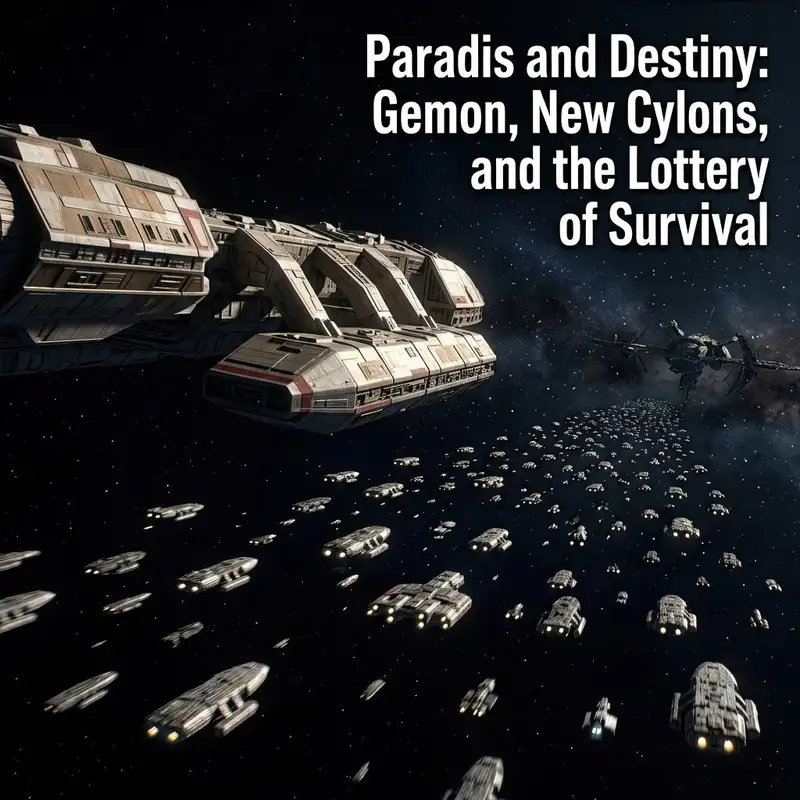
Paradis and Destiny: Gemon, New Cylons, and the Lottery of Survival [Hatch Continuation]
Fifteen ships cannot make the next passage through deep space. Their faster-than-light drives are too worn, too damaged, or too unreliable. The fleet has repaired what it can, cannibalized what it dares, and stretched every available workshop beyond its intended purpose. Yet machinery has reached the point where optimism becomes another form of deception. Roughly eight hundred people must remain behind in a dying system. The figures in the novel are not perfectly consistent, and they do not need to be. The crisis is clear enough. These are not fifteen empty hulls to be written off a maintenance ledger. They are homes, families, skilled workers, children, elders, political constituencies, and fragments of the civilization the fleet has spent decades trying to preserve. The question is no longer whether everyone deserves to live. Everyone does. The question is who will write the rules when the means of survival cannot carry everyone forward.
This is the problem at the center of Richard Hatch and Brad Linaweaver’s continuation novels Paradis and Destiny. They belong to Hatch’s separate literary future for the characters of the original Battlestar Galactica, following the events of Rebellion. They are not the future imagined by Galactica nineteen eighty, and they do not share the history, technology, or Cylon society of the later reimagined television series. In these books, the fleet has been fleeing for approximately a generation, perhaps twenty-five to thirty yahrens by the stories’ own uncertain reckoning. The exact number matters less than the accumulated condition it describes. Ships age. Institutions become brittle. The people who began the journey as warriors, officials, or young refugees become parents, elders, and symbols of an earlier order. A fleet can stay mobile for a long time. It cannot remain unchanged.
Destiny begins by turning a refuge into a trap. The world called Gemon in Hatch’s own description, and associated with Paradis in the novel’s title and some later accounts, is dying. Its sun is entering a terminal phase, and the system will become lethal. The danger is not an enemy raid that can be evaded by a rapid launch. It is a deadline imposed by astronomy, engineering, and declining supplies. The fleet must depart before radiation, environmental collapse, and failing life-support systems make departure impossible. But a fleet’s ability to leave is determined by its weakest essential components. A damaged ship cannot be ordered into a voyage its drive cannot survive. A transport cannot be abandoned without considering its passengers. A workshop ship may be mechanically weak but still carry people with skills no one else possesses. The selection problem is therefore logistical, demographic, political, and moral at the same time.
The temptation, in any such emergency, is to talk as if mathematics can make the decision clean. Count the berths. Count the fuel. Count the ships that can jump. Then assign bodies to available space and call the result necessity. But the books understand that necessity is not neutral simply because it is real. Somebody decides which technical specialists are indispensable. Somebody decides whether families remain together. Somebody determines whether a political official receives the same chance as a mechanic, a pilot, or a child. Somebody has to enforce the decision when frightened people refuse it. The lottery of survival is more than an emergency procedure. It is a public statement about whose claims count, who has authority to judge those claims, and whether the fleet still believes itself to be a society of citizens rather than a convoy ruled by those nearest the weapons and navigation controls.
That question had already been tested on Gemon before the planet began to die. In Paradis, the fleet arrives at a world that appears, at first, to answer almost every practical prayer of a refugee people. It has resources. It offers space, repair opportunities, and the prospect of rest after years of movement. It seems to promise an end to the strange and exhausting life of a civilization confined to ships. For Apollo and many around him, the attraction is understandable. A permanent refuge would mean more than safety from the Cylons. It would mean agriculture that did not depend on dwindling stores, workshops that did not have to function in cramped hangar bays, children raised under an open sky, and political institutions no longer forced to operate under emergency conditions.
But Gemon is not empty. Its indigenous inhabitants, the Gamon, have their own society, their own history, and their own authority over the land the Colonials hope to use. That fact should have been the beginning of the discussion. Instead, it becomes an obstacle for many of the newcomers, who see abundance and immediately begin translating abundance into availability. The fleet’s need is genuine. Its people are hungry for security, repair capacity, and a future beyond constant pursuit. Yet need does not automatically confer a right to settle. A refugee population can still become a colonizing power when it arrives with superior weapons, industrial tools, military discipline, and a habit of assuming that its own survival must override every other claim.
The Gamon are initially easy for the Colonials to misunderstand. Their telepathic communication, unfamiliar customs, and apparently simple material culture lead outsiders to mistake difference for weakness. This is a recurring failure among technologically confident societies. They assess another people by visible machinery, architecture, and weapons, then assume that whatever is not organized in familiar forms must be undeveloped. The Gamon elder presents a different understanding of life, death, and existence itself. The Gamon claim that their people can pass beyond the physical dimension rather than simply die in the ordinary Colonial sense. The novel treats this as meaningful within its spiritual and metaphysical framework. It does not provide a laboratory demonstration that closes every question. What matters politically is that the Colonials are dealing with a people whose deepest values they have not taken the time to understand.
That failure becomes dangerous when Colonial construction pushes into territory the Gamon regard as sacred. The resulting confrontation appears to end in the massacre of Gamon protesters. Later, the Gamon explanation complicates what the Colonials believe they have seen. Those who appeared to die are said to have transcended beyond the physical plane. But that claim, even if accepted on its own terms, does not erase the preceding abuse. Colonial crews entered restricted ground. Colonial power was applied to a population with less visible military force. The encounter demonstrates how quickly a settlement project can become coercive when one side treats consent as a delay rather than a condition. Apollo recognizes that the event cannot be dismissed as an unfortunate misunderstanding. It carries the moral shape of an older Colonial failure.
The warning comes from the Borellian Nomen, whose history in this continuation branch stands as a reminder that Colonial expansion has not always been benevolent, restrained, or wise. The novels do not require a full retelling of that earlier conflict to make the point. Apollo sees a familiar pattern. A powerful outsider arrives, judges another people by Colonial standards, claims practical necessity, and gradually turns access into control. The rhetoric may be development, education, protection, or shared prosperity. The operational reality can become dispossession. Gemon forces the fleet to confront a painful contradiction. The Colonials have survived persecution and Cylon attack, but victimhood does not guarantee moral clarity when they hold the stronger position over someone else.
The discovery of an ancient vessel and records connected to the Thirteenth Tribe gives the Gamon resistance a historical foundation. Earlier humans had reached Gemon long before Apollo’s fleet. They had attempted to educate and technologically uplift the Gamon. At first, such a project might have looked generous to the visitors. They offered knowledge, tools, and access to forms of power the Gamon had not possessed. But the legacy was dependence, militarization, and destructive conflict within Gamon society. Technology arrived without the social stability, political consent, or cultural preparation needed to absorb it. Advanced outsiders had not just shared useful knowledge. They had altered the balance of power among the people of the planet and left devastation behind.
This is what may be called cultural security. The Gamon are not rejecting permanent Colonial settlement because they hate every visitor or fear every tool. They resist because their history has taught them what happens when an advanced civilization assumes it has the right to reshape another society. Their position is strategic as well as spiritual. They have seen outside technology become a source of factional advantage, armed competition, and dependency. They know that a refugee fleet, however desperate, brings its own demands for land, labor, resources, law, and protection. Once settlers begin repairing ships, building installations, and organizing defenses, temporary necessity can harden into permanent occupation.
Apollo’s most important decision in Paradis is therefore not a military victory. It is an acceptance of limitation. Gemon can be a haven for essential repairs, but it cannot become a Colonial homeland without repeating an earlier disaster. The fleet must leave when it can. That decision denies the refugees a solution they deeply want, and it does so for reasons that cannot be reduced to fuel or enemy pressure. The Colonials are forced to recognize that survival purchased through domination would preserve their bodies while damaging the political and moral identity they claim to defend. Gemon’s apparent paradise becomes a test of whether the fleet can learn from history instead of merely fleeing its consequences.
Then Destiny removes even the illusion that the fleet can remain temporarily secure. Gemon begins to perish. A world rich enough to repair ships and sustain exhausted refugees cannot provide a future when its star itself becomes the source of catastrophe. This reversal matters because it exposes the difference between resources and mobility. Mineral wealth, local debris, workshops, and salvage can extend a fleet’s life. They cannot instantly restore every failed faster-than-light drive. They cannot create a complete shipbuilding economy from raw materials. They cannot replace specialized machinery, trained technicians, or the accumulated industrial depth of a lost civilization. The fleet has enough capacity to improvise. It does not have enough capacity to manufacture a universal rescue.
The selection of survivors is therefore produced by material failure, not by casual cruelty. That does not make it less cruel to experience. The books report fifteen ships as unfit for the next stage of the journey and place the number left behind at approximately eight hundred. Another description suggests that only about two-thirds of the population may continue. The numbers do not settle into one clean manifest, but the strategic condition remains plain. The fleet has reached a point where the value of a ship cannot be separated from its ability to travel. A vessel full of people, however loved and useful, becomes a death trap if it cannot leave the system. The command problem is brutal because every available remedy consumes something else the refugees cannot spare.
Civilian leadership is central to the effort to make the selection legitimate. The lottery is not presented as Apollo’s private decree. President Tigh must mediate among military command, elected authority, Council politics, and public fear. Diana and the newly elected civilian leadership are involved in administering a process that no leader could make popular. That division of authority matters. A military commander may understand ship readiness and strategic danger, but technical competence alone cannot decide who is entitled to a future. At the same time, civilian officials cannot ignore the operational need to preserve people whose experience is essential to navigating, defending, and governing the ships that will depart.
The exemption rules reveal the difficulty. Apollo, Athena, and Tigh are excluded from the lottery because their command experience is judged irreplaceable in the immediate crisis. Younger warriors, including Dalton, Troy, and Trays, are also protected because the fleet cannot afford to discard capable military personnel at the moment an enemy threat may return. The policy has a rational military basis. A refugee fleet without qualified command, trained pilots, or people able to maintain its remaining defenses could escape Gemon only to die soon afterward. But rationality is not the same as fairness. Every exemption announces that some lives are too strategically valuable to risk, while others must accept the possibility of abandonment.
Starbuck’s position makes that tension visible. He is an experienced warrior, yet he remains subject to selection. His inclusion matters because a lottery from which every prominent officer is exempt would look less like emergency planning and more like an elite escape plan. Council members, too, are placed at risk. That decision tests whether political figures who once enjoyed status, wealth, or influence are willing to share the danger facing ordinary refugees. The arrangement is imperfect by design because perfection is unavailable. A purely random selection might preserve procedural equality while sacrificing indispensable skills. Broad exemptions might preserve military effectiveness while creating a caste system. The lottery tries to balance both claims, and in doing so reveals how difficult it is to keep equality alive when survival itself has become scarce.
The crisis also destroys the old meaning of wealth. Some Council figures attempt to buy places on departing ships, as though private currency can still command the material world it once represented. But money has little authority when food, breathable air, electrical power, fuel, and transport capacity have become the true measures of value. The image of civilians burning cubits for fuel cannot be reduced to a sign of hardship. It shows a total inversion of the old economy. Tokens of privilege become heat. Savings cannot manufacture a functioning drive. Influence cannot create berths where there are none. Yet the attempt to purchase survival does enormous political damage because it confirms the public suspicion that the powerful still believe rules are for other people.
Riots, killings, and fear follow. The lottery has ceased to look like an orderly civic procedure and begun to feel, for many, like a public declaration of expendability. Families do not experience selection as an abstract allocation system. They experience it as the possible severing of parents from children, spouses from one another, and friends from the communities that have carried them through decades of flight. The military is drawn into the crisis because somebody must protect meetings, control crowds, and prevent sabotage. But crowd control in a refugee fleet is unlike suppressing unrest in a secure state. The people in front of the armed guards are not an outside population. They are the very civilians the fleet exists to protect.
That creates a rules-of-engagement problem with no painless answer. Force may be necessary to stop a mob from killing someone, storming a ship, or sabotaging an evacuation. But force used carelessly can destroy the consent the lottery requires in order to function. A soldier enforcing a civilian decision can become, in the eyes of a terrified crowd, the face of arbitrary rule. The more disorder spreads, the more authority shifts toward those who control weapons and security personnel. The more authority shifts toward the military, the easier it becomes for political opponents to claim that the lottery was never democratic at all. The fleet is fighting not only over berths. It is fighting over whether law can survive the pressure of fear.
Sire Uri and allied Council figures exploit that instability. Their grievance is not imaginary in the narrow sense. Apollo’s emergency authority is substantial, the lottery is deeply unpopular, and civilian institutions are struggling to keep control over a military crisis. But the conspirators transform political opposition into armed coercion. They place bombs throughout the fleet and threaten mass destruction unless the Council is restored to power. At that point, the dispute is no longer only constitutional. It has become hostage-taking on a civilization-wide scale. The bombs threaten ships, civilians, command systems, and whatever remains of public trust. An enemy force could hardly design a more effective attack on fleet cohesion.
Apollo refuses to yield to the threat. Loyal military forces move against the plot, and martial-law authority becomes part of the response. Under the circumstances, preventing mass murder is a legitimate emergency objective. A commander who simply surrendered the fleet to bombers in the name of procedural purity would not be defending civilian government. He would be allowing it to be destroyed by those prepared to kill civilians for political leverage. Yet the necessity of Apollo’s response does not resolve every constitutional concern. Emergency power can be required and still remain dangerous. The fact that Uri’s methods are criminal does not automatically make every action taken under martial law wise, limited, or self-justifying.
This is the political trap at the heart of Destiny. Apollo must use force to stop an internal threat, but each use of force strengthens the appearance that command has displaced civilian authority. Tigh’s role remains important precisely because Apollo cannot legitimately become the sole author of the fleet’s political future. The newly elected leadership, the Council, and the public must still exist after the emergency if there is to be anything worth calling a democratic civilization. The bomb plot discredits the conspirators, but it does not answer the larger question of how extraordinary military authority is returned to ordinary political control. In a fleet without secure territory, courts, or a settled population, that question can never be postponed indefinitely.
Apollo’s answer to the lottery is not a revised formula. It is a personal act. He publicly supports honoring the selection process, then exchanges places with Starbuck and volunteers to remain behind. The gesture is strategically costly. Apollo is not exempt because he is ornamental. His command experience is genuinely valuable, especially at a moment of Cylon danger and fleet fragmentation. Athena and Tigh can provide continuity for the departing fleet, but Apollo’s absence cannot be dismissed as painless. That is why the choice carries political force. He accepts, in his own person, the kind of risk imposed upon citizens who possess far less power to influence the decision.
The substitution does not solve the transport shortage. It does not repair a drive, add fuel, or create another ship. It does not make Starbuck’s survival mathematically fairer than another person’s. Its significance is moral and institutional. Apollo demonstrates that command is not claiming immunity from sacrifice while asking everyone else to accept it. In military terms, he turns leadership into visible shared risk. In political terms, he tries to restore consent to a process already damaged by exemptions, bribery, and coercion. The act does not replace law. Personal virtue cannot serve as a permanent constitution. But in a moment when the public doubts whether leaders understand the cost of their decisions, it becomes a powerful form of legitimacy.
Other choices make the lottery even less impersonal. Cassie chooses to remain with Starbuck, placing family loyalty above the chance of escape. Koren elects to remain for Caran despite not being selected. Sheba also chooses to stay, while ordering Rhaya to return to active duty. These decisions are painful because they disrupt the bureaucratic neatness of the selection process. A lottery can assign a place. It cannot command a person to value survival more than love, parenthood, friendship, or duty. Nor should it pretend that such attachments are irrational inconveniences. They are part of the human reality the fleet is trying to preserve.
At the same time, voluntary sacrifice is not uncomplicated. Every person who stays behind changes the distribution of labor, morale, and responsibility among those remaining. A parent’s choice affects a child. A warrior’s choice affects the defensive capacity of either group. A commander’s choice can inspire unity, but it can also place an emotional burden on others who now feel obligated to imitate sacrifice. Destiny does not suggest that private love magically resolves public scarcity. It shows that no allocation system can fully separate survival from relationships. The fleet can create rules. It cannot remove the personal meaning of who departs, who remains, and who chooses to share another person’s fate.
The external Cylon threat makes the internal crisis more severe. The novels introduce renewed danger without presenting the Cylons as a single, uncomplicated political body. Imperious Leader’s forces must be distinguished from a separate reptilian-purist faction associated with Alpha Leader. That faction’s hatred of human genetic influence, its interest in biological experimentation, hybrid Centurions, and destructive power belong to its own ideology and operations. It should not be casually treated as identical to every Cylon command or every Cylon objective in this continuation branch. The practical difference is that even an enemy civilization can contain competing programs, prejudices, and chains of command.
Baltar becomes the fleet’s most troubling source of intelligence. His nightmares and visions involve the Cylon world and suggest that the fleet has been deceived into lingering in a system where it can be trapped and destroyed. The information proves actionable in the novel, but its reliability remains difficult to classify. Baltar’s knowledge may arise from his past association with Cylon systems, trauma, altered biology, manipulation, spiritual experience, or some combination the books do not fully resolve. A responsible command cannot demand perfect certainty before acting on a warning of approaching annihilation. But neither can it pretend that dreams are ordinary reconnaissance reports. Baltar’s intelligence has value precisely because it is unique, and danger precisely because it cannot be cleanly authenticated.
The operational consequence is immediate. The lottery cannot be treated as a sealed domestic matter. Every hour spent in riot, constitutional conflict, or evacuation delay leaves the fleet exposed to attack. The Cylons do not need to win a conventional battle if the refugees immobilize themselves through distrust. This is one of the more credible military insights in the paired novels. A fleet can be destroyed by firepower, but it can also be destroyed by decision paralysis. A political system that cannot allocate scarce resources, contain armed coercion, or distinguish useful intelligence from manipulation may fail before the enemy reaches firing range.
Baltar’s final role is neither that of a conventional commander nor that of an ordinary civilian. He is a former traitor, a man burdened by his earlier betrayals, and an individual whose access to Cylon knowledge gives him a value no normal staff structure can replace. He understands enough about Cylon technology and tylium to prepare a massive destructive device aboard his ship. When the Cylon armada approaches, Baltar sacrifices himself and destroys the attacking force. The novel gives the event dramatic scale, but it does not establish a reproducible weapon system, a routine Colonial capability, or a precise scientific mechanism that can be entered into a tactical manual.
His sacrifice changes the immediate military balance. It buys survival for people who otherwise face Cylon destruction while already divided by the lottery. But its deeper meaning is contested. Apollo sees redemption in Baltar’s final defense of the fleet. That judgment has weight. Baltar chooses, at the end, to use his singular knowledge against the enemy rather than for himself. Yet redemption is not erasure. One decisive act cannot make earlier betrayal harmless, restore those who died because of it, or eliminate the moral record of what he did. What it can do is alter the final meaning of his life. Baltar is no longer only the man who helped endanger the fleet. He becomes, in his last act, one of its defenders.
Even with the Cylon force destroyed, the survivors left behind remain in terrible condition. They face dwindling food, failing power, and limited air. Gemon’s system may contain local raw materials, but raw materials are not the same thing as rescue. Mining, refining, fabrication, and repair require time, tools, skilled labor, energy, and working machinery. The stranded population could attempt to exploit what remains, but doing so would demand stripping faster-than-light technology from departing ships and consuming assets needed by those still able to leave. That choice might prolong life for one group while condemning another. It would also leave the people on Gemon exposed if more Cylons arrived.
This is the final logistical lesson of the lottery. A resource-rich environment cannot save a population that lacks the industrial chain needed to turn resources into survival. The fleet no longer possesses the shipyards, factories, transport networks, and secure territories of the Colonies. It has fragments of capacity scattered through aging vessels. The abandoned people are not saved simply because they are near a planet. They remain dependent on machines that are failing, on supplies that are shrinking, and on an enemy whose return cannot be dismissed. Their situation makes clear why the lottery never was an exercise in discarding obsolete ships. It was a decision about who would be left with the means to live and who would be left with hope alone.
The novel’s resolution arrives through that space between practical survival and hope. The Gamon elder appears to Apollo and declares that the Colonials have chosen a new destiny through unity and sacrifice. Then a vast Space Ark associated with the Thirteenth Tribe arrives. It sends oxygen canisters to the stranded survivors, relieving the most immediate threat. The event is deliberately miraculous in the novel’s framework. It should not be reduced to an ordinary Colonial rescue mission whose equipment happened to arrive late. Nor does it provide a complete technical or theological explanation of the Ark, the Thirteenth Tribe, or the larger forces that may be at work in this universe.
What matters is the order of events. The Ark does not arrive before Apollo accepts the Gamon’s right to resist settlement. It does not prevent the fleet from confronting the moral ugliness of the lottery. It does not stop the riots, neutralize Uri’s bombs, or make Baltar’s sacrifice unnecessary. The intervention follows human decisions rather than replacing them. The refugees are offered rescue after they have faced the consequences of scarcity, rejected armed political coercion, and seen leaders choose to share danger rather than hide behind office. Whether one reads the Ark as providence, prophecy, advanced intervention, or a mystery the novels choose not to resolve, it does not excuse the fleet from responsibility for what came before.
Paradis and Destiny therefore make destiny something more demanding than prediction. Gemon teaches the fleet that survival cannot be purchased through colonial domination, even when the Colonials are exhausted refugees who believe they have nowhere else to go. The lottery teaches that democratic legitimacy cannot survive if leaders treat ordinary citizens as expendable while protecting themselves through privilege. Apollo’s sacrifice does not make the selection fair in every detail, and Baltar’s sacrifice does not erase his crimes. But both acts reject the easier belief that necessity makes every choice just. The Ark preserves those left behind, yet the fleet’s moral rescue begins earlier, when its people choose responsibility over entitlement and sacrifice over the illusion that survival belongs first to the powerful.