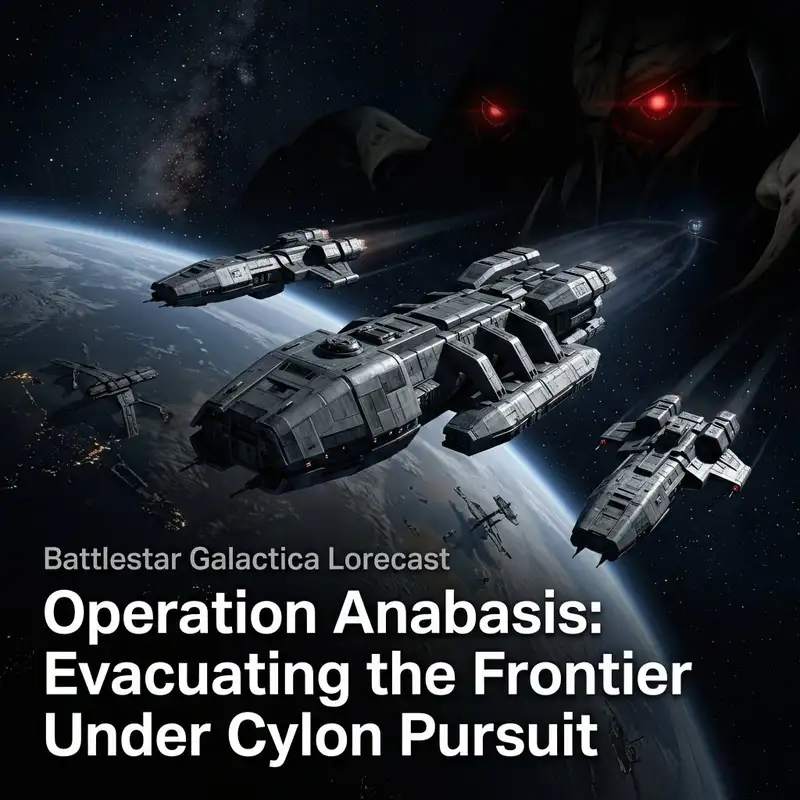
Operation Anabasis: Evacuating the Frontier Under Cylon Pursuit [Deadlock]
The mining colony was already dead when Samantha Agathon’s expedition arrived. The force had crossed deep into dangerous territory on the strength of intelligence taken from a damaged or captured Cylon Basestar. Its purpose was offensive. Find the enemy’s distant staging ground, locate the Cylon commander known as Lachesis, and strike before that command structure could direct more attacks against Colonial space. The expedition carried warships, trained personnel, and, by the official account, roughly ten thousand Colonial soldiers. It had the weight of a serious military operation behind it. But at the colony, there was no intact garrison to reinforce, no population to defend, and no obvious victory waiting to be claimed. The Cylons had reached the objective first and erased the human presence below. At that point, the decisive command decision was not how to press the attack. It was whether the expedition could still serve a useful purpose at all.
This account belongs to the continuity of Battlestar Galactica Deadlock, the licensed game branch set during the First Cylon War. It shares broad ideas and visual language with the reimagined television setting, but it is not interchangeable with the screen chronology. Its ships, campaigns, institutions, and operations must be understood within the game’s own narrative frame. Operation Anabasis occurs in the middle period of that war, after the principal Deadlock campaign and before the later events of Sin and Sacrifice. It is presented not as one fixed sequence of battles, but as a survival operation whose exact route, engagements, losses, and fleet composition can vary from one playthrough to another. What remains fixed is the strategic problem. A Colonial expedition goes outward to strike at Cylon command, arrives too late to save a frontier colony, and must then turn home while gathering threatened civilians under relentless pursuit.
The original plan had a brutal but recognizable military logic. Colonial forces believed that Lachesis was connected to a distant Cylon command or staging network. If that network could be found and disrupted, the Colonies might reduce pressure on their own frontier, force the Cylons to react, and perhaps prevent a larger offensive from developing. In a war against an enemy with superior reach and dangerous industrial depth, a decapitation strike has obvious appeal. It promises leverage. Rather than contesting every Raider, Basestar, or occupied installation, the attacker seeks the node that makes those forces coherent. The difficulty is that such plans depend on intelligence remaining current. A damaged Basestar can reveal a route, a location, or a threat. It cannot guarantee that the enemy will still be where Colonial planners expect, or that the information exposes the whole Cylon system rather than one part of it.
The uncertainty grows sharper the farther a force operates from friendly support. A strike group can carry weapons, troops, fuel, and repair crews, but it cannot carry an entire military infrastructure with it. Every jump away from established Colonial territory lengthens the chain of risk. Damage becomes harder to repair. Intelligence becomes older. Reinforcements become less likely. A ship that suffers a propulsion failure is no longer simply a maintenance problem. It can become an operational liability for every other ship assigned to protect it. The Colonials had entered this region looking for an enemy center of gravity. Instead, they discovered that the frontier itself had become a target. The intelligence had not been worthless. It had warned of a Cylon threat beyond the usual defensive perimeter. Yet intelligence that arrives after a massacre does not permit a clean offensive response. It imposes a responsibility.
The destroyed mining colony changed the meaning of the expedition. Official material describes the settlement as having been annihilated, with no human survivors left on the surface. Supplementary game-reference material suggests that a small number of colonists may have survived in orbit aboard an abandoned tylium freighter, but that detail is less firmly established than the larger fact of the colony’s destruction. The point is not a precise casualty figure. It is that the Colonials had reached a place whose industrial value and human community had both been exposed by distance. Mining colonies are rarely glamorous strategic objectives. They are places where fuel, raw material, machinery, skilled labor, and families exist because a larger society needs them. Their destruction demonstrated that the Cylon war was not confined to fleet actions between warships. It was becoming a war against the connective tissue of Colonial survival.
For Samantha Agathon, the failure was not merely tactical. The intended strike had failed to locate or destroy Lachesis. The expedition had not prevented the destruction of the colony. It had crossed into hostile space and found proof that the enemy’s timetable was moving faster than Colonial planning. Yet military responsibility does not end when the original objective becomes impossible. The question changes. If one settlement has already been lost, what can still be saved? The frontier colonies beyond Cyrannus were isolated. They had no reason to expect rapid help from the Colonial Fleet, and no guarantee that warning would arrive before Cylon forces did. Agathon’s remaining option was to redirect the expedition toward those settlements, collect whoever could be reached, and escort them back toward Caprica. It was not a triumphant redirection. It was an admission that the operation had entered a different kind of war.
Samantha Agathon remained the expedition’s operational commander, but the operation was not a single battlestar’s story. Helena Agathon, Samantha’s sister, served as a key partner in communications and logistics aboard a supply or research vessel. That arrangement reveals something important about fleet warfare. The commander who decides when to engage, screen, or jump is visible. The personnel who make that decision executable are often not. Someone must maintain communications among military escorts and civilian vessels. Someone must track what has been salvaged, what can be repaired, which ships remain mobile, what route options exist, and what losses can still be absorbed. A battlestar can issue an order to withdraw. It cannot make a damaged civilian convoy disappear into safety by command presence alone.
The Agathon sisters therefore represent two necessary forms of authority. Samantha’s role is operational. She must decide how much combat power to commit, when to seek contact, when to break it off, and how much risk can be accepted to save people beyond the next jump point. Helena’s role reflects the architecture behind those decisions. Communications, routing, supply, and coordination determine whether a fleet can act as a fleet rather than as a scattered collection of ships fleeing in the same general direction. The available account does not establish detailed disagreements, formal staff procedures, or a constitutional conflict between the sisters. There is no need to invent one. The more interesting reality is that an evacuation creates distributed command by its nature. No single bridge crew can personally manage every repair, every civilian transfer, every sensor contact, and every jump calculation.
Once civilians became the objective, the expedition’s doctrine had to change. A strike force seeks initiative. It wants to locate the enemy, concentrate power, reach a chosen target, and produce a result that justifies the risk of penetration. An evacuation force has almost the opposite priorities. It must protect its slowest, weakest, or most damaged ships. It must keep enough escorts intact for the next contact, not merely win the current one. It must preserve jump readiness. It must prevent panic, confusion, and separation among civilian vessels whose crews may not have military training or military-grade systems. It must decide whether a favorable battle is worth accepting if the ammunition, damage, or delay required to win that battle leaves the convoy exposed afterward.
This is the point at which a fleet’s center of gravity shifts. The battlestars and escorts remain the most visibly armed components of the operation, but they are no longer the reason the operation exists. Civilian ships become the center of gravity because their loss cannot be justified by a tally of destroyed Cylons. A military vessel may accept damage to shield a transport. Fighters may be launched not to chase Raiders for glory, but to keep enemy contacts away from a civilian ship while its faster-than-light drive prepares for departure. A Raptor mission may matter because it scouts a safe approach or identifies a route, not because it produces a spectacular strike. In a conventional battle, destruction of enemy units can be a meaningful measure of success. In Anabasis, it is only a means. The mission succeeds when people and ships continue moving home.
That changes the meaning of a tactical victory. A Colonial force might destroy an attacking Cylon formation and still emerge worse off if a critical escort loses propulsion, if civilian ships are scattered, if a flight deck is too damaged to sustain the next launch cycle, or if crews are pushed beyond their ability to conduct maintenance and damage control. The enemy does not need to destroy every Colonial warship. It only needs to break mobility, create delay, and force the convoy to remain in a place where further attacks can find it. A ship that survives the first engagement but cannot jump with the group may become an anchor around which the entire operation slows. The Colonials, in turn, do not need to annihilate every pursuer. They need to deny the Cylons the chance to turn local pressure into decisive destruction.
Lachesis is the enemy presence most closely associated with that pressure. The operation presents this Cylon commander as unwilling to abandon the chase, and later Deadlock material confirms that Lachesis remains important after Anabasis ends. Still, it would be a mistake to describe every Cylon ship encountered during the withdrawal as personally commanded by one figure. The game does not establish a complete Cylon order of battle, a perfect chain of command, or an all-seeing adversary directing every contact. What it does establish is enough. The Colonials are being pursued by an enemy capable of maintaining pressure across multiple jumps, exploiting weakness, and making every delay dangerous. For the people inside the convoy, the precise administrative structure behind that pursuit matters less than the fact that it keeps returning.
Pursuit turns time into the decisive resource. In many military operations, a commander wants more time to gather intelligence, repair damage, rest crews, reorganize formations, and choose the best moment to engage. In a pursuit operation, the enemy tries to deny all of those things. The Cylons impose a tempo in which Colonial commanders must make decisions before their preferred preparations are complete. A ship may need repairs, but stopping to repair exposes it to attack. A combat air patrol may need recovery and maintenance, but keeping it airborne consumes fuel, strains airframes, and tires personnel. Civilian crews may need time to prepare for another jump, transfer wounded, or restore damaged systems. The enemy’s advantage lies partly in forcing those needs to compete with one another.
Faster-than-light travel does not erase this problem. A jump is not just a button pressed in the instant before a missile strikes. It requires a functioning drive, viable coordinates, a destination that does not create a new hazard, and enough coordination for the fleet to move without leaving its most vulnerable ships behind. A military escort can sometimes accept separation and rejoin later. A civilian evacuation cannot casually make that assumption. A transport that misses the departure window may be stranded. A damaged ship may require protection while it prepares to jump. A destination that appears safe may provide poor cover, limited salvage, or new environmental danger. The ability to move rapidly through space is powerful, but it also creates a demand for calculation, timing, and collective discipline.
The approximate journey home is framed as a sequence of about ten jumps. That number should not be mistaken for ten fixed historical battles or ten known locations. Operation Anabasis is designed as a survival mode. Routes vary. Encounters vary. Available rewards, penalties, environmental conditions, and losses vary. One player may send a particular fleet through a resource-rich route and emerge battered but intact. Another may take a different path, lose ships, find unexpected hazards, or fail to complete the withdrawal. Those outcomes are not rival historical accounts of the same campaign. They are the game’s way of modeling a larger operational truth. An evacuation under pursuit is not controlled by one elegant plan. It becomes a chain of decisions made with incomplete information and diminishing reserves.
The ten jumps are therefore best understood as an operational rhythm. Each jump produces temporary separation from immediate danger, but every jump also presents a new problem. Which destination offers the best chance of recovery? Which route might allow salvage? Which direction avoids the strongest expected Cylon pressure? Which option shortens the road home, and which one conserves the fleet’s ability to survive another engagement? The safest apparent route may consume scarce time or bypass opportunities to repair. The most direct route may expose the convoy to a stronger attack. A resource opportunity may improve long-term endurance, but reaching it may require accepting danger now. The commander is not choosing between safety and risk. Every available choice contains risk. The question is which risk preserves the greatest number of future options.
That is operational art in its most unforgiving form. The enemy’s position matters, but so do the condition of the fleet, the needs of civilians, the availability of repair material, the reliability of navigation, and the psychological condition of people who have learned that entire settlements can vanish before help arrives. A route is not just a line between points. It is a wager about fuel, damage, enemy response, and human endurance. A commander who always chooses the shortest route may arrive with a broken escort force. A commander who always chooses the most cautious route may run out of time, resources, or political confidence. In a game, these choices are made through destinations, hazards, and fleet-management systems. In military terms, they express the real difficulty of moving a mixed force through contested space without a secure rear area.
No pause is free. Salvage and repair are central to the operation because a fleet cannot fight forever on the condition in which it began. A warship that has survived a battle is not automatically ready for the next one. Its weapons may require maintenance. Its propulsion may be compromised. Its hull may have suffered damage that overworks engineering crews. Its fighter operations may be constrained by aircraft losses, maintenance backlogs, deck damage, or exhausted pilots and technicians. Even systems that remain technically functional can become fragile if crews are forced to operate them continuously without time for inspection and repair. The difference between a ship that floats and a ship that can contribute to fleet defense is often measured in labor hours, spare components, and the ability to conduct damage control before the next emergency.
Salvage has the same double character. Recovering useful material can make the difference between endurance and collapse. It can provide parts, weapons, fuel-related resources, or the means to restore damaged systems. At the same time, salvage also takes time. Ships must remain in an area long enough to collect, sort, and distribute what they find. Crews must expose themselves to additional work when they may already be strained. Escorts must maintain security while the force is less mobile than it would prefer to be. In a pursuit operation, recovery is never merely an economic activity. It is a calculated acceptance of vulnerability in exchange for future combat power. A fleet that refuses every opportunity to repair may die later from accumulated damage. A fleet that pauses too long for recovery may not survive the present.
The operation also allows for resource missions connected to tylium and to interference with Cylon fuel capacity or movement. These should not be treated as one fixed series of historical raids. They are possible operational opportunities within the scenario. Still, their presence makes strategic sense. Tylium is not an abstract resource bar. Fuel and the systems that extract, process, transport, and protect it determine whether ships can maneuver, jump, sustain power, and remain useful. Disrupting an enemy’s access to fuel can slow pursuit. Securing resources for one’s own fleet can extend a withdrawal. Yet such missions carry opportunity costs. A force that turns aside to seek resources may gain endurance, but it may also expose the civilian convoy or delay the journey home. The hard question is never whether fuel matters. It is whether the fleet can afford the action required to secure it.
This is where the limits of Colonial industrial depth become plain. Far from established bases, a fleet cannot assume the existence of a shipyard, a warehouse, a replacement air wing, or a dependable pool of trained personnel. It can improvise. It can cannibalize damaged equipment. It can repair what is repairable and preserve what cannot be replaced. But a distant expedition cannot recreate the industrial capacity of the Twelve Colonies in the space between jumps. The loss of a skilled technician, a maintenance crew, a supply ship, or a specialized component may matter as much as visible battle damage. In this kind of operation, logistics personnel are not supporting actors behind the guns. They are part of the fleet’s fighting strength. Without them, weapons eventually become metal, ships become shelter, and the escort becomes unable to escort.
The space through which the fleet moves is not empty in the military sense. Operation Anabasis includes possible hazards such as dust nebulae, asteroid clouds, ionized regions, satellite networks, and minefields. These do not form a mandatory sequence of events in one canonical withdrawal. They are categories of danger that the game can introduce to make each route uncertain. As historical concepts, they show why space terrain matters. A dust field can interfere with detection and targeting. Asteroids can complicate maneuver, obscure contacts, and create collision risks. Ionized conditions can threaten systems or make communications less reliable. Minefields transform movement into a problem of clearance, detection, and route discipline. Satellite networks may offer information, warning, or a threat depending on who controls them.
Terrain in space does not need mountains or rivers to create friction. It can affect missile employment, sensor confidence, reinforcement timing, navigation, and the ability of ships to maintain formation. A commander may use concealment to avoid a stronger enemy force, but concealment also limits friendly awareness. A route that masks the convoy from Cylon sensors may complicate Colonial coordination. A dense environment may restrict the movement of large ships while creating opportunities for smaller craft. The precise effects depend on the scenario, and the game’s tactical mechanics should not be mistaken for literal measurements of range, armor, or targeting probability. Still, the broader principle remains sound. Environmental conditions can make both attack and escape harder, especially when the fleet includes civilian vessels that cannot simply maneuver like dedicated warships.
The most important cargo in Anabasis cannot be manufactured, salvaged, or replaced by winning a skirmish. It is the civilian population drawn from the threatened frontier. The colonists are not passive counters whose value comes from a rescue score. They are families, workers, technicians, miners, navigators, medical personnel, children, elders, and people with knowledge of settlements and industries that may already be disappearing. In a long war, population is not only a moral concern. It is the basis of every institution that permits war to continue. Ships require crews. Repair facilities require skilled labor. Agriculture, mining, medicine, education, and local government require people with experience that cannot be quickly recreated. The destruction of a frontier colony therefore damages more than a map. It removes part of the society that sustains the fleet.
Evacuation also creates immediate burdens. Civilians need transport space, air, water, food, medical care, security, and somewhere to sleep. They may arrive injured, grieving, exhausted, or uncertain whether family members remain behind. A military formation built for combat must now account for noncombatants who cannot be ordered into the same level of risk without consequence. The ships carrying them become politically important as well as militarily vulnerable. If the Colonial Fleet claims to defend the Colonies, then the treatment of evacuees becomes part of the meaning of that claim. The operation does not establish a detailed constitutional debate, presidential directive, or Quorum dispute. None should be invented. Yet the civil-military obligation is visible even without formal speeches. The fleet exists to fight the war, and it fights the war because there are civilians whose lives, labor, and future it is supposed to preserve.
A successful extraction does not make those obligations disappear when the fleet reaches safer territory. Bringing colonists toward Caprica transfers hardship rather than ending it. Survivors still require housing, work, medical treatment, records, family reunification, and incorporation into communities already strained by wartime demands. A frontier settlement may have possessed specialized knowledge or industrial skills that are valuable but difficult to absorb quickly. A mining population may bring expertise essential to fuel production, but also needs for equipment, employment, and protection. The evacuation is therefore both humanitarian and strategic. It saves lives in the immediate sense, while preserving a portion of Colonial capacity for the war that continues afterward. The people rescued are not an afterthought to the campaign. They are the reason the campaign must be judged differently from a raid.
Operation Anabasis also exposes the limits of Colonial intelligence. The destruction of the mining colony confirms that the Cylons can strike deep into the frontier. It demonstrates that warning and reinforcement systems are inadequate for dispersed settlements. It confirms that Lachesis, or Cylon forces associated with that command, remain dangerous enough to drive a sustained pursuit. Yet confirmation of danger is not the same as understanding the enemy. The Colonials do not emerge from the operation with a complete map of Cylon logistics, a settled picture of command hierarchy, or a guaranteed method for preventing future attacks. They know more about the scale of their vulnerability. They do not solve it.
The operation’s communications dimension should also be kept in proportion. This is a First Cylon War story in the Deadlock branch, not a later account of the Fall of the Twelve Colonies. It does not require the importation of later television-era cyber failures or specific network compromises. Yet communications still matter because a convoy under pursuit depends on coordination. Military escorts must know where civilian ships are. Civilian ships must understand when to move, where to rendezvous, and what threats are approaching. Scouts and reconnaissance assets must pass information quickly enough to matter. Poor information can cause separation, wasted fuel, dangerous route choices, or a delayed jump. The broader lesson is not that technology solves command problems. It is that command becomes fragile when the fleet’s picture of itself and the enemy breaks down.
Later Deadlock material places Sin and Sacrifice after Operation Anabasis, and that chronology gives the evacuation its proper scale. Anabasis was not the destruction of Lachesis. It was not a war-ending operation. It did not remove the wider Cylon threat from the frontier or settle the question of how the Colonies would regain the initiative. Later events show Lachesis remaining a serious danger as the war enters an even more threatening phase. That does not diminish the value of the evacuation. It clarifies it. The operation preserved people and options. It prevented one offensive failure from becoming a larger human disaster. Yet it did not transform withdrawal into decisive strategic victory.
That helps explain why the operation should not be measured by a fictionalized list of canonical ship losses or enemy kills. The survival-mode structure deliberately makes such lists variable. One player’s fleet roster is not another player’s fleet roster. One chosen route is not a universal Colonial route. One dramatic escape does not establish that every ship or settlement was saved. The stable historical judgment lies elsewhere. The operation became known as a completed rescue effort because a Colonial force was able to extract civilians and return toward safety despite the failure of its original offensive purpose. That outcome matters precisely because it was constrained. The Colonials did not solve the war. They kept a portion of their society from being consumed by it.
At the point of contact, Anabasis is about screening, delaying, disengaging, and preserving the ability to jump. Colonial warships fight not only to destroy attackers but to buy time. Fighters and support craft matter because they extend awareness, contest enemy access to vulnerable ships, and help hold a defensive perimeter long enough for the convoy to move. At the mission level, success means that civilian vessels remain protected and coordinated. For the wider campaign, success means that the mixed fleet sustains movement across repeated jumps despite damage, supply pressure, and enemy pursuit. These levels are connected, but they are not identical. A tactical success that leaves the convoy unable to continue is not enough. An operational escape that saves ships but abandons civilians would betray the mission’s purpose.
For the war as a whole, the rescue preserves population, labor, knowledge, and the political meaning of Colonial defense. It also reveals the inadequacy of a military posture that treats remote settlements as secure simply because they lie within Colonial space. At the intelligence level, it provides warning without complete understanding. At the logistical and industrial level, it shows that endurance depends on repair crews, salvage, fuel access, transport capacity, and skilled labor as much as on visible firepower. At the institutional level, it enlarges the Fleet’s mandate. Colonial naval power is not only the ability to strike an enemy command node. It is the ability to convert combat capability into protected movement when civilians are threatened.
That conversion is the real meaning of Anabasis. The operation begins with a force sent outward to find and destroy a Cylon command threat. It becomes an evacuation because the original target is overtaken by a more urgent reality: people on the frontier are exposed, and the force already in the region may be the only one capable of reaching them. The command problem is not solved by courage alone. It requires accepting that offensive ambition must give way to escort duty, that a damaged ship may be more important than a destroyed enemy, and that a route home must be protected one difficult decision at a time. The Colonial Fleet retains military power only if it can use that power in service of survival.
Operation Anabasis ends with a different measure of military success. The question is no longer how much territory was taken or how many enemy ships were destroyed. It is whether the force can bring its warships, crews, civilians, and remaining institutional capacity back through pursuit without coming apart. Retreat under pressure is still an operation, and evacuation can demand more discipline than attack. Survival is not passive when an enemy is trying to prevent it.