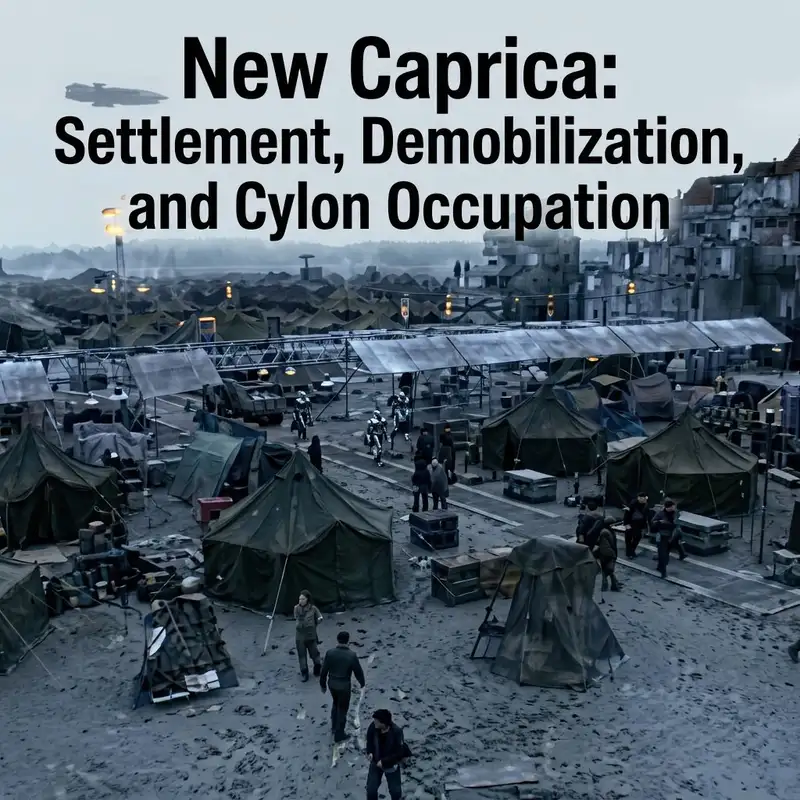
New Caprica: Settlement, Demobilization, and Cylon Occupation
Admiral William Adama looked down from Galactica at a planet that was supposed to solve the fleet’s greatest problem. New Caprica had homes, rough as they were. It had families, jobs, classrooms, committees, arguments, and the beginnings of a life that did not depend on a jump calculation every few days. It also had more than half of Galactica’s crew living on the ground below. The old battlestar could barely gather enough pilots and support personnel for a training squadron, much less sustain the kind of combat air patrol that had kept the civilian fleet alive. The ship that had become humanity’s mobile fortress was turning into an undermanned orbital guard post. That was the central contradiction of New Caprica. The survivors had finally begun to live like citizens again. In doing so, they had made themselves militarily vulnerable in ways that were difficult to see until the Cylons arrived.
The discovery of New Caprica came at a moment when the refugee fleet was exhausted by more than Cylon pursuit. Life aboard the ships had become an extended emergency. Space was limited. Supplies were finite. Every crisis became a political crisis because there was no reserve population, no secure hinterland, and no distant industrial base waiting to replace what had been lost. The fleet had survived by moving, but movement was not the same as living. A convoy can endure for a while. It cannot easily provide the psychological security of a home, the civic rhythms of a town, or the confidence that children will inherit something more than emergency rations and battle stations.
Gaius Baltar understood that exhaustion, and he made New Caprica the central promise of his presidential campaign. His argument was not merely that the planet was habitable. It was that the fleet had to stop defining survival as escape. Laura Roslin, his opponent, believed the planet was unsuitable and dangerous as a permanent refuge. Yet when Baltar won the election, she chose not to overturn the result. That decision mattered. The settlement was not just imposed by a reckless president on an unwilling people. It emerged from a democratic choice made by a population desperate for permanence, however fragile its institutions had become.
After taking office, Baltar directed the fleet to establish settlements on the planet. His order transformed a promising discovery into state policy. The word settlement is important here. New Caprica was not a mature colony supported by established agriculture, industry, planetary defense, or reliable transport routes. It was a hurried attempt to put down roots using the people, equipment, and supplies that had survived the destruction of the Twelve Colonies. The political decision came first. The material foundations had to be assembled afterward.
What New Caprica offered was real. People could step outside without living under a ship’s hull. They could build homes rather than claim bunks. They could organize schools, start businesses, form families, work land, and imagine local government as something more substantial than an emergency Quorum meeting aboard a refugee vessel. Laura Roslin became a teacher. Galen Tyrol and Cally Tyrol left military service and tried to build a domestic life. Tyrol also became involved in labor organizing, because any settlement built from salvaged equipment and exhausted workers would soon discover that wages, safety, representation, and work assignments were not minor issues.
For a population that had lost its worlds, that kind of ordinary life was not sentimental decoration. It was strategic in its own way. Schools preserved knowledge. Families created reasons to plan beyond the next jump. Civilian institutions gave people a role other than victim, soldier, or dependent. A settlement could potentially reduce the strain on the fleet’s life-support systems and create opportunities for food production, construction, and local work. It could restore dignity to people who had spent too long being moved from one crisis to the next by commanders, presidents, and enemy action.
But a habitable world is not automatically a self-sustaining society. New Caprica’s early physical record was one of temporary shelters, limited infrastructure, harsh weather, and constant dependence on equipment brought down from the fleet. The settlers possessed neither the industrial depth of the lost Colonies nor the time to recreate it. They could repair, improvise, and redistribute. They could not quickly build a secure planetary economy, replace specialized machinery, or manufacture the naval strength needed to deter a Cylon return. The difference between surviving on a planet and being secure on a planet is considerable. New Caprica achieved the first condition only unevenly. It never achieved the second.
The deeper transformation was military. A refugee fleet had depended on Galactica, Pegasus, their crews, their pilots, their maintainers, and the civilian ships they protected. Those institutions did not exist apart from the people who staffed them. When experienced personnel left the ships for the ground, they did not merely reduce a roster on a clipboard. They removed flight-deck workers, engineers, technicians, command staff, security personnel, and pilots from a system that required every one of those specialties to operate under combat conditions.
Saul Tigh was discharged by Adama and settled on New Caprica with Ellen. Felix Gaeta left fleet duty to become Baltar’s chief of staff. The Tyrols left their military roles. Other personnel followed, many of them for the same understandable reasons. They had spent their lives in uniform or in support of the fleet. Now there was land, a chance to marry, raise children, build homes, and become part of a civilian community. Demobilization was not a failure of discipline. It was the point of peace. A military force exists to make ordinary life possible, not to preserve itself indefinitely as the sole form of society.
That made the military consequences politically awkward. Adama could see that Galactica was losing readiness, but he could not merely order every former crew member back to the ship without admitting that the settlement’s promise had been hollow. Each person who left active service was also evidence that the survivors wanted a future beyond battle stations. The more successful New Caprica became as a civic project, the harder it was to justify restoring a permanent wartime posture. In that sense, the colony’s strengths and its vulnerabilities were inseparable.
Tactically, reduced manpower meant fewer people available to launch, recover, repair, fuel, and arm Vipers. A battlestar does not generate combat power from its hull alone. Pilots need aircraft. Aircraft need deck crews, ordnance workers, fuel, spare parts, maintenance, medical support, command-and-control, and people rested enough to make sound decisions. An undermanned ship can still fight. It simply cannot fight for as long, in as many places, or with the same margin for losses.
Operationally, the fleet was losing cohesion. Personnel who had trained and served together were dispersed between orbit and ground. The chain of command remained, but its practical depth was thinner. A crisis would require calling people back from homes, jobs, and families, then reassembling them aboard ships whose routines had already been disrupted by settlement. That process takes time. Surprise is dangerous precisely because it denies time.
The settlement also changed the fleet’s strategic geography. Before New Caprica, the survivors’ principal defense was mobility. The civilian ships could jump away from danger. Galactica and later Pegasus could screen them, delay attackers, launch fighters, and create time for the convoy to escape. The fleet had no secure territory, but it was hard to trap in one place. New Caprica reversed that relationship. It concentrated people, supplies, political authority, and military manpower on a single known world.
That concentration created obligations. Homes could not jump away. Schools could not evade pursuit. Fields, workshops, storage sites, and medical facilities all tied people to the ground. The more settlers invested in New Caprica, the less plausible it became to treat the planet as a temporary stop. A mobile fleet can abandon cargo when necessary. A settlement asks people to abandon neighbors, children, property, graves, and the institutions they have only just begun to rebuild.
The colony did have some connection to the ships remaining in orbit, and the Fleet did not abandon all caution. Yet the available record does not show New Caprica possessing the depth of planetary defense, secure long-range communications, reserve manpower, evacuation planning, or industrial capacity that would have been needed to make it defensible against a major Cylon force. The weakness was not that nobody understood danger. The weakness was that the population had chosen a political and human objective that exceeded its military means.
Demobilization alone did not cause what followed. The Cylons still had superior intelligence, strategic mobility, and the ability to bring overwhelming force. The survivors had grown accustomed to the possibility that distance, uncertainty, or Cylon internal priorities might buy them time. The political pressure to make New Caprica work encouraged optimism. And the enemy achieved surprise. Those factors mattered as much as the reduced readiness of Galactica and Pegasus. Still, an exposed settlement staffed by people drawn away from the fleet was less able to absorb shock than the mobile convoy had been.
On the three-hundred-eightieth day since settlement, the Cylons arrived in orbit. Their appearance exposed the settlement’s central military problem in a matter of minutes. Galactica and Pegasus faced a force they could not defeat while also protecting the remaining civilian ships. The battlestars were not choosing between a clean victory and a shameful retreat. They were choosing between preserving a mobile remnant of humanity or losing the ships that might later rescue anyone on the ground.
The decision to withdraw left most of the population behind, and no language can make that less severe. Families were separated. The people who had trusted the fleet’s protection were suddenly trapped on a planet beneath enemy control. But a doomed stand in orbit would not have liberated New Caprica. It would have removed the last significant Colonial military force from the larger war. Adama’s withdrawal was therefore an act of triage. It preserved ships, crews, and civilian vessels that could still move. It also preserved the possibility, however remote, of a return.
Baltar remained president after the occupation began, but the title no longer carried independent sovereignty. His administration survived in form while Cylon authority controlled the decisive conditions of power. That distinction matters. A puppet government can still make choices. Its officials can cooperate, resist, bargain, delay, conceal, or betray. But they do so under coercion, without control of force, and with civilians exposed to retaliation for every decision. The occupation did not erase Baltar’s agency. It narrowed it brutally.
The Cylons did not arrive with one simple policy. Some humanoid Cylons spoke of coexistence and appeared to believe that the earlier destruction of the Colonies had been a mistake. Others treated peace language as compatible with increasingly harsh control. Still others favored coercion with little patience for human independence. The occupation authority was therefore divided by ideology, experience, and model politics. It is inaccurate to describe every Cylon as pursuing exactly the same end by exactly the same means. It is equally inaccurate to let internal disagreement obscure the reality experienced by the occupied population.
That reality was coercive. Curfews, food pressure, detention, interrogation, torture, execution, and collective punishment became tools of rule. The occupiers used force directly, but they also learned that ordinary systems could be turned into mechanisms of control. Food distribution became political. Employment became political. Access to education, housing, medical care, and family security became political. Under occupation, the question of whether a person could feed children or keep a spouse out of detention could depend on what a neighbor had reported, what a local official had signed, or what the resistance had done nearby.
The point of such a system was not only to find weapons or arrest organizers. It was to make resistance costly before it began. An occupier does not need to watch every citizen at every moment if citizens believe that any act of defiance may bring punishment upon people around them. The result is a social geography of fear. Homes become places to hide equipment or fugitives. Workplaces become sites of surveillance. Schools become vulnerable civic spaces. The line between private life and political life disappears.
The New Caprica Police became central to that system. It was a human-staffed security force operating under Cylon authority. That arrangement served a clear counterinsurgency purpose. Human police possessed local knowledge. They knew the settlement’s streets, homes, workplaces, families, grudges, and routines. They could conduct routine enforcement and intelligence gathering without requiring a Cylon presence at every door. That freed the occupiers to reserve their own forces for detention, intimidation, and major security operations.
Yet membership in the police did not establish one uniform motive. Some people joined from fear. Some hoped to protect themselves or relatives. Some saw paid work and a measure of security in a collapsing civic order. Some accepted the occupation’s logic or used the institution for personal power. Some committed abuses. Others may have believed they were preventing worse violence. Those distinctions do not remove the force’s institutional role. The police helped make occupation function. But moral judgment is more accurate when it examines what particular people did, what choices they possessed, and whom their actions harmed.
The deeper damage was social trust. Once an occupying power governs through local personnel, every neighbor may appear to be an informant, an enforcer, a potential recruit, or a victim trying to survive. That uncertainty fractures communities more effectively than a simple division between enemy and ally. It also creates conditions in which resistance networks can grow, because the same local knowledge that helps an occupier can help people evade one.
Saul Tigh emerged as the senior Colonial military figure in the underground struggle. Galen Tyrol brought another kind of authority, rooted in labor, technical experience, and the social networks of ordinary settlement life. Their work did not create a conventional army. The resistance had no ability to meet Cylon firepower in open battle, hold terrain, or defend New Caprica with visible formations. Its military purpose was narrower and more difficult. It had to survive long enough to gather intelligence, preserve morale, disrupt occupation control, prepare for an opportunity, and maintain the idea that Cylon rule was not permanent.
Former Fleet personnel carried useful habits into that work. They understood security, chain of command, logistics, maintenance, compartmentalization, and the consequences of careless communications. But professional experience was not enough. An underground movement depends on civilians who hide weapons, pass messages, transport supplies, conceal fugitives, provide cover stories, and sometimes do nothing more dramatic than refuse to cooperate. Those acts can be as important as armed attacks. They are also dangerous, because the occupier can punish people who never considered themselves combatants.
The early resistance faced practical constraints that the romance of insurgency often ignores. Weapons had to be hidden. Recruits had to be screened without exposing the organization. Cylon jamming made communications with the fleet difficult and often impossible. Intelligence was fragmentary. Every operation risked arrest, retaliation, and the loss of people who knew too much. The resistance could not afford the open recruitment, resupply, medical support, or communications architecture available to an ordinary military unit. It had to operate through trust, secrecy, and local initiative, all under conditions designed to destroy trust.
That environment also produced moral disagreement. Some resistance leaders believed violence was necessary to demonstrate that the Cylons could be hurt and to prevent the population from accepting occupation as normal. Others understood that attacks in crowded places could kill the very people the movement claimed to defend. There was no painless option. Inaction permitted occupation to consolidate. Violent action could invite repression and alienate civilians. The question was never whether resistance would carry costs. The question was who would bear them, and whether a particular operation advanced liberation or merely widened suffering.
The bombing of the New Caprica Police Academy brought that dilemma into sharp focus. Tucker Clellan, known as Duck, had joined the police while secretly assisting the resistance. His position gave the underground access to an institution at the heart of the occupation’s local security structure. But when the academy was attacked, human police recruits died. The target was connected to Cylon control, yet the dead were not abstract symbols of collaboration. They were people in training, caught inside a force whose members had entered for different reasons and exercised different degrees of choice.
The attack showed that the resistance could penetrate an institution meant to enforce occupation. It also proved that an attack on a coercive institution could inflict a severe cost on the occupied society itself. Such operations can weaken an occupier’s confidence and disrupt its manpower. They can also provide justification for a crackdown, deepen fear among civilians, and make neutrality impossible. The academy bombing did not settle the question of resistance. It made that question more urgent.
The resistance also received classified information from an unidentified source inside the occupation structure. That intelligence could be used to identify high-level targets and expose vulnerabilities. But intelligence is never just information. It raises questions about reliability, motive, access, and manipulation. The underground could not fully know whether its source sought human liberation, pursued a separate Cylon agenda, or intended to steer the resistance into actions that served someone else’s purpose. In an occupation shaped by infiltration and deception, a useful source could also be a dangerous one.
As violence escalated, Cylon policy hardened. The occupation’s internal rhetoric about peace and coexistence was tested by human resistance, and coercive factions gained greater influence. This was a familiar dynamic, though not an inevitable one. An occupation that relies on force interprets resistance as proof that more force is required. The resistance interprets the resulting repression as proof that compromise is impossible. Civilians are then pushed between institutions that each claim necessity while demanding loyalty, labor, silence, or sacrifice.
For four months, the people on New Caprica had no contact with Galactica and the free fleet. That separation was not merely emotional. It was a command-and-control failure imposed by distance, Cylon jamming, and the occupation’s control of the planet. Before the settlement, Adama and Tigh had recognized that such a separation might occur. Their contingency concept involved periodic Raptor attempts to establish contact if the fleet had to withdraw. It was a modest plan, but modest contingency planning can matter when the main political strategy has failed.
The effort to restore contact took time because the enemy controlled the environment. A message had to pass through or around Cylon surveillance and electronic interference. Any transmission risked revealing the resistance’s position. Any landing risked exposing a Raptor crew, a local contact, or an assembly area. Once contact was finally established, the existence of a rescue possibility transformed the resistance’s mission. The underground was no longer trying only to endure and disrupt. It now had to help prepare an entire population for evacuation.
Adama faced a brutal decision. He could preserve the remaining mobile fleet and accept that New Caprica might be lost permanently. Or he could risk Galactica, Pegasus, their crews, and the civilian convoy in an attempt to recover the people left behind. The rescue would not just be a military raid. It required coordination between ships in orbit, resistance cells on the ground, civilian leaders, pilots, Raptor crews, and thousands of frightened people who would have to move toward launch sites under enemy pressure.
The grounded civilian ships were essential. They contained the faster-than-light capability needed to remove large numbers of people from the planet. But their launch keys had been confiscated, turning the vessels into traps unless the resistance could recover access. Evacuation plans also required assembly points, local guides, knowledge of detention sites, and people who could direct civilians without creating visible concentrations too early. A battlestar can arrive with force. It cannot, by itself, persuade panicked civilians where to run, identify which prisoners need freeing, or locate the equipment needed to launch grounded ships.
Sharon Agathon, known as Athena, became an indispensable liaison between the fleet and the resistance. Her identity as a humanoid Cylon gave her the ability to move through some Cylon security arrangements in ways a human operative could not. Centurions could not distinguish her from other humanoid Cylon models. That gave the rescue plan a powerful advantage. It also created a severe problem of trust. Athena had earned loyalty through service, sacrifice, and her commitment to the fleet, but her presence still forced humans to rely on the same kind of enemy infiltration capability that had once nearly destroyed them.
That was not a contradiction the fleet could solve through reassurance. It was an operational fact. Athena’s identity created access. It also created fear. A force fighting for survival cannot avoid such tensions by pretending they do not exist. It has to decide whether the capability gained is worth the vulnerability felt by those asked to trust it. On New Caprica, the rescue would depend on that trust being sufficient, not perfect.
The operation that followed is often remembered for Galactica’s descent into New Caprica’s atmosphere. The maneuver deserves its place in the record, but it was only one part of a linked operation. The rescue required deception in space, air operations during an extraordinary descent, resistance action on the ground, civilian movement toward ships, recovery of launch access, and a decision by Pegasus to place itself between the evacuation and destruction.
The deception began with Raptor-launched decoys intended to make the Cylons believe more than one battlestar was approaching. The purpose was not to win a prolonged fleet engagement through illusion. It was to create uncertainty at the moment uncertainty mattered most. If the Cylon command had to divide attention, shift forces, or misjudge the location of the main threat, Galactica might gain the narrow opening needed to reach the planet and support the evacuation.
Galactica then made the exceptional decision to jump into the atmosphere. The maneuver was tactically brilliant because it bypassed the expected approach and placed the battlestar where its fighters and weapons could immediately affect the ground battle. It was also structurally punishing. A ship designed for space operations was not conducting a routine atmospheric insertion. The jump and descent imposed stresses that damaged the vessel and reduced its margin for further emergencies. Adama used the maneuver because the situation demanded something extraordinary, not because Galactica had discovered a new standard operating procedure.
As Galactica fell through the atmosphere, Vipers launched to provide cover for the evacuation. That image captures the courage of the pilots, but it also represents the work of an entire carrier system operating under extreme conditions. Aircraft had to be ready. Deck crews had to launch them during a descent that was already dangerous to the ship. Pilots had to find targets, protect launch sites, conserve fuel, and avoid becoming losses that the fleet could not easily replace. The screen cannot provide a precise accounting of every sortie, but the operational meaning is clear. Galactica was spending scarce air power to create time on the ground.
On New Caprica, resistance fighters and civilian networks did the work that no orbiting ship could do. They freed detainees. They moved people toward the grounded vessels. They recovered access needed to launch ships. They directed civilians through a settlement shaped by occupation, fear, and incomplete information. The evacuation depended on people understanding where to go, whom to trust, and when to move. It depended on parents, workers, former police, resistance members, prisoners, and civilians making decisions under fire without a complete picture of the battle.
That is why the rescue cannot be understood as a battlestar saving passive people below. Galactica created an opportunity. The resistance converted that opportunity into movement. Civilian organization gave the movement purpose. Without local networks, assembly plans, and people willing to act despite terror and uncertainty, the ships on the ground would have remained stranded assets. The settlement’s civic life, which had become so vulnerable under occupation, also supplied the human connections necessary for escape.
Pegasus carried a different burden. Under Lee Adama’s command, the newer battlestar had a responsibility to protect the free fleet. That responsibility could have justified staying clear of the battle and preserving the strongest remaining military asset. But Galactica’s rescue could not succeed if the Cylons were free to concentrate their full strength against it and the evacuating ships. Pegasus entered the fight to create the time and space the operation required.
The ship’s final action was not a clean tactical victory. Pegasus was lost after engaging a Cylon basestar and colliding with it. Its crew evacuated, but the battlestar itself could not be replaced. For a civilization with no shipyards, no reserve battlegroups, and no secure industrial base, the destruction of Pegasus was not merely the loss of a warship. It was the loss of accumulated expertise, flight capacity, maintenance capacity, weapons, command infrastructure, and future options.
The evacuation succeeded substantially, but it was not bloodless, complete, or uncomplicated. Galactica emerged damaged. Pegasus was gone. The fleet had again become a mobile society under military protection, but now with even less naval strength than before. New Caprica, the place meant to end the flight, had become another abandoned world in the survivors’ memory.
Its failure should not be reduced to the idea that civilians were foolish for wanting homes, peace, and self-government. Those were not weaknesses. They were the purposes for which survival mattered. New Caprica failed because the survivors tried to build those things before they had the ability to defend, supply, communicate with, or evacuate them against an enemy that remained active, capable, and divided in ways no one could safely predict.
The rescue proved another point. Military power alone could not save the colony. Galactica’s deception, atmospheric jump, and Viper cover were indispensable, but they were insufficient without civilian networks, resistance organization, local knowledge, political memory, and people willing to move toward danger in order to escape it. The second exodus preserved the population, but it also demonstrated that survival would remain incomplete until mobility, legitimacy, and civilian life could coexist without one destroying the other.