Kobol, the Tomb of Athena, and the Route to Earth
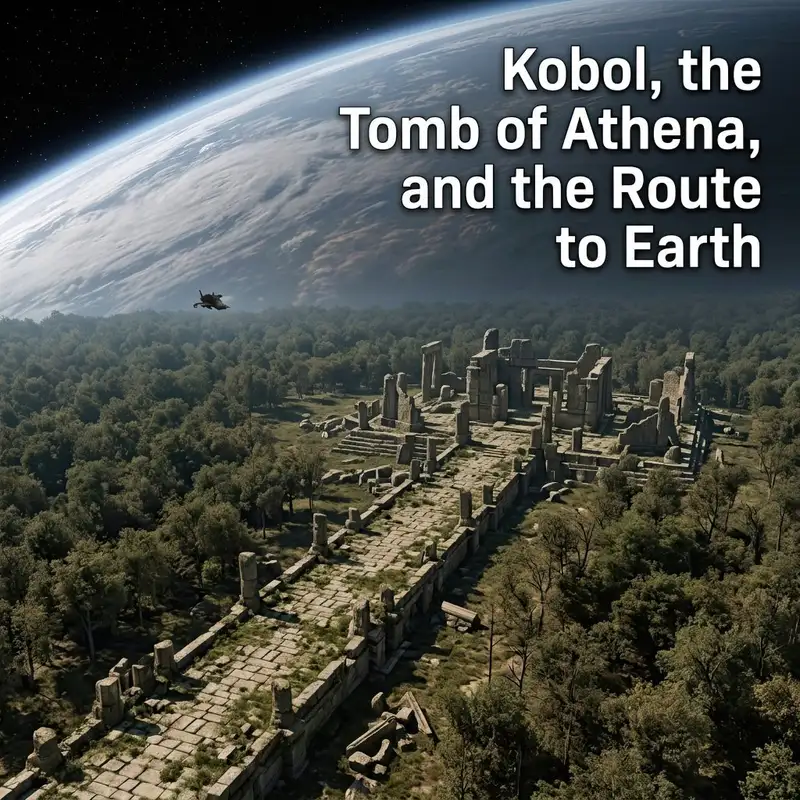
A Raptor survey finds a planet that should not exist on any useful chart. From orbit, its crews see the remains of a city. On the surface, they find ruins old enough to belong to the oldest Colonial stories. Commander William Adama looks at that discovery and sees a possible refuge. The fleet is exhausted, hunted, and carrying a civilian population with no secure source of food, labor, or repair. A planet with ruins may also have land, water, shelter, and the chance to stop running. President Laura Roslin sees the same world and reaches a different conclusion. To her, Kobol is not the destination. It is a signpost. Colonial scripture says humanity’s ancestors left Kobol, and that the way to Earth can be found there. Before either interpretation can be tested, a survey party is attacked. People are killed. Aircraft are lost. Kobol becomes contested ground before it becomes either sanctuary or route.
That sequence matters because the fleet’s conflict over Kobol was never a simple contest between military realism and religious faith. Adama and Roslin were each responding to genuine survival problems. Adama had command of the principal warship protecting the refugees. He had watched the Colonies die under nuclear attack. He knew that a fleet without a defensible place to rest, repair, grow food, or reduce its dependence on fragile ships might not survive long enough to find anything. Roslin, meanwhile, had inherited a civilian government whose legitimacy rested partly on preserving a purpose beyond immediate survival. If the fleet abandoned Earth as a goal, it might gain a temporary refuge while losing the shared mission that made sacrifice bearable.
Kobol therefore presented an intelligence problem before it became a theological one. Reconnaissance gave the fleet physical evidence. Ancient structures existed. The ruins appeared to correspond, in rough historical terms, with the traditional era when the thirteen tribes were believed to have left the world. Roslin recognized elements of the site from visions she had experienced. Priest Elosha could connect the discovery to the Sacred Scrolls. But none of that evidence interpreted itself. Ruins do not issue policy guidance. They become strategically meaningful only when commanders, civilians, scholars, priests, and scouts decide what they mean and what risks are acceptable in pursuit of that meaning.
Adama’s proposal to consider settlement was not cowardice or a lack of imagination. It was a commander’s answer to a fleet-level problem. A convoy can jump away from immediate danger, but it cannot live indefinitely on morale, recycled air, and borrowed time. The survivors needed tylium, spare parts, trained labor, medical capacity, and some way to sustain children, families, and institutions. A habitable world, even an uncertain one, could alter every one of those calculations. Roslin’s answer was also practical in its own way. A settlement on Kobol would place the fleet on a world known to the Cylons, close enough to ancient sites that Cylon forces were already present. It might offer rest, but it could also become a trap, a siege, or a graveyard.
The first ground mission made that danger unmistakable. The survey force did not enter an empty archaeological park. It entered terrain only partially understood, with limited reconnaissance, uncertain routes, and hostile Cylon activity. The Cylons ambushed the expedition. A Raptor was lost or brought down, another got away, and ten people aboard a third Raptor were reported lost. The precise shape of the Cylon deployment is never fully established. There is no reliable order of battle, no complete map of their positions, and no basis for claiming that every danger on Kobol had been arranged as a deliberate trap. What the fleet did know was enough. The Cylons could contest the ground, interfere with reconnaissance, and impose casualties.
The tactical result was immediate. Personnel and aircraft were lost. The operational result was more important. Kobol could not be surveyed casually, and it could not be occupied without accepting the risks of a hostile environment. The strategic effect was more subtle. Both Adama and Roslin now had to make decisions while under pressure. The planet might be a refuge, but it was not a secure one. It might contain evidence about Earth, but obtaining that evidence would require a mission into Cylon-contested territory. The fleet had found something precious, but it had not found safety.
Roslin believed the next requirement was the Arrow of Apollo, an artifact held at the Delphi Museum on Caprica. In Colonial religious tradition, the Arrow was associated with the path to the Tomb of Athena, a place on Kobol that might reveal the way to Earth. This was still not a conventional intelligence operation. The fleet had no survey report saying that the Arrow contained coordinates, no scientific proof that it could unlock a route, and no reliable means of testing the tradition without recovering the artifact. Yet the proposition had enough internal logic to demand attention. If the Tomb existed, if the Arrow was connected to it, and if Kobol was truly the point of departure for the ancient tribes, then the fleet possessed a chain of evidence worth investigating.
The problem was access. Caprica was not merely dangerous. It was a devastated colony under Cylon control. Sending Galactica there would have risked the only major military shield protecting the civilian fleet. Sending a conventional Colonial craft would have been no better. The distance and the hostile environment placed Caprica beyond the practical reach of an ordinary mission. The fleet’s solution came from an asset that had begun as enemy technology and had become something more valuable than a laboratory specimen: a captured Cylon Raider adapted for faster-than-light travel.
The Raider’s importance lay in strategic mobility. It offered a reach no available Colonial craft could easily duplicate. That did not make it safe. Captured enemy technology carries risks even when it appears to function. Its systems may fail. Its capabilities may be misunderstood. Its presence may expose a crew to dangers that ordinary Colonial procedures cannot predict. It was a single platform, with limited capacity and no margin for casual loss. But it could reach Caprica without committing Galactica or dragging the refugee fleet into a mission it could not afford. In an era of scarcity, one unusual aircraft could carry more operational value than a squadron of familiar ones.
Roslin persuaded Kara Thrace to fly that mission. Starbuck’s decision was not just an act of personal courage, although courage was required. It was an unauthorized military movement undertaken in direct defiance of Adama’s authority. Thrace was the commander of Galactica’s air group. Her skills made her unusually capable of attempting the operation, but that made the breach in discipline more serious, not less. A military force cannot function if every officer with a compelling cause can seize a strategic asset and improvise foreign policy. At the same time, military organizations also depend on initiative when formal command has become too rigid to respond to a developing crisis. Starbuck’s mission sat directly in that dangerous space.
She reached Caprica and recovered the Arrow from the Delphi Museum. The mission also returned with Karl Agathon, known as Helo, and Sharon Valerii. That return transformed the Arrow operation from a religious expedition into an immediate counterintelligence crisis. Sharon was a Number Eight Cylon copy. She had lived among humans as Sharon Valerii, had relationships and memories formed in that life, and was carrying Helo’s child. At this point, she had also broken with the Cylon campaign to exterminate humanity. None of those facts made her harmless. None allowed the fleet to forget that humanoid Cylons had infiltrated Colonial society before the Fall. But neither did her identity prove that every statement she made was deception.
The political conflict aboard Galactica escalated while Starbuck was away. Adama regarded Roslin’s actions as an intolerable risk to fleet security. From his position, the president was directing an unauthorized mission to Cylon-occupied Caprica, encouraging a senior officer to defy command, and placing a religious interpretation above the immediate survival of the fleet. Roslin saw Adama’s resistance as an attempt to use armed force to overrule civilian government and abandon the mission that had given the survivors their political purpose. Both leaders had reasons for fear. Neither had enough trust left to manage that fear through ordinary constitutional processes.
Adama ordered Roslin to stand down. She refused. He detained the sitting president. Lee Adama, caught between military obedience, civilian authority, and loyalty to both his father and Roslin, supported the president’s position and was arrested as well. It is tempting to soften this crisis because the fleet was small, hunted, and operating far from any surviving court or legislature with normal enforcement power. But emergency conditions do not make constitutional questions disappear. Roslin remained the lawful president. Adama controlled Galactica, the principal concentration of armed force. The difference between formal authority and practical coercive power was suddenly impossible to ignore.
Adama’s decision can be understood without being treated as constitutionally harmless. He had a duty to protect the fleet. He had watched Cylon infiltration destroy the Colonies’ defenses. He knew that divided command, uncertain intelligence, and unauthorized use of military assets could kill thousands of civilians. Yet a commander who removes civilian authority whenever he judges civilian policy too dangerous establishes a precedent that outlives the immediate crisis. The fleet could survive a Cylon attack and still lose the political restraint that distinguished military protection from military rule.
Gaius Baltar provided skepticism from another direction. As vice president and as the fleet’s most prominent scientific voice, he challenged Roslin’s reliance on scripture and visions. His doubts were useful because the Tomb mission did require more than conviction. A sacred text may preserve historical memory, encode a route, or inspire dangerous error. The mere fact that a prophecy appears meaningful does not automatically tell a government which risks to take. Baltar’s skepticism, however, did not resolve the crisis. He could identify uncertainty, but he could not provide an alternative destination. The fleet still had to choose whether uncertain evidence justified action.
Roslin eventually escaped Galactica’s control and departed with twenty-four civilian ships. The breakaway group carried roughly eighteen thousand people, more than one-third of the reported survivor population. This was not a symbolic protest flotilla. It included transports, freighters, construction platforms, a private cruiser, and a mining ship. The departure divided families and political communities, but it also divided the fleet’s economic base. Mining capacity mattered for fuel. Construction capacity mattered for repair, adaptation, and any future settlement. Freighters and transports mattered because a refugee society does not survive on warships alone.
Galactica possessed overwhelming military superiority. The breakaway ships had some capacity for self-defense, including weapons on certain vessels, but no one seriously believed they could defeat a battlestar in open combat. Their strength lay elsewhere. Roslin’s group had civilian legitimacy, public support among a major share of the survivors, and control over assets Galactica could not easily replace. This created a strategic stalemate. Adama could compel compliance through force, but doing so against civilians carrying essential labor and industrial capacity would defeat the larger purpose of protecting humanity. Roslin could assert legal authority, but she could not secure her group against a major Cylon attack without military support.
For the civilians aboard those ships, the split was not an abstract constitutional seminar. It meant choosing, or being carried along by, a decision that could not easily be reversed. A mining crew could find itself separated from the warship that protected it. Families could be divided by ship assignments. Technicians, teachers, medics, and children became part of a political gamble whether they had voted for it or not. The fleet had survived genocide by retaining enough ships and people to perform different necessary functions. Division threatened that fragile specialization. A battlestar could not mine every resource, educate every child, repair every civilian vessel, or produce the trust required to hold a population together.
Roslin’s group possessed one advantage Galactica did not: Sharon’s knowledge. Sharon said she knew how to find the Tomb of Athena. She warned that the route was dangerous and that speed would matter. Her information had obvious value. The expedition had physical ruins, religious tradition, and an artifact, but it still lacked a reliable path from the ancient city toward the Tomb. Sharon could connect those fragments. She could identify landmarks that would otherwise remain symbols without practical meaning. In a military sense, she was an intelligence source with access to information no Colonial officer possessed.
She was also the kind of source that makes intelligence officers lose sleep. The fleet had no dependable way to separate accurate information from partial truth, manipulation, implanted memory, Cylon programming, or individual loyalty. Sharon’s pregnancy and relationship with Helo made her human connection deeply personal, but they did not create a formal verification process. Her assistance could indicate genuine opposition to the Cylon extermination campaign. It could also lead the breakaway fleet into danger. The released events do not confirm that Kobol was a Cylon trap, and it would be wrong to turn Sharon’s guidance into proof that she had been manipulating the fleet. The point is that Roslin had to act before certainty was available.
That is one of the mission’s enduring difficulties. A commander can refuse all uncertain intelligence and become blind. A commander can embrace every promising source and become vulnerable to deception. The fleet had already learned that conventional assumptions about identity were inadequate. Cylons could look human. Some humans could be compromised. Some Cylon copies could make choices that diverged from their model line or their original assignment. Sharon did not represent all Number Eights, all Cylons, or some simple category called the enemy. She was one individual whose actions had to be judged in real time, under conditions designed to make judgment difficult.
Adama’s eventual choice to reunite with Roslin’s group was therefore more than a personal reconciliation. It was recognition that military command without civilian legitimacy could not sustain the fleet’s wider mission. He could not protect humanity by treating a third of its surviving population as an enemy convoy. Nor could he afford to let that convoy enter hostile territory without support. The decision did not erase the arrest of Roslin or Lee. It did not resolve every disagreement about prophecy, Cylon intelligence, or command authority. But it acknowledged a hard truth of refugee warfare: a battlestar can impose order for a time, yet it cannot preserve a civilization by itself.
Adama also showed operational restraint. Galactica could not merely land on Kobol or abandon the wider fleet while its commander pursued a ground mission. The ship remained responsible for defense, for fighter operations, for communications, and for protecting civilian vessels from a Cylon force whose full presence remained uncertain. Adama went down with a small Raptor party rather than a large landing force. That limited the assets exposed on the surface, but it also limited reconnaissance, medical support, security, and extraction capability. The expedition would have to move with what it could carry and survive with less margin than any responsible planner would prefer.
Once the groups joined, the search became a field operation built from incomplete layers of evidence. The ruins associated with the ancient City of the Gods, or the Opera House of Colonial tradition, gave the expedition a starting point. From there, the route led toward the mountains and landmarks connected to Hera and Athena. Roslin’s vision, Elosha’s reading of scripture, physical ruins, the Arrow of Apollo, and Sharon’s Cylon knowledge all contributed to the route hypothesis. No single element was sufficient. Scripture named places but did not provide a modern ground map. Sharon could identify a path, but her information could not be accepted without caution. The terrain provided evidence, but it did not explain its own symbolic significance.
This was not faith replacing military judgment. It was faith functioning as one source of orientation among several, while military judgment tried to manage the risk. The difference matters. Religious landmarks can guide people through an uncertain landscape, especially where cultural memory has preserved names and relationships between places. But a shrine, gate, or tomb is not the same thing as verified navigation data. The expedition still had to assess weather, distance, injury, enemy activity, and the limits of its transport. The sacred story gave them a framework. It did not remove the need for fieldcraft.
Kobol’s conditions made the expedition dangerous even without a direct Cylon attack at every step. The ground was rugged. Weather reduced visibility and increased the danger of moving through unfamiliar country. The team had limited knowledge of where Cylon forces had placed mines or defenses. Their Raptor could not provide the kind of continuous coverage that a larger force might have wanted. Any serious injury could become a crisis if evacuation was delayed. The fleet’s broader military resources remained in orbit because they had to remain available to defend the civilian ships. The people walking toward the Tomb were therefore carrying the strategic hopes of the fleet with only a small fraction of its protective capacity around them.
Priest Elosha’s death made the cost of that vulnerability painfully clear. She stepped on an antipersonnel mine and was killed. Other members of the expedition also died during the movement across Kobol. The Sacred Scrolls had warned that a return to Kobol would come at a price in blood. For believers, Elosha’s death gave that warning terrible force. For skeptics, the mine remained evidence of a hostile environment and incomplete reconnaissance. The story does not require the listener to choose between those interpretations. Prophecy did not physically place the mine. At the same time, the warning shaped how survivors understood the loss and whether they believed the mission’s cost had meaning.
Elosha was not merely another casualty from a shrinking population. She was a priest, counselor, and interpreter of traditions that had become politically and strategically important to the fleet. Her loss weakened an institution already struggling to serve traumatized civilians scattered across many ships. In a normal society, religious leadership can be replaced through training, succession, and a stable community. In the refugee fleet, every death removed experience, memory, and relationships that might never be fully restored. The mission gained no moral exemption because it sought Earth. Those who ordered it remained responsible for the foreseeable danger, even if the exact minefield and the exact losses could not have been predicted.
That responsibility belongs to more than one person. Roslin pressed the mission because she believed the route to Earth justified the risk. Adama joined because he recognized that the fleet could not remain divided and that the evidence had become too important to ignore. Sharon supplied knowledge that made the route possible, knowing that any failure would deepen suspicion of her. Elosha interpreted the sacred tradition that gave the expedition confidence to proceed. No one controlled all the conditions. No one could guarantee success. But each participant helped transform a possibility into an operation, and each had to live with the cost when that operation drew blood.
The Tomb of Athena altered the mission’s meaning because it converted a tradition into material evidence. The Arrow did not function like an ordinary key inserted into an obvious lock. It did not contain a display of coordinates or physically point through space toward Earth. When used within the Tomb, it activated an interior mechanism or display associated with the twelve tribes and the ancient names connected to the Colonies. The chamber resembled a planetarium, though the story does not explain its engineering, age, builders, or operating principles in enough detail to support a technical reconstruction.
That uncertainty should not obscure what the expedition had actually found. The Tomb presented a physical relationship between an inherited religious narrative and an astronomical map. The names and symbols were not merely preserved in a priest’s text or a president’s vision. They appeared in a structure on the ancestral world itself. Adama did not need to accept every theological claim made about Kobol in order to recognize that the display was evidence. A professional commander can remain uncertain about divine causation while admitting that an artifact has changed the intelligence picture.
For Roslin, the Tomb validated more than a personal belief. It showed that the search for Earth was not merely a desperate story told to keep frightened people moving. There was now a concrete basis for treating Earth as an objective. That did not prove the planet would be habitable. It did not prove that the fleet could reach it. It did not prove that every sacred text had been understood correctly. But it strengthened the claim that the Colonies’ inherited history contained operationally useful knowledge. The difference between a hope and a mission is often not certainty. It is the possession of enough evidence to justify allocating scarce resources toward a shared goal.
Lee Adama, Apollo, recognized the Lagoon Nebula, known astronomically as M8, as a reference point in the display. That recognition supplied the fleet with what it actually needed from the Tomb: orientation. The display indicated that Earth was the world from which the twelve Colonial constellations could be seen. It provided a direction and an astronomical marker. It did not offer a plotted route, a sequence of safe jumps, a complete destination database, or a promise that the path would be free of Cylon forces. The distinction is essential. A direction tells a navigator where to begin looking. It does not solve the work of getting there.
The fleet still needed scouts, calculations, fuel, maintenance, intelligence, and protection. Civilian ships would still require coordination. Damaged drives would still fail. Vipers would still need pilots, deck crews, ammunition, and spare parts. Galactica would still have to choose when to fight, when to flee, and when to expose itself to protect a slower ship. The Tomb did not make logistics irrelevant. It gave logistics a direction. That was strategically transformative, but it was not miraculous in the simplistic sense.
Kobol also changed the balance between evidence and belief. Before the Tomb, Earth was sustained largely by scripture, legend, fragmentary history, and Roslin’s conviction. After the Tomb, the fleet had physical evidence that a route existed in principle. The mission could now be described in navigational as well as religious terms. Believers could see the display as confirmation. Skeptics could see it as an ancient astronomical record. Both interpretations could support the same operational decision: continue the search.
The reunion of Adama and Roslin’s groups made that decision possible in a way the Tomb alone could not. Tactically, the mission had recovered the Arrow, reached the Tomb, and survived Cylon-contested terrain at real human cost. Operationally, it reunited separated ships and restored a navigational reference that could organize future movement. Strategically, it made Earth a credible objective rather than a purely sacred aspiration. The fleet had not reached safety, but it had regained a reason to accept the dangers of remaining mobile.
Politically, the outcome was more complicated. Roslin resumed her role as civilian leader, and Adama returned to his military command. The immediate constitutional rupture was repaired, but its precedent remained. The fleet had learned that the president could be arrested by the commander of its principal warship when fear and distrust overwhelmed normal restraint. It had also learned that civilian authority without military cooperation could divide the population and expose essential ships to grave danger. Neither lesson was comfortable. Together, they defined the continuing burden of governing under extinction pressure.
The reunion also restored the industrial and logistical assets that had been drifting apart. The mining ship, construction platforms, freighters, transports, and civilian specialists were again part of one survival system rather than competing factions. That did not mean the fleet had solved its resource problems. It meant that its people could once again coordinate fuel, labor, repair, housing, and defense under a common political framework. In a population this small, institutional cohesion was itself a strategic resource. Lose it, and every other shortage becomes harder to manage.
Sharon’s role remained equally unresolved. Her knowledge had helped lead the expedition to the Tomb. That made her valuable. It did not make the fleet’s fear of her irrational. The Cylons had destroyed the Colonies through infiltration, network compromise, military force, and deception. Trusting one Cylon copy could not erase that history. Yet refusing to recognize individual choice would have blinded the fleet to information it needed. Sharon’s presence forced the survivors to confront a problem that would recur throughout their journey: collective labels could identify danger, but they could not fully explain responsibility, loyalty, or the possibility of change.
Kobol’s greatest contribution was not certainty. It did not hand the fleet a complete route to Earth, settle every religious question, or heal the damage caused by political division. It turned sacred tradition into operationally usable evidence through dangerous reconnaissance, captured enemy technology, disputed Cylon intelligence, civilian resistance to military control, and lethal ground risk. The Tomb gave the survivors a direction toward Earth. Their reunion gave that direction a fleet capable of following it.