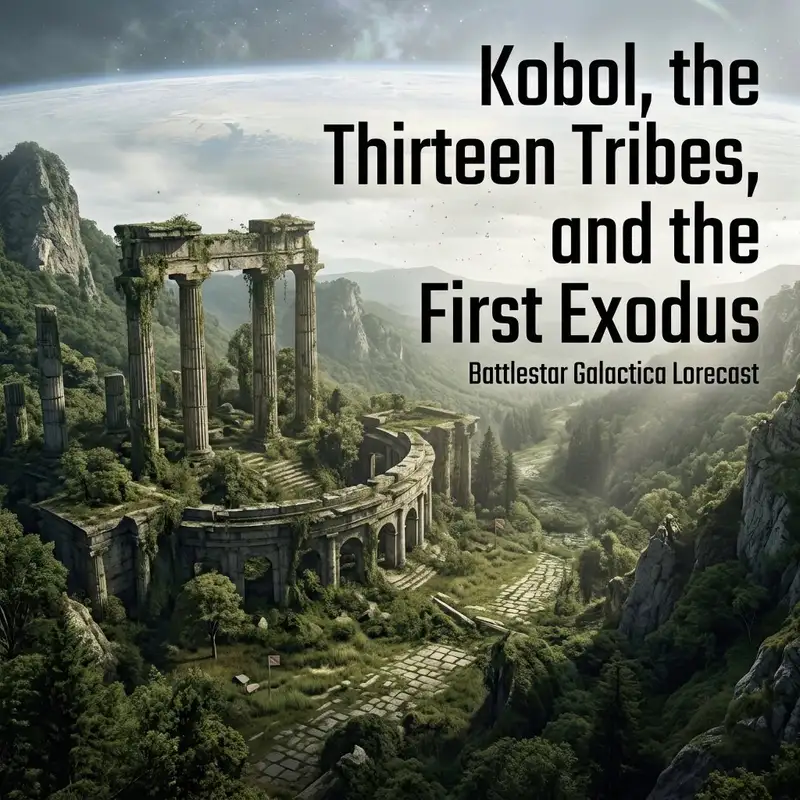
Kobol, the Thirteen Tribes, and the First Exodus
Kobol did not welcome the refugee fleet as a homeland. It presented itself as a military problem. The planet was ruined, uninhabited, and dangerous. Its ground held old mines, difficult terrain, and Cylon forces willing to contest any landing. The survivors who reached it had no secure port, no functioning cities, no visible agriculture, and no industrial base that could sustain a population already reduced to a fragile convoy of civilian ships. Kobol could not feed them. It could not shelter them. It could not replace a lost Viper, repair every damaged drive, or give the fleet a defensible permanent base.
Yet the planet mattered because it was supposed to be where humanity began. Colonial religious tradition described Kobol as the ancestral home of the tribes, a place associated with the Lords of Kobol and with the first great departure of humanity into the stars. For the fleet, that made Kobol more than an archaeological curiosity. Somewhere in its ruins might lie evidence of Earth, the distant refuge that had become the center of Colonial hope. The paradox was severe. The survivors needed a new world, but their best lead came from a dead one.
That made the return to Kobol something more complicated than a pilgrimage. It was an expedition conducted under threat, with incomplete intelligence and no margin for a prolonged occupation. Every day spent searching exposed the fleet to Cylon pursuit, mechanical failure, fuel consumption, and political fracture. The people on the ground were not merely historians or believers. They were part of an improvised reconnaissance effort, trying to turn fragments of sacred memory into usable navigation.
The danger of returning to Kobol raised a deeper question. Why did the Colonials regard this place as home at all? What did they actually know about the world from which their ancestors had supposedly departed? And what happens when a civilization’s oldest memories survive not as official records, maps, and archives, but as scripture, prophecy, ritual, and scattered ruins?
The Colonial account began with the Sacred Scrolls. These texts preserved the traditional belief that humanity had once lived on Kobol, where human civilization existed in the presence of the Lords of Kobol. For many Colonials, that language was religious before it was historical. Kobol was not merely a location on an old chart. It was a sacred point of origin, a place where divine history, human ancestry, and political identity overlapped.
The Scrolls described thirteen tribes leaving Kobol. Twelve traveled outward and eventually became the ancestors of the Twelve Colonies. The Thirteenth Tribe, according to the inherited tradition, journeyed to a distant world called Earth. That account gave the Colonies a common ancestry even when the colonies themselves remained distinct in culture, politics, class, religion, and local loyalty. Caprica was not Tauron. Tauron was not Gemenon. Picon was not Sagittaron. Yet all could claim descent from a larger civilization that had once existed before their separate worlds.
After the destruction of the Twelve Colonies, that tradition acquired immediate strategic importance. Earth was no longer only a religious promise or a subject for scholars. It became a possible destination for refugees. If another branch of the ancestral people had survived elsewhere, then extinction might not be the final condition of the survivors. Earth represented land, water, labor, shelter, and perhaps a population that had escaped the Cylon war. It also represented something less measurable but equally necessary. It offered a reason to believe that the fleet was moving toward a future rather than merely delaying its destruction.
That did not make the Sacred Scrolls a complete historical archive. They had survived for an immense span of time through copying, interpretation, teaching, ceremony, and political use. They preserved meaning. They preserved names. They preserved the idea of thirteen tribes and a lost Earth. Yet they did not provide a detailed migration log, a complete chronology, a census, a list of vessels, or a reliable description of Kobol’s final political order. The texts were neither empty superstition nor a modern intelligence briefing. They were a surviving cultural memory, and cultural memory can remain true in important ways while becoming uncertain in its sequence and detail.
The first difficulty appears in the dates. Early Colonial understanding placed the Exodus from Kobol roughly two thousand years before the Fall of the Twelve Colonies. That was the broad time frame carried in the Colonies’ religious and historical imagination. It was old enough to be remote, but near enough to suggest a continuous connection between Kobol, the Colonies, and Earth.
Later evidence complicated that account. The Temple of Five, associated with the journey of the Thirteenth Tribe, pointed toward a much older departure. Its archaeological evidence suggested that the Thirteenth Tribe had left Kobol approximately four thousand years before the refugee fleet reached that region of space. The difference matters because it cannot be quietly solved by choosing whichever number sounds more convenient. The screen record leaves a real chronology problem. The traditional Colonial Exodus and the Thirteenth Tribe’s departure may not have been one synchronized migration.
The possibility changes the meaning of the old story. The Colonial tradition may have compressed several departures, generations, and historical transformations into one sacred narrative. It may have remembered that thirteen tribes had a shared relationship to Kobol while losing the exact order in which they separated. It may have preserved the destination of the Thirteenth Tribe while misremembering who that tribe was. This is not unusual for a civilization whose common past has survived through sacred literature rather than uninterrupted archival institutions. Meaning often lasts longer than sequence.
The phrase First Exodus, then, does not describe the later evacuation from the Twelve Colonies after the Cylon attack. It does not mean the escape from New Caprica. It refers to the ancient dispersal from Kobol, or perhaps to a set of ancient dispersals later remembered as one foundational departure. It was the first great movement in the surviving Colonial story, the event that transformed one ancestral civilization into separate societies scattered across the stars.
The dates become more difficult still when the later refugee fleet discovers what happened to the Thirteenth Tribe. The Colonials had believed that the Thirteenth Tribe was another human branch of the Kobolian diaspora, a people who reached Earth long before the Twelve Colonies knew how to find them. That belief was understandable. It followed directly from the Sacred Scrolls and from the shared assumption that all thirteen tribes were human.
The discovery of the devastated first Earth overturned that assumption. The people who had lived there were not human in the ordinary Colonial sense. They were Cylons. Their civilization had developed humanoid bodies, reproduction, and technologies related to resurrection. Their dead had been buried in a world scarred by a nuclear catastrophe. The Earth the fleet finally found was not a living refuge inhabited by lost Colonial cousins. It was a graveyard.
The revelation belongs to the later history of the fleet. Laura Roslin, William Adama, Kara Thrace, Elosha, and the others who first struggled over Kobol did not know it. They acted on the best evidence available to them, which was a mixture of scripture, ruins, prophecy, artifacts, and urgent need. It would be unfair to treat their early decisions as foolish simply because later discoveries revealed that the old account was incomplete. Their problem was not that they trusted tradition. Their problem was that they had no reliable alternative map.
The revelation also requires care in the use of the word Cylon. The Thirteenth Tribe was not merely an early version of the Cylon force that destroyed the Twelve Colonies. It was not Cavil’s faction waiting in the distant past. It was not a hidden reserve of Centurions, Raiders, or humanoid infiltrators with a direct chain of command into the later war. The first Earth had its own society, its own history, and its own catastrophe. The surviving evidence indicates a relationship of ancestry and recurring pattern, not a seamless military organization stretching across millennia.
Even the later Cylon models did not possess a complete understanding of this history. Their knowledge was uneven, manipulated, and shaped by memory suppression, factional politics, and incomplete access to the past. The Final Five carried crucial pieces of the story, but they were not a universal answer to every mystery surrounding Kobol, the Lords of Kobol, prophecy, or the Thirteenth Tribe. Their existence clarified part of the historical record. It did not convert that record into a complete and orderly file.
What the later evidence does establish is unsettling. The Colonial ancestors remembered the Thirteenth Tribe as a lost human people who had traveled to Earth. In reality, that branch of the Kobolian inheritance had become, or had already been, a Cylon civilization. The old religious tradition had retained a true direction and a true connection while losing the identity of the travelers themselves. It was accurate enough to guide descendants across enormous distances. It was incomplete enough to conceal one of the most consequential facts in Colonial history.
That makes the ancient Exodus a military and political question as much as a religious one. An interstellar migration is not merely a departure. It requires navigation, functioning vessels, trained personnel, social organization, labor, provisions, and the ability to maintain some form of collective purpose after arrival. People must build shelters, raise children, preserve skills, allocate resources, settle disputes, and decide who has authority. Even a successful migration can fail if the travelers reach a new world without the institutions required to survive there.
The surviving evidence does not allow a detailed reconstruction of the Kobolian departure. There is no reliable ancient order of battle. No confirmed list of ship classes has survived. There is no established count of vessels, passengers, settlements, or industrial facilities. The screen material does not provide a full political map of Kobol or identify which tribe founded which later colony. Any confident account of ancient Kobolian fleet formations, government ministries, military commands, or migration routes would be invention.
Kobol’s ruins demonstrate that loss. Whatever civilization once existed there, it did not remain available to the Colonies as a secure inheritance. The descendants of the twelve tribes possessed a common origin story, but not a complete account of the world from which that story came. They knew enough to name themselves the Twelve Colonies. They did not know enough to understand the full ancient relationship among Kobol, Earth, humanity, and Cylon life.
The Twelve Colonies therefore became a successor civilization, not a simple continuation of Kobol. Their shared ancestry mattered. It supported a common government, a common fleet, common rituals, and the idea that the colonies belonged to a larger whole. But unity remained incomplete. Colonial identity was always layered. People belonged to the Colonies, but they also belonged to Caprica, Picon, Tauron, Aerilon, Gemenon, Sagittaron, Virgon, and the other colonial societies. They carried local traditions, regional resentments, religious differences, occupational identities, and political loyalties that no ancient origin myth could erase.
The distinction matters because a common past is not the same thing as a unified political culture. The Twelve Colonies could cooperate, but they could also compete. They could share a military and still disagree about war. They could preserve common sacred texts and still interpret them differently. They could regard Kobol as ancestral home while knowing almost nothing about its final centuries. Their civilization inherited enough memory to build a collective identity, but not enough to possess secure historical self-knowledge.
The later creation of Cylons in the Twelve Colonies becomes more tragic in that light. The Colonials did not knowingly recreate the history of the Thirteenth Tribe. There is no evidence that Colonial engineers, political leaders, or military planners understood that their own sacred tradition contained an earlier Cylon civilization. Kobol did not directly cause Colonial robotics. Ancient scripture did not dictate the development of artificial life. At the same time, the Colonials created thinking machines without knowing that their inherited past already included another branch of civilization in which synthetic life had become central.
The Colonials remembered Earth as a human refuge. The truth was harsher. The first Earth had been the site of Cylon self-destruction. Its inhabitants had reached another world and built a sophisticated society, yet their civilization still ended in nuclear ruin. Their migration had extended their history. It had not guaranteed restraint, reconciliation, or political wisdom. They escaped Kobol, but they did not escape the capacity of a technologically advanced society to destroy itself.
That ancient history became operationally relevant only because the modern Colonial fleet had suffered an exodus of its own. After the Fall, the survivors possessed ships, trained crews, a president, a military command, and some scattered resources. They also possessed almost no secure territory. Their entire society had been compressed into a vulnerable traveling population. Food, water, medical supplies, tylium, replacement parts, pilot training, repair capacity, and political legitimacy all had to be managed aboard a fleet that could not just return home.
In those circumstances, Earth became more than an idea. It became a strategic objective. At the same time, the fleet’s search began under a serious problem of command credibility. Commander William Adama had told the survivors that he knew Earth’s location. He did not. The claim was a deliberate attempt to provide direction and preserve morale after the destruction of the Colonies. In the immediate crisis, that deception gave the fleet a destination. It also created a fault line. If Earth was not a verified objective, then the fleet’s strategy rested partly on an officer’s judgment that hope was worth more than strict transparency.
President Laura Roslin had a different source of authority. Her office came through Colonial constitutional succession after the government’s destruction. She was not merely a religious figure, and she did not derive her legal position from prophecy. Yet her illness, her interpretation of the Book of Pythia, and the apparent fit between the prophecy and the fleet’s circumstances made her religious understanding politically powerful. The Book described a dying leader guiding a caravan of the heavens toward Earth. For many survivors, Roslin’s cancer and the fleet’s flight made that language difficult to dismiss.
Roslin’s position was not irrational simply because it involved faith. The fleet had discovered Kobol. Kara Thrace had returned from Caprica with the Arrow of Apollo. Ancient artifacts and locations were beginning to produce evidence that could not be explained away as mere comforting legend. Roslin saw a pattern in those facts. She believed the route to Earth lay through the religious inheritance of the Colonies, not through Adama’s invented strategic certainty.
But Roslin’s interpretation created a command problem. A president who asks a refugee population to accept prophecy as a guide is asking that population to accept a form of evidence that cannot be fully tested in advance. Adama’s concern was not simply that he disliked religion. He understood that a fleet under Cylon pursuit could not remain viable if navigation, security, and political authority were divided among leaders acting on incompatible claims. Ships needed coordinated jumps. Civilian vessels needed protection. Pilots and deck crews needed orders that did not change with every dispute over sacred interpretation.
The conflict between Roslin and Adama was therefore not a clean contest between reason and faith. It was a conflict between different forms of leadership under extinction pressure. Roslin had constitutional legitimacy and a compelling interpretation of the surviving evidence. Adama controlled the principal military force and understood the risks of fragmenting the fleet. Both had reasons to distrust the other. Both also needed what the other represented. A civilian government without military protection could not secure the fleet. A military command without civilian legitimacy could preserve order for a time, but not necessarily a society.
The crisis became operationally dangerous when Roslin’s supporters separated from Galactica. More than one-third of the surviving fleet traveled toward Kobol under Roslin’s political leadership. Tom Zarek, whose revolutionary past made him both a useful ally and a destabilizing political presence, joined that movement. The division was not a symbolic protest. It physically separated civilian ships from the main battlestar and from the largest concentration of experienced pilots, mechanics, weapons, medical support, and command-and-control capability.
A divided fleet is vulnerable even when no enemy is visible on DRADIS. Civilian ships can suffer drive trouble, navigation failure, accidents, illness, supply shortages, or disputes among captains. They may not have the fuel reserves, technical crews, or defensive systems needed to survive independently. Coordinated faster-than-light movement requires shared calculations and trust. A fleet split by competing authorities risks leaving damaged vessels behind, losing contact, or presenting the Cylons with smaller groups that cannot protect one another.
In immediate combat terms, each group had fewer resources. Operationally, the survivors lost cohesion and mutual support. At the political level, the dispute raised the question of whether constitutional authority or military command would determine the fleet’s future. At the civilian level, people who had already lost their worlds became more exposed to danger because their leaders could not agree on the meaning of one ancient planet.
Neither side possessed a complete monopoly on legitimacy. Roslin had a valid constitutional claim to lead. Adama had responsibility for the force capable of keeping the fleet alive. Lee Adama stood in the middle of that division, pulled between loyalty to his father, duty to the military chain of command, and recognition that civilian authority could not be reduced to whatever a battlestar commander found convenient. The personal strain on Lee reflected a larger institutional problem. Survival demanded unity, but unity could not be built by pretending that the conflict did not exist.
The expedition to Kobol depended on the Arrow of Apollo, an artifact recovered by Kara Thrace from Caprica. The Arrow gave physical form to a tradition that had seemed almost entirely textual. It linked the contemporary fleet to a story about ancient routes, temples, and the possibility of Earth. But possessing a relic did not explain how to use it, where to carry it, or whether the tradition surrounding it had been preserved correctly.
That is where the Tomb of Athena became important. The tomb transformed religion into an intelligence question. The issue was no longer simply whether the Sacred Scrolls were meaningful. The issue was whether ancient tradition, artifacts, and locations could generate information that could be checked against the physical universe. If the Arrow opened or activated something in the tomb, and if that result pointed toward Earth, then the fleet had acquired more than a symbol. It had acquired a lead.
The expedition also depended on Sharon Agathon, a Number Eight Cylon whose role made every decision more difficult. Sharon possessed knowledge that proved relevant to the ancient site. She could interpret or recognize elements that the human expedition could not. At the same time, she was an intelligence risk by definition. The Cylons had infiltrated Colonial society, destroyed the Colonies, and repeatedly used human appearance as a weapon. No responsible commander could ignore that history merely because Sharon had acted against other Cylons.
Yet Sharon could not be reduced to a weapon of the enemy either. Her actions, loyalties, and relationships had diverged from those of other Number Eight copies. Treating all Eights as one interchangeable person would have been analytically simple and operationally disastrous. The expedition had to live with an uncomfortable reality. Some of its most useful intelligence came from a person whose identity also embodied the threat that had nearly destroyed humanity.
Elosha brought another kind of expertise. As a priestess and interpreter of the Sacred Scrolls, she understood the religious language surrounding Kobol, the Arrow, and the Tomb of Athena. Her presence shows that spiritual authority was not ornamental. In an expedition built around ancient texts and sacred sites, religious knowledge had practical value. It helped the group identify places, interpret symbols, and understand why certain artifacts mattered.
At the same time, Kobol was not protected sacred ground. Elosha’s death made that point with brutal clarity. The ancient homeland remained a contested operational environment, where mines, Centurions, and uncertainty could kill a religious leader as easily as a Marine or pilot. Faith did not remove the need for perimeter security. Scripture did not identify every threat. The expedition’s spiritual purpose could not substitute for reconnaissance, weapons, medical support, or disciplined movement through dangerous terrain.
The Tomb of Athena eventually produced what the fleet needed most: a route. Its projection offered a map-like representation pointing toward Earth. The image connected celestial bodies and ancient markers in a way that could guide the continuing search. It was one of the most important moments in the fleet’s history because it turned inherited memory into directional intelligence.
The mechanism remains unresolved. The projection cannot be confidently labeled ordinary Colonial technology. It cannot be proven to be direct divine intervention. It cannot be understood only as a fully understood Cylon device, and it is not a simple holographic database waiting for a password. The Tomb of Athena preserved or produced information in a form the expedition could use, but the series does not provide a complete technical or metaphysical explanation for how it did so.
The uncertainty does not make the information worthless. Military and political leaders often act on evidence they cannot fully explain. A reconnaissance contact may be incomplete. A map may come from an untrusted source. A recovered system may reveal a route without revealing who built it or why. The responsible question is not whether every intelligence lead arrives with total certainty. The question is whether leaders understand the difference between a lead and proof.
For Roslin, the Tomb confirmed that the Sacred Scrolls contained more than pious memory. For Adama, it provided information that could be incorporated into the fleet’s search without requiring him to surrender every concern about command, security, or evidence. Their eventual reconciliation mattered because the route to Earth required more than belief or skepticism alone. It required both direction and the practical capacity to move a civilian fleet through hostile space.
The Tomb’s route later connected with other ancient clues, including the Temple of Five and the Eye of Jupiter. Those sites did not produce a neat route plan with every hazard and destination labeled. They formed a chain of evidence. Each clue narrowed uncertainty while introducing new questions. The strategic value lay in the accumulation. The fleet could test one marker against another, compare religious tradition with astronomical evidence, and continue moving without pretending that it possessed a complete picture.
The eventual discovery of the first Earth showed the limits of even accurate navigation. The fleet followed a genuine trail. The route was not invented. The ancient evidence led somewhere real. But a correct route can still lead to a devastating truth. The first Earth was not the living sanctuary the Colonials had imagined. It was the destroyed endpoint of the Thirteenth Tribe’s migration.
The ruins revealed a nuclear catastrophe that had occurred long before the modern fleet arrived. The world bore the evidence of a civilization that had reached a high level of technological development and then destroyed itself. The Final Five were survivors of that world. They had lived within the Thirteenth Tribe’s Cylon civilization and later traveled toward the Twelve Colonies, carrying knowledge of resurrection that had been lost, abandoned, or rediscovered over time.
The Thirteenth Tribe had developed humanoid existence, natural reproduction, and an earlier form of resurrection technology. That history is important because it demonstrates that resurrection was neither magic nor an unlimited protection against loss. It required knowledge, infrastructure, bodies, and a society capable of maintaining the system. Its existence did not prevent political violence. It did not prevent fear, conflict, or self-destruction. A civilization can overcome one form of mortality and remain vulnerable to the choices it makes with power.
The first Earth therefore changed the meaning of the Exodus. The ancient migration from Kobol had not produced one simple human family dispersed across the stars. It had produced at least two profoundly different successor histories. One led to the Twelve Colonies, where humans eventually created Cylons and fought wars against them. The other led to a Cylon civilization that developed its own society, its own forms of embodiment and reproduction, and its own nuclear catastrophe.
The resemblance between those histories is disturbing, but it should not be exaggerated into a precise mechanical cycle. The record does not establish that every civilization repeats the same events in the same order. It does not establish that prophecy removes free will, or that technology inevitably produces genocide. What it does show is a recurring set of failures. Created life is treated as a tool, then becomes a political and moral question. Advanced technology changes the scale of conflict without solving the problem of restraint. Migration preserves a population but does not guarantee that the survivors have learned how to govern themselves.
The Thirteenth Tribe escaped Kobol and reached Earth, but their new world did not save them from themselves. The Twelve Tribes survived Kobol and built the Colonies, but their civilization later created Cylons without understanding the ancient warning embedded in its own inheritance. The refugee fleet escaped the destroyed Colonies, but it carried forward the same pressures that had damaged earlier societies: fear, secrecy, contested authority, technological dependence, religious division, and the temptation to sacrifice law for survival.
Kobol’s importance lies in that connection. It was not a paradise waiting to be reclaimed. It was a ruin, and ruins are useful partly because they deny comforting stories. The survivors came to Kobol expecting an origin. What they found was evidence that their origin had always been more complicated than they believed. The planet could not restore the Twelve Colonies. It could only offer fragments: a tomb, an arrow, sacred language, dangerous ground, and a direction toward another uncertain world.
The First Exodus was both a religious origin story and a strategic survival movement. The religious account preserved enough truth to matter. It kept alive the memory of Kobol, the thirteen tribes, and Earth across a span of time that had erased most practical records. Yet it also obscured chronology, compressed different histories, and misidentified the Thirteenth Tribe. The tradition was not false because it was incomplete. It was incomplete because civilizations rarely preserve the whole truth of their own beginnings.
Roslin and Adama’s eventual reunion matters for the same reason. A prophecy may identify a road, but a fleet still needs command, fuel, maintenance, security, labor, medicine, and a population willing to remain one people. Civilian authority needs military protection. Military force needs lawful purpose. Faith can sustain endurance and point toward evidence, but it cannot replace the hard work of governing a frightened society under pressure.
Kobol gave the fleet a direction, not a sanctuary. Its ruins preserved enough memory to move the survivors forward, but not enough certainty to spare them from interpretation, division, or error. The First Exodus had carried peoples away from catastrophe once before. Reaching another world had not guaranteed peace, wisdom, or continuity. For the refugees following the same ancient path, that was Kobol's real warning: a destination can preserve a population, but only the society built after arrival determines whether the exodus was truly a beginning.