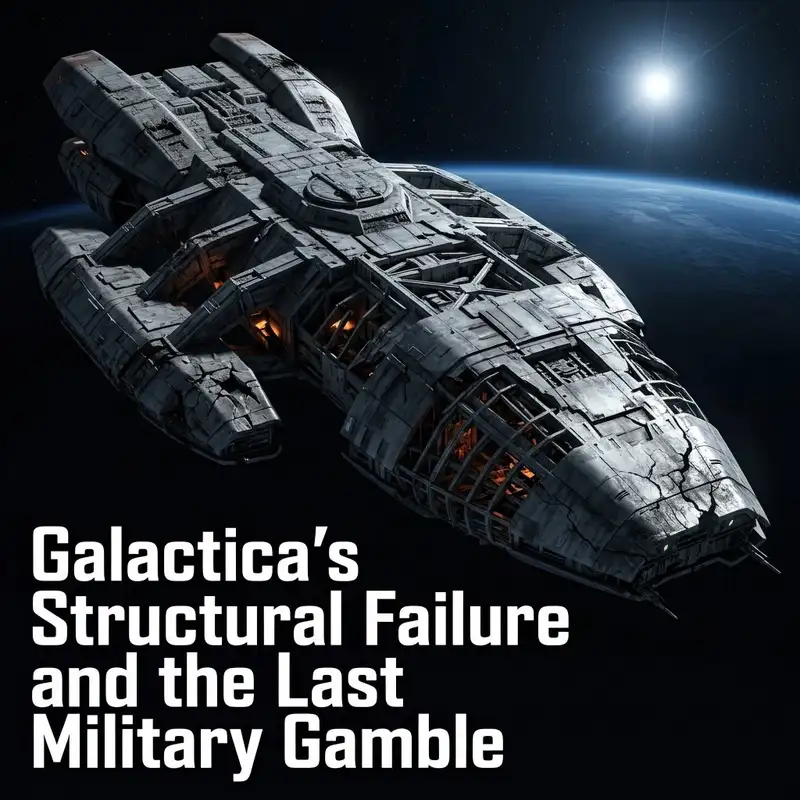
Galactica’s Structural Failure and the Last Military Gamble
The breach did not look like the end of a warship at first. It looked like another emergency aboard Battlestar Galactica. Damage-control teams sealed what they could. Survivors were counted. The missing were searched for, then mourned. But this was not routine battle damage, and it was not a compartment that could simply be patched, repressurized, and forgotten. At least sixty-one humans and Cylons were dead or unaccounted for after the failure. More important, the breach revealed what Chief Galen Tyrol had been warning the command staff for some time. Galactica was no longer merely worn, battered, or overdue for a refit. Her internal structure was coming apart.
By that point, Galactica had carried more than a military mission for years. She was a battlestar, an aviation platform, a command ship, a repair base, a prison, a hospital, and at times the armed center of a refugee government. Her Vipers defended civilian ships that had no meaningful defense of their own. Her engineers kept damaged systems running with dwindling supplies. Her officers helped impose order when the fleet had no stable territory, no shipyard network, and no margin for institutional collapse. The ship had become a physical expression of survival. That made the diagnosis harder to accept. A ship can still have power, weapons, engines, and a crew. It can still look formidable from the outside. Yet it may no longer be a sustainable military asset.
Admiral William Adama finally acted on that reality. He ordered the crew to stop treating repairs as recovery. Useful equipment would be stripped. Personnel, weapons, and supplies would be transferred where possible. Galactica would be prepared for abandonment. The order was not defeatism. It was an acknowledgment that the fleet could not repair itself by refusing to recognize what had been lost. A cracked pressure line can be repaired. A damaged flight deck can be reinforced. A destroyed Viper can sometimes be replaced from stores or salvaged parts. But a warship whose supporting structure is failing throughout the hull presents a different problem. Every jump, launch, collision, and maneuver becomes another test of whether the ship can remain one piece.
The final crisis had been building for some time. During the mutiny aboard Galactica, Tyrol found deformation near the faster-than-light machinery. Later, a more extensive inspection revealed hairline fractures throughout structural members. The damage was not confined to a single scar from one battle. Galactica had endured combat, repeated jumps, internal sabotage, emergency maneuvers, and years of maintenance performed without the factories, dry docks, or industrial depth that had once supported the Colonial Fleet. Her age mattered, but age alone was not the explanation. The ship had been asked to do what no peacetime maintenance schedule anticipated: remain continuously operational as the last major warship of a civilization that had lost its home.
The precise engineering balance remains unclear. The released record does not assign exact portions of responsibility to earlier battles, repeated faster-than-light jumps, atmospheric stress, or the final campaign. It is tempting to search for one decisive moment, one impact, one overloaded bulkhead, or one reckless maneuver that destroyed the ship. That temptation misses the larger military lesson. Galactica failed cumulatively. Every successful emergency action drew down a reserve of structural strength that could not be restored. The ship survived because her crew kept finding ways to make damaged systems work. She also approached collapse because survival had become a succession of necessary exceptions.
Tyrol believed there might be one option left. The rebel Cylons possessed a biological repair material that might help restore Galactica’s damaged structure. Adama refused it. The decision was understandable. The Colonial survivors had lived through genocide enabled in part by infiltration, compromised systems, and misplaced confidence in technology supplied through hidden Cylon access. Adama had spent years commanding a ship whose relative isolation from certain networked systems had helped preserve it during the Fall. He was not eager to introduce unfamiliar Cylon material into the bones of the last battlestar.
Still, distrust had a cost. The refusal did not prove that the Cylon material would have failed, and it does not prove that it would have saved Galactica. The fleet lacked enough knowledge to make either claim. But it exposed the cruel logic of the final year of the war. Humanity needed Cylon allies to survive, while carrying memories that made trust feel like another form of vulnerability. Galactica’s failing structure became part of that larger conflict. The ship could not be repaired by Colonial industry. It might have been helped by Cylon technology. Yet accepting that help meant allowing the enemy’s methods into a vessel that had survived partly by remaining separate from them.
Galactica was already being dismantled when Hera Agathon was taken. Sharon Valerii, known as Boomer, abducted the child and delivered her to the Cylon Colony. Hera was not merely a hostage, though she was that. She was not merely the daughter of Karl Agathon and Sharon Agathon, though that alone made her recovery a moral obligation to the people who loved her. Hera was also the first known child born from a human and a Cylon. Her existence carried biological and political significance that neither side fully understood.
John Cavil’s faction believed Hera might provide an answer to the Cylon reproductive problem. The Cylons could resurrect, but resurrection depended on infrastructure, replacement bodies, and a system of continuity that had become increasingly fragile and contested. Hera represented something different: reproduction, inheritance, and perhaps a future beyond the limits of existing Cylon design. That did not mean Cavil possessed a complete scientific solution, or that Hera’s biology would automatically unlock one. It meant that he had a powerful reason to study her, control her, and deny her to the humans and rebel Cylons who might oppose him.
Ellen Tigh understood the danger in those terms. Hera’s capture was not an intelligence loss that could be accepted in the name of broader strategy. She was a child in the hands of an enemy faction prepared to treat her as material for experimentation and political leverage. For the refugee fleet, abandoning Hera would have carried consequences beyond her immediate family. The fleet had spent years claiming that survival meant preserving a human community, not merely keeping a certain number of bodies alive. If that claim meant anything, it had to include the willingness to risk lives for a child who could not defend herself.
The decision also had a strategic dimension. A Cavil faction that gained reliable control over whatever Hera represented would have gained time, leverage, and perhaps a path toward renewal. The survivors had already learned that an enemy’s internal divisions could create opportunities, but those divisions could also close. A prolonged conflict favored neither side cleanly. The humans could not replace battlestars, air wings, or experienced crews. The rebel Cylons had broken with Cavil, but their political future was uncertain and their ability to reproduce had not been restored. Hera’s abduction threatened to hand the initiative back to the faction most committed to domination.
Finding the Colony was itself a problem. It had moved, and it operated near a naked singularity, a location whose hazards were obvious even if the exact astrophysics were never explained. The Colony was not merely another basestar waiting at a known coordinate. It was a fortified Cylon installation positioned where ordinary pursuit would be difficult and escape would be dangerous. The fleet had an urgent rescue requirement, but no conventional campaign plan, no reliable prospect of reinforcement, and no time to assemble a long operation around reconnaissance, attrition, and gradual pressure.
Samuel Anders provided the opening. By then, he was connected to Galactica in a Hybrid-like state, tied into systems and knowledge that no human officer could fully interpret. Through that connection, he supplied the Colony’s location. It was an extraordinary intelligence source, but not a complete one. Anders could provide access to the objective. He could not guarantee that the assault force understood every defensive system, every internal route, every Cylon contingency, or every consequence of attacking near the singularity. The operation would begin with unusual intelligence and end in uncertainty.
That made the coming mission a raid, not a campaign. Its objective was not to occupy Cylon territory, retake the Twelve Colonies, or exterminate every hostile Cylon. The surviving fleet had neither the resources nor the political basis for any of those ambitions. The objective was narrower and more demanding: reach the Colony, recover Hera, break Cavil’s ability to hold her, and escape if escape remained possible. The mission would depend on speed, surprise, local superiority at the point of attack, and the hope that Cylon division could be turned into a temporary military advantage.
Adama had to decide whether to commit Galactica after ordering her abandoned. On paper, preserving the battlestar might have appeared prudent. A damaged Galactica was still the fleet’s largest concentration of firepower, trained personnel, command experience, and aviation capability. But preserving her for a hypothetical future engagement only had value if the fleet could survive long enough to use her. Cavil holding Hera changed that calculation. So did the fact that Galactica’s future usefulness was declining every day. The fleet was not choosing between a healthy battlestar and a rescue mission. It was choosing between spending a dying battlestar now or watching the strategic situation worsen while the ship decayed.
Adama called for volunteers. That distinction mattered. The mission was likely to be fatal, and the admiral did more than order every remaining member of Galactica’s crew into the attack. Volunteers would form a mixed force of humans and rebel Cylons. Their cooperation was militarily valuable. The rebel Cylons understood Cylon systems, possessed access that humans lacked, and shared an immediate interest in preventing Cavil from controlling Hera. But the coalition was not held together by trust. It was held together by necessity, recent alliances, and the fact that every participant understood how much had already been done to the others.
President Laura Roslin’s presence gave the operation political and human weight, but she was not issuing flight orders or directing the assault from a tactical command station. Adama commanded the military operation. That concentration of authority carried risk. In a fleet reduced to a few surviving institutions, the commander of the last battlestar could become the final arbiter of questions that should belong to civilian government, law, and public consent. Yet Adama’s decision did not aim to preserve military rule. It aimed to give the civilian fleet a future in which one warship no longer had to serve as its permanent capital, shield, and source of emergency authority.
The assault began by using Galactica’s remaining mobility as a weapon. Rather than approaching from a distance and attempting a long exchange of fire, the battlestar jumped directly to the Colony at extremely close range. The maneuver traded safety for surprise. A conventional standoff engagement would have given the Colony’s defenses more time to respond and would have exposed Galactica to a fight she was no longer built to endure. Close insertion reduced warning time, but it also placed the battlestar immediately inside the enemy’s defensive envelope.
The Colony’s weapons and point-defense systems damaged Galactica at once. The ship had achieved surprise, not immunity. This was the danger of close-range assault against a fortified target. The attacker reaches the objective quickly, but does so at the price of accepting concentrated fire before the defense has been fully suppressed. Galactica could no longer rely on endurance. Her armor, compartmentation, and damage-control discipline still mattered, but they could not make a structurally compromised ship invulnerable. The mission was consuming the remaining margin that Tyrol had spent months measuring.
Anders created the next opening by interfacing with the Colony’s Hybrids. The result was a temporary shutdown of its weapons and related systems. That act was decisive, but it did not mean the battlefield was under friendly control. A defense network can be disrupted without being defeated. Systems can be restored. Personnel can adapt. Automated forces can still be released. The shutdown gave Galactica a narrow period in which to act. It was a breach in the enemy’s ability to coordinate, not a guarantee that the rescue force would be safe.
The Colony responded by releasing Raiders. Galactica’s remaining Vipers launched to meet them. Their mission was not just to accumulate kills. They had to protect the assault force, contest the Raider screen, preserve space around the battlestar, and keep the Raptors alive long enough to deliver boarding teams where they were needed. In carrier operations, the fighter is only one part of a larger system. Every Viper launched required a serviceable airframe, maintenance crews, deck crews, fuel, weapons, recovery space, and a ship still capable of conducting flight operations under fire. Galactica was spending all of those resources at once.
The Raptors then made the maneuver that showed how completely the mission had abandoned the idea of preserving Galactica for later use. They executed a short-range jump from the starboard flight pod to the far side of the Colony. The purpose was access. A conventional approach would have been too slow, too exposed, or simply blocked by the enemy’s defenses. The Raptor jump put boarding forces where Cavil’s defenders did not want them, creating a second axis of penetration through a battle that otherwise favored the fortified installation.
The price was the starboard flight pod. The maneuver destroyed it. That was not a dramatic flourish detached from military reality. A flight pod was part of the battlestar’s aviation system: launch space, recovery capacity, maintenance access, crew work areas, and the physical infrastructure that allowed fighters and Raptors to operate. Losing it meant sacrificing a critical element of Galactica’s future combat capability. In another war, with shipyards and replacement parts, that damage might have been repairable over time. This fleet had neither. The decision treated the pod as expendable because the mission required access now, not theoretical readiness later.
Even that penetration did not provide a secure entrance to the Colony. The assault force needed a breach large enough to exploit, and Adama made the final decision in the only form Galactica still possessed. He ordered the battlestar to accelerate and ram the Colony. The order converted Galactica’s armored forward section into a breaching instrument. A warship designed to carry fighters, absorb punishment, and deliver firepower became, in its last major action, a massive projectile.
The impact crushed Galactica’s forward section and entangled her with the Colony. Tactically, it worked. It created access for Lee Adama’s assault force and the boarding teams. The ram placed human and rebel-Cylon personnel inside the enemy’s defensive perimeter, where they could search for Hera and disrupt Cavil’s control of the installation. Operationally, however, the cost was ruinous. Galactica was no longer functioning as a maneuvering capital ship. Even if her engines still produced power, even if some weapons remained operational, the ship had been committed bodily to the target.
That was the last use of Galactica as a warship in the full sense of the term. She had not merely taken damage while fighting. She had been deliberately spent to create a breach. The difference matters. A commander can accept casualties while still intending to preserve a unit. Adama’s ram order accepted that Galactica might not leave the Colony intact, or at all. It was a calculated sacrifice made because the alternative was not a clean withdrawal to fight another day. The alternative was abandoning Hera, allowing Cavil to consolidate his position, and retaining a battlestar whose service life was already ending.
Inside the Colony, the mixed assault force initially achieved what the larger human-Cylon alliance had made possible. Humans and rebel Cylons fought alongside one another against Cavil’s defenders. Their partnership was operationally effective because each side brought something the other lacked. The humans contributed trained personnel, combat experience, and a direct commitment to Hera’s recovery. The rebel Cylons contributed access, shared knowledge, and an understanding of the political stakes inside Cylon society. But cooperation in combat did not erase the crimes, betrayals, and grief that had accumulated over the war.
The alliance broke at the worst possible moment. Through the Final Five’s shared memory transmission, Tyrol learned that Tory Foster had murdered his wife, Cally. Tyrol killed Tory. It was a personal act born from grief and betrayal, but it had immediate political consequences. The delicate effort to negotiate or bargain over resurrection knowledge collapsed. The people involved were not abstract representatives of united blocs. They carried individual memory, guilt, rage, and loyalties that no common operational plan could erase.
Cavil’s death followed the collapse of that final political possibility. Faced with the loss of the resurrection knowledge he wanted, and with the alliance around him disintegrating, he killed himself. That did not destroy the Cylon civilization. It did not erase every hostile Cylon force, settle every question of synthetic personhood, or convert years of genocide and war into reconciliation. It did end the immediate leadership crisis centered on the Colony. The rescue mission had succeeded in part because Cavil’s faction was divided from the rebel Cylons, but it also demonstrated that division was not the same thing as durable peace.
Hera was recovered, but victory inside the Colony did not free Galactica from the battlefield. The battlestar remained physically trapped in a damaged, destabilizing enemy installation near the singularity. Then another catastrophe changed the situation. Racetrack’s Raptor was lost in the surrounding debris field. The crew died. In the released sequence, the nuclear launch that followed was accidental. It was not a deliberate suicide attack, and it was not a final weapons order from Adama. A chance impact activated the launch controls, sending the missiles toward the Colony.
The nuclear strikes destabilized the Colony and sent it toward the singularity. The immediate tactical result was the destruction of Cavil’s central stronghold. The strategic result was more complicated. Hera had been recovered, and the enemy faction centered at the Colony had been broken. But Galactica was still entangled with the dying structure. The missiles did not create a clean escape route. They made escape immediately necessary. The battlestar had only moments to separate from an installation collapsing toward a gravitational hazard that no amount of ordinary damage control could survive.
Kara Thrace faced the final navigation problem. She did not possess the fleet’s rendezvous coordinates. In normal operations, a jump required planning, calculation, and a destination judged safe enough for the ship and its passengers. A blind jump was not routine improvisation. It was a choice between known destruction and an unknown destination. Adama authorized it because remaining with the Colony meant death. The command decision was stark, but not irrational. Galactica no longer had the luxury of waiting for certainty. Her commander could either risk the ship in transit or lose it where it stood.
Kara recognized a pattern in the musical sequence associated with Hera, her father, and the Final Five. She understood it as coordinates. The sequence worked. Galactica jumped away from the collapsing Colony and arrived near a habitable world, later called Earth. This was not the devastated Earth the fleet had found earlier, and it was not the Earth of the original Colonial legend. It was a different world, one capable of sustaining the survivors who had spent years searching for a place where flight might finally end.
How Kara possessed the knowledge to make that jump remains unresolved. The story connects the coordinates to music, memory, vision, prophecy, and experiences that cannot be reduced to ordinary navigation procedure. The coordinates are real in their effect. They take Galactica where she needs to go. But the series does not provide a complete scientific explanation for Kara’s knowledge, nor does it define every force that may have guided it. The military significance lies in the decision made with that knowledge. Kara acted. Adama trusted her judgment. The ship jumped because the alternative was certain destruction.
The jump saved Galactica from the Colony, but it completed the ship’s structural collapse. Hull breaches opened. Electrical failures spread. Explosive decompressions tore through damaged spaces. Saul Tigh reported that the battlestar had broken her back and would never jump again. That statement marked the terminal failure of a long decline. The final jump was the event that made the damage undeniable and irreversible. It was not the sole origin of Galactica’s condition. The ship arrived at Earth carrying the accumulated cost of every year in flight and every decision made to keep the fleet alive.
In material terms, Galactica’s final mission was a disaster for the Colonial military. The last great battlestar had lost a flight pod, suffered catastrophic bow damage, exhausted much of its remaining operational margin, and lost the ability to jump. The fleet could not replace her. It could not rebuild a comparable air wing, manufacture another capital ship, or restore the industrial system that had once made Colonial defense possible. No heroic interpretation should obscure that loss. The military arm of the Twelve Colonies had reached the end of its ability to sustain itself as a conventional force.
Tactically, however, the operation achieved its purpose. Hera was recovered. The Colony was destroyed. Cavil’s immediate faction was defeated as a coherent center of power. Operationally, Galactica reached an objective that a conventional standoff battle likely could not have reached. A damaged battlestar could not have sat at range and traded fire indefinitely with a fortified Cylon installation. The raid worked because it concentrated force at the critical point, exploited Anders’ access to Cylon systems, used the remaining air wing to create space, inserted troops through an extraordinary Raptor maneuver, and finally turned the battlestar itself into a breaching tool.
Strategically, the gamble ended the immediate cycle of pursuit. The civilian fleet did not need Galactica to continue searching for a refuge after the jump because the ship had carried it to one. That did not erase the survivors’ trauma, restore the dead, or settle every conflict between humans and Cylons. It did create the possibility that survival could become something other than perpetual readiness. For years, civilian life had been organized around alert status, food and fuel shortages, political emergencies, damaged ships, and the expectation that any pause might end with another attack. Earth offered a chance to stop treating a military formation as the permanent structure of society.
That possibility depended on accepting the loss of Galactica. A surviving ship is not always a usable ship. Galactica could remain in orbit, provide shelter for a time, and serve as a monument to the people who had fought aboard her. But she could no longer be the fleet’s shield. Her final state required the survivors to confront a question that had been postponed throughout the journey: what would they build if the battlestar no longer stood between them and danger? Military command had carried extraordinary authority because the fleet was constantly under military threat. Settlement required authority to become more dispersed, more civilian, and less dependent on one commander’s ability to make emergency decisions.
Lee Adama’s argument for abandoning advanced technology belongs in that context. His position was not a technical claim that every machine caused war or that technology itself was morally corrupt. The survivors had relied on technology for life support, navigation, medicine, food production, and survival. His warning concerned recurrence. The Colonies had built a civilization capable of creating Cylons, fighting them, exploiting them, fearing them, and then destroying itself through a war that neither side could truly win. To begin again by reconstructing the same military-industrial order would risk rebuilding the conditions that had made catastrophe possible.
Galactica’s final disposition made that argument visible. The ship had once been intended for retirement, then returned to combat by genocide, then kept alive by improvisation and sacrifice. At the end, she became a relic rather than a foundation for a new state. Her destruction after the survivors departed was not a celebration of helplessness. It was an acceptance that no society can remain permanently organized around one aging warship, one emergency chain of command, and one expectation of endless war. The survivors had to carry memory forward without carrying every instrument of their destruction into the next world.
Was the mission reckless? In one sense, unquestionably. It committed an already failing battlestar to close assault against a fortified target near a singularity. It sacrificed irreplaceable aviation infrastructure, accepted catastrophic structural damage, and depended on intelligence from a Hybrid-linked officer, a divided Cylon enemy, and a navigation solution no commander could fully explain. If the operation had failed, the fleet would have lost Hera, Galactica, many of its best personnel, and perhaps its last chance to end the immediate conflict on favorable terms.
But recklessness is not the same as irrationality. The alternative was not safety. Galactica was dying. Cavil held Hera. The fleet had no reserve battlestar, no industrial base, and no reason to believe it could sustain another long war of pursuit, attrition, and emergency repair. Adama did not spend a healthy ship to satisfy pride or revenge. He spent a failing military institution because preserving it had become less important than the people and future it was supposed to defend.
Galactica’s final mission was militarily credible precisely because it was not sustainable. Adama did not preserve the last battlestar for another campaign. He spent it to recover Hera, destroy the enemy center that held her, and carry the fleet beyond the point where survival depended on one aging warship. The ship’s broken back marked a military defeat in material terms, but it also marked the moment the survivors could finally attempt to become something other than a fleet at war.