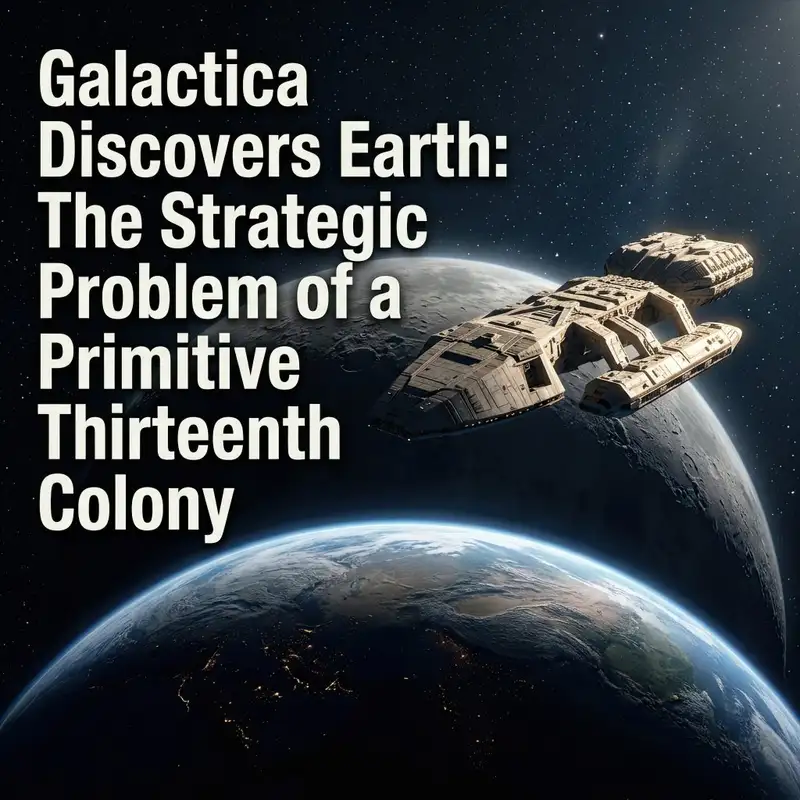
Galactica Discovers Earth: The Strategic Problem of a Primitive Thirteenth Colony [Galactica 1980]
After roughly thirty years of flight, Commander Adama faced the decision his people had imagined for generations. The Colonial fleet had found Earth, the world identified in their tradition as the refuge of the lost Thirteenth Colony. It was inhabited. It had cities, aircraft, governments, universities, armies, and the unmistakable signals of a living human civilization. Yet Adama did not order a landing. He ordered caution. The fleet remained away from the planet it had spent decades seeking because Earth, at the moment of discovery, was more than home. It was a potential battlefield.
That is the central paradox of Galactica nineteen eighty. Finding Earth solves the navigational problem that had defined the fleet’s long journey, but it creates a harder strategic problem. The Colonials have reached a habitable ancestral world, but they have not reached a prepared sanctuary. Earth is technologically behind the Colonial fleet in the ways that matter most against the Cylons. It has no interstellar defense force, no obvious means of detecting or countering Cylon Raiders, and no unified planetary authority capable of making decisions for all humanity. A public arrival might fulfill a dream. It might also expose Earth to destruction.
This Earth belongs to the original screen continuity and its Galactica nineteen eighty sequel branch. It is not the devastated Earth found in the later reimagined series, and it is not another distant settlement reached after the Twelve Colonies. In this story, Earth is the ancestral destination of the Colonial fleet, a world long imagined as a source of kinship and refuge. The discovery therefore carries emotional weight as well as military importance. The people on Earth are not treated as strangers in the abstract. They are understood as distant relatives. But kinship does not eliminate the difficulties of contact, sovereignty, security, or trust.
Dr. Zee gives Adama the fleet’s most important initial assessment. He studies Earth’s transmissions and reaches an uncomfortable conclusion. Earth possesses impressive capabilities by its own standards, but those capabilities are not enough to resist a Cylon attack. The problem is not that Earth lacks courage, intelligence, or organized institutions. The problem is that it has developed within the limits of one planet. Its military aviation, nuclear weapons, scientific programs, and long-range rockets were not built for combat against an enemy that can cross interstellar distances, attack from orbit, and operate with technology beyond Earth’s experience.
To make the danger visible, Zee presents a computer projection in which Cylon Raiders descend on Los Angeles and destroy it. The scene is a warning, not a report from the battlefield. The Cylons have not found Earth in this trilogy. Los Angeles is not actually attacked. The projection illustrates what might happen if the Colonial fleet announces its presence and thereby gives the Cylons a path to the planet. It is a strategic forecast of exposure, not proof that disaster has already begun.
That distinction defines Adama’s restraint. He is not responding to an active Cylon invasion of Earth. He is trying to prevent one. The fleet’s arrival creates a security risk precisely because it could turn a hidden world into a discoverable world. From the Colonial perspective, Earth’s relative technological weakness means that it cannot absorb the consequences of being drawn openly into the larger war. From Earth’s perspective, of course, the planet is neither empty nor helpless. Its nations have armed forces, political systems, scientific communities, and populations with their own histories and loyalties. Calling Earth primitive is a Colonial comparison, not a complete description of the people living there.
Adama and Zee therefore propose a strategy of concealment, assessment, and gradual cultivation. The fleet should move away from Earth rather than gather above it. Small Colonial teams should enter quietly, learn how the planet works, identify trustworthy scientists, and encourage technological development over time. The aim is not immediate alliance. It is preparation. Earth must eventually become capable of contributing to its own defense, but it cannot safely be transformed in a single dramatic encounter.
This is a patient plan, but it is not passive. It treats intelligence as the first requirement of assistance. Before the Colonials can decide whom to approach, they must understand Earth’s political geography. There is no single world government that can speak for the planet. A conversation with one military officer, one scientist, or one national leader would not settle Earth’s response. Any public contact could trigger panic, competition, secrecy, disbelief, or attempts by rival governments to seize Colonial technology. The Colonials do not know which institutions are trustworthy, which are vulnerable to coercion, or which discoveries would be used for peaceful research rather than military advantage.
Adama’s position also recognizes a limit on Colonial authority. He commands Galactica and holds immense responsibility for the fleet’s survival, but that command does not give him legitimate control over Earth. Earth’s people did not ask to become part of Colonial strategy. They did not consent to having their scientific development directed by visitors from another world. The fleet may see Earth as its long-sought refuge, but Earth is already home to billions of people with their own claims on its future. Protecting the planet cannot mean casually treating its inhabitants as resources, recruits, or laboratory subjects.
The first insertion force shows both the promise and the weakness of Colonial superiority. Captain Troy, Adama’s grandson and the former Boxey, leads the Earth operation with Lieutenant Dillon. They arrive with equipment that gives them advantages Earth cannot easily match. Their Languatrons help bridge language barriers. Their navigational computrons support movement and calculation. Their Vipers can operate in Earth’s atmosphere. Their turbocycles offer rapid ground transport. They also possess a concealment device capable of hiding a person or a craft from ordinary visual and electronic detection.
Yet the concealment system is not limitless. Its energy demands impose a practical time constraint. A Viper’s invisibility field can operate for only a limited period, described in the operation as roughly a day by Earth’s clock. That is enough to support infiltration. It is not enough to make the team permanently invisible. Every mission must still account for power, recovery, navigation, maintenance, and a route back to the fleet. Advanced equipment gives Troy and Dillon tactical freedom, but it does not free them from logistics.
Their Vipers can evade Earth’s aircraft. That does not mean they can remain indefinitely without support. Their turbocycles can move quickly through unfamiliar territory. That does not mean they understand roads, traffic laws, police procedures, or local behavior. The Languatrons can translate words. They cannot automatically supply cultural fluency. A reconnaissance mission is not successful merely because its participants carry better machines. It succeeds when those participants can collect information, avoid unnecessary exposure, and leave without creating a crisis that defeats the mission’s purpose.
The first major contact with Earth demonstrates this immediately. Troy and Dillon enter American airspace in aircraft no Earth authority recognizes. United States air-defense personnel detect the intruders. General Cushing orders an interception. From his standpoint, this is not an overreaction. Unidentified aircraft have entered protected national airspace, declined to identify themselves, and displayed capabilities outside ordinary expectations. Any responsible defense organization would treat that as a possible threat. Earth does not know that the Vipers belong to distant human descendants seeking help. It knows only that unknown vehicles have violated its airspace.
The Colonials, meanwhile, see Earth’s interceptors as a danger to be avoided, not enemies to be defeated. Troy and Dillon use their craft’s defensive capability to survive incoming missiles and escape the interception. In the immediate engagement, the result favors the Colonials. Their Vipers are not destroyed, and the team reaches the ground. But the encounter is not a clean success. It produces evidence that something extraordinary has entered Earth’s skies. It leaves Earth authorities with an unanswered security problem. It also confirms that the Colonials’ secrecy will be difficult to maintain once their missions require movement through defended airspace.
The crucial intelligence failure is mutual misclassification. Earth sees intruders because, in operational terms, that is exactly how Troy and Dillon behave. The Colonials see a potential ally, but their methods give Earth no reason to understand their intentions. Concealment can prevent immediate capture. It cannot create trust. The ability to disappear from radar may be useful during an emergency, but it also makes every later explanation less credible. A government that has watched unknown aircraft evade its defenses is unlikely to greet the pilots with calm curiosity.
Adama’s wider plan depends on finding people who might receive limited information without turning the discovery into a public emergency. Professor Donald Mortinson becomes a likely contact because he represents an entry point into Earth’s scientific community. The Colonials need more than someone who can be impressed by advanced machinery. They need someone who can recognize evidence, ask serious questions, preserve secrecy, and potentially connect them to other responsible researchers. Mortinson is valuable because science, at least in principle, offers a language that can cross the technological gap.
But the encounter also reveals the ethical danger within the Colonial mission. From Mortinson’s perspective, strangers appear with inexplicable knowledge and technology, apply pressure, and attempt to control the terms of contact. Even if Troy and Dillon believe they are acting to protect Earth, their conduct can resemble abduction, manipulation, or intimidation. A superior power often describes intervention in the language of necessity. The people being intervened upon experience the loss of choice first.
Jamie Hamilton complicates the mission further. As a journalist, she is a threat to secrecy. Her profession trains her to investigate anomalies, demand explanations, and bring hidden facts into public view. In an operation built around concealment, that is dangerous. Yet Jamie also possesses something the Colonials badly need. She understands Earth. She knows its language beyond literal translation, its institutions, its habits, its media, and its history. Troy and Dillon can operate remarkable machines, but they do not know how to buy ordinary goods, navigate social expectations, or explain themselves without attracting attention.
That gap should not be dismissed as simple comic incompetence. It is an intelligence problem. Military organizations often prepare extensively to enter hostile territory while underestimating the difficulty of moving through civilian society. A team can know the route, the objective, and the equipment, then fail because it does not understand currency, local transportation, law enforcement, journalism, or the small customs that identify an outsider. Troy and Dillon’s difficulty blending in demonstrates that technical superiority does not produce cultural competence.
Jamie becomes useful because she can translate Earth not just as vocabulary, but as a lived environment. She understands why police questions matter, why reporters pursue a story, why unusual conduct attracts scrutiny, and why national authorities cannot just be ignored. Her knowledge becomes strategic. The Colonial mission needs someone who can interpret both the present and the historical context of Earth. The fleet has discovered a planet, but it has not yet discovered how to live responsibly in relation to the people on it.
Adama’s gradual approach is therefore built on more than fear of Cylon detection. It is built on an appreciation of unintended consequence. Every direct intervention changes the political conditions under which the next intervention must occur. Reveal a Viper, and Earth defense agencies become more alert. Pressure a scientist, and academic curiosity becomes fear. Involve a journalist, and secrecy becomes harder. Offer one government advanced technology, and its rivals may respond with suspicion or competition. The mission cannot be managed solely through better machines because its central problem is human response.
Not everyone in the Colonial leadership accepts this patient strategy. Council member Xaviar shares Adama’s concern about Earth’s vulnerability, but he rejects the timetable. His argument begins from a real strategic fear. The fleet remains threatened by the Cylons. Earth’s technological development, if left to unfold at its normal pace, may take far too long to produce an ally capable of helping the Colonials. A refugee fleet cannot assume it has centuries available for a distant civilization to develop interstellar defenses. Xaviar believes delay is its own form of risk.
His disagreement with Adama is more than personal. It is a dispute about emergency power, technological intervention, and the meaning of responsibility. Adama commands Galactica’s operations. Dr. Zee has extraordinary influence as a scientific adviser whose judgment the Colonial leadership has long respected. Xaviar sits within the Council of Twelve, the fleet’s political institution. The trilogy does not provide a complete constitutional map of their relationship, nor does it establish every rule governing the Council’s deliberations. But it makes clear that Xaviar is not an insignificant outsider. He has political standing, access to high-level knowledge, and a competing theory of survival.
Xaviar argues that Earth should be accelerated rather than cultivated. He believes the Colonials can use a time-warp synthesizer, associated with Zee’s work, to introduce advanced knowledge into Earth’s past. Electronics, aviation, atomic science, and other developments could appear earlier than they otherwise would. The resulting Earth, in Xaviar’s view, might become technologically capable quickly enough to contribute to the struggle against the Cylons. It is a seductive proposal because it promises to overcome the fleet’s greatest problem: time.
Yet Xaviar’s plan is fundamentally different from selective contact with scientists in nineteen eighty. Adama’s approach attempts to influence a living society cautiously, with at least some awareness that Earth must develop its own institutions and make its own choices. Xaviar proposes to alter the conditions under which those institutions and choices ever emerge. He does more than want to help Earth defend itself. He wants to rewrite Earth’s industrial and military development across generations.
The time-warp synthesizer is presented as an unusual and dangerous instrument, not a routine Colonial capability. The fleet does not casually use time travel as a standard method of navigation or warfare. That matters because Xaviar’s proposal is not a normal contingency plan. It is an extraordinary attempt to solve strategic weakness by reaching outside the ordinary boundaries of cause and effect. The very fact that it appears so powerful should make it more, not less, subject to restraint.
Technology is never just a package of diagrams that can be handed from one civilization to another. A design requires materials, manufacturing capacity, trained labor, scientific education, maintenance systems, supply chains, doctrine, political control, and institutions capable of deciding how it will be used. Giving advanced knowledge to the past does not guarantee a stable or humane future. It may simply give existing powers more destructive tools. The faster a technology spreads, the less opportunity there may be to build the legal and political systems needed to restrain it.
Xaviar also faces an intelligence problem that his urgency cannot solve. Once history has been changed, the Colonials lose the baseline from which they are judging Earth. They no longer know which institutions, alliances, wars, or scientific communities will exist. A world accelerated toward advanced weapons may become stronger, but stronger for whom? A more capable Earth could become a better ally. It could also become more divided, more authoritarian, more militarized, or less recognizable to the fleet that hoped to protect it.
The setting Xaviar chooses exposes the flaw in his strategy with brutal clarity. He travels to June fourth, nineteen forty-four, during the Second World War. He seeks contact with German rocket developers working amid advanced weapons research and the V-2 program. This is not an empty laboratory where neutral scientists calmly consider the future of humanity. It is a war zone shaped by an authoritarian regime, coercive institutions, military urgency, and mass violence. Any technology introduced there enters a system already organized to exploit science for domination and war.
The choice shows why technical knowledge cannot be separated from political context. A rocket is not only a machine. In that setting, it is part of a weapons program. A scientific breakthrough cannot be reduced to a contribution to human progress. It becomes an asset controlled by a regime, a military hierarchy, and an industrial system operating under wartime pressure. Xaviar may believe he is helping Earth reach a higher level of development, but he is offering leverage to actors whose immediate purpose is victory in a destructive conflict.
The wider historical moment makes control even less plausible. The Normandy landings are underway. Military priorities shift rapidly. A German officer who has custody of prisoners abandons that responsibility because the invasion has made other demands more urgent. The episode does not need to provide a complete history of the war to make its point. History is already moving under pressures of invasion, occupation, ideology, logistics, fear, and command failure. Xaviar has entered a violent political system that no visitor can direct simply by offering superior technology.
Troy, Dillon, Jamie, and those caught up in the operation attempt to prevent Xaviar from carrying out his intervention. Their immediate objectives are practical. They must deny him secure access to Colonial equipment, recover control of the Viper involved, and stop him from making further changes beyond the fleet’s knowledge. But their pursuit cannot restore the original conditions of the mission. Colonial technology has already appeared in a historical war zone. Earth people have already been drawn into a conflict they cannot fully understand. The boundaries of the covert operation have broken down.
Xaviar is captured temporarily, but the tactical success does not last. He uses Colonial concealment technology to escape and regains access to a Viper. Troy, Dillon, and Jamie pursue him through the atmosphere and toward near-space as he begins another time-warp maneuver. The action is less important as a contest of aircraft than as a demonstration of lost control. The Colonials possess superior machines, but superior machines cannot guarantee command of a mission once the mission’s political and temporal consequences begin multiplying.
The trilogy does not provide a final accounting of Xaviar’s fate. It does not establish that he successfully remade Earth history, nor does it prove that his efforts had no effect. He begins another attempt to escape through time before Troy and Dillon can conclusively stop him. Adama warns that interference in Germany during nineteen forty-four could alter two or three generations of Earth’s development. He also fears that Xaviar may seek another point of intervention, including eighteenth-century America. Those statements define the danger. They do not confirm an alternate history.
That unresolved ending is strategically appropriate. The Colonial fleet has not completed a rescue of Earth. It has opened a campaign whose consequences it cannot yet calculate. The mission began with a concern that public arrival might expose Earth to the Cylons. It has expanded into a second danger: Colonial desperation may expose Earth to uncontrolled interference from the very people who claim to be protecting it. The fleet must now worry not only about what the Cylons might do if they find Earth, but also about what one impatient Colonial leader might do with access to Earth’s past.
Jamie’s retention as a guide to Earth history is therefore more significant than it first appears. She is not just a local companion for future adventures. Her presence acknowledges that historical knowledge is an operational requirement. If Colonial teams are going to act on Earth, they need people who understand the social and political consequences of those actions. Engineers can explain machines. Pilots can operate Vipers. Commanders can assess threats. But none of those skills alone can explain what a technological intervention means when it enters a particular nation, war, institution, or generation.
The deeper lesson is that Earth’s apparent weakness is more than a shortage of weapons. Earth is a complex civilization whose strengths and vulnerabilities are bound together. Its governments are divided, but they are real. Its science is incomplete by Colonial standards, but it is embedded in universities, industries, and communities. Its military forces cannot defeat the Cylons, but they exist to defend their own societies and will react rationally to unidentified intruders. Its people cannot be reduced to a future reserve force for Galactica.
The Colonials’ own strength is similarly incomplete. They have Vipers, concealment systems, advanced navigation, and knowledge Earth lacks. They also have finite equipment, limited mission endurance, incomplete intelligence, and no legitimate authority over the planet they have found. Their refugee status creates pressure to act quickly, but pressure does not create wisdom. A fleet that has survived for decades may be capable of defeating Earth’s interceptors without being capable of governing the consequences of its arrival.
In the immediate fight, Troy and Dillon evade American interception, conduct their insertion, and pursue Xaviar. Across the wider operation, covert contact proves fragile because Earth’s institutions notice anomalies and Colonial teams struggle with local conditions. For the larger campaign, Earth cannot openly join the fleet without risking Cylon discovery. At the political level, no single government can offer consent for the whole planet. At the industrial level, advanced designs cannot safely leap over the institutions, labor, materials, and political restraints that make technology sustainable. At the civilian level, Earth remains safest partly because its people remain unaware of the danger gathering beyond their sky.
Xaviar identifies a genuine problem. Adama’s restraint does not make the Cylon threat disappear, and gradual development may not proceed quickly enough to save either Earth or the fleet. But Xaviar mistakes acceleration for control. He assumes that advanced technology can be delivered without empowering the wrong institutions, changing the wrong wars, or creating consequences that no Colonial authority can reverse. His answer to uncertainty is to impose more change. That is often the temptation of leaders who possess superior tools and too little time.
Adama’s approach is more defensible because it accepts that Earth is not a project. It is a sovereign, populated, politically complicated world whose survival cannot be separated from its freedom to develop on its own terms. Concealment, selective contact, and patience are not glamorous answers. They offer no immediate battlestar squadron, no guaranteed ally, and no simple victory over the Cylons. They do, however, recognize that protecting a civilization means more than preserving its population long enough to use it in a future war.
Galactica discovers Earth, but discovery does not grant permission to remake the people living there.