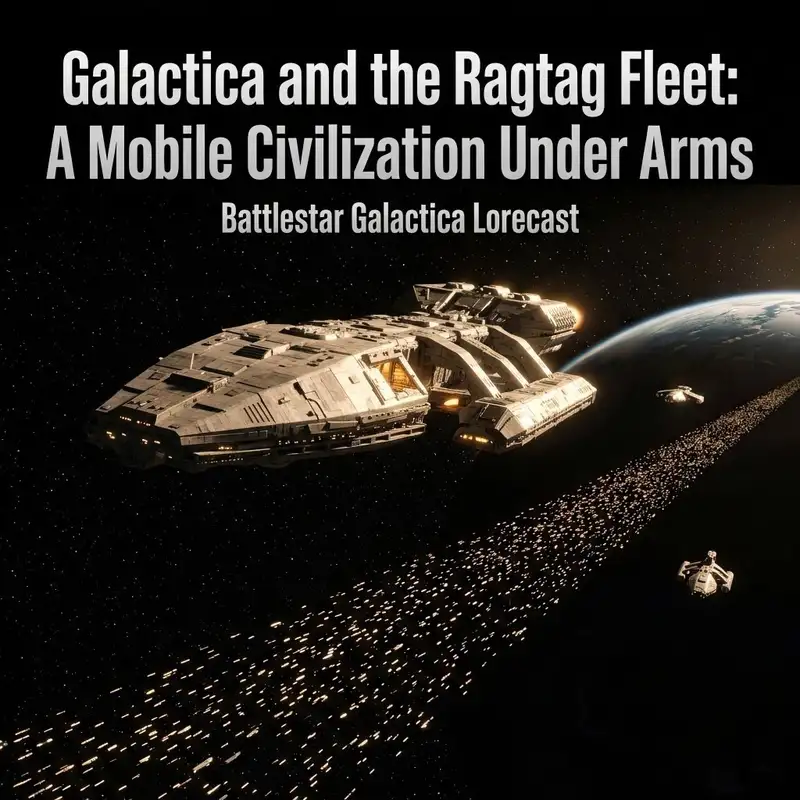
Galactica and the Ragtag Fleet: A Mobile Civilization Under Arms
For thirty-three minutes at a time, the survivors had no future beyond the next jump. Cylons found them, Galactica launched Vipers, civilian captains waited for new coordinates, Raptors carried reconnaissance and command traffic, and exhausted crews tried to bring every ship away before the enemy arrived in force. A battlestar built to fight a war had become the moving center of a scattered population. It had to defend the fleet, coordinate its escape, recover pilots, calculate risk, and maintain enough order for dozens of separate communities to move together. This was not a conventional convoy following a warship. It was a society being forced to operate at combat tempo.
That distinction explains both Galactica’s importance and its limits. The ship was the armed core of the survivor fleet, but it was never the whole fleet. It could launch fighters, direct rescues, conduct repairs, hold prisoners, treat casualties, and provide the strongest available command platform. It could not grow food, replace every skilled worker, preserve every family, create a legislature by naval order, or manufacture a civilization from its own steel decks. The central achievement of Galactica was not that it ruled the survivors. It was that, often imperfectly and sometimes coercively, it gave them enough protection and coordination to remain something more than passengers under military guard.
The Fall of the Twelve Colonies made that problem immediate. The Cylon attack was more than the destruction of Colonial warships. It was a coordinated assault on a civilization. Population centers were struck, military defenses were compromised, communications collapsed, and the institutions that connected the Colonies to one another were shattered. The survivors who later gathered around Galactica came from ships with different purposes, resources, crews, and expectations. Some had carried freight. Some had carried passengers. Some possessed useful machinery or stores. Others carried little more than people who had escaped before the destruction reached them.
Galactica itself survived under unusual conditions. The ship was old, partly prepared for decommissioning, and less dependent on the integrated systems that proved vulnerable during the Cylon offensive. That relative separation mattered, but it was not magic. Galactica still relied on computers, sensors, communications, weapons systems, trained personnel, and maintenance. Its survival reflected a combination of older architecture, reduced exposure to compromised networks, human procedure, timing, and the fact that the Cylons had not expected the ship to become the nucleus of resistance. The wider Colonial collapse involved more than one defective system. It involved infiltration, stolen access, peacetime complacency, common software, strategic surprise, and an enemy that had spent years learning how its target civilization worked.
At Ragnar Anchorage, the first political relationship of the refugee fleet took shape under conditions no constitution had been designed to handle. Commander William Adama commanded Galactica and the military personnel under his authority. Laura Roslin, elevated to the presidency through the surviving line of succession, claimed the responsibility to represent the civilian population. Neither could perform the other’s job. Roslin had legal and political standing, but no independent means of enforcing fleet-wide decisions. Adama possessed disciplined personnel, weapons, and the strongest surviving ship, but military command over Galactica did not automatically make him ruler of every civilian aboard every vessel.
For a time, necessity concealed that divide. Civilians needed protection from the Cylons. Galactica needed civilian ships because a warship alone could preserve neither a population nor a culture. The military required mechanics, medics, teachers, engineers, laborers, farmers, children, and people capable of sustaining forms of life that had no obvious battlefield use. The civilian population required fuel, warning, escorts, rescue operations, and a ship able to stand between them and the enemy. Dependency created unity, but it also created a permanent argument. When Galactica issued an order, was it a military instruction, an emergency law, a request for cooperation, or the beginning of military government?
The ordeal portrayed in the first thirty-three-minute jump cycle showed how quickly that question became operational rather than theoretical. A synchronized faster-than-light jump was not a simple command to move. Each ship needed functioning equipment, calculations, coordination, and a destination that did not place it in immediate danger. A damaged ship, a delayed calculation, or a captain who failed to receive instructions could become separated from the fleet. Separation was not a minor inconvenience. It could mean isolation, capture, destruction, or abandonment in a region where no rescue force existed.
Galactica’s Vipers could buy time, but they could not make time unlimited. Every launch required deck crews, fuel, ammunition, maintenance, and pilots alert enough to survive combat. Every recovery put more pressure on the ship’s flight operations. Raptors had to scout, relay information, and support the coordination of a fleet whose civilian vessels were not built to conduct combat maneuvers. Commanders could not treat the civilian ships as passive cargo. Their drives, crews, and captains set the rhythm of fleet movement as surely as Galactica’s engines or guns did.
The repeated Cylon contacts also exposed a hard operational truth. Tactical survival from one encounter did not solve the problem of exhaustion. A Viper pilot could destroy a Raider, and a battlestar could force an enemy unit away from the immediate formation, but the fleet still had to jump again. Pilots lost sleep. Deck crews worked under continuous pressure. Bridge officers made decisions with diminishing concentration. Civilian crews had to prepare their ships repeatedly while wondering whether the next jump would leave them behind. The enemy did not need to win a decisive fleet battle if it could make the survivors fail through fatigue, error, and attrition.
In that sense, Galactica’s first great contribution could not be reduced to firepower. It imposed enough structure on chaos to keep a population moving. Yet every act of coordination raised the stakes of command failure. A warship can accept a high-risk maneuver to gain tactical advantage. A refugee fleet cannot make the same calculation casually when its formation includes children, patients, prisoners, unarmed crews, and ships that may lack the performance margin of a battlestar. The more the civilians depended on Galactica’s decisions, the more those decisions required political legitimacy as well as professional competence.
The water crisis made the limits of military self-sufficiency impossible to ignore. When a sabotage incident destroyed much of Galactica’s water reserve, the danger was not confined to the ship’s crew. Water was a fleet-wide survival system. It had to be stored, transported, rationed, protected, and distributed among vessels with unequal supplies and unequal ability to endure shortage. A battlestar could enforce rationing aboard its own decks. It could not solve the larger question of who would sacrifice first, who would receive priority, and how much hardship civilians would accept from a command structure they had not elected.
The emergency search for water showed why resources had political meaning. Water was not just a number in a supply ledger. It affected hygiene, medical care, food preparation, morale, labor, and the trust between ships. A community that believed another ship was receiving special treatment had reason to resent it. A captain asked to surrender reserves had to answer to the people living under that captain’s care. The fleet’s survival depended on collective action, but collective action depended on confidence that sacrifice would be distributed with at least some fairness.
Galactica could organize the response because it possessed the security forces, reconnaissance assets, and command experience to do so. But its role was that of defender and emergency coordinator, not a replacement for the fleet’s civilian economy. It could help find a source and protect the operation. It could not make water appear through military discipline. The same principle would apply to food, medicine, tylium, spare parts, and skilled labor. A battlestar can carry stores. It cannot substitute for the industrial and agricultural depth of twelve living worlds.
Scarcity also changed the meaning of labor. The Astral Queen, a prison transport, demonstrated that a ship’s inhabitants could not be categorized simply as useful civilians or expendable burdens. Its prisoners included people with political grievances, criminal histories, and reasons to distrust Colonial authority. They also represented labor and technical capacity that the fleet could not casually discard. When the need for water-pumping assistance forced contact with the prisoners, Lee Adama faced a mission that was logistical, political, and moral at once.
The immediate military temptation was clear. In an extinction crisis, a commander might regard prisoners as manpower under emergency control. That approach promised speed and simplicity. It also risked reproducing the habits of a state that no longer existed, without the courts, oversight, and public confidence that had once restrained it. The prisoners’ demands were disruptive, but their demand to be treated as political actors rather than cargo touched the fleet’s central problem. If survival required their work, could the military simply command it? If not, what form of representation or bargaining could exist in a formation where everyone was trapped together and the enemy remained close?
The answer was not clean. Security mattered. Some prisoners were dangerous. Weapons could not be distributed casually in a confined fleet. Yet the crisis established that necessity did not erase political status. The fleet needed workers, but it also needed a way to decide who counted as a citizen, whose grievances could be heard, and how emergency authority would end. A society can demand labor in a crisis. It cannot indefinitely define people only by the labor it needs from them without hollowing out its own claim to be worth saving.
That pressure helped drive the reconstruction of civilian government. Laura Roslin’s administration had little resemblance to the pre-Fall Colonial state in material capacity. There were no intact ministries, no secure capital, no normal courts, no tax base, and no independent police force spread across a settled population. But the effort to reestablish succession, representation, and the Quorum of Twelve mattered precisely because the fleet lacked those stabilizing structures. Civilian government was not a decorative reminder of better days. It was the means by which fleet-wide decisions could claim to represent people beyond Galactica’s chain of command.
The Quorum did not make the fleet a normal republic. Representation was uneven, resources were distributed unequally, and military pressure remained close at hand. Civilian ship captains also retained practical influence because they controlled crews, machinery, supplies, and local communities. A captain who disagreed with a presidential policy could not always be ignored, especially if that ship carried a function the rest of the fleet needed. The survivors were therefore governed through overlapping authorities: the presidency, the Quorum, military command, ship captains, informal leaders, religious communities, and the habits of people who still remembered life before the destruction.
Adama depended on that civilian framework even when it constrained him. A military order could launch aircraft or establish a defensive perimeter. It could not easily persuade civilians to accept rationing, work assignments, population policy, or a hazardous change of course. Roslin, in turn, depended on Galactica because political legitimacy without force could not protect a dispersed fleet from attack or compel compliance during emergencies. Their relationship was often tense because it was structurally tense. Each represented something the other could not provide.
Galactica’s technical condition reinforced that lesson. The ship’s older systems and legacy architecture gave it some protection from the type of network compromise that devastated much of the Colonial defense establishment. But resilience had costs. Older equipment required knowledge, manual procedures, spare parts, and personnel who could keep systems operating without the support network of the Colonies. Reduced integration might limit one kind of vulnerability while increasing the burden on technicians and slowing coordination. The fleet did not discover a simple rule that old technology was safe and new technology was dangerous. It discovered that every design choice creates dependencies.
The Centurion boarding action and Cylon virus incident made the point brutally clear. Galactica was not computer-free, and it was not immune to penetration. When Cylons gained access, the crew had to confront both cyber intrusion and physical attack inside the ship. A battlestar is not protected merely because its hull is strong. Its safety depends on internal security, compartmentalization, communications, trained responders, functioning systems, and the ability of people under stress to distinguish a real threat from confusion or panic.
This was the deeper connection between the Fall and the fleet’s later security problems. Cybersecurity was more than a question of whether a system was connected. It involved software provenance, access, authentication, supply-chain trust, operational procedure, and the human tendency to assume familiar systems will behave as designed. Galactica survived one form of Cylon exploitation, but it carried other vulnerabilities: aging machinery, maintenance strain, limited replacement capacity, and a crew required to make more decisions manually. Its strength was not invulnerability. Its strength was the capacity to adapt when certainty failed.
The same is true of intelligence. The fleet faced an enemy able to infiltrate human society, exploit networks, mimic human appearance, and use superior information to shape events. That environment encouraged suspicion. It also made suspicion dangerous. A population that believed anyone might be an infiltrator could begin treating ordinary disagreement as treason and uncertainty as proof. Galactica’s security apparatus had real responsibilities, but it operated in a setting where false accusations could damage trust as surely as a missed Cylon agent could damage a ship.
Colonel Saul Tigh’s martial law showed what happened when fear and authority outran legitimacy. During Roslin’s absence, Tigh faced a fleet under pressure, uncertain leadership, and concerns about security. His response emphasized control, detention, and military order. Those instincts were understandable in a commander responsible for preventing collapse. They also imposed costs. Civilians and crew members who felt ruled rather than protected became less willing to trust the institutions that needed their cooperation. Emergency measures can stabilize a situation in the short term while making the next crisis harder to manage.
Tigh was not reducible to a villain, nor were civilians a single innocent bloc. The fleet included criminals, opportunists, frightened people, political rivals, and individuals prepared to exploit disorder. But martial law demonstrated that coercion is not a neutral tool. Detention, armed enforcement, and restrictions on civilian activity can make a military command more immediately powerful while weakening the consent that allows a mixed fleet to function. Galactica had the means to impose order. It did not have the luxury of making order its only political principle.
The arrival of Battlestar Pegasus transformed that balance. Until then, Galactica’s military strength had made it the indispensable center of the survivor fleet. Pegasus brought a second surviving battlestar, a separate command structure, additional personnel, and a greater concentration of military resources. It also brought Admiral Helena Cain, whose experience of the Fall had produced a sharply different theory of survival. Where Adama had gradually accepted the need to operate within a civilian political order, Cain treated military necessity as sufficient authority.
Pegasus offered genuine advantages. It expanded the fleet’s capacity to fight, to conduct operations, and to absorb some burdens that Galactica had carried alone. It represented the possibility that the survivors might no longer depend on one aging ship and one exhausted crew. But material strength did not settle the question of governance. Cain’s command climate revealed the danger of a military institution that regards civilians, prisoners, and even its own personnel primarily as assets to be used. Her ship had survived, but survival had been purchased through practices that damaged the moral and legal foundations of the community it claimed to defend.
The treatment of prisoners aboard Pegasus was especially revealing. Cylon prisoners posed real security and intelligence problems. The enemy had carried out genocide and continued to pursue the fleet. None of that made abuse or sexual violence an acceptable instrument of command. Such conduct could not be reduced to a private moral failure by isolated individuals. It reflected a system in which dehumanization had been allowed to become routine. A force that treats captives as objects may become more efficient at coercion in the moment, but it also loses discipline, accountability, and the ability to recognize limits on its own power.
Cain’s conflict with Adama was therefore more than a clash between two strong personalities. It was a conflict between two models of emergency authority. One model held that the military, having survived, could define the purpose of the remaining society. The other increasingly recognized that military power existed to preserve civilians and their institutions, even when those institutions were frustrating, fragile, or politically inconvenient. Adama did not always meet that standard perfectly. But Pegasus showed what the alternative could become when command power no longer accepted a boundary outside itself.
The joint operation against the Resurrection Ship demonstrated why Pegasus could not just be rejected as a moral warning. The two battlestars together could undertake a coordinated strike against a target of strategic importance. Destroying a Cylon vessel in battle mattered. Destroying the resurrection capability associated with that operation mattered more because it changed the consequences of Cylon losses. For a time and in that area, dead hostile Cylons would remain dead. The mission therefore altered the enemy’s risk calculation and gave the human fleet a real operational gain.
Yet the operation also underlined the difference between tactical power and political health. Galactica and Pegasus could cooperate effectively in combat despite the distrust between their commanders. Their combined strength could create opportunities neither ship could create alone. But the success of the strike did not validate every method used by Pegasus, nor did it erase the institutional damage caused by Cain’s command. A more capable warship is not automatically a better foundation for a civilization. Capability matters. So do law, discipline, restraint, and the willingness to treat people as more than instruments.
The fleet’s industrial adaptation followed the same pattern of limited success. Galactica’s crew, aided by civilian specialists, repaired damaged systems, salvaged useful material, and improvised solutions that would have been routine in a functioning Colonial economy. The construction of a replacement Viper from available resources was an important achievement because it represented skill, initiative, and cooperation across institutional lines. It also carried symbolic weight. The survivors could still build something. They were not entirely confined to consuming what remained from the world that had been destroyed.
Scarcity also created black markets. That was not evidence that every civilian had become corrupt or that military discipline had entirely failed. It was a predictable response to unequal access, fear, weak enforcement across separate ships, and the existence of people who could profit from desperation. When food, medicine, labor, sex, protection, or passage become scarce, informal systems emerge. Some provide mutual aid where official distribution fails. Others exploit the vulnerable. The line between survival trade and predation can become hard to police, especially when the institutions doing the policing depend on the same fragile network of captains, officials, and armed personnel.
New Caprica was the fleet’s most serious attempt to escape that condition. The discovery of a habitable world offered something the survivors had not possessed since the Fall: the possibility of rooted life. Settlement meant farms rather than ration cards, homes rather than berths, local institutions rather than perpetual emergency coordination, and a chance for children to grow up somewhere that was not moving through hostile space. The decision to settle was not reducible to cowardice, nor was it a rejection of the military. It was a judgment that permanent flight might preserve bodies while destroying the social conditions that made those lives human.
For Galactica, settlement changed its role. The ship remained in orbit with a reduced population and a continuing military purpose, while many civilians chose the risks of the planet. The separation exposed a tension that had always existed. Galactica was vital to the fleet, but many survivors did not want the battlestar to remain the center of their existence forever. They wanted law, work, family life, and political community on a scale that could not be sustained indefinitely inside a military formation.
The Cylon occupation turned that hope into a catastrophe. New Caprica became not just a failed colony but an occupied society. Its people were divided among resistance members, occupation officials, police personnel, detainees, collaborators, families trying to avoid notice, and civilians who could not afford the moral clarity demanded by those who carried weapons. Cylon policy relied on detention, coercion, execution, surveillance, and the use of local structures to control the population. The occupation should not be sanitized. It was a system of domination imposed after genocide.
At the same time, the occupied population cannot be understood through simple categories. Resistance activity imposed costs on the occupiers and preserved the possibility of liberation. It also exposed civilians to retaliation and forced underground organizers to make decisions that could kill people who had no voice in them. Collaboration could involve ambition, ideology, fear, coercion, or the belief that cooperation might protect a family or reduce suffering. Police service under occupation did not mean the same thing for every person who wore the uniform. New Caprica made clear that the end of mobile military rule did not end vulnerability. It changed vulnerability into the daily politics of survival under control by another power.
The rescue operation brought Galactica and Pegasus back into their most essential role: not as rulers of the population, but as the military instrument of its extraction. The objective was not just to destroy Cylons or win a dramatic battle in orbit. It was to remove a civilian population before the available operational window closed. That required intelligence from the resistance, coordination with Sharon Agathon, timing among ships, fighter and Raptor support, command decisions by both battlestars, and the ability of frightened civilians to reach evacuation points under pressure.
The operation depended on integration across communities that had spent a year apart. The resistance needed to create enough disruption to make evacuation possible. The fleet needed to arrive, fight, and hold long enough to lift people from the surface. Civilians needed to move quickly despite confusion, fear, and the knowledge that the occupation had already taught them not to trust easy promises. The battlestars absorbed extraordinary risk, but the success of the mission rested on work done by people on the ground, in command centers, in flight decks, and aboard ships whose names were rarely celebrated.
The exodus was a tactical and operational achievement. It reunited much of the population with the fleet and denied the Cylons the settled community they had occupied. It did not settle the political consequences of occupation. Liberation did not instantly resolve accusations of collaboration, the desire for vengeance, the trauma of detention, or the question of how a civilian government should reassert itself after a year in which armed groups had made many decisions. Galactica could return people to the fleet. It could not return them to the world they had lost, or erase what they had done and suffered while trying to survive.
Later, the discovery of the devastated first Earth broke another foundation of fleet cohesion. The survivors had endured hardship partly because the search for a destination gave movement meaning. When that destination proved to be a ruined world rather than a refuge, despair became a strategic problem. At the same time, divisions within Cylon society created the possibility of an alliance with rebel Cylons. This was not a simple conversion of enemy into friend. Individual copies, model lines, and factions had different experiences, interests, and degrees of responsibility. Some Cylons opposed the course of the hostile faction. Others remained committed to domination and violence.
For the human fleet, cooperation with rebel Cylons was militarily plausible and politically explosive. The alliance offered knowledge, capabilities, and a common interest against a hostile Cylon faction. It also required survivors of genocide and occupation to share space with members of the civilization that had destroyed their worlds. No amount of strategic logic could make that emotionally easy. The alliance forced the fleet to confront whether security meant permanent separation from the enemy, or whether survival sometimes required cooperation with individuals who had once been part of that enemy system.
The mutiny that followed demonstrated the danger of institutions unable to contain profound disagreement. Opposition to the alliance included real fears about infiltration, security, and accountability. It also became armed rebellion, involving the seizure of authority and violence against fellow survivors. To describe every participant as irrational or purely treasonous would miss the accumulated grievances in the fleet. To describe the mutiny as ordinary political dissent would ignore the gravity of using military force against the civilian and military order that had kept the fleet alive.
By that point, Galactica’s role had become almost unbearable. The ship remained a symbol of continuity, but it was also physically failing. Years of combat, emergency jumps, improvised repairs, and the absence of proper refit facilities had taken their toll. Adama’s attachment to Galactica was understandable. The ship carried the memory of those who had died, the institutional identity of the Colonial Fleet, and the history of a population that had survived because its crew refused to abandon the mission. But symbolic value does not repair structural damage.
In the final mission, Galactica served once more as weapon, refuge, and platform for collective action. The ship carried the accumulated burden of every earlier compromise. Its crew had fought for civilians who sometimes distrusted them. Its officers had exercised emergency power and learned, often painfully, that emergency power could not become the permanent basis of society. Its flight decks had launched pilots into battles that could not restore what had been lost. Its corridors had held prisoners, patients, frightened civilians, Cylon allies, and people who had every reason to believe the old categories no longer worked.
The last assault mattered because it created the conditions for a final choice. The survivors were more than trying to defeat an enemy formation. They were trying to reach a place where the fleet could stop being a fleet. The evacuation of Galactica and the decision to settle on the habitable Earth marked the end of a social order organized around permanent readiness, scarce fuel, emergency jumps, and a warship’s ability to protect vulnerable civilian vessels. The military had fulfilled its purpose not by expanding into a permanent state, but by helping make permanent military rule unnecessary.
That decision did not prove that technology, military institutions, or organized defense had been mistakes. Without Galactica, the survivors would likely have lacked the time, security, and coordination required to preserve any future at all. Without civilian labor, law, family life, political representation, and the stubborn independence of the ships around it, Galactica would have been only a damaged warship carrying the remnants of its own crew. The fleet survived because it was armed, but it remained worth saving because it never became only an army.