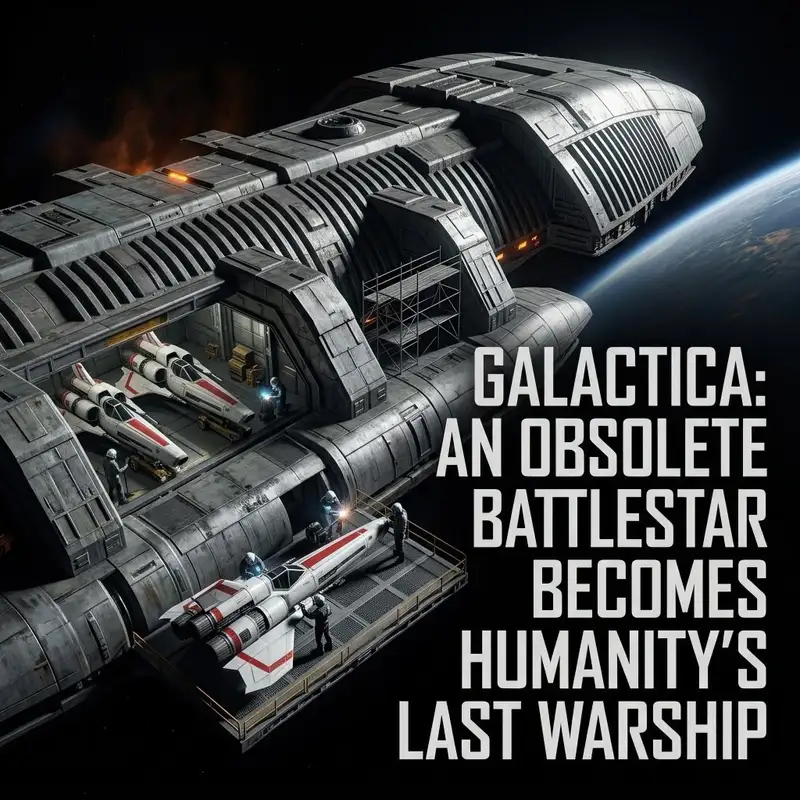
Galactica: An Obsolete Battlestar Becomes Humanity’s Last Warship
Galactica went into its final battle already dying. Its hull had been battered by years of pursuit, combat, emergency jumps, and repairs that often amounted to disciplined improvisation. Sections of the ship had been stripped for parts because other parts still had to work. The crew understood that another major operation might finish what attrition had begun. Yet when the time came to recover Hera, the child whose survival had become central to a fragile human-Cylon alliance, Galactica was still expected to do nearly everything. It would carry fighters and assault teams, coordinate a hazardous approach, absorb enemy fire, recover wounded personnel, and somehow bring its people home. A vessel once marked for retirement had become the platform on which the survival of two peoples could depend.
That final operation exposes the central contradiction of Galactica’s history. It was not the Colonial Fleet’s newest battlestar, its most advanced design, or its best supplied ship. Before the Cylon attack, it was being converted into a museum. By the end, it was structurally failing and no longer capable of a future as a normal warship. But for years after the Fall of the Twelve Colonies, Galactica remained the military center of the surviving human population. It was carrier, escort, command post, repair yard, hospital, detention facility, intelligence hub, evacuation force, and, at times, the only visible proof that civilian government still had armed protection.
That did not happen because old technology was magically superior to new technology. Galactica survived one particular form of Cylon attack because its older systems were less tightly integrated into the vulnerable Colonial network. It endured afterward because trained people turned an aging hull into a working institution. The ship had armor, compartments, weapons, flight decks, and faster-than-light drives. More important, it had engineers who could keep damaged systems alive, deck crews who could launch aircraft under pressure, medics who could preserve a shrinking population, Marines who could defend the ship’s interior, and officers who had to make military decisions without forgetting that the civilians behind them were the remnant of a civilization.
To understand why Galactica became humanity’s principal warship, it is necessary to return to the day it was supposed to leave war behind.
Before the Fall, Galactica was nearing the end of its service life. It was a veteran of the First Cylon War, a conflict that had ended in armistice rather than genuine reconciliation. Decades of separation had allowed the Twelve Colonies to imagine that the Cylons had become a distant problem. The Colonial Fleet had modernized. Newer battlestars and newer Viper Mark Seven fighters represented the active force. Galactica, by contrast, belonged to an earlier generation. Its final public role was intended to preserve memory, not project power.
That transition was visible aboard the ship. One flight pod was being prepared for museum use. Equipment had been removed or repurposed. Ammunition and weapons were no longer maintained at the level expected of a front-line combatant. The ship retained military systems, but it was no longer held at the readiness level of a fleet expecting war. Its faster-than-light drives had not been used in years. Its air wing relied heavily on older Viper Mark Two fighters, aircraft that had been overtaken by more modern designs but remained familiar to crews who knew how to maintain and fly them.
This was not just a question of metal fatigue and dated electronics. Galactica’s retirement reflected a political judgment. A government that decommissions a battlestar assumes it possesses enough security, industrial depth, and strategic warning to decide which old ships are worth preserving. Museums are possible because a society expects to have a future in which history can be displayed safely. The conversion of Galactica’s flight pod was therefore an expression of confidence. The Colonies believed the great war with the Cylons belonged to the past.
That confidence was not irrational in the ordinary sense. The armistice had lasted for decades. There was no continuous shooting war. But it had become institutional complacency. The Fleet was built around the assumption that it would have warning, that its systems were understood, and that the Cylons, if they returned at all, would return as a recognizable external enemy. Those assumptions were fatal because the Cylons had spent years preparing to make themselves unrecognizable.
The Colonial Fleet’s modernization created real advantages. Networked systems could coordinate ships, share information, improve navigation, and reduce the burden on individual crews. But common software and common architecture also created common vulnerability. The Command Navigation Program, developed through Gaius Baltar’s work and compromised through Number Six’s infiltration, gave the Cylons access to systems the Colonies trusted. That access mattered enormously. It did not explain the entire Fall by itself.
The Cylon attack was a coordinated strategic campaign. It combined long-term infiltration, sabotage, intelligence collection, deception, compromised software, surprise, direct fleet assault, and nuclear attacks against population centers. Colonial commanders were not defeated by a single line of code. They were defeated by an enemy that knew their assumptions, exploited their reliance on connected systems, and struck before political and military institutions understood the scale of the threat.
Galactica survived the first electronic blow because its critical systems were not organized in the same integrated manner as the modern Fleet. It still had computers. It still depended on navigation, communications, fire control, damage-control systems, and technical equipment that required trained operators. It was not a hand-cranked relic floating outside technology. But its older architecture and limited network integration meant that the Cylon compromise did not disable it in the same way it disabled more modern Colonial warships.
That distinction is important. Galactica was not invulnerable because it was old. Its systems could fail. Its equipment could be damaged. Its personnel could make mistakes. Later events would prove that Cylon software could penetrate the ship when operational necessity required greater connectivity. What saved Galactica during the opening attack was a combination of design, timing, isolation, and luck. It was outside the main pattern of dependency at the moment the pattern became a weapon.
The ship also survived because it was present with people aboard who understood that the situation had changed faster than official doctrine could. Commander William Adama had been preparing to retire. Colonel Saul Tigh was serving as executive officer on a ship that had been fading into ceremonial status. Many aboard Galactica had been assigned to a decommissioning command, not a wartime flagship. Their first task was not to execute a rehearsed battle plan. It was to recognize that the plan no longer existed.
Survival did not mean readiness. Galactica emerged from the initial Cylon attack with limited ammunition, reduced stores, aging fighters, incomplete personnel, and damage that demanded immediate attention. A warship being dismantled for public display is not restored to combat effectiveness by determination alone. Weapons had to be recovered. Ammunition had to be found and moved. Aircraft had to be made serviceable. Pilots had to launch. Engineers had to assess systems that had not been expected to bear wartime loads. Marines and security personnel had to prepare for threats that no longer seemed theoretical.
The first operational achievement was therefore institutional. Galactica’s crew converted a retirement-stage ship into an emergency combatant while under attack and while receiving fragmentary information about the destruction of the Colonies. That conversion depended on people who understood procedures, machinery, command relationships, and risk. A fighter is not useful merely because it exists in a launch bay. It needs a pilot, a flight deck, fuel, weapons, maintenance, communications, and a place to recover. A battlestar is not useful merely because its guns still function. It requires power, targeting, ammunition, damage control, watch teams, medical care, food, and a command staff able to decide what matters most when every request arrives marked urgent.
Galactica could fight. More importantly, it could jump. Its faster-than-light drives had been idle for years, yet the crew restored enough capability to escape destruction. That did not make the ship a strategic victor. The Colonies had already suffered a civilization-level defeat. But it allowed Galactica to become a rallying point for scattered survivors. A functioning battlestar, even an aging one, could give frightened civilian ships a place to gather, a defensive screen, and a command structure able to coordinate movement through hostile space.
That mission changed the meaning of military success. Galactica was no longer fighting to preserve a state with intact territory, shipyards, bases, supply networks, and reserve forces. It was protecting the remaining population of that state as it fled. The civilian ships that gathered around it were not cargo vessels in a narrow naval sense. They contained workers, children, doctors, technicians, food stores, water systems, political institutions, cultural memory, and the possibility of future families. Lose the convoy, and the battlestar’s survival would become strategically meaningless.
This was the central operational problem of the refugee fleet. Galactica had to buy time. Civilian ships needed time to calculate jumps, prepare drives, coordinate destinations, recover stragglers, and avoid leaving damaged vessels behind. Fighters had to intercept Raiders. Raptors had to scout, reconnoiter, communicate, and support jumps. The battlestar had to place itself between the Cylons and ships that often possessed little meaningful defensive capability. Destroying enemy Raiders mattered, but it was rarely the true measure of success. The measure was whether the civilian fleet escaped intact enough to continue.
The repeated attacks depicted early in the fleet’s flight make that burden clear. In the period remembered as thirty-three minutes, the survivors are forced into a punishing rhythm of jump, regroup, detect an approaching threat, launch defenses, and jump again. Every cycle drains the crew. Pilots fly while exhausted. Deck crews service aircraft with little rest. Command staff attempt to make sound judgments while sleep deprivation erodes attention and patience. Civilians live with the knowledge that a delayed ship, a failed calculation, or a missed launch can become a mass-casualty event.
Galactica’s worth in that crisis was not just firepower. It was command and control under pressure. The ship provided a place where contacts could be assessed, defenses organized, civilian captains contacted, and priorities set. It offered a chain of command that could make decisions quickly enough to keep a dispersed collection of ships acting as a fleet. This was not glamorous work. Fleet survival often depended less on decisive speeches than on whether someone could keep pumps, seals, launch systems, fuel lines, and navigation procedures functioning through another hour.
Carrier operations were central to that effort. Vipers were the fleet’s mobile defensive edge. They could intercept Raiders, escort Raptors, screen civilian ships, conduct reconnaissance, and buy precious minutes when a battlestar could not be everywhere at once. But every Viper represented a chain of scarce resources. Pilots could not fly indefinitely. Aircraft required inspections and repairs. Munitions had to be allocated. Fuel had to be transferred. Damaged fighters needed recovery, and the people who recovered them needed rest before they made mistakes that might cost more aircraft.
The loss of a pilot carried consequences beyond one cockpit. The fleet could not merely draw from a large training command or request replacements from a nearby base. Each death removed experience that was difficult to rebuild. Each damaged Viper increased the workload on already strained mechanics and deck crews. Each major engagement forced Adama and his officers to balance immediate defense against the need to preserve enough air power for the next attack. Galactica’s Vipers were not an inexhaustible heroic squadron. They were a national resource being spent in small, painful increments.
The same was true of the ship itself. Galactica could protect food, water, tylium, medicine, and industrial equipment, but it could not manufacture civilization from its own hull. It had engineering spaces, workshops, stores, and trained personnel. It could repair, improvise, salvage, and ration. It could not replace every specialized component destroyed during the Fall. It could not build unlimited aircraft or replenish every weapon. The refugee fleet survived through distributed labor and specialized civilian ships as much as through the battlestar’s guns.
This gave Galactica’s older systems a complicated value. Limited integration made certain Cylon attacks harder to execute. Manual procedures and compartmentalized systems could keep a damaged ship functioning when a single network failure might have paralyzed a more dependent vessel. But human procedures are labor-intensive. They require trained people, physical access, time, and communication. A crew member with a checklist and a wrench can keep a system alive under difficult circumstances. That same crew member cannot instantly share data across a fleet or calculate every problem without support.
Older systems also carried maintenance burdens. Components age. Wiring degrades. machinery requires attention. Parts intended for replacement may no longer exist in useful quantity. The ship’s resilience came at the price of continual work. Galactica was not safer because it was backward. It was resilient because its crew understood the costs of operating a less integrated platform and accepted those costs when the alternative was greater vulnerability.
The fleet’s shortages made this clear in crises involving water, fuel, repairs, and food. Galactica could enforce priorities, escort resource missions, and provide technical assistance. It could not erase scarcity. A battlestar did not produce water simply because it had a captain. It could not make tylium appear by issuing a military order. It could not train a skilled engineer overnight, restore a destroyed refinery, or replace the industrial depth of twelve worlds. The warship’s power was real, but it was bounded by the physical condition of the people and ships around it.
Those bounds became especially visible when Galactica had to abandon some of its isolation for operational necessity. The ship’s systems were more difficult for the Cylons to exploit when they remained separated. But the refugee fleet’s survival often required coordination, calculation, and information sharing. In the crisis that followed Adama’s incapacitation, crew members networked computers to help solve the problem of a difficult jump. That decision was understandable. It was also dangerous.
The resulting Cylon virus demonstrated that Galactica’s initial escape from the Command Navigation Program compromise was conditional, not absolute. Once a pathway existed, Cylon intrusion could exploit it. The ship’s old architecture had reduced exposure. It had not transformed the vessel into a fortress beyond digital attack. The crew now had to confront a familiar military truth: a security measure that protects one function can obstruct another, and an emergency connection made for good reasons can become an enemy access route.
The virus was not merely a technical nuisance. It affected the ship’s ability to control systems and created uncertainty about what could be trusted. Cyber compromise is dangerous because it attacks confidence as well as machinery. Commanders need to know whether sensors are accurate, whether orders will reach their destination, whether navigation data is reliable, and whether systems will respond as expected. Once that confidence is damaged, every decision becomes slower and more hazardous.
The Cylons paired electronic compromise with physical assault. Centurions boarded Galactica and moved into vulnerable areas of the ship. This combination mattered. A virus can disrupt systems, but armed boarders can exploit the confusion, seize spaces, sabotage equipment, and force defenders into close combat inside their own hull. Cyber defense and shipboard security were not separate problems. The breach in one domain created opportunities in the other.
The defense of Galactica during that period depended on Marines, security personnel, engineers, officers, and civilians who had to protect a ship whose internal spaces were now contested. The battle was not a clean naval engagement. It was a struggle over access routes, equipment, communications, wounded personnel, and the ability to prevent a localized breach from becoming a mission kill. The ship survived because people held critical spaces and because the crew retained enough control to fight through the disruption.
The later decision to purge the virus revealed the full meaning of Galactica’s role. Adama ordered the civilian fleet to jump away while Galactica remained behind. The battlestar would isolate itself, clear compromised systems, and confront a large force of approaching Raiders. This was not a simple act of defiance. It was an escort mission taken to its logical extreme. Galactica accepted temporary separation and near-certain danger because the civilian fleet had to survive even if the warship did not.
The arrival of Battlestar Pegasus complicated this picture. For the first time since the Fall, Galactica was no longer the only major surviving Colonial combatant. Pegasus brought newer systems, stronger material capability, and a degree of industrial potential that Galactica lacked. Its appearance restored options. Two battlestars could divide missions, support larger operations, provide redundancy, and challenge Cylon forces in ways Galactica alone could not.
Cain’s command philosophy treated civilian authority, legal restraint, and individual rights as obstacles when they interfered with military necessity. Her ship demonstrated how a powerful warship can remain tactically effective while becoming morally and politically dangerous. Galactica’s crew was hardly free of fear, anger, coercion, or failure. But Adama’s command remained more closely connected to the civilian population and to President Laura Roslin’s claim of constitutional authority. That connection did not make every decision wise. It did give Galactica’s military power a purpose beyond the survival of its own command.
The tension between Galactica and Pegasus was therefore not just about armor, aircraft, or newer systems. It was about what a surviving military institution owed to the people it claimed to defend. Cain saw a fleet that had become vulnerable through compromise with civilians. Adama saw civilians as the reason a fleet existed at all. Both commanders faced real threats. Their different answers shaped the possibility of cooperation.
When the two battlestars later operated together against a Cylon Resurrection Ship, Galactica demonstrated that age did not make it irrelevant in high-end combat. Combined operations allowed the Colonial force to take risks and execute a mission that neither ship could have approached in quite the same way alone. Pegasus added modern capability. Galactica added experienced personnel, hard-earned adaptability, and a command structure practiced in protecting a civilian fleet. The operation showed what a two-battlestar force could accomplish. It also emphasized how exceptional that moment was. The Colonies had not rebuilt a Navy. They had assembled a temporary concentration of survival assets.
Galactica’s role also expanded far beyond conventional battlestar doctrine. It became the place where military necessity collided with nearly every other problem of refugee life. It was a headquarters for fleet defense, but also a center for intelligence assessments and security investigations. It held prisoners. It treated wounded. It supported reconnaissance and rescue missions. It repaired what it could. It housed people who had nowhere else to go. It became a location where political disputes could become operational crises within hours.
This made the ship a mobile state without making it the state itself. Laura Roslin retained civilian authority as President of the Twelve Colonies. The Quorum of Twelve, ship captains, civilian leaders, and political factions continued to matter. Adama commanded Galactica and controlled decisive military force, but he did not automatically possess unlimited political authority. The relationship between Roslin and Adama was a partnership under emergency conditions. Military protection gave the civilian government the ability to function. Civilian legitimacy gave military operations a constitutional purpose.
That partnership was often strained. Roslin and Adama disagreed over policy, intelligence, elections, prisoners, settlement, and the acceptable limits of emergency power. Their disagreements were not evidence that one side failed to understand extinction-level danger. They were evidence that survival created competing duties. The President had to consider the political community. The commander had to consider immediate security. Neither responsibility could be discarded without consequences.
Galactica’s daily functioning depended on people rarely celebrated as symbols of the ship. Engineers kept life-support and propulsion systems alive. Deck crews turned damaged aircraft into launchable ones. Medics dealt with combat casualties, illness, exhaustion, pregnancy, and the ordinary injuries that become serious when resources are scarce. Marines defended the ship, conducted boarding actions, and supported ground operations. Technicians maintained communications and sensors. Cooks, clerks, mechanics, and civilian specialists kept the institution from collapsing into a collection of armed compartments.
The battle for survival was therefore also a battle against fatigue, resentment, shortages, and the temptation to treat labor as disposable. A pilot can be called a hero after a successful intercept. The person who repaired a launch mechanism, sterilized an instrument, balanced an inventory, or kept a water system from failing may receive no such recognition. Yet the fleet could not survive without them. Galactica’s military value rested on that dense web of work.
The decision to settle on New Caprica revealed the limits of what even a successful warship could provide. After prolonged pursuit and deprivation, the prospect of a habitable world offered relief from the endless cycle of jumps and alerts. The settlement was politically understandable. People wanted ground beneath their feet, homes that were not metal compartments, and a chance to build something other than another emergency plan.
But a settlement is not secure simply because it is desired. New Caprica carried environmental, logistical, and strategic risks. When the Cylons arrived, the civilian population was exposed to occupation. Galactica was not present to defend the settlement. Its absence mattered, but it should not be treated as a single commander’s abandonment of the people. The fleet had made a political choice to settle, and the conditions surrounding that choice were shaped by exhaustion, hope, division, and limited information.
The occupation demonstrated what a battlestar cannot prevent once it is not physically able to screen a population. Cylon rule brought detention, coercion, torture, executions, collaboration, resistance, fear, and social fracture. Some civilians resisted. Some served occupation institutions. Some tried to keep families alive under conditions in which clean choices were scarce. The military absence of Galactica did not create every wound of the occupation, but it left the settlement without the protective force that had defined refugee life.
When Galactica returned, its mission had evolved again. The operation to evacuate New Caprica was not a conventional victory parade. It was a complex rescue under hostile pressure. The battlestar had to coordinate with Pegasus, launch and recover fighters, support ground forces and civilian movement, protect ships attempting to escape, and accept severe risk to recover a population that had been living under occupation. It was one of the clearest demonstrations of Galactica’s transformation from a warship into the armed guardian of a political community.
After New Caprica, the strain on Galactica became increasingly difficult to ignore. The ship remained active through further crises, internal political conflict, mutiny, fleet defense, and the shifting alignments of the war. It continued to launch aircraft, carry personnel, and serve as the fleet’s core military platform. But every operation took something from it. Damage accumulated. Repairs became more difficult. The supply of usable parts narrowed. Systems that had endured through experience and effort approached the point where effort alone could no longer compensate for age.
At the institutional level, the crew’s identity became intertwined with the ship’s continued existence. That attachment was understandable. Galactica had carried them through the Fall, through repeated pursuit, through civil conflict, through occupation rescue, and through losses that could not be replaced. But attachment also creates risk. A military organization can mistake preservation of its symbol for preservation of its mission. By the final campaign, Adama and the crew had to confront the possibility that saving Galactica and using Galactica for its last necessary mission might be incompatible goals.
That moment came with the effort to recover Hera. The operation demanded an assault against a Cylon target under extraordinary circumstances. Galactica was no longer a ship that could be preserved for a long future of patrols and repairs. Its condition had deteriorated too far. The crew had already begun stripping equipment and preparing for a future in which the vessel might yield its remaining useful parts to the fleet. Yet the mission required a warship with its particular combination of flight operations, command capacity, combat endurance, and symbolic authority.
The final assault did not prove that Galactica had somehow overcome obsolescence. It proved the opposite. The ship’s age and damage imposed real risks. The people aboard knew that the operation could destroy the vessel. They went anyway because the strategic stakes justified using the asset rather than preserving it. Hera’s recovery mattered not only to one family or one faction. It mattered to the possibility that the human-Cylon alliance could survive its own history of genocide, vengeance, betrayal, and fear.
Galactica entered the operation as transport, assault platform, carrier, and command ship. Its personnel applied years of accumulated experience. Pilots flew missions shaped by a war in which every aircraft and aviator was precious. Engineers kept failing systems working long enough to support another evolution. Marines and assault teams carried out tasks that a conventional fleet might have assigned to specialized units backed by secure bases and reserves. There were no secure bases. There were no reserves. There was Galactica and the people who still knew how to make it function.
The final jump completed the ship’s transformation and ended it. Galactica had used faster-than-light travel throughout the refugee campaign as both escape mechanism and operational tool. Jumps separated the fleet from danger, enabled surprise, and allowed ships to cross distances that conventional movement could not manage. But each jump depended on machinery, calculations, coordination, and an acceptable destination. The final operation pushed those requirements beyond what the aging ship could safely absorb.
The jump inflicted catastrophic structural damage. The screen evidence does not require a technical fantasy about precisely which beams failed or how every system broke. What matters is clear. Galactica was no longer capable of continued military service. The ship had been used past the point at which a peacetime navy would have retired it, repaired it, or broken it down. It had endured because the survivors had no adequate substitute. In the end, it was broken by the mission for which it had been preserved.
Its final disposition carried symbolic weight, but the symbolism rested on material truth. Galactica had been a refuge because people maintained it. It had been a warship because people armed it, crewed it, and accepted the burden of defending others. It had been a political center because civilians and military leaders continued to argue over what survival meant. It had become a memory vessel because it carried the remains of a civilization that could no longer return home.
Galactica became humanity’s last effective warship because accidental survivability was converted into organized endurance. Its old systems limited one form of Cylon attack, but that was only the beginning. Its real strength was the human institution inside the hull: people willing to repair, launch, calculate, govern, argue, and fight for a civilian population that could not defend itself. The ship could preserve a people long enough to choose a future, but it could not replace the civilization that had built it.