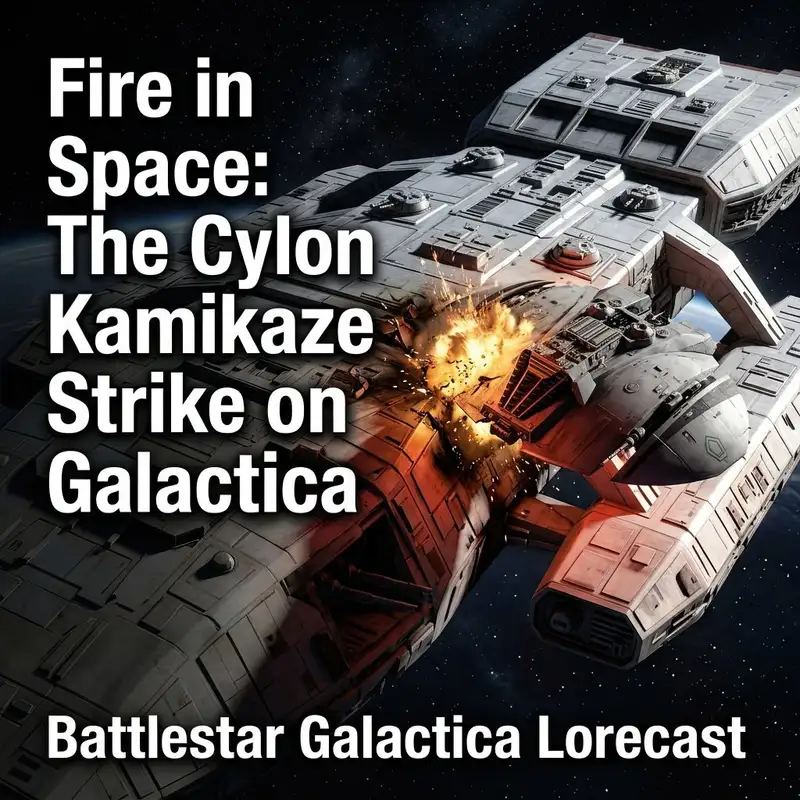
Fire in Space: The Cylon Kamikaze Strike on Galactica
The first warning does not look like a catastrophe. It looks like a familiar problem. Cylon Raiders are closing on Galactica, and Colonial Vipers scramble to meet them before they reach the battlestar. Then the pilots recognize that the Raiders are not fighting like fighters. They are not turning away from danger, seeking an advantage, or preserving themselves for another pass. They keep coming. A Viper can get behind one. It can fire. It can destroy the target. But the next Raider is already driving straight toward Galactica. What appears to be a fighter interception has become a missile-defense emergency, except the incoming weapons are Raider craft. The Colonial pilots are not trying to win a clean engagement. They are racing to prevent impact.
This is the central danger in the original Battlestar Galactica episode “Fire in Space.” The Cylon assault does not need to defeat Galactica in a conventional fleet action. It only needs to get enough explosive force through the Viper screen and into the battlestar’s enclosed interior. Once that happens, armor, guns, and fighter skill matter less than bulkheads, fire crews, medical teams, communications, emergency power, and the ability of the command structure to keep functioning after the command center itself has been hit.
The attack takes place after Galactica’s encounter with Pegasus and Commander Cain. Sheba is now aboard, serving alongside Apollo and Starbuck, but this is not a continuation of that earlier campaign. Pegasus is absent. The immediate question is Galactica’s survival. The battlestar remains the armed shield of a civilian fleet searching for Earth, but in this incident it becomes something more vulnerable and more complicated. It is a warship, an air base, a hospital, a repair yard, a workplace, and a home to personnel, families, children, and civilians who have nowhere else to go.
The warning reaches the bridge after Galactica has encountered Cylon basestar contacts roughly ten centars earlier. Colonel Tigh initially considers whether the approaching force may be a combat probe. That is not an unreasonable first assessment. A smaller Cylon formation might test Galactica’s alert posture, identify its defenses, draw out Vipers, or confirm the battlestar’s course and readiness. A probe is dangerous, but it belongs to a recognizable military category. It can be met with reconnaissance, fighter interception, defensive preparation, and the expectation that the enemy will preserve enough force to report what it has learned.
The incoming Raiders quickly prove too numerous for that explanation. Adama and Tigh recognize that Galactica is facing a serious attack and act accordingly. Blue Squadron launches first, followed by the remaining Viper squadrons. Inside the battlestar, compartments are secured against the possibility of heavy damage. That preparation matters. A large ship cannot wait until it is struck to decide which doors should close, which passages should be controlled, or how to isolate a damaged section. Compartmentation is one of the oldest principles of naval survival. A ship survives by preventing one injury from becoming a shipwide failure.
Still, the initial classification has cost something that cannot be recovered. It has not cost Galactica the battle by itself. Commanders must make decisions with incomplete information, and no officer can treat every distant contact as a full-scale assault. But the wrong frame compresses time. A force believed to be probing can become a force already inside weapons range before its true purpose is understood. In this case, the Cylons are more than testing Galactica’s defenses. They are testing whether Galactica can prevent an attacker from reaching the hull at all.
The Colonial defensive concept is straightforward. Vipers are the outer screen. They intercept Raiders before those Raiders can attack the battlestar or threaten the civilian fleet behind it. In an ordinary engagement, this would mean maneuver, pursuit, attack angles, defensive turns, and the effort by both sides to preserve combat power. The Vipers possess the initiative against Raiders that do not evade effectively. Colonial pilots can get into firing positions. They can destroy targets. At first glance, the engagement appears favorable.
That impression is misleading because the Raiders are not competing for the same objective. The Vipers are trying to destroy enemy craft. The Raiders are trying to reach Galactica. Their willingness to continue directly toward the battlestar, even under attack, changes the meaning of the fight. A Raider that is shot down after it has crossed the defensive screen may still have succeeded in forcing a close-range detonation. A Raider that crashes into the hull may inflict more damage than one that survives a prolonged dogfight.
The word kamikaze is useful here as a description, not as a complete explanation. The Raiders are being used in a suicide-strike role. The episode does not explain whether their crews, control systems, or command arrangements understand the mission in human terms. It does not establish their inner experience, their degree of autonomy, or a wider Cylon doctrine governing such attacks. What it does show is a tactical method. The attacker accepts the loss of individual craft in exchange for the possibility that one penetrator can create catastrophic internal damage.
This is the basic asymmetry of the strike. Galactica must stop nearly every Raider. The Cylons need only a few to get through. The defensive side may inflict severe losses and still fail at the operational level. That does not make the Viper pilots ineffective. It means their task has been made unforgiving. They are defending a large, slow, irreplaceable target against attackers whose value lies not in survival but in impact. The margin for a successful defense is measured not by enemy losses, but by whether any Raider reaches a vulnerable part of the ship.
One Raider approaches Galactica’s bridge. Apollo and Sheba move to intercept it. Their decision creates an ugly but necessary tradeoff. If the Raider reaches the bridge intact, it may kill or incapacitate the officers directing the defense. If it is destroyed close to the ship, the explosion itself may damage the bridge. There is no clean option. In missile defense, the last line of protection can be dangerous even when it works. Destroying an incoming weapon close to the defended platform is better than allowing a direct hit, but it does not make the platform safe.
Apollo and Sheba destroy the Raider, yet the blast damages the bridge and injures Commander Adama. The immediate tactical threat is removed. The command problem is not. Galactica’s bridge is more than a room with windows and controls. It is a place where reports are assembled, orders are issued, priorities are established, and uncertainty is reduced enough for the ship to act. Damage there interrupts more than conversation. It interrupts the process by which a battlestar converts fragmentary observations into coordinated action.
Adama’s injury also exposes the importance of command continuity. Galactica cannot suspend its defense while its commander is taken to sickbay. The ship is still under attack. Vipers are still operating outside the hull. Fires may already be spreading inside. Tigh assumes practical command, not because the episode presents a permanent transfer of authority, and not because he becomes the political ruler of the fleet, but because a military organization must be able to continue when its senior officer is suddenly unable to direct events.
That succession is one of Galactica’s strengths. The battlestar has a commander, an executive officer, pilots, deck crews, medical personnel, fire crews, technicians, and specialists whose roles are distinct but connected. Losing Adama is serious because his experience and judgment matter. It is not instantly fatal because the institution around him remains capable of acting. In a crisis, a chain of command is not a ceremonial list. It is a mechanism for ensuring that responsibility moves before paralysis does.
Then the second Raider gets through. It evades interception and rams Galactica’s port landing bay. This impact changes the character of the engagement. The battle outside the hull gives way to a disaster inside it. The Raider’s destruction is no longer a distant flash seen by a pilot. It is fire, shock, debris, damaged equipment, broken access routes, and a spreading emergency in the spaces where Galactica launches, recovers, services, and supports its Vipers.
A landing bay is operationally significant even without assigning it a detailed technical specification. It is part of the battlestar’s ability to conduct flight operations. It connects people, equipment, aircraft, munitions, maintenance, and internal movement. Damage there can interfere with the very system that had just defended the ship. A battlestar that cannot launch or recover Vipers effectively loses much of its value as a mobile combat platform. A landing-bay fire is therefore not just an engineering problem. It is a threat to Galactica’s continuing ability to protect the fleet.
The impact also produces a deeper vulnerability. Fire does not respect departmental boundaries. It moves through damaged spaces, consumes available material, destroys equipment, threatens air supplies, and forces crews to close passages that other people need for escape. A blast can kill quickly. Fire creates a longer crisis because it spreads, blocks access, undermines repair, and turns time into an enemy. The farther it advances, the more systems must be sacrificed to stop it.
Among those caught in the danger are Boomer, Athena, Boxey, Muffit, and other people in Galactica’s rejuvenation center. The setting matters because it makes clear that the battlestar is not occupied solely by combat personnel. Athena and Boxey are not part of the bridge team or a Viper squadron. They are dependents within the fleet’s mobile society. Boomer is on furlon, away from his ordinary duties. Yet the landing-bay impact makes every person nearby part of the survival equation.
The danger to the trapped group is not separate from Galactica’s military problem. It is part of it. A warship carries trained personnel, family ties, children, institutional memory, and the social confidence that allows crews to keep working under extreme pressure. If a battlestar saves its engines but abandons everyone behind sealed doors, it may remain afloat without remaining the kind of force its people are willing to serve. Rescue is not a sentimental distraction from combat power. It is one of the conditions that sustains combat power.
Compartment sealing begins to shape the crisis. Closing off damaged sections can limit decompression and slow the spread of smoke and flame. It can protect the larger ship by sacrificing access to one part of it. But every sealed door also divides people from help. Fire crews may be unable to reach trapped survivors. Survivors may find their exits closed for reasons they cannot see. Commanders may know that an area must be isolated without knowing exactly who remains inside it. Naval damage control is always a balance between containing destruction and preserving the people caught within it.
Tigh now carries an extraordinary burden. He must preserve Galactica’s ability to fight, maintain enough awareness of the external threat to avoid another attack, direct the internal response, protect the commander’s medical treatment, and keep the ship from descending into confusion. These demands compete with one another. A crew member assigned to a fire team is not available elsewhere. A power system dedicated to one emergency may be needed by another. A decision to seal a compartment can preserve the ship while worsening the immediate danger to those inside.
The reports arriving at command are grim. Galactica’s primary boraton firefighting system has been destroyed. Energizer number one has also been lost. Internal communications are disrupted, and deep scan capability is badly affected. The episode does not require the conclusion that every system aboard has failed. Galactica remains capable of launching Vipers, receiving reports, directing personnel, and maintaining enough order to respond. But it has lost the integrated support that makes those activities efficient. The ship is not blind or mute. It is seeing and speaking through injury.
Tigh believes the Raiders carried solonite or a similar explosive payload. The exact design is not established, and no precise yield is needed to understand the consequence. The strikes have placed enough explosive force inside or against Galactica to destroy critical firefighting capacity and endanger the ship’s power systems. The Cylon attack has achieved its apparent purpose not by outgunning the battlestar, but by turning damage into a cascading process. The first explosion creates the conditions under which later failures become more likely.
This is when damage control becomes Galactica’s main battle. There is still an external enemy. The Viper squadrons still have work to do. But the ship’s immediate survival no longer depends mainly on who controls the space around the hull. It depends on whether fire can be contained before it reaches spaces whose loss would cripple Galactica more completely. The enemy has placed the decisive front inside the battlestar.
The degradation of deep scan creates another operational problem. A battlestar needs to know what is beyond its hull. It needs warning of returning Raiders, approaching basestars, changing contacts, and possible threats to the civilian fleet. Without normal scan support, Tigh cannot assume that the absence of a report means the absence of danger. He must act with a reduced picture of both the fire inside the ship and the enemy outside it.
The answer is improvised but sensible. The Viper squadrons become Galactica’s external eyes. Pilots rotate patrols and report what they can observe. This is not a replacement for the battlestar’s normal scanning capability. A Viper pilot sees from a cockpit, through the limits of available instruments, range, angle, and immediate danger. Reports must travel back to a damaged command structure and be interpreted there. Even so, dispersed aircraft can provide something Galactica urgently needs: warning.
The role of the Vipers has changed. They began as interceptors, tasked with preventing Raider impacts. Now they serve as a distributed observation network. Their value lies not only in the weapons they carry, but in their ability to extend the ship’s awareness beyond damaged sensors. This is a useful reminder that aircraft are often more than attack platforms. They scout, identify, report, escort, relay, and help a larger formation make decisions when its own systems are degraded.
Inside Galactica, the Fire Leader and the firefighting crews become as important as any Viper pilot. Their work is not glamorous, and the episode is clear about its difficulty. They confront heat, smoke, damaged access routes, failed equipment, uncertainty about what lies beyond the next compartment, and the knowledge that every delay gives the fire another opportunity to reach essential systems. Their task extends beyond extinguishing visible flames. It is to prevent the ship’s interior from becoming a chain reaction of destroyed spaces.
Boraton is the crucial firefighting agent available to them, but the ship’s normal system has been damaged. That forces Galactica into an improvised response. Apollo studies the ship’s schematics and identifies a narrow ventilation route connecting the bridge area with the trapped group in the rejuvenation center. The passage is too small for a person to use as an evacuation route. It cannot become a corridor for a rescue team. But its existence changes the problem. A route too small for a human may still carry a message, equipment, or a smaller means of assistance.
Apollo also helps develop an emergency method of getting boraton into the burning landing-bay area. Viper laser-turret equipment is adapted for the purpose, working in conjunction with megapressure pumps connected to the firefighting system. The solution is inventive because Galactica no longer has the luxury of using equipment only as it was designed. In a normal operation, Viper systems support combat. In this emergency, available hardware is converted into part of a firefighting effort.
The first result offers hope. The improvised system suppresses the fire. For a moment, it appears that Galactica may have regained control. But emergency operations rarely offer perfect solutions. The pressure-pump system fails, and the flames return. That failure is important because it prevents the incident from becoming a simple story of ingenuity defeating danger. Improvisation buys time. It does not erase damage, restore destroyed systems, or guarantee that a temporary fix can sustain itself under stress.
The trapped group faces its own version of that same problem. Boomer attempts to hotwire a door leading into a storage compartment. The effort is practical and limited. He is not transformed into a formal engineering specialist by a single act of improvisation. He is a person inside a burning warship trying to find a route that will keep others alive. When normal access has been destroyed or sealed, survival often depends on someone being willing to attempt a solution with incomplete tools and incomplete knowledge.
The group moves away from the immediate fire, but relocation is not rescue. The lifemasks in the storage area have been destroyed. Their new position may be safer from flame, yet it remains dangerous because breathable air is becoming a scarce resource. This is one of the most basic truths of a shipboard fire. People do not need to be directly touched by flame to be in mortal danger. Smoke, heat, and the loss of breathable atmosphere can close the margin of survival before rescuers ever reach them.
Boxey’s observation about Muffit provides the next opening. The mechanical daggit can locate mushies, and that practical ability suggests a way to navigate the narrow ventilation route. The plan does not turn Muffit into a miraculous device or a general-purpose military sensor. It uses the animal’s established capabilities within the immediate circumstances. A route inaccessible to adults may be passable to Muffit. A small carrier can move through a duct where no firefighter, pilot, or rescue crew could fit.
Muffit first carries a message through the ventilation system. Later, the daggit delivers lifemasks to the trapped group. The act matters because it reconnects people who have been separated by fire and sealed compartments. In a damaged ship, communications are not abstract. A message can tell rescuers where survivors are. A lifemask can turn a trapped room from a waiting place into a survivable one. A narrow duct can become the only line between people facing the same disaster from opposite sides of a bulkhead.
The rescue problem also reveals the moral pressure on Tigh’s command. He cannot know every detail at once. He must protect the ship as a whole while specific people are running out of air in a trapped compartment. A purely mechanical calculation might say that a damaged section should remain sealed and abandoned if reopening it risks a larger failure. But Galactica’s crews do not operate as if those lives are disposable. They search for ways to contain the fire and save the trapped people together. That is harder than choosing one objective over another. It is also the only response likely to preserve the trust that makes a refugee fleet function.
While the trapped group waits, sickbay confronts its own emergency. Dr. Salik operates on Adama. The commander’s injury is not just personal. Adama carries experience, authority, and a stabilizing presence within Galactica and the larger fleet. His survival matters for morale and for future command. But the operation cannot become an excuse for delaying the decisions required to save the ship. Tigh must command while Adama is unavailable. Salik must treat the commander while the battlestar’s power and environmental safety are under threat.
The fire’s approach toward the energizer and solium compartments raises the stakes again. The episode does not provide a detailed technical explanation of every system or its physical properties. It does establish that the threatened spaces are important enough that their loss could produce a far larger catastrophe. Tigh and the Fire Leader are no longer managing a contained bay fire. They are trying to prevent an internal emergency from spreading into the systems that keep Galactica functioning as a warship and a refuge.
At this point, Adama offers the decisive recommendation. If conventional firefighting cannot hold the fire, then the ship must use the vacuum of space. The principle is clear even if the engineering details remain sparse. Isolate the affected section. Create a controlled hull breach. Vent the fire’s environment into space. Accept the damage caused by that breach in order to deny the flames the conditions they need to continue. It is a severe measure because decompression is itself dangerous. It can destroy equipment, endanger anyone who remains in the affected area, and leave the ship with another wound to repair.
But the alternative is worse. A ship facing internal fire must sometimes choose which damage it can survive. Galactica cannot preserve every compartment intact. It cannot protect every piece of equipment. It can only prevent the fire from reaching the systems whose loss may destroy the entire battlestar. The choice to vent a section is not reckless. It is controlled destruction in service of survival.
Apollo and Starbuck take on the external part of the operation. Wearing pressure suits, they move outside the hull to plant explosive charges along the damaged area. Their assignment is an unusual extension of their Viper roles, but it follows the logic of emergency response. They are available, they can operate in the required environment, and the ship needs people who can reach the correct point on the exterior. In a crisis, rigid occupational boundaries can become a luxury. The important question is not whether an assignment fits a peacetime job description. It is whether the available people can accomplish it before time runs out.
That does not make the work routine. A hull walk on a damaged battlestar is dangerous even without trying to place charges beside an active internal fire. The two pilots must manage their own movement, suit integrity, the placement of the explosives, timing, and the need to clear the blast area. They are operating outside a ship that remains under stress, with little room for error. Their action is heroic, but its military importance lies in the larger system. They are not performing a separate adventure. They are helping the fire crews, engineers, medical staff, command team, and trapped survivors by making the final containment measure possible.
Apollo briefly loses his grip. The moment is more than a test of nerve. It shows how quickly a carefully planned emergency measure can fail because of one physical hazard. Starbuck reaches him and gets him clear. Their teamwork is essential because no individual can safely treat the exterior of a damaged ship as a place where skill alone eliminates risk. The charges are planted, the two men withdraw, and the detonation follows.
The breach vents the affected area into space. The fire is extinguished. Galactica has suffered another wound, but it has avoided the larger disaster of allowing the blaze to consume more vital compartments. The ship is not restored to normal. Its landing bay is damaged. Its firefighting capacity has been compromised. Its command space has been struck. Its commander has been injured. Its internal communications and scan capability have been impaired. Yet the fire, which had become the central threat to the battlestar’s survival, has finally been stopped.
Muffit’s role in the rescue completes the smaller but equally important human side of the operation. The daggit reaches the trapped group with lifemasks and later helps a fallen firefighter. Muffit returns badly burned but still functioning. In the logic of the episode, the mechanical daggit has become a rescue asset because it could fit where people could not. It has not solved the crisis alone. It has carried help through the one route available, allowing the trapped survivors to endure long enough for the larger response to succeed.
Adama survives Salik’s operation. His recovery restores the formal commander, but the episode has already demonstrated that Galactica’s survival could not wait upon one man’s return. Tigh held the command function together. Apollo, Starbuck, Sheba, and the Viper squadrons defended and observed outside the ship. Fire crews fought the blaze. Boomer and the trapped survivors improvised inside sealed spaces. Salik kept Adama alive. Muffit carried essential equipment through a passage no human could use. Each action addressed a different failure in the chain.
The episode’s most important military lesson is that a warship is not defended only by armor and weapons. It is defended by layered systems, trained people, internal organization, and the ability to absorb damage without losing coherence. Galactica’s Vipers cannot be everywhere. Its bridge can be struck. Its firefighting system can fail. Its commander can be carried unconscious to sickbay. The ship survives because no single loss causes every other function to stop.
That resilience should not be confused with invulnerability. The lack of a detailed long-term repair account in later stories is a limitation of the continuity, not proof that the damage was trivial. The episode makes clear that Galactica has suffered serious harm. Repair would require time, labor, materials, technical knowledge, and the ability to keep protecting the civilian fleet while damaged systems are restored. A battlestar can improvise in an emergency, but improvisation is not the same as industrial capacity. It can save a ship from immediate destruction without making the consequences disappear.
The civilian and social dimension matters as much as the technical one. Boxey is not an incidental passenger. Athena cannot be reduced to waiting in a compartment while the military story happens elsewhere. The trapped personnel represent what Galactica is protecting. The battlestar’s value lies not only in its weapons or its ability to launch Vipers. It also lies in the people who live within its hull, the families connected to its crew, and the fragile community that depends on the ship’s continued existence.
The Cylon strike also reveals a method for imposing disproportionate harm. An attacker does not need to destroy a battlestar outright if it can set the battlestar on fire from within. The Cylon Raiders function as penetrating weapons. Their apparent tactical wastefulness becomes their advantage because it changes the defender’s calculation. A Viper pilot can win the engagement against a Raider and still be too late to prevent the effect the Raider was sent to produce.
“Fire in Space” is often remembered for the hull walk, the trapped survivors, and the image of a battlestar venting flame into vacuum. Those scenes matter because they make the danger visible. But the deeper story is institutional. Galactica survives because command continuity holds after Adama is injured. It survives because Tigh can act with incomplete information. It survives because pilots become scouts, Viper equipment becomes firefighting support, a mechanical daggit becomes a rescue courier, and a controlled hull breach becomes the last line of damage control.
The Cylon attack proves that Galactica’s greatest vulnerability is not just whether Raiders can outfight Vipers. It is whether one penetrator can turn the battlestar’s own enclosed spaces, damaged systems, and trapped population into weapons against it. Galactica endures because its people keep transforming whatever remains of the ship into a working system of command, rescue, medicine, firefighting, and survival until a burning warship can become a fighting one again.