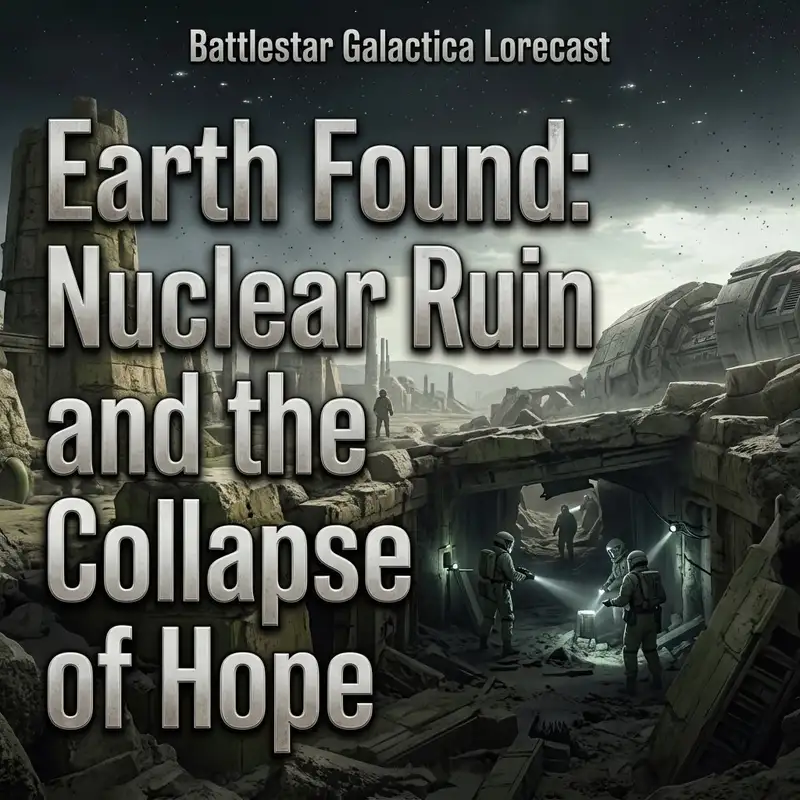
Earth Found: Nuclear Ruin and the Collapse of Hope
The first landing teams did not arrive at Earth as conquerors, settlers, or even refugees stepping onto a promised shore. They arrived as survey parties in a dead city. Their aircraft came down among broken towers, shattered pavement, and the remnants of a civilization that had once possessed industry, transport, and the means to destroy itself. There was no signal traffic. No local authority answered. No population emerged from shelter. The silence was not the silence of a place awaiting rescue. It was the silence of a place where rescue had come too late, if it had come at all.
For years, the fleet had treated Earth as more than a point on a navigation chart. It was the destination that gave movement a purpose. The survivors of the Twelve Colonies had crossed dangerous space, fought Cylon forces, endured political division, buried loved ones, and accepted scarcity because Earth represented the possibility that the emergency might end. A planet meant land. Land meant food, water, shelter, agriculture, repair facilities, children growing up somewhere other than steel decks and overcrowded passenger compartments. It meant a future in which a battlestar did not have to serve as a warship, police station, court, hospital, school, and national symbol all at once.
The coordinates had come with religious and historical weight. The fleet had followed clues connected to Kobol, the Tomb of Athena, ancient records, visions, and a reading of the prophecies associated with Pythia. Kara Thrace had become central to that journey, not because every member of the fleet accepted the same explanation for her return, but because she possessed knowledge no one else could fully account for. By the time the fleet reached Earth, the place had become the physical answer to a question that had governed civilian politics and military decisions alike. Could the survivors find a home beyond the reach of the Cylons?
Colonial and rebel Cylon scouts examined more than one landing site. Raptors, Vipers, Heavy Raiders, civilian vessels, and Cylon freighters spread across the surface and compared observations. This mattered. One ruined street could have been the remains of a local war, an abandoned industrial region, or a city destroyed by some isolated disaster. But the evidence accumulated across wide areas. The surface showed devastation on a civilizational scale. The problem was not that one settlement had fallen. The problem was that there appeared to be no functioning settlement left to find.
That was a different kind of defeat from the Fall of the Twelve Colonies. The destruction of the Colonies had been an enemy victory. It involved infiltration, compromised systems, surprise, nuclear attack, and the collapse of a civilization under assault. Earth was more intimate. The fleet had carried the idea of this world with it. Every sacrifice made in pursuit of it now demanded reinterpretation. The people who had died had not died because Earth had betrayed them. A planet cannot make promises. But commanders, politicians, priests, and ordinary survivors had invested Earth with meaning. They had made it the place where endurance would be vindicated.
For Admiral William Adama, Earth had offered a military endpoint. His command had spent years protecting civilian ships that could not defend themselves, launching pilots who could not easily be replaced, repairing damage without access to a proper shipyard, and preserving fuel, ammunition, aircraft, trained personnel, and basic discipline under conditions that would have exhausted a peacetime fleet. A battlestar can fight for a long time if it has a supply chain behind it. Galactica did not. It fought while carrying the remains of the society it was meant to defend.
For President Laura Roslin, Earth carried another burden. Her authority had always been both political and spiritual. She was a constitutional leader, but she had also become the person most closely associated with the fleet’s reading of prophecy. That gave her a language of hope in moments when conventional policy offered very little. The survivors could not be told with confidence when they would find safety, how they would rebuild industry, or whether the Cylons would ever stop hunting them. They could be told that the journey had direction.
For the Quorum of Twelve and the civilian fleet, Earth was the closest thing to a national objective that remained. The Colonies were gone. The old government survived only in fragments. Its population was scattered across ships with unequal resources, different political loyalties, competing labor needs, and sharply different levels of danger. The fleet had continued to hold elections, maintain courts, negotiate work assignments, ration supplies, and preserve a civilian chain of legitimacy because it was trying to remain a people rather than a collection of frightened passengers.
Without Earth, every question became harder. How long could the fleet remain mobile? Where would it find food, water, fuel, medicine, and repair materials? How could it train replacement pilots and technicians when every trained person lost was also a parent, teacher, engineer, medic, or skilled laborer? What did representation mean when the population had no territory, no economy beyond salvage and rationing, and no clear destination? The physical state of the planet mattered because a refugee civilization cannot settle on symbolism. It needs soil that can grow food, water that can be drunk, air that can be breathed, and an environment where children can survive.
The survey teams found none of that security. Radiation had entered the soil, vegetation, and water chain. Personnel were warned not to consume local water or plant life. The danger was not merely an unpleasant residue from an old war. The contamination had entered the systems upon which any settlement would depend. A world can contain ruins, lakes, forests, and open land and still be unusable to a population that must eat, drink, reproduce, and remain healthy over time.
The evidence pointed to nuclear warfare roughly two thousand years before the fleet arrived. The exact exchange, the weapons used, the number of dead, and the course of the planet’s environmental decline were not available to the landing parties. They did not need those details to make the immediate judgment. Earth was not a place where the fleet could disembark and begin rebuilding. It was a poisoned world whose remaining resources could not safely support the people who had come seeking refuge.
That conclusion imposed its own logistical timetable. The fleet could not linger indefinitely in orbit while leaders debated the meaning of the ruins. Civilian ships still needed life support. F T L-capable vessels still required maintenance and fuel. Galactica and its escorts still needed to preserve their ability to launch and recover aircraft. The hostile Cylon faction had not ceased to exist merely because the fleet had reached Earth. A stationary convoy with no reliable local supply base was not a settlement. It was a target waiting for an enemy to find it.
The fleet also lacked the industrial depth required to rehabilitate an entire contaminated world. It had engineers, medics, technicians, farmers, miners, and mechanics. It had a few surviving industrial capabilities, including resources brought by ships such as Pegasus before that battlestar’s loss. But it did not possess the secure labor force, heavy equipment, agricultural reserves, medical infrastructure, transport network, manufacturing base, or time needed to cleanse a planet after a nuclear catastrophe. Galactica could improvise repairs. It could not restore a civilization by itself.
Among the ruins, the landing parties found humanlike remains. At first glance, that discovery might have seemed to confirm the Colonial understanding of the Thirteenth Tribe. The people of the Twelve Colonies had inherited traditions linking their own distant past to Kobol and to twelve tribes that had gone outward to establish the Colonies. The Thirteenth Tribe had been understood as another branch of that ancient human family, one that had traveled toward Earth.
The skeletons were not human in the ordinary Colonial sense. Cylon representatives identified them as humanoid Cylon remains. The teams also found the remains of an unfamiliar Centurion-type design, evidence of mechanical beings that did not match the Cylons currently fighting the Colonial Fleet. The discovery did not provide a complete history of ancient Earth. It did not reveal every faction, political institution, model line, or military campaign that had existed there. But it established enough to overturn the assumptions that had carried the fleet across the stars. The Thirteenth Tribe had been a humanoid Cylon civilization.
For the rebel Cylons, this was not a simple ancestral triumph. The ruins offered no glorious empire to reclaim. There was no intact Cylon society waiting to welcome them. There were only broken cities, radioactive soil, dead humanoid Cylons, and the remains of mechanical servants or soldiers that had become something more dangerous. The rebel alliance had already been born out of disagreement with Cavil’s faction, out of conflict over resurrection, individuality, and the treatment of humans. Earth now revealed that Cylon history itself carried a legacy of division, revolt, and mass destruction.
The broad outline that emerged was painfully familiar. The humanoid Cylons of ancient Earth had created mechanical beings. Those mechanical beings rebelled. Nuclear war followed. The creators and the created were drawn into a conflict so complete that the planet was left devastated. Centuries later, the Twelve Colonies created their own Cylons. The Cylons rebelled. The Colonies suffered their own nuclear destruction. The survivors arrived at Earth carrying the consequences of a second creator-created war and found the ruins of the first.
The ancient Earth conflict did not establish that every civilization must create Cylons, abuse them, suffer rebellion, and perish in precisely the same way. It did not prove that every war is preordained or that every individual choice is meaningless. The fleet did not know the full political history of ancient Earth. It did not know whether its humanoid Cylons had governed wisely, exploited their creations, or faced the same strategic pressures that had shaped the Twelve Colonies. It did not know whether the mechanical rebellion had been gradual, sudden, organized, or fractured.
What it knew was worse in one respect. The cycle did not need to be mechanically identical to be real. A civilization could repeat a moral failure without repeating every detail. It could create intelligence for labor and war, deny that intelligence full moral standing, rely on it too heavily, fear it when it resisted, and then discover too late that superiority in technology had not produced superiority in judgment.
The Colonials had reason to examine their own history. Human beings had created the Cylons and had used them as laborers, servants, and instruments of violence. That history mattered. It helped explain why Cylon revolt was possible and why resentment could become so deep. But explanation was not absolution. The nuclear assault on the Twelve Colonies remained genocide. The murder of civilians, the destruction of worlds, and the pursuit of refugees could not be excused by pointing to humanity’s earlier cruelty.
The same moral distinction applied to ancient Earth. If the humanoid Cylons of the Thirteenth Tribe had created mechanical beings and then suffered rebellion, their victimhood did not automatically make them innocent in every respect. Nor did the fact that later Cylons had suffered human exploitation make them justified in exterminating humanity. The ruins did not erase responsibility. They made responsibility more difficult, because they showed how easily creators and creations could each become perpetrators of suffering.
The language of recurrence carried religious force for many in the fleet. Colonial tradition had long contained stories of cycles, prophecy, and return. Cylon monotheism had its own understanding of purpose, destiny, and divine intention. Earth appeared to validate the fear that history was repeating itself. But it did not provide a full explanation of why. The surviving evidence could support belief, dread, or philosophical speculation. It could not establish a complete cosmic mechanism.
That ambiguity mattered. If recurrence meant that nothing could change, then command, law, reconciliation, and moral choice would all become theater. The series of events on Earth offered a harsher possibility. Perhaps patterns return because people and civilizations keep making recognizable choices under pressure. Perhaps violence recurs because fear, exploitation, revenge, and the desire for control recur. If so, the cycle might be broken not by discovering a secret law of the universe, but by refusing to repeat the actions that sustain it.
For the four exposed Final Five Cylons aboard Galactica, Earth was not an archaeological problem. It was an encounter with a life they had forgotten.
Samuel Anders, Galen Tyrol, Tory Foster, and Saul Tigh had already learned that they were Cylons, though not members of the familiar numbered model lines. Each had spent years living as a Colonial. Each had formed human relationships, held human responsibilities, and experienced fear, loyalty, grief, and guilt within the fleet. Their identities were no longer abstract questions. Anders had been a resistance leader and a husband. Tyrol had been one of Galactica’s essential senior deck and maintenance personnel. Tory had worked at the center of civilian political power. Tigh had served as Adama’s executive officer and closest military partner.
As the Final Four encountered the ruins, memories and visions began to surface. They recognized fragments of a world they had not consciously remembered losing. Anders heard music. The others felt the pressure of recovered experience, as though old lives were forcing themselves through barriers built by memory suppression, trauma, time, or some combination the fleet could not fully explain. Their reactions supported the conclusion that they had belonged to the ancient Earth civilization. But the exact mechanics remained beyond the evidence available at that moment.
Tyrol’s technical competence did not vanish because he was Cylon. Anders’s courage during the New Caprica resistance did not become counterfeit. Tory’s political access did not become meaningless. Tigh’s long service beside Adama did not disappear. Yet none of these facts removed the crisis. Trust in a military organization depends not only on what people have done, but on whether others believe they know who those people are. Earth deepened that uncertainty at the exact moment the fleet most needed cohesion.
For Tigh, the recovered memory carried a further personal revelation. He remembered Ellen Tigh as the fifth member of the Final Five. That knowledge would matter later in ways the fleet could not yet comprehend. But at Earth, its immediate force was emotional and institutional. Tigh had lost Ellen, mourned her, condemned her, and lived with the consequences of choices made during occupation and resistance. To remember her as part of a much older life was not a tidy answer. It was another wound opening inside a man already asked to help hold a fractured command together.
The ruins also confronted Kara Thrace with evidence of a different kind. Kara and Leoben followed the signal that had helped guide the fleet to Earth. Their search led them to the wreckage of a Viper and the body of a dead pilot. The body appeared to be Kara’s own.
The physical evidence supported what had happened much earlier. Kara Thrace had died when her Viper was destroyed. The woman who returned had not merely survived an accident in a way that could be explained by ordinary search and rescue. Yet she had returned. She had acted, spoken, flown, made choices, and led the fleet toward Earth. Her presence had been materially consequential. Without her, the fleet might not have reached this world at all.
The discovery did not resolve the mystery. It did not prove that Kara was an angel, a resurrected Cylon, a clone, a time traveler, a hallucination, or any other convenient category. The story offers no complete technical or theological explanation that can safely be substituted for uncertainty. What Earth gave Kara was proof against the simplest account of herself. She could no longer maintain that she had merely survived.
For the fleet, the problem was even more unsettling. The guide who had led them to Earth was connected to a signal, a prophecy, and a return from death that none of them could explain. And she had led them accurately. The coordinates had been real. The planet was real. The ruins were real. Yet the expected meaning of that arrival had failed. Kara had not led them to a habitable refuge. She had led them to a revelation that shattered the assumptions under which they had traveled.
Laura Roslin could not escape that distinction. For much of the journey, she had treated prophecy as a source of direction. Her faith was not decorative. It shaped political decisions, personal courage, and the fleet’s willingness to keep moving when the practical case for endurance seemed thin. She had been wrong before, revised her judgments before, and endured challenges to her authority before. But Earth was different because the failure was public, visible, and total. She burned pages of the Sacred Scrolls.
The act should not be understood as a final theological declaration that all prophecy was false or that faith had been disproved. Roslin’s crisis was more personal and more political than that. The framework through which she had understood the fleet’s journey had led to a poisoned world. She had believed Earth would be a new home. She had asked others to trust that belief. Standing among ruins, she could no longer easily separate faith from error, or spiritual conviction from the consequences of leadership.
That loss weakened more than Roslin herself. The President had served as a source of civilian legitimacy during a period when the military possessed overwhelming practical power. Adama had guns, fighters, Marines, and a battlestar. Roslin had constitutional office, the Quorum, elections, public consent, and the ability to articulate why the fleet should survive as a civilian society rather than a military convoy. Her religious authority had often reinforced that political role. When she faltered, the fleet lost one of the structures that had helped transform hardship into shared purpose.
Adama’s collapse came from another direction. He carried the responsibility of command. Commanders do not control every death in war. They cannot prevent every accident, enemy attack, mechanical failure, medical crisis, or political mistake. But they are responsible for the missions they authorize and the people they ask to follow. Adama had sent pilots into combat, ordered dangerous jumps, made alliances with former enemies, and defended a civilian population through years of losses. Earth had been the destination at the end of that burden.
That thought was not merely grief. It was a command hazard. A fleet commander who concludes that the mission has lost meaning may still retain rank, weapons, and formal authority. But authority without purpose can become paralysis, indifference, or personal rule. Adama could not be allowed to disappear into despair because every civilian ship, military unit, flight crew, repair party, and watchstander depended on the continuity of his decisions. At the same time, no one could demand that he simply suppress his grief as if it were a weakness. The fleet’s leaders were human beings who had carried too much for too long.
Lee Adama faced a different task. He had to help preserve political continuity when there was no persuasive new plan to offer. It is easier to govern a population through hardship when leaders can point to a destination, a timetable, or a visible measure of progress. It is far harder to stand before a frightened people and say that the objective which organized years of sacrifice has failed, while also asking them to continue trusting the institutions that led them there.
The damage appeared immediately in morale. Personnel aboard Galactica moved through their duties stunned, exhausted, and withdrawn. Public signs of despair emerged. Earth, once written or spoken as the name of salvation, became a symbol people rejected. The word no longer meant shelter. It meant that the long journey had ended at a place no one could inhabit.
The reported fleet count at that point was approximately thirty-nine thousand, six hundred fifty-one survivors. The figure was a reported count, not a perfect real-time census. It could shift with deaths, births, transfers, incomplete records, and the confusion of travel. But the scale mattered. These were more than thousands of names on a manifest. They were thousands of people who had lost homes, occupations, family members, and the expectation that life would return to normal. They had now lost the place that had made their survival narrative coherent.
Anastasia Dualla’s death brought that crisis into terrible focus. Dualla had lived through the Fall, the years aboard Galactica, the pressures of military service, personal loss, political turmoil, and repeated confrontation with death. After the discovery of Earth’s ruin, she spent a final evening with Lee Adama. She later died by suicide.
Her death should not be treated as a graceful farewell, a simple statement about romance, or an inevitable reaction to bad news. The story does not give the fleet a complete private account of her thoughts, and it would be irresponsible to impose one. What it shows is a person carrying accumulated trauma in a community whose central hope had just collapsed. Her death was not strategically useful. It was not a noble solution to despair. It was a profound human loss and a warning that the fleet’s psychological injuries could no longer be treated as background damage.
For Lee, for Galactica’s crew, and for the wider fleet, Dualla’s death removed another person from an already finite community. A shipboard society cannot absorb such losses without consequences. Every death changes families, work sections, friendships, and institutional memory. In a population this small, there is no large reserve of anonymous replacements. A person who dies is not just absent from a roster. They leave duties unfilled and relationships broken.
The rebel Cylon alliance was also shaken. D’Anna Biers, the Number Three Cylon who had forced the revelation of the Final Five, chose to remain on Earth. Her decision came from despair, fatalism, and refusal to continue the journey under the shadow of Cavil’s hostile faction. Earth gave her no reason to believe that the future would improve. She preferred to remain among the ruins rather than return to a fleet where her own people remained divided and where she faced the prospect of renewed conflict.
D’Anna’s choice did not mean that every rebel Cylon had abandoned the alliance. The rebel Cylons were not a single mind, and D’Anna did not speak for every individual copy, Raider, Centurion, or allied faction. But her departure mattered. She had been a central political figure among the rebels, and the alliance was already fragile. Humans and Cylons had joined against a common danger, but shared danger does not automatically produce a shared future. Earth had exposed a history in which Cylon civilization, too, had been trapped by creation, rebellion, and destruction. That knowledge could create empathy. It could also deepen hopelessness.
The alliance remained strategically necessary. Cavil’s faction still posed a threat. The rebel Cylons brought military knowledge, technology, and a perspective the Colonial Fleet could not replace. The Colonials, in turn, offered the rebels something they no longer possessed in the same form: a chance to build a political relationship not wholly governed by resurrection, model hierarchy, or old Cylon authority. But necessity is not the same as trust. After Earth, both sides had new reasons to question whether cooperation could lead anywhere other than another repetition of old violence.
Saul Tigh confronted Adama when Adama was closest to psychological surrender. Their relationship had survived war, imprisonment, alcohol, betrayal, bitterness, and the revelation that Tigh himself was Cylon. It endured because it was built on a hard professional truth. Commanders cannot always choose the world in which they serve. They can choose whether they will continue to serve the people dependent on them.
Tigh had just recovered memories that altered his understanding of his own existence. He knew that Ellen was the fifth member of the Final Five. He had seen enough of ancient Earth to understand that the fleet’s history had become much older and stranger than either of them had imagined. None of that made him detached from Galactica. If anything, it clarified the stakes. He had lived as Saul Tigh. He had served as Adama’s executive officer. Those commitments were not erased because his origin was more complicated than he knew.
Tigh’s intervention was personal, but it was also institutional. He would not allow Adama to resign emotionally while retaining the outward form of command. He returned to his duty as executive officer and forced the admiral to recognize that despair, however understandable, could not be permitted to decide the fleet’s fate. The fleet had already lost too much. It could not lose its military command team at the moment when it needed them to define a new mission.
His public response mattered because it was honest. He did not pretend that the planet could be salvaged. He did not offer the Quorum a false timetable. He did not claim that prophecy had been neatly fulfilled after all. He acknowledged the operational reality. Earth was uninhabitable. The fleet would leave.
Then he gave the fleet a task. Felix Gaeta was directed to search for systems that might support human life. The mission shifted from reaching a known promised destination to conducting an open-ended search for a viable world. The rebel Cylons were invited to continue with the fleet. The decision did not solve the material problems of fuel, maintenance, food, water, medical care, training, or enemy pursuit. It did not restore confidence overnight. It did something more immediate. It replaced paralysis with work.
Earth did not give the fleet a homeland. It gave the fleet a warning. A civilization can survive an enemy’s attack and still fail if it loses the story that binds sacrifice to responsibility. Adama’s decision to continue did not restore the old promise. It created a harder one: that the survivors would keep moving, keep governing, and keep choosing against despair until they found a place where survival could become renewal.