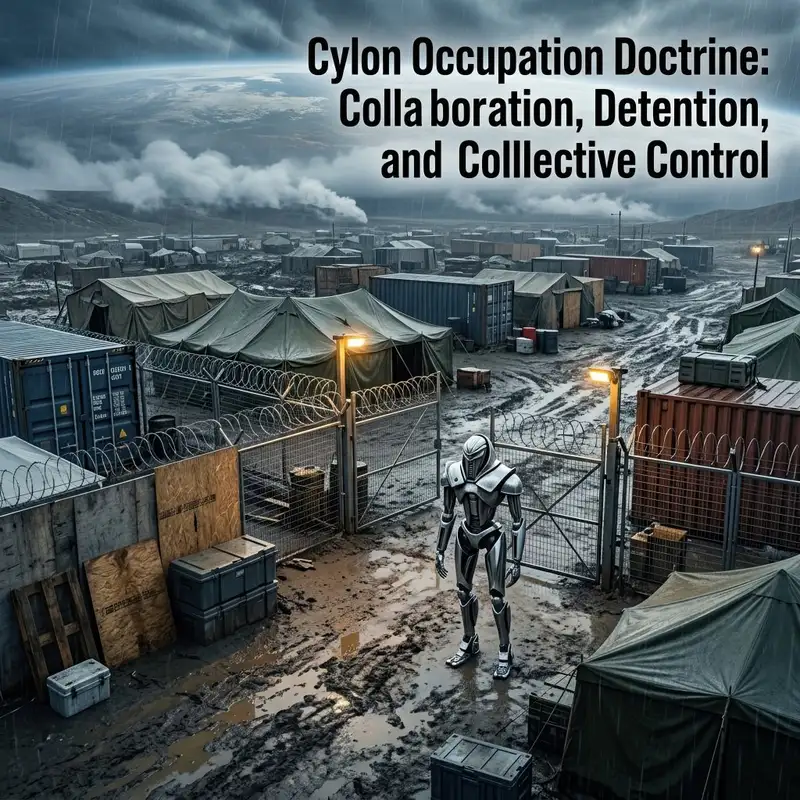
Cylon Occupation Doctrine: Collaboration, Detention, and Collective Control
Gaius Baltar sits before an execution order, and the paper matters precisely because it should not. The Cylons have soldiers, detention cells, weapons, and control of the settlement. They do not need a human president’s signature to kill prisoners. Yet they demand one. A Cylon official tells Baltar that detainees will be executed, then places the authorization in front of him. The office of the presidency remains visible. The language of Colonial law remains visible. But command, policy, and coercion belong to someone else.
That is the governing contradiction of New Caprica. The Cylons conquer a human settlement and then discover that conquest is not the same as rule. They can deploy Centurions in the streets. They can raid homes, detain opponents, and compel officials to cooperate. What they cannot manufacture by force is the ordinary web of trust that allows a government to function. They need people to keep working, share information, police neighborhoods, maintain utilities, and accept that official orders have some claim on obedience. Their occupation doctrine therefore becomes an effort to use human institutions without allowing those institutions any genuine independence.
Baltar is not a free executive under this arrangement, but neither is he a powerless bystander. He faces coercion, fear, and the immediate danger that resistance by him may bring punishment upon others. Those conditions matter. They do not erase every decision he makes, every concession he accepts, or every advantage he seeks to preserve. The occupation turns him into a civilian intermediary whose authority is real enough to implicate him, but too hollow to restrain the power directing him. That is a miserable position for a president, and a useful one for an occupier.
New Caprica had been vulnerable before the Cylons arrived. The settlement was not a fortified colony with a standing army, redundant infrastructure, or a secure line of communication to friendly forces. It was a fragile attempt to build a life after months of flight. The people who settled there had chosen ground beneath their feet over the constant danger and privation of life aboard ships. That choice was understandable. It also left them exposed.
The reported population of the settlement is generally associated with roughly thirty-nine thousand people, though no wartime count should be mistaken for a perfect census. These were civilians, former Fleet personnel, families, laborers, political figures, technicians, farmers, and people already carrying the losses of the Twelve Colonies. Their settlement had limited material depth. Food, power, shelter, medical care, transportation, and communications all depended on systems that could be interrupted, seized, or redirected. There was no industrial reserve waiting over the horizon. There was no neighboring government that could send relief.
When Galactica, Pegasus, and much of the civilian fleet withdrew rather than be destroyed in place, the settlers were left without conventional protection. That withdrawal was not abandonment in the simple moral sense. The battlestars preserved the possibility of a future rescue by surviving. But on the ground, the immediate result was isolation. The Cylons could arrive with overwhelming force and face no organized army capable of contesting the landing, holding terrain, or forcing a conventional battle.
The military conquest of New Caprica was therefore swift. Its political conquest was not. The difference matters. A force can defeat defenders, occupy a city, and seize official buildings in a matter of hours. Governing requires a different kind of capacity. It requires information about the population. It requires workers who understand local systems. It requires interpreters of custom, grievance, and family loyalty. It requires people willing, or at least resigned, to carry out routine tasks without needing a Centurion posted beside every door.
The Cylons understood this in their own divided and imperfect way. Their occupation authority did not speak with one mind. Caprica Six and Sharon Valerii, the Number Eight usually called Boomer, show an interest in some form of coexistence. They have lived among humans, formed relationships with them, and recognize that rule by pure terror is unstable. Cavil and Number Three, among others, increasingly treat human resistance as proof that harsher control is required. These differences should not be turned into rigid doctrines shared by every copy of a model. They are competing judgments made by individual Cylons in a volatile occupation.
That division shaped policy. One tendency sought order through managed cooperation. Another sought order through fear, surveillance, and punishment. In practice, the occupation moved toward coercion because the initial hope that humans would accommodate the new regime was repeatedly undermined by resistance. But coercion did not solve the underlying problem. It made the population easier to intimidate in the short term while making it less likely that any human institution would retain public legitimacy.
Humanoid Cylons were particularly useful in this political environment. Centurions could guard checkpoints, conduct raids, stand watch over prisoners, and make the threat of violence unmistakable. They could not easily persuade a frightened human population that occupation orders served the common good. Humanoid Cylons could speak, bargain, interrogate, deceive, and manipulate the familiar forms of politics. They could understand that a signed order, a public ceremony, or a local police patrol might matter more than another visible machine in the street.
But even humanoid Cylons remained outsiders to the social terrain they had conquered. They could infiltrate human society. They could imitate its faces and exploit its vulnerabilities. They could not merely inherit its local trust. Every arrest risked turning relatives into enemies. Every demand for information threatened to produce silence, false accusations, or carefully managed lies. Every attempt to make the settlement orderly raised a difficult question. Order for whom, and under whose authority?
The New Caprica Police was the occupation’s answer. It was a human-staffed force meant to put local faces between the Cylons and the population they controlled. In one sense, the idea had practical logic. Human officers knew the streets, the residents, the workplaces, and the points of friction. They could communicate with civilians in ways Centurions could not. They could perform the daily work of identification checks, arrests, searches, and transport without requiring the Cylons to maintain an enormous visible garrison.
In another sense, the police force exposed the weakness of the occupation. If Cylon rule had been accepted as legitimate, it would not have needed humans to validate it. The police did not replace Cylon power. They operated under it. Their authority depended on the threat behind them, and everyone knew it. That made ordinary policing almost impossible to separate from political control. A force created to keep order became an instrument for enforcing subjugation.
The people who joined the New Caprica Police did not all arrive there for the same reason. Some may have believed that humans policing humans could reduce direct Cylon brutality. Some sought to protect their families by placing themselves inside the system rather than beneath it. Some were frightened. Some were grieving. Some were angry. Some saw employment, authority, or survival where others saw betrayal. Occupation creates these choices deliberately. It makes participation in a compromised institution appear safer than refusing to participate, then uses that participation to extend control.
Jammer illustrates the moral trap. A former member of Galactica’s crew, he joins the police in part because he believes the force might spare civilians from the worst methods of an alien occupation. That belief does not make the raids, arrests, or intimidation carried out by the police harmless. It does explain why a collaborator cannot always be understood as a person who simply chose the occupier’s cause. Later, when faced with an execution, Jammer refuses. His refusal cannot undo the institution’s record, but it establishes that personal agency survives even inside a coercive system.
Duck presents another path through the same institution. His grief and desire for revenge pull him toward the police, while his hidden connection to the resistance complicates his public role. Neither man stands for every officer. That is the point. Occupation systems rely on categories because categories are administratively convenient. Policeman. Collaborator. Suspect. Resister. In reality, the same person may be afraid, compromised, resentful, useful, and morally responsible at once.
The police wore masks in part because they feared retaliation from the people they were meant to govern. That is an operational measure, but it is also a political admission. A police force confident of public support does not normally need to conceal its members from the community. The masks protected officers and their families. They also made the force appear less like a civic institution and more like an armed extension of foreign power. Each protection measure further weakened the relationship that policing requires.
The New Caprica Police conducted raids, made arrests, moved detainees, and participated in the machinery of execution. Those actions placed its members at the point where occupation policy became personal. A Cylon order might begin in an office. A prisoner’s experience began when human officers came through a door at night. That distance between policy and enforcement is important. It is how a regime turns broad political control into fear inside homes, workplaces, temples, and families.
The resistance grew from the same social terrain. By the sixty-seventh day of the occupation, Saul Tigh, Galen Tyrol, Jean Barolay, and others were building underground networks. They did not possess tanks, artillery, air power, or reliable long-range communications. They could not defeat the Cylons in a conventional campaign. Their strength lay elsewhere: concealment, neighborhood knowledge, loyalty, improvised weapons, sabotage, and the ability to impose a continuing security burden on the occupier.
That kind of resistance depends on relationships. Someone has to hide weapons. Someone has to carry messages. Someone has to provide food, shelter, a warning about a raid, or a believable excuse for being in the wrong place. Someone has to decide whether a neighbor can be trusted. The resistance is not merely a group of armed fighters. It is a network embedded in a civilian population. That gives it resilience, but it also makes civilians vulnerable whenever the occupier treats association itself as evidence of guilt.
The weapons cache hidden in a temple shows the pressure this placed on every civic space. A temple is a place of worship, memory, and community. Under occupation, it can also become a hiding place, a rendezvous point, or a target. When the Cylons assault the temple, people die, including Nora Clellan. The raid does more than remove weapons from circulation. It teaches the settlement that religious and social institutions are no longer protected from the logic of counterinsurgency.
That lesson cuts both ways. Resistance members learn that no space is safe. Civilians learn that contact with a friend, relative, or community leader may bring suspicion. The Cylons learn that their ability to penetrate a network is incomplete, or they would not need broad, disruptive raids. Every such operation may produce useful intelligence. It may also deepen the hostility that keeps the resistance supplied with recruits, concealment, and silence.
The insurgency’s central problem was not whether it could strike. It was what striking would accomplish, and who would pay the price. Saul Tigh believed the occupation had to be made costly. His aim was not to defeat the Cylons through a series of small attacks. That was beyond the resistance’s means. The aim was to disrupt their control, force them to spend resources on internal security, and keep the settlement politically unstable until the fleet could return.
That calculation becomes clear in the attack on a New Caprica Police ceremony. The bombing kills or wounds both humans and Cylons. It also damages a power substation, leaving much of the city without electricity for an extended period. The tactical effects are immediate. There are casualties. A public gathering thought secure has been penetrated. Critical infrastructure is damaged. The occupation authorities must confront the possibility that their local security force cannot even protect its own ceremonies.
The operational consequences reach further. A power failure is not merely an inconvenience. In a settlement with limited redundancy, electricity supports communications, lighting, work, medical care, heating or environmental systems, and the basic rhythm of civilian life. The attack imposes pressure on the occupier, but it also imposes hardship on the people the resistance claims to defend. This is the cruel arithmetic of sabotage in a constrained society. Infrastructure belongs to the regime and to the population at the same time.
Tigh sees the attack as part of a larger campaign to keep the Cylons off balance. Galen Tyrol objects to the civilian danger. Laura Roslin, imprisoned but still politically alert, rejects suicide attacks that endanger civilians. Their disagreement is not a debate between courage and cowardice. It is a dispute about what kind of resistance can preserve the society it seeks to liberate. A movement that makes occupation expensive may also make daily life unlivable. A movement that refuses every risky action may leave the occupier free to consolidate control.
The police ceremony was a target connected to the occupation apparatus. It was not a simple attack on an uninvolved civilian crowd. Yet that distinction does not remove the moral problem. The police included people with different degrees of choice and culpability. The ceremony took place within a civilian settlement. The bomb’s effects could not be confined to a clean battlefield. New Caprica does not offer the resistance a sterile choice between violence and innocence. It offers a series of choices in which military effect, civilian risk, fear, and political legitimacy collide.
The Cylons respond by drawing the wrong broad lesson from a real security problem. They treat the bombing more than as the work of a specific cell, but as evidence that the wider population must be controlled more aggressively. This is the familiar temptation of an occupying force. When it cannot distinguish loyal civilians from insurgents with confidence, it expands the category of suspect. It converts uncertainty into policy.
Suspect lists, association-based arrests, identification checks, and nighttime raids become tools of collective control. The purpose is not only to capture fighters. It is to isolate them from their social base. If a worker can be detained because of a family connection, if a spouse can be arrested because of a hidden weapon, if a neighbor can be questioned because of a meeting, then ordinary ties become liabilities. The occupier hopes fear will make civilians withdraw from the resistance before they ever join it.
Cally Tyrol’s arrest demonstrates how this works at the household level. She is not seized because the Cylons have solved every mystery of the underground. She is seized because relationships themselves have become intelligence terrain. Her connection to Galen Tyrol gives the occupation leverage. The arrest threatens a family, pressures a resistance leader, and sends a message to anyone who believes private life remains separate from public control.
This method can produce information. It can also corrupt information. Fear encourages people to say what interrogators want to hear. Personal grudges can be repackaged as security reports. The innocent learn to conceal themselves. The guilty learn to use the innocent as cover. People who might have remained neutral begin to see the occupation as a threat to their families rather than a distant political condition. The more broadly the Cylons cast their net, the more the settlement’s social fabric becomes a source of resistance rather than stability.
Surveillance has the same limitation. It can reveal movement, contact, and opportunity. It cannot automatically reveal loyalty. The Cylons possess superior technology, humanoid infiltrators, armed patrols, and access to human officials. Yet local intelligence remains difficult because human beings change their behavior under coercion. They hide what matters. They tell partial truths. They cooperate publicly while passing information privately. They may be loyal to a person rather than a program, to a family rather than a faction, or simply to whoever seems most likely to keep them alive.
Detention turns collective suspicion into a permanent institution. A detention center is not merely a place where captured insurgents wait for trial. On New Caprica, it becomes an instrument of occupation. It removes political opponents from public life. It intimidates relatives and associates. It creates pressure points for interrogation and bargaining. It tells the population that legal protection is conditional, revocable, and dependent on the wishes of those who command armed force.
Laura Roslin is imprisoned there. Tom Zarek is imprisoned there. Their politics are not identical, and neither represents every detainee. Roslin is the former president whose authority challenges Baltar’s occupied administration. Zarek is a figure of radical opposition with his own history of conflict with Colonial authority. Detaining both is useful because the occupation does not need their views to match. It needs their independent influence removed from the settlement.
The crucial feature of the detention system is not the architecture of the prison or the number of people held inside. It is the absence of credible law. There is no independent court with the practical power to review arrests. There is no trusted process separating evidence from accusation. There is no meaningful appeal against the authority directing the guards. Colonial legal vocabulary survives in documents and offices, but law no longer restrains the people who control the weapons, the cells, and the lists.
This is why Baltar’s signature matters so much. The Cylons could execute detainees as occupiers. If they do so under a presidential order, the act can be presented as Colonial justice. The signature distributes responsibility. It confuses the public record. It encourages people to argue over Baltar’s guilt rather than focus solely on Cylon command. It turns the language of government into another instrument of control.
The strategy is politically sophisticated and morally corrosive. It seeks not only obedience, but confusion. If a prisoner dies under a Cylon order, the occupation is obvious. If a prisoner dies under an order signed by the president, then the occupier can claim that humans are administering their own affairs. The claim is false in the meaningful sense. Baltar does not control the policy. But it is useful falsehood because it damages the very idea that a Colonial institution can stand apart from Cylon coercion.
Baltar’s administration becomes a contested space for that reason. It contains clerks, officials, guards, and political figures trying to operate beneath a regime that has stripped their offices of independence. Some accommodate. Some resist quietly. Some do both, at different times and for different reasons. Felix Gaeta is the clearest example. He works within Baltar’s administration while secretly passing information to the resistance. His position gives him access. It also puts him in constant danger.
Gaeta’s role demonstrates that collaboration and resistance can overlap inside the same institution. A person may carry out necessary administrative work and still sabotage the occupier’s purposes. Another may begin with the hope of limiting harm and end by facilitating repression. A third may use proximity to power for personal survival or advantage. These differences do not make moral judgment impossible. They make it necessary to judge acts, knowledge, coercion, and consequences rather than relying on a single label.
The occupation also understands that not every resistance leader should be arrested immediately. Cavil’s treatment of Saul Tigh reflects a counterinsurgency calculation. A known opponent who remains active can lead authorities toward hidden networks, weapons, contacts, and plans. Arrest him too soon, and the organization may fragment into smaller, less visible cells. Leave him room to operate, and he may reveal more than he intends.
That calculation helps explain why the Cylons combine surveillance, pressure, and selective tolerance. Their aim is not just to punish rebellion after it appears. It is to map the human network beneath it. They want to know who carries messages, who provides shelter, who has access to weapons, who can influence workers, and who can move between official institutions and the underground. Seen that way, the occupation’s intelligence problem is more important than its firepower problem.
Ellen Tigh’s collaboration becomes part of this struggle. Her conduct cannot be reduced to one motive. Coercion, manipulation, personal agency, fear, and the damage she causes to the resistance all matter. For Saul Tigh, the betrayal is intimate as well as operational. For the Cylons, it is an opportunity to exploit a human relationship as an access route into the underground. Occupation forces often seek this kind of leverage because family ties can reach places patrols cannot.
Yet the intelligence trap has limits. The more the Cylons use detention, threats, and compromised human intermediaries, the less they can trust the information they receive. A network under pressure may expose one member while protecting another. It may feed the occupier enough truth to preserve a source while hiding its larger purpose. People who cooperate may do so out of fear rather than loyalty. They may become unreliable the moment the balance of power shifts.
That shift begins when the resistance reestablishes contact with Galactica. Communication through the surrounding nebula gives the people on New Caprica something they have lacked since the occupation began: an external lifeline. The underground is no longer acting only to survive, retaliate, or make Cylon rule costly. It can begin preparing for a specific military and civilian objective, the evacuation of the settlement.
This connection changes the resistance’s value. A local insurgency cannot match a Cylon occupation force in open combat. It can provide intelligence that an arriving fleet cannot obtain from orbit. It can identify detention sites, assist in moving civilians, spread instructions, create diversions, and help people reach extraction points. It can turn knowledge of streets, buildings, and local relationships into operational support for a rescue.
The return plan also requires an unusual decision by Admiral William Adama. Sharon Agathon, another Number Eight and distinct from Boomer, has become part of the Colonial Fleet. Adama commissions her as an officer and sends her to New Caprica because the Centurions cannot visually distinguish her from other humanoid Cylons. Her identity becomes an operational advantage. She can move through an enemy-controlled environment in a way no human officer can.
This is not merely a clever disguise operation. It is a test of the Fleet’s own political and moral capacity. Sharon had once been an infiltrator. She had committed acts under Cylon influence and had become a figure of deep fear aboard Galactica. By this point, she has also made choices that establish her loyalty to the human fleet and to the people she loves. Commissioning her does not erase her past. It recognizes that origin, appearance, and model designation cannot be the only measures of responsibility.
The operation demands trust under conditions where trust has repeatedly been weaponized. Adama needs Sharon because she can accomplish a mission others cannot. Sharon needs the commission because she must be treated as a responsible participant in the community she is risking her life to save. The decision does not settle every question about Cylons and humans. It does establish a practical principle. A fleet fighting for survival cannot preserve its values by treating every being of Cylon origin as permanently incapable of loyalty.
When the evacuation begins, the occupation collapses with startling speed. That should not be mistaken for proof that the Cylons were militarily weak. Their forces remain formidable. Their weapons, Centurions, and control mechanisms can dominate the settlement under ordinary conditions. What fails is the political system supporting their control. The resistance has preserved networks. The returning Fleet creates a crisis the occupation cannot contain. Human intermediaries cannot restore trust once the possibility of liberation becomes real.
The liberation of detainees is especially significant. Prisoners are more than recovered personnel. Their release reverses one of the occupation’s central claims, that the Cylons and Baltar’s administration possessed the authority to decide who belonged within the political community. The detention center had made exclusion a routine instrument of rule. Opening it demonstrates that the regime’s legal shell no longer has force behind it.
The civilian movement during the evacuation also reveals the limits of the resistance’s success. Underground preparation helps, but it cannot make the operation clean. Families are separated. People are trapped by distance, fear, injury, or confusion. Some cannot reach the ships in time. Some die during the occupation and the escape. A later summary associates roughly two thousand human deaths with the occupation and evacuation, but even that number should be understood as a grim approximation rather than a complete accounting of every life disrupted or lost.
Tactically, Cylon control of New Caprica breaks down during the evacuation. Operationally, the resistance has helped create the conditions for a fleet rescue, though it has not protected everyone. Strategically, the Cylons fail to convert a swift conquest into stable human rule. They retain overwhelming power but cannot make that power produce durable consent, reliable information, or an obedient political community.
The political consequences are equally severe. Baltar’s administration loses whatever remaining claim it had to independent sovereignty. His signatures, offices, and public role had been useful to the occupation because they obscured the source of power. Once the settlement escapes, that ambiguity becomes a burden. People must reckon with what was done under the appearance of Colonial authority, and with the difference between coercion, accommodation, complicity, and resistance.
The New Caprica Police leaves a particularly difficult legacy. Its members had held practical authority under occupation. Some enforced brutal policies. Some carried out raids and arrests. Some participated in executions. Some had joined under pressure or in the belief that they could reduce harm. Some tried to resist from within. Liberation does not make those distinctions disappear, but neither can a damaged community afford to ignore the suffering caused in the name of security.
That is why post-occupation justice is never merely a matter of identifying villains. Communities emerging from fear often want certainty. They want to know who betrayed whom, who gave names, who wore the mask, who signed the order, who stood aside, and who profited. Those questions are necessary. They can also become dangerous when vengeance substitutes for evidence, or when collective blame reproduces the occupation’s own habit of treating human beings as categories.
New Caprica demonstrates the limits of conquest without legitimacy. The Cylons could seize a settlement, penetrate its institutions, compel its officials, and use human beings to administer their own subjugation. But every raid, coerced signature, masked patrol, detention order, and act of collective punishment destroyed trust faster than force could restore order. Their occupation was defeated not just by resistance violence or Galactica’s return, but by the contradiction at its core: a regime that needed human consent treated human political life as something to be managed through fear.