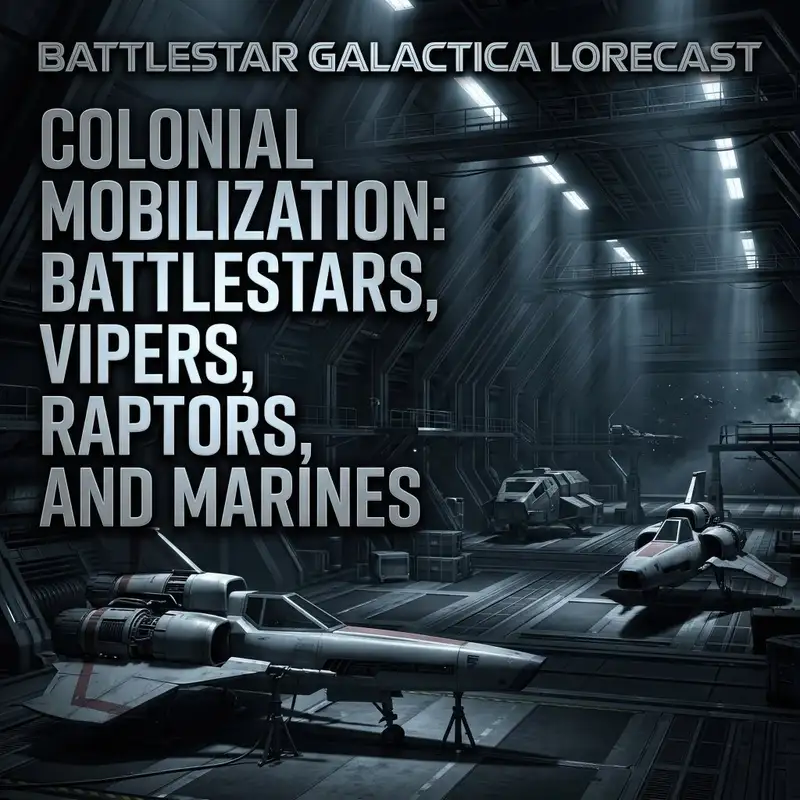
Colonial Mobilization: Battlestars, Vipers, Raptors, and Marines
On the day Battlestar Galactica was prepared for retirement, its oldest fighters sat behind museum barriers. Viper Mark Twos, veterans of the First Cylon War, had become artifacts. Visitors could walk past them, admire their worn frames, and imagine an earlier generation of pilots flying out to meet a machine enemy that had supposedly vanished decades before. Outside those displays stood the modern Colonial military, built around newer systems, newer fighters, and a peacetime belief that the old war had ended for good. Within hours, that arrangement would be reversed. The museum aircraft would become combat assets. The modern system would become a target. And Galactica, a ship being stripped of its military purpose, would become one of the few places where Colonial defense could still function.
The reversal is the best place to begin the history of Colonial mobilization. Readiness was never simply the number of battlestars on a roster, the number of fighters parked in a hangar, or the size of a defense budget. A military becomes real only when people, machines, fuel, ammunition, navigation, communications, maintenance, training, intelligence, and lawful authority can operate together under pressure. The Twelve Colonies built such a system over generations, and especially during the First Cylon War. It was formidable in the kind of war it expected. It could move command authority and air power through faster-than-light space. It could defend colonies, escort ships, patrol routes, and strike Cylon forces. But the same integration that gave the Colonial Fleet its reach also gave the Cylons common systems to exploit, common assumptions to penetrate, and a peacetime structure that could be shocked into paralysis.
The First Cylon War created the military problem that shaped the Fleet for decades. The Colonies were politically distinct societies with their own histories, interests, industries, and identities. They faced a revolt by artificial beings originally created for labor and service, then organized for war. The response could not be improvised by one colony alone. It required common defense arrangements, shared production, trained personnel, common command relationships, and enough political agreement to keep the military effort supplied and directed. That was mobilization in its full sense. It meant factories producing equipment, schools producing technicians and officers, shipyards maintaining warships, and civilian governments authorizing the resources that military commanders consumed.
The First Cylon War was also the period in which battlestars became central to Colonial strategy. The released record does not provide a complete campaign map, a perfectly reliable order of battle, or a neat account of every unit that fought. It does show the kind of operational environment Colonial forces faced. In Blood and Chrome, a young William Adama serves aboard Galactica during the war, on a mission involving escort, movement through dangerous space, and a Raptor carrying personnel and information of strategic importance. That one mission does not define the whole war. It does, however, demonstrate an important fact. Even a major warship could not operate as an isolated fortress. It required scouts, transport craft, fighter cover, navigators, engineers, and people willing to carry out missions far from secure support.
A unified military response required more than ships. A battlestar could only be built if the Colonies had access to industrial labor, specialized materials, trained engineers, and political institutions willing to sustain expensive long-term defense. A Viper pilot was the end product of a much longer chain. Someone had to recruit that pilot, train the pilot, maintain the aircraft, load weapons, manage fuel, recover damaged craft, treat injuries, and replace losses. The same was true of Marines, Raptor crews, medical personnel, ordnance workers, communications specialists, and deck crews. Colonial mobilization created a force that could fight across interplanetary distances because a civilization stood behind it. That foundation was so extensive that it became easy to overlook. It would only become visible after the Colonies lost it.
A battlestar was the physical expression of that system. It was a capital warship, but that description is too narrow. A battlestar carried command spaces, communications equipment, sensors, weapons, fighters, support craft, medical facilities, engineering departments, magazines, repair capacity, security personnel, and a crew trained to keep the entire structure functioning under attack. Its own guns, armor, flak, maneuver, and damage-control systems mattered. So did its ability to launch and recover aircraft. A battlestar’s Vipers could intercept Raiders before they reached civilian ships. Its Raptors could scout beyond the range of immediate visual contact, support electronic operations, carry teams, and investigate threats. Its command staff could coordinate those activities across a wider formation.
Faster-than-light travel made that combination strategically powerful. A battlestar could move military force rapidly between calculated destinations, appearing where a colony, convoy, or patrol route needed protection. Yet faster-than-light travel did not remove the ordinary burdens of war. A jump still required functioning drives, accurate calculations, a destination that would not kill the ship, and enough coordination to prevent a formation from scattering. A battlestar that jumped ahead without its support vessels could find itself short of fuel, parts, ammunition, or medical support. A civilian ship that could not keep pace could become both an operational problem and a humanitarian emergency. Mobility gave the Fleet options. It did not make those options free.
The battlestar’s commander held formidable military authority, but that authority existed within a civilian political order. Colonial warships defended the Twelve Colonies. They did not replace them. A commander could make tactical decisions about threats, launches, and ship survival. That did not automatically make the commander sovereign over every civilian institution, local government, or political dispute touched by military operations. This distinction mattered before the Fall, when civilian government had depth and continuity. It mattered even more afterward, when the surviving warships became the only organized armed force available to protect a population in flight. The Fleet’s strength came partly from its connection to a political community. Once that community was reduced to refugees aboard vulnerable ships, force and legitimacy became much harder to separate.
The Viper was the most visible extension of battlestar power. It was the Colonial Fleet’s primary fighter, used for interception, combat air patrol, escort, reconnaissance support, and strike missions. In practice, a Viper gave a battlestar reach. It could meet Raiders away from the hull, defend a transport, screen a Raptor, or pursue a threat that a capital ship could not easily engage. Yet the mythology of the fighter pilot can obscure the system that made a Viper useful. A pilot in a launch tube represented only the final step in a long sequence of work. The aircraft had to be serviceable. It had to be fueled, armed, inspected, and launched. The pilot had to be rested enough to make decisions, briefed on the mission, and recovered afterward. If the aircraft returned damaged, deck crews and mechanics had to decide whether it could fly again.
Those constraints mattered because Vipers were not disposable ammunition. A fighter could be lost in seconds. Replacing the pilot who flew it was much harder. Training created more than stick-and-rudder skill. It produced judgment under stress, familiarity with formation flying, knowledge of ship procedures, and the ability to distinguish an attack opportunity from a trap. A veteran pilot also carried institutional memory. That pilot knew how a squadron actually operated when the deck was crowded, communications were confused, and the commander needed an answer before the next contact reached the fleet. A military can accelerate training during crisis. It cannot instantly manufacture experience.
The Viper Mark Two belonged to the First Cylon War generation. By the armistice period, it was old enough to be displaced by newer designs, and aboard Galactica it was being preserved as part of a museum conversion. That did not mean the Mark Two was useless. Older equipment can remain capable if it is maintained, if crews understand it, and if its mission still fits its limitations. But age also carries costs. Old airframes require attention. Parts become harder to obtain. Experienced maintenance personnel become increasingly important. Procedures designed around older systems can complicate coordination with newer equipment. Galactica’s Mark Twos were not superior because they were old. They became valuable because a particular Cylon attack struck the newer architecture more effectively.
The Viper Mark Seven represented modernization. New systems could improve performance, coordination, and integration with a wider Colonial defense network. That was not foolish in itself. Militaries modernize because threats evolve, crews need better tools, and organizations seek more efficient ways to share information. The danger came when the advantages of common systems were treated as proof that common systems were safe. During the renewed Cylon attack, the compromised Command Navigation Program disabled Mark Seven Vipers in the circumstances shown. Galactica’s older Mark Twos remained available because they did not share that same exposure. The lesson is not that every new fighter was doomed, every old fighter was secure, or every networked system was a mistake. The lesson is that a force dependent on common software must understand who wrote it, who can access it, and what happens when it fails across the fleet at once.
Raptors reveal another side of Colonial mobilization. If Vipers were the Fleet’s fast-moving defensive edge, Raptors were much of its connective tissue. They could conduct reconnaissance, scouting, communications support, electronic countermeasures, search and rescue, transport, and specialized insertion missions. They carried people and information into places where a battlestar could not just arrive without risk. A Raptor might be sent ahead to investigate a possible jump destination, accompany an escort mission, search for survivors, support a boarding action, or carry Marines toward an objective. The exact task depended on the moment. Their value lay in flexibility.
The flexibility also made Raptors scarce in a way that simple aircraft categories can hide. A commander who used a Raptor for scouting could not use that same airframe and crew for rescue or transport at the same time. A Raptor crew sent ahead of the fleet often entered uncertainty before the battlestar could protect it. Its mission might determine whether the fleet jumped into safety, into danger, or into empty space with no useful resources. That made Raptors central to intelligence as well as mobility. A fleet cannot decide what to defend, where to move, or whether a contact is enemy, civilian, or trap without information. DRADIS, wireless communication, and reconnaissance improved that picture. None of them made it complete.
The First Cylon War demonstrated the need for such craft in action. Blood and Chrome places a Raptor in the middle of a wartime movement and escort problem, not as a mere shuttle waiting for more glamorous aircraft to finish the work. That is a useful reminder of how militaries actually function. Combat formations depend on the personnel who move intelligence, equipment, specialists, wounded people, and small teams between larger platforms. The craft that carries a Marine detachment or a critical passenger may influence an operation as much as the fighter that shoots down an enemy. In a fleet built around faster-than-light jumps, reconnaissance and navigation were not background chores. They shaped whether the battle force arrived in the right place at all.
If Raptors allowed the Fleet to see and move, Marines allowed it to control physical space. Colonial Marines, including battlestar-based detachments often called mardets, were responsible for more than assault missions. They performed shipboard security, military policing, boarding, prisoner handling, installation defense, evacuation support, and off-ship operations when required. On a battlestar, Marines protected areas where a single breach could become a crisis. They guarded command spaces, sensitive equipment, detention areas, launch facilities, and access points. During a boarding operation, they could secure a ship whose systems, crew, cargo, and loyalties were unknown. During an evacuation, they might provide order where panic, crowding, and fear could become as dangerous as enemy fire.
The range of responsibility means Marines should not be treated as generic infantry in a science-fiction uniform. A Marine trained for shipboard security faced different problems from a soldier advancing across open ground. Weapons, movement, fields of fire, prisoners, civilians, life-support systems, and pressure hulls all had to be considered. A firefight aboard a ship could threaten the people and machinery the Marines were supposed to protect. Their function also crossed the boundary between external war and internal order. They were military personnel, but their presence could become politically significant when civilian police, courts, and local institutions were weakened or absent. That made discipline and lawful command especially important. The person holding a rifle at a detention hatch might also be standing at the boundary between necessary security and unchecked coercion.
The early refugee fleet showed how quickly that capacity could shrink. Galactica reportedly had only about thirty Marines available in the first period after the Fall. The exact figure matters less than what it represents. A small detachment had to cover guard duty, internal security, boarding work, prisoner control, emergency response, and support for missions beyond the ship. Every loss or reassignment had consequences in more than one area. Sending Marines on an off-ship operation could leave fewer personnel to secure the battlestar. Holding prisoners could consume people needed for boarding or rescue. Supporting civilian order could draw military security away from military threats. This was not merely a manpower shortage. It was the collapse of institutional depth.
The visible warships depended on a much larger hidden mobilization. Deck crews launched and recovered aircraft. Mechanics kept engines and flight controls working. Ordnance personnel handled weapons. Engineers maintained power, environmental systems, and damage-control equipment. Navigators and communications specialists turned orders into movement. Medical personnel treated injuries that could remove trained people from service even when they survived. Instructors prepared replacements. Clerks, cooks, technicians, and supply personnel sustained the people who did the fighting. Their work rarely appeared as dramatic as a Viper launch, but without it, the launch did not happen.
Before the Fall, the Colonies possessed the industrial and educational systems that made this labor possible. A damaged Viper could be repaired because there were parts, trained technicians, established procedures, and a broader economy capable of supporting military maintenance. A battlestar could undergo refit because shipyards, suppliers, workers, and planners existed beyond the ship itself. The Colonial military was not self-sufficient. It was sustained by planetary society. It relied on industrial networks that were dispersed across the Colonies, but still connected by common procurement, transportation, and political authority. That arrangement made conventional strength possible. It also meant that the destruction of the Colonies would be more than the destruction of military hardware.
Razor provides a harsh illustration of this reality through the experience of Pegasus. The story shows that a battlestar can survive combat and still carry the consequences of attrition for years. Aircraft are lost. Crews are killed. Damage must be repaired. Command decisions about ammunition, flight operations, and personnel affect what a ship can do later. Pegasus entered the post-Fall struggle with material advantages that Galactica did not possess, including greater surviving capacity in some areas. Yet no individual ship, however powerful, could replace the industrial base of twelve functioning worlds. The difference between having fabrication capability and possessing a civilization-wide shipbuilding system is considerable. One can help a force endure. The other can sustain a war.
The distinction became decisive after the Cylon attack. The survivors retained some ships, weapons, aircraft, skilled people, and stores. They did not retain secure factories, routine supply routes, broad recruitment pools, established shipyards, or a normal economy. Every repair became an act of triage. Every experienced technician became harder to replace. Every pilot lost represented not only a cockpit left empty, but also the instructors, training facilities, and peacetime stability that had once produced pilots in depth. The post-Fall Fleet could improvise, salvage, conserve, and adapt. It could not just order a replacement civilization.
The Colonies’ modernization program created another vulnerability because it concentrated trust in shared systems. The Command Navigation Program was intended to support coordination across Colonial military assets. In an ordinary strategic environment, standardized software and connected systems offered obvious advantages. Navigation could be coordinated. Information could move more quickly. Units could operate with a common technical language. The problem was not that integration existed. The problem was that the Cylons had penetrated it. Gaius Baltar’s access to the program, shaped by Number Six’s infiltration, created a pathway through which the enemy could exploit a system trusted by Colonial defense.
The compromise was not the only cause of the Fall, and reducing the disaster to a single software flaw would be comforting but false. The Cylons combined cyber exploitation with infiltration, deception, strategic surprise, and nuclear attack. They had spent years learning about Colonial society, military procedures, technology, and vulnerabilities. The armistice period encouraged assumptions that a renewed war would provide warning, diplomatic signals, or visible military preparation. Instead, the attack struck systems that had been designed to make the Fleet efficient. A defense architecture built for coordinated conventional response found its coordination disrupted before many of its units could fight.
Galactica survived that particular failure partly because of its older and less-networked systems. That is not the same as saying the ship had no computers, no technology, or no vulnerabilities. Galactica still depended on machinery, communications, navigation, trained operators, and disciplined procedures. Its age imposed burdens. It required maintenance expertise. It lacked the easy integration available to newer systems. Yet its separation from the compromised architecture reduced its exposure to the Command Navigation Program attack. The Mark Two fighters preserved aboard the ship could fly when the newer Mark Sevens were disabled under Cylon control. Resilience came not from nostalgia, but from difference. Systems that fail differently can preserve options when a common-mode failure destroys the rest.
The renewed Cylon attack was therefore a systems attack, not merely a fleet engagement. Cylon forces struck military command continuity, networked warships, planetary infrastructure, and civilian populations in coordinated fashion. Picon Fleet Headquarters was destroyed. Admiral Nagala, aboard the battlestar Atlantia, attempted to direct a larger fleet response, evidence that Galactica had not been the only Colonial warship or the sole center of command. At the same time, the available screen record does not provide a complete, precise inventory of every battlestar lost. It does establish the strategic result. Much of the Colonial military was disabled or destroyed before its conventional strengths could be concentrated.
At the point of contact, Cylon surprise and technological compromise prevented many Colonial units from bringing their weapons, fighters, and command systems to bear effectively. Operationally, the Fleet lost coordination. Ships that might have supported one another were isolated, disabled, or destroyed. For the war as a whole, the Colonies lost the means to generate military power at national scale. The attack did not merely kill crews and sink warships. It destroyed the factories, training institutions, population centers, governments, and supply networks that made those warships possible. The intended target was a civilization.
This helps explain why the destruction of the Colonies cannot be understood as a conventional defeat alone. A state can lose a battle and rebuild. A fleet can lose ships and construct replacements. The Colonies suffered an attack intended to deny them both recovery and continuity. The civilian population was not collateral scenery around a military contest. It was the foundation of every future squadron, shipyard, hospital, school, legislature, and family. The loss of inhabited worlds meant the loss of people who had never worn uniforms but whose work, knowledge, and political participation sustained the military. It also meant the loss of the civilian authority that gave military defense its purpose.
Galactica’s emergency remobilization began amid that wreckage. The ship had been preparing to leave active service. Its old Vipers were museum pieces. Its crew was operating in the shadow of decommissioning, not expecting to become the armed core of a refugee population. Then the old fighters had to be pulled from display status and made ready for combat. Pilots had to be found, assigned, and launched. Maintenance personnel had to turn stored equipment into operational aircraft. Commanders had to abandon the assumptions of a national defense force and confront a different mission: preserving whatever people and ships had escaped.
The transition was not automatic. Surviving an attack is not the same as becoming capable of protecting a convoy. Galactica still needed fuel, ammunition, repairs, pilots, medical care, and functioning command systems. Its crew had to absorb rescued personnel, make sense of incomplete information, and shift from defending a known homeland to escorting an improvised fleet through uncertain space. The ship’s air wing was no longer measuring success primarily by enemy losses. Vipers now had to buy time for civilian ships to prepare jumps, escort vulnerable vessels, and prevent Raiders from reaching people who could not defend themselves. Raptors had to scout, carry messages, search for survivors, and help the fleet avoid hazards it could not afford to discover by collision.
The civilian fleet became the true strategic center of gravity. The ships accompanying Galactica carried more than passengers. They carried food, water, medical personnel, skilled workers, families, children, records, religious communities, political representatives, and the practical knowledge required to keep a society alive. Some ships had military value. Others had industrial, agricultural, medical, or social value. Many were vulnerable. A battlestar could win an engagement and still fail strategically if the convoy it protected was destroyed, scattered, or abandoned. The purpose of the warship had changed. Galactica was no longer defending territory. It was defending the human material from which territory, government, and civilization might someday be rebuilt.
The change also altered the relationship between military command and civilian authority. In the immediate aftermath of the Fall, Galactica possessed weapons, trained personnel, secure spaces, and an established chain of command. Those capabilities made the ship indispensable. They did not make its commander the unquestioned lawful ruler of the survivors. A refugee fleet required protection, but it also required political legitimacy, civilian consent, representation, law, and institutions capable of limiting the armed force that protected it. The tension was unavoidable. Military officers could see immediate threats that civilians could not. Civilian leaders could represent needs that a warship’s command structure was not built to weigh: housing, food, family separation, labor, rights, and the danger that emergency power would become permanent.
The personnel who made Colonial mobilization possible were therefore not merely resources, even though their numbers had become brutally finite. Pilots were people with training, judgment, fear, and families. Marines were security professionals who could be asked to defend civilians one day and restrain them the next. Mechanics and deck crews carried expertise that could determine whether a mission flew at all. Civilian workers possessed skills that a battlestar could not replace. The Fleet had to count fuel, ammunition, aircraft, and trained people because survival demanded accounting. But a civilization that treated every person only as an input to military power would preserve little worth defending.
Colonial mobilization had worked because it linked force, industry, information, and political purpose. Battlestars provided mobile command and combat power. Vipers extended defense beyond the hull. Raptors supplied movement, reconnaissance, and electronic support. Marines secured ships, prisoners, installations, and dangerous transitions between war and civil order. Behind all of them stood factories, schools, shipyards, technicians, elected governments, and civilians willing to sustain the burden. The system was formidable because no single part had to carry the whole war alone.
The renewed Cylon attack exposed what Colonial readiness had become. Ships and weapons still existed, but software, supply chains, command continuity, and peacetime assumptions had been penetrated alongside them. Galactica survived partly because her older systems failed differently, but survival depended just as much on people who could improvise when procedures and machines stopped working. The fleet that escaped the Colonies would spend the rest of the war living inside that lesson. Hardware mattered. Readiness mattered more, and readiness ultimately meant preserving the trained people, functioning institutions, and moral discipline that gave the hardware a purpose.