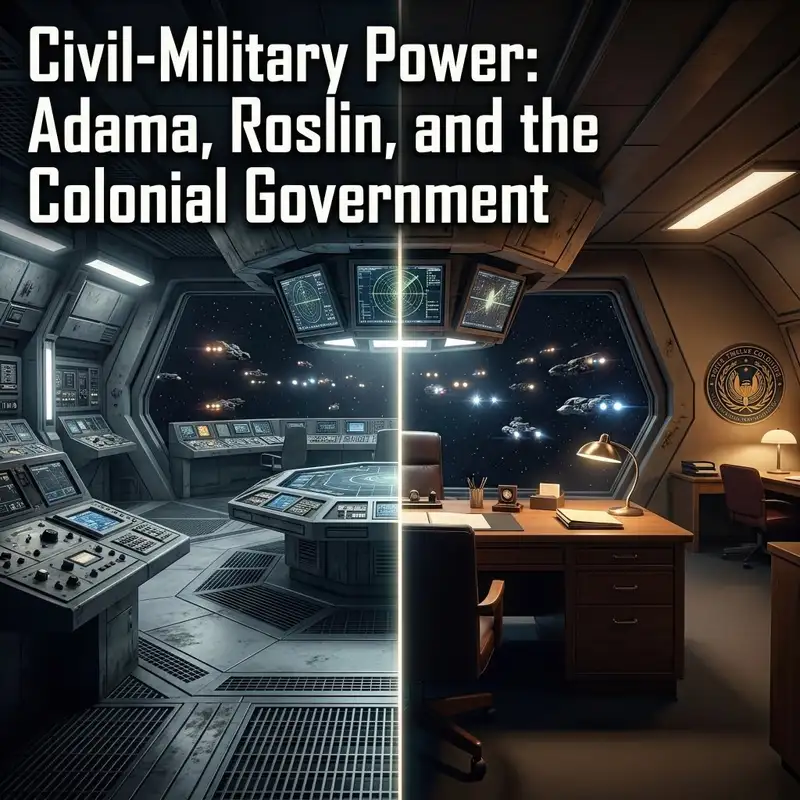
Civil-Military Power: Adama, Roslin, and the Colonial Government
On Colonial One, in the first hours after the Cylon attack, Laura Roslin took an oath to govern a people whose government had almost ceased to exist. The President was dead. The Vice President was dead. Most of the cabinet was gone. Communications with the Twelve Colonies had collapsed into fragments, alarms, and silence. Roslin had been Secretary of Education, a civilian official without a fleet command, a security service, a functioning civil service, or even a reliable idea of how many people remained alive. Yet the Articles of Colonization still provided a line of succession, and in a crisis that law mattered. It gave the survivors more than a title. It gave them a claim that the Colonial state had not died with its worlds.
William Adama faced the opposite problem aboard Battlestar Galactica. He had a warship, trained personnel, Vipers, weapons, engineering crews, Marines, discipline, and the habits of command. He had enough force to fight, at least for a time. But he no longer had a recognizable nation behind him. The Colonial Fleet had been shattered. Military bases, shipyards, supply depots, training commands, and political authorities were assumed lost or inaccessible. Adama commanded Galactica. He became the principal surviving military leader by circumstance and credibility. That did not automatically make him the legal commander of every civilian ship, or the unquestioned ruler of the people aboard them.
This was the problem at the center of Colonial civil-military power after the Fall. Law survived in an oath and a handful of institutions. Force survived in a battlestar and the people able to operate it. Neither was sufficient on its own. Roslin could claim constitutional succession, but she could not defend the fleet against Raiders or order a jump through hostile space without military cooperation. Adama could deploy Vipers and enforce discipline, but a warship without civilians, labor, children, records, families, and political consent was not preserving a civilization. It was only extending the life of a military unit after its country had been destroyed.
Their first serious disagreement established the terms of their partnership. Adama’s instinct was to repair Galactica, gather what military strength remained, and prepare to strike back at the Cylons. That was not irrational. The Cylons had carried out a coordinated attack on an entire civilization. They had destroyed the Colonial Fleet, devastated the home worlds, and demonstrated an ability to infiltrate human institutions. A commander who assumed the enemy would continue hunting survivors had every reason to maintain readiness, conserve combat power, and avoid allowing his ship to become trapped by vulnerable civilians.
Roslin looked at the same situation and reached a different conclusion. The surviving civilian ships were not a distraction from the mission. They were the mission. A battlestar existed to defend a population, not to seek revenge after the population had been abandoned. Her order to collect survivors forced Adama to confront the difference between continuing a war and preserving the people for whom the war had once been fought. The decision changed Galactica’s role. It would no longer operate as an independent capital ship searching for an enemy fleet. It would become the armed shield of a convoy, responsible for ships that varied wildly in speed, condition, supplies, technical capacity, and political importance.
That shift carried a cost. A convoy moves at the pace of its weakest members. Civilian vessels require rendezvous plans, fuel, navigation assistance, repairs, medical support, and protection while preparing to jump. Their captains cannot just be treated as junior officers. Their passengers cannot be ordered into battle stations and expected to solve the practical problems of food, sanitation, childcare, housing, and public order. The military gained a population worth defending. It also acquired obligations that made every tactical decision more complicated.
Adama’s false claim that he knew the location of Earth became part of this first bargain. He had used the story to give the civilians a destination and the crews a reason to keep moving. When Roslin learned the truth, she possessed the leverage to challenge him at the moment he most needed political cooperation. Adama admitted the deception rather than trying to govern through the myth. The result was not a written constitution or a clearly defined separation of powers. The surviving record does not provide one. It was an emergency settlement between two people who understood that neither could displace the other without endangering the fleet.
Roslin would lead the civilian government. Adama would direct military operations. In practice, the boundaries were never clean. A decision to investigate a suspected Cylon involved security, law, fear, and the treatment of civilians. A decision to search a planet for water or fuel involved reconnaissance, labor, risk, and the distribution of scarce resources. A decision to send a Raptor on a mission might be tactically military, but if it affected the fleet’s route toward Earth, it became political as well. Their arrangement worked not because it eliminated conflict, but because it gave conflict a place to be argued before it became force.
The early water crisis showed why neither side could govern alone. Galactica could defend the fleet, but it could not produce water by issuing an order over the public-address system. The civilian ships carried people with technical knowledge, industrial equipment, transport capacity, and specialized labor. They also carried life-support systems of their own, each with different vulnerabilities. A shortage on one vessel might become a political crisis for all of them. A commander could requisition supplies in an emergency, but repeated coercion would eventually destroy trust between the warship and the ships it was supposed to protect.
Galactica was formidable, but it was not self-sufficient. Its systems were aging. Its stores were finite. Its flight crews required rest, fuel, ammunition, maintenance, and replacement aircraft. Its engineers could repair battle damage and improvise extraordinary solutions, but they could not recreate the industrial depth of the destroyed Colonies. Every damaged Viper, injured technician, depleted missile rack, and exhausted pilot carried more weight because there was no secure rear area waiting to replenish the fleet. The battlestar’s combat power depended on civilian survival as much as civilian survival depended on the battlestar.
The civilian fleet, meanwhile, could not survive by voting alone. It needed defensive patrols, search and rescue, intelligence, secure communications when possible, and someone capable of making rapid decisions when a Raider contact appeared on DRADIS. The Cylon threat made delay dangerous. It also made secrecy tempting. A government hunted by infiltrators and warships can begin to treat every civilian disagreement as sabotage, every demand for information as a security breach, and every legal restraint as a luxury. Roslin and Adama had to learn that real danger did not erase the need to distinguish between protection and control.
The crisis involving prisoners from the Astral Queen made that distinction immediate. The fleet needed labor. It needed people willing and able to work in hazardous conditions. The prisoners were a potential source of manpower, but they were also citizens and detainees with grievances, political identities, and a history of conflict with the Colonial state. The military could secure the ship. It could use force to prevent an escape or mutiny. It could not merely convert prisoners into obedient labor without creating a new political problem inside a fleet already struggling to define the meaning of law.
Tom Zarek emerged from that crisis as a challenge to both Roslin and Adama. He understood that the collapse of the Colonies had created an opening. A political order based on emergency rule could be resisted by appealing to representation, public consent, and the anger of people who believed the old government had failed them long before the Cylons arrived. But Zarek was not a simple democratic corrective. He carried his own history, ambitions, and willingness to use instability for political leverage. His importance was that he exposed a fact both Roslin and Adama would have preferred to postpone. Emergency authority always produces a struggle over who gets to define the emergency.
Roslin needed civilian ship captains, labor leaders, religious communities, and political rivals because the fleet could not be ruled from one bridge. Adama needed them for more practical reasons as well. A ship’s crew knew its own machinery. A civilian doctor, farmer, refinery worker, teacher, mechanic, or engineer could be as strategically important as an officer with access to weapons. The survivors were not cargo protected by Galactica. They were the remaining human infrastructure of the Colonies. If they ceased to cooperate, the battlestar could retain order for a while, but it could not build a future.
Adama’s offensive strike against the Cylons during the campaign later called the Hand of God reminded the fleet that military command still required room to act. The operation was not an attempt to restore the old Colonial Fleet through one victory. It was a limited effort to destroy a Cylon resource target and seize an opportunity that might not return. Adama’s role in such decisions was essential. A civilian President could establish broad objectives and demand accountability, but she could not be expected to direct every launch, reconnaissance mission, diversion, or strike package from Colonial One.
The operation also demonstrated why Roslin’s authority remained necessary even when Galactica succeeded. A tactical victory did not solve the fleet’s shortages. It did not replace lost pilots or restore the industrial capacity of the Colonies. It did not answer the question of where the survivors were going or what political order would govern them if they arrived somewhere safe. Military action bought time. Civilian government had to give that time a purpose. The distinction sounds neat in theory. In the fleet, it was always under pressure from immediate events.
That pressure helped drive the reconstruction of the Quorum of Twelve. The Quorum was not a fully documented modern legislature with settled procedures, stable districts, and an uncontested electoral system. The series does not provide enough evidence to describe it that way. But its revival mattered. It created a representative forum in which civilian leaders could debate policy, challenge the President, and claim a voice separate from Galactica’s chain of command. Roslin was no longer only the surviving cabinet officer on a transport. She was becoming the executive of a rebuilt, if fragile, political order.
The Quorum also created friction by design. It gave Zarek and others a place to oppose Roslin without taking control of a ship or organizing a revolt. That was a gain for legitimacy, even when it slowed decision-making. A government that permits no opposition may act quickly, but it begins to confuse obedience with consent. A government that permits opposition must tolerate delay, criticism, and the possibility that frightened people will choose policies its leaders believe are dangerous. Roslin accepted the Quorum because she understood that the fleet needed more than a President. It needed institutions capable of surviving the President.
The most severe test of the Adama-Roslin settlement came at Kobol. Roslin had received evidence that pointed toward a possible route to Earth: the ruins on Kobol, the Arrow of Apollo, the Sacred Scrolls, and the possibility that a specific sequence of events might reveal a path the survivors had not yet found. Her conviction was religious, but it was not based on nothing. There were artifacts, texts, ruins, and discoveries that appeared to connect the old Colonial traditions to a real historical geography. Later developments would complicate and, in some respects, reinforce the importance of that trail.
But Roslin did not possess laboratory proof that her interpretation was correct. She possessed evidence, belief, and an urgent sense that the fleet could not drift indefinitely while waiting for certainty. In her view, Earth was no longer a comforting fiction invented by Adama. It was a strategic objective with spiritual and historical significance. If the Colonies had been destroyed, then finding a permanent refuge mattered more than preserving every existing procedure. The danger was that a leader who believes she has been given a necessary destination can begin to treat dissent as blindness.
Adama saw the Kobol crisis through the responsibilities of command. Personnel were already deployed and vulnerable. The fleet faced threats it did not fully understand. Sending Kara Thrace back toward Caprica in a captured Cylon Raider was an extraordinary risk. The mission involved a craft of uncertain reliability, a route back toward enemy-held territory, and an objective shaped by Roslin’s interpretation of prophecy. Adama did not reject the possibility of Earth because he was incapable of faith. He rejected Roslin’s authority to order a mission that he believed endangered the fleet and violated the discipline required to keep it alive.
The dispute was not just religion against reason. Roslin’s position involved evidence and strategic aspiration, even if the evidence was incomplete. Adama’s position involved operational caution, but also a belief that military command had to retain the authority to prevent leaders from gambling with lives it was responsible for protecting. Both were making risk assessments. Both believed the fleet’s survival was at stake. The constitutional problem was that each also believed the other had crossed into a domain that should not belong to them.
Roslin authorized Kara’s mission despite Adama’s opposition. Adama responded by demanding Roslin’s resignation. When she refused, he terminated her presidency, ordered her confinement, and used Galactica’s military power to impose that decision. Whatever his motives, the action was a military coup in effect. A lawful civilian President had not been removed by a civilian process, a vote, or a court whose authority had been established. She had been removed because the commander of the surviving battlestar judged her decisions too dangerous to permit.
That judgment was not born from casual ambition. Adama had watched the Colonies die because their defenses had been compromised and their assumptions had failed. He faced an enemy that could infiltrate human society, corrupt military systems, and exploit hesitation. He had to consider the possibility that a mission approved on religious grounds could cost the fleet pilots, ships, intelligence, or its remaining ability to defend itself. His fear was real. But necessity does not become lawful merely because the danger is real. Adama gained immediate control over the disputed mission. He also weakened the civilian authority that made Galactica more than an armed sanctuary.
The coup revealed how thin the emergency bargain had always been. Roslin’s authority depended on more than the Articles of Colonization. It depended on whether civilians, officers, ship captains, and political leaders believed that she still represented the continuity of the Colonial government. Adama’s authority depended on more than his rank. It depended on whether his crew believed that military force remained in service to a civilian population rather than above it. Once he detained Roslin, both forms of legitimacy became unstable.
Lee Adama’s divided loyalty made the crisis personal as well as institutional. He was a military officer, the commander’s son, and a man who had come to respect Roslin’s claim to civilian authority. Civil-military conflict rarely remains an argument between offices. It travels through families, crews, friendships, and professional identities. Officers must decide whether loyalty means obedience to a commander, fidelity to a legal order, protection of civilians, or some combination that may become impossible to maintain. Lee’s choices showed that the fleet did not divide neatly into soldiers on one side and civilians on the other.
Adama’s incapacitation after Boomer’s shooting made the danger worse. Saul Tigh assumed command of Galactica under conditions of fear, uncertainty, and institutional breakdown. Tigh faced genuine threats. The fleet was divided, Roslin was detained, Cylon infiltration was no longer a theoretical concern, and the commander who had held the system together was unable to act. But the answer Tigh reached was martial law, enforced with a widening reliance on military control. The episode was a warning about emergency power. Once civilian authority is suspended, the military does not merely inherit a set of duties. It inherits temptations.
Tigh’s actions did not prove that military officers are uniquely prone to tyranny. They showed how rapidly any institution can harden when it believes its survival depends on acting before consultation becomes possible. The problem was structural. Galactica had weapons, detention spaces, trained security personnel, and the ability to compel compliance. The civilian government had been decapitated, divided, and physically constrained. Under those conditions, the line between temporary security measures and permanent rule could disappear with alarming speed.
Roslin’s escape, aided by Lee and connected to Zarek’s political network, demonstrated that rank alone could not settle the conflict. She retained support among civilians, religious believers, and people who saw her detention as proof that Galactica had overreached. Others stayed with the battlestar because they trusted Adama, feared the Cylons, or believed that a divided fleet could not survive. The split was not purely ideological. People made choices based on faith, family, fear, material dependence, loyalty to a ship, and their assessment of which leader could keep them alive.
The struggle over Kobol therefore became a practical demonstration of plural authority. Roslin had a constitutional claim and a civilian following. Adama had military command and the force to protect or coerce. Zarek had political influence but no stable monopoly over the fleet’s institutions. Tigh could impose martial law on Galactica, but he could not convert that into unquestioned authority over every ship. The survivors were not one homogeneous body waiting to be commanded. They were a fractured political community trying to decide which institutions still deserved loyalty.
Adama’s eventual decision to reunify the fleet mattered because it was an act of institutional restoration. He did not merely forgive Roslin or resolve a quarrel with his son. He recognized that Galactica could not become the permanent government of the Colonies without destroying the political purpose of its own mission. Roslin’s return did not mean Adama accepted every prophecy-driven decision or surrendered military judgment. It meant the commander accepted that civilian rule had to be restored even when it was inconvenient, risky, and personally painful.
That restoration did not erase the damage. Public confidence in the military remained fragile. The Gideon massacre, and the scrutiny that followed, made clear that a fleet at war could still demand accountability for violence against civilians. The Cylon threat had created real security concerns. It had not made every use of force legitimate, every detention justified, or every secret beyond question. When civilians lose faith in the people who carry weapons, a military may retain combat effectiveness while losing the political foundation that permits it to operate.
The importance of public scrutiny was not that it made Galactica’s command comfortable. It did the opposite. It forced military leaders to confront how their decisions appeared to people outside the chain of command. A battlestar crew might interpret a security action through the lens of threat warnings, intelligence gaps, and force protection. A civilian passenger might interpret the same event through fear, grief, and the knowledge that every abuse of authority now occurred inside the last surviving human society. Both perspectives were incomplete on their own. Government required a way to hold them in tension.
The arrival of Battlestar Pegasus made the constitutional problem more dangerous. Pegasus was a strategic windfall. It brought another battlestar, additional trained personnel, more fighters, equipment, and a surviving military community outside Galactica’s immediate control. For a fleet facing the Cylons, this was an enormous advantage. But it also meant that military force was no longer concentrated under one commander who had, however imperfectly, accepted Roslin’s authority. Admiral Helena Cain commanded an independent ship with its own history, its own command culture, and its own understanding of what survival required.
Cain was not merely a villain inserted to make Adama appear moderate. She had preserved Pegasus through the destruction of the Colonies and carried the burden of decisions made under extreme pressure. She possessed operational competence and the authority of rank. But her command climate revealed what happens when military necessity is allowed to become the sole measure of legitimacy. Her treatment of civilians and prisoners, including Sharon Valerii, demonstrated a willingness to subordinate law, dignity, and individual rights to her own definition of the war effort.
Sharon’s status placed the conflict at the intersection of military justice, intelligence, and personhood. She was a humanoid Cylon who had committed acts of infiltration and violence, but she was also an individual whose loyalties and relationships had changed. Galactica and Pegasus did not merely disagree about procedure. They disagreed about whether a prisoner could be treated as a source of intelligence, an enemy combatant, a person under military custody, or an object available for whatever a commander believed necessary. Cain’s methods were not made acceptable by the reality of the Cylon threat. The threat explained the pressure. It did not erase command responsibility.
Pegasus also exposed the danger of divided armed power. Roslin could claim the presidency, but a civilian government cannot safely govern if rival commanders possess separate forces and accept different limits on their own authority. Adama and Cain each commanded personnel willing to follow orders. Each had a battlestar capable of inflicting catastrophic harm if the dispute turned violent. The fleet’s political survival depended on preventing that conflict from becoming an armed contest between two military hierarchies.
The planned attack on the Cylon Resurrection Ship created a narrow opening for cooperation. Destroying the ship promised to deny the Cylons a major advantage by preventing the resurrection of forces destroyed within its effective reach. The mission had clear military value. It also offered Adama and Cain a shared objective more immediate than their institutional rivalry. The operation required coordination between Galactica and Pegasus, but it could not succeed if either commander treated the other as the primary enemy.
Tactically, the mission was about destroying a critical Cylon asset. Operationally, it was about using two battlestars without allowing their conflict to paralyze the fleet. At the political level, it was a test of whether civilian authority and military judgment could restrain escalation long enough to preserve the larger mission. Roslin’s role mattered because she remained the civilian source of legitimacy. Adama’s role mattered because he understood that a battle against the Cylons could not justify a private war between Colonial commanders.
The temporary unity did not solve the underlying constitutional question. It succeeded because the participants could agree on a limited objective. They did not suddenly establish a permanent doctrine for the relationship between the President, the Quorum, independent commanders, and the remaining military forces. But the episode demonstrated a principle that would remain essential. Shared purpose can contain institutional conflict for a time. It cannot replace the institutions needed to manage that conflict after the shooting stops.
By the time of the presidential election, the fleet’s argument had shifted from immediate survival to the shape of its future. The discovery of a habitable planet created a choice that no military operation could answer alone. Gaius Baltar argued for settlement. Roslin argued that the search for Earth should continue. Their positions involved ideology and ambition, but they also reflected different assessments of exhaustion, risk, and consent. The fleet had endured repeated attacks, shortages, deaths, displacement, and years of uncertainty. For many civilians, a difficult planet was preferable to another indefinite journey under military protection.
Support for settlement was not just evidence that the public had been manipulated or had lost courage. The electorate was responding to material conditions. People wanted homes, stability, work that was not organized around emergency rationing, and the chance to raise children somewhere other than a ship’s corridor. They had watched leaders invoke survival so often that promises of a distant destination could sound like another demand to endure hardship without a clear end. Baltar’s platform gained strength because it offered a tangible alternative to permanent flight.
Roslin’s opposition was not empty stubbornness. She believed the fleet had been given evidence that Earth remained its intended destination. Her faith had shaped real strategic decisions before, and some of those decisions had produced discoveries that conventional planning alone might not have reached. But belief becomes politically dangerous when it claims an authority beyond ordinary persuasion. Roslin increasingly relied on the language of destiny and necessity. The more she treated the election as a choice between obedience to a larger purpose and surrender to fear, the more she risked reducing citizens to obstacles in a mission only she could interpret.
The election tested whether the restored civilian order could tolerate a result its leaders disliked. Roslin’s campaign had access to influence, loyal officials, and the prestige of incumbency. When her allies interfered with the ballot count to prevent Baltar’s victory, they crossed the line between political competition and the subversion of consent. Roslin was responsible not because every act was necessarily carried out by her own hand, but because she accepted an illegal path to retain office. A President who claims that the people must be protected from their own decision has already begun to replace constitutional authority with personal judgment.
Adama’s response was one of his most important acts of restraint. He had removed Roslin from office during the Kobol crisis because he believed military necessity required it. Now he confronted her because political necessity had tempted her to do something equally destructive. An illegal victory might have kept a trusted leader in power. It might even have preserved a policy Adama preferred. But it would have made the government’s claims hollow. The fleet could not insist that it remained a civilization of laws if its election survived only when the incumbent’s allies controlled the count.
Roslin conceded. Baltar became President. The transfer of power did not prove that the Colonial government had become stable, or that its institutions were immune to future abuse. The Quorum remained fragile. The military remained indispensable. The population was still hunted, depleted, and divided. But the decision mattered because the people around Roslin and Adama chose to restore the boundary they had violated. They accepted that a lawful transfer of authority was more valuable than retaining control through fraud.
That is the essential history of Adama, Roslin, and the Colonial government in the first years after the Fall. They did not discover a perfect constitutional formula. Their partnership was improvised, repeatedly compromised, and often dependent on personal trust rather than settled law. Roslin learned that civilian legitimacy could not protect the fleet without force. Adama learned that force without civilian consent turned protection into rule. Their failures were serious because both believed survival could justify crossing limits that had once seemed fundamental.
The Colonial government survived this period because neither leader could permanently make survival, rather than law and consent, the sole source of power. Galactica could preserve the bodies of the survivors, defend their ships, and buy them time. But only civilian institutions, however incomplete and damaged, could preserve the political meaning of their survival.